Earth Science Geologic Time Chapter 11
Historical notes  Catastrophism Landscape developed by catastrophes  James Ussher, mid-1600s, concluded Earth was only a few thousand years old  Modern geology  Uniformitarianism   (Actualism) Fundamental principle of geology  “ The present is the key to the past”
Historical notes  Modern geology  James Hutton  Theory of the Earth   Published in the late 1700s
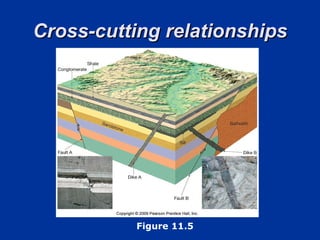
Relative dating  Placing rocks and events in sequence  Principles and rules of  Law of superposition   – oldest rocks are on the bottom  Principle of original horizontality  – sediment is deposited horizontally  Principle of cross-cutting relationships  – younger feature cuts through an older feature
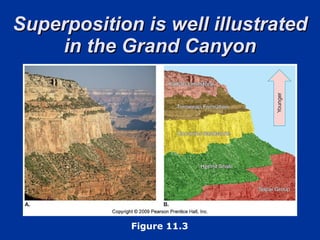
Superposition is well illustrated in the Grand Canyon Figure 11.3
Cross-cutting relationships Figure 11.5
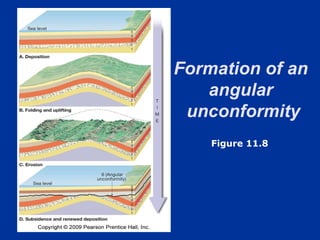
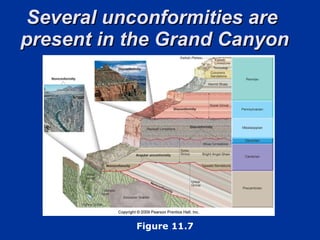
Relative dating  Principles and rules of  Inclusions   – one rock contained within another (rock containing the inclusions is younger)  Unconformities An  unconformity  is a break in the rock record  Types of unconformities  Angular unconformity  – tilted rocks are overlain by flat-lying rocks  Disconformity  – strata on either side are parallel  Nonconformity  Metamorphic or igneous rocks below  Younger sedimentary rocks above
Figure 11.8 Formation of an  angular  unconformity
Several unconformities are  present in the Grand Canyon Figure 11.7
Correlation of rock layers  Matching rocks of similar age in different regions (lithostratigraphy) Often relies upon fossils (biostratigraphy)
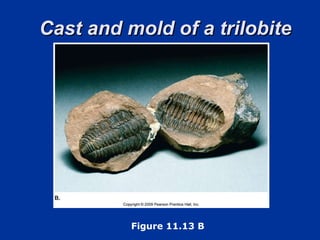
Fossils: evidence of past life  Remains or traces of prehistoric life  Types of fossils  Petrified  – cavities and pores are filled with precipitated mineral matter  Formed by  replacement  – cell material is removed and replaced with mineral matter  Mold  – shell or other structure is buried and then dissolved by underground water  Cast   – hollow space of a mold is filled with mineral matter
Fossils: evidence of past life  Types of fossils  Carbonization   – organic matter becomes a thin residue of carbon   Impression   – replica of the fossil’s surface preserved in fine-grained sediment   Preservation in amber  – hardened resin of ancient trees surrounds an organism
Cast and mold of a trilobite Figure 11.13 B
Fossils: evidence of past life  Types of fossils  Indirect evidence includes  Tracks Burrows Coprolites  – fossil dung and stomach contents  Gastroliths   – stomach stones used to grind food by some extinct reptiles
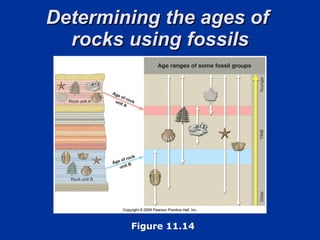
Fossils: evidence of past life  Conditions favoring preservation  Rapid burial  Possession of hard parts  Fossils and correlation Principle of  fossil succession Fossils succeed one another in a definite and determinable order  Proposed by William Smith – late 1700s and early 1800s
Determining the ages of  rocks using fossils Figure 11.14
Fossils: evidence of past life  Fossils and correlation Index fossils Widespread geographically  Existed for a short range of geologic time
Radioactivity and  radiometric dating  Atomic structure reviewed  Nucleus  Protons   – positively charged  Neutrons   Neutral charge  Protons and electrons combined  Orbiting the nucleus are  electrons  – negative electrical charges
Radioactivity and  radiometric dating  Atomic structure reviewed  Atomic number An element’s identifying number  Number of protons in the atom’s nucleus  Mass number   Number of protons plus (added to) the number of neutrons in an atom’s nucleus  Isotope  Variant of the same parent atom  Different number of neutrons and mass number
Radioactivity and  radiometric dating  Radioactivity  Spontaneous breaking apart (decay) of atomic nuclei Radioactive decay  Parent  – an unstable isotope Daughter products  – isotopes formed from the decay of a parent
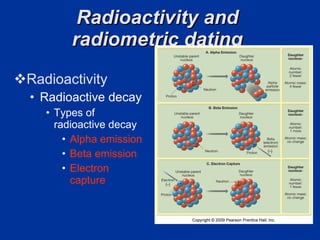
Radioactivity and  radiometric dating  Radioactivity  Radioactive decay  Types of radioactive decay Alpha emission  Beta emission  Electron capture
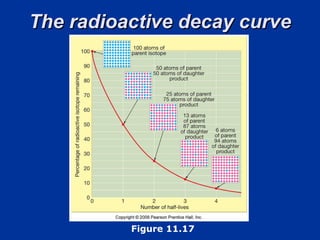
Radioactivity and  radiometric dating  Radiometric dating   Half-life  – the time for one-half of the radioactive nuclei to decay  Requires a closed system Cross-checks are used for accuracy  Complex procedure  Yields numerical dates
The radioactive decay curve Figure 11.17
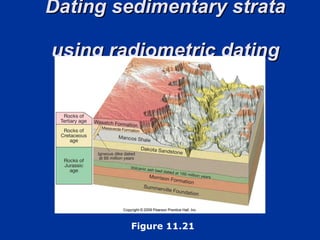
Dating sedimentary strata  using radiometric dating Figure 11.21
Radioactivity and  radiometric dating  Carbon-14 dating   Half-life of only 5,730 years  Used to date very recent events  Carbon-14 produced in upper atmosphere  Incorporated into carbon dioxide  Absorbed by living matter  Useful tool for anthropologists, archaeologists, historians, and geologists who study very recent Earth history
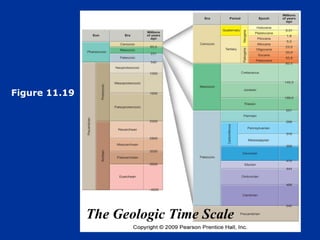
Geologic time scale  Divides geologic history into units  Originally created using relative dates  Subdivisions Eon Greatest expanse of time  Four eons Phanerozoic  (“visible life”) – the most recent eon  Proterozoic
Geologic time scale  Subdivisions Eon Four eons Phanerozoic Proterozoic Archean  Hadean   – the oldest eon Era  Subdivision of an eon
Geologic time scale  Subdivisions Era Eras of the  Phanerozoic  eon  Cenozoic  (“recent life”)  Mesozoic  (“middle life”) Paleozoic  (“ancient life”)  Eras are subdivided into  periods Periods are subdivided into  epochs
Figure 11.19 The Geologic Time Scale
Geologic time scale  Difficulties in dating the time scale Not all rocks are datable (sedimentary ages are rarely reliable) Materials are often used to bracket events and arrive at ages
End of Chapter 11

Geologic time primer & carbon dating review

  • 1.
    Earth Science GeologicTime Chapter 11
  • 2.
    Historical notes Catastrophism Landscape developed by catastrophes James Ussher, mid-1600s, concluded Earth was only a few thousand years old Modern geology Uniformitarianism (Actualism) Fundamental principle of geology “ The present is the key to the past”
  • 3.
    Historical notes Modern geology James Hutton Theory of the Earth Published in the late 1700s
  • 4.
    Relative dating Placing rocks and events in sequence Principles and rules of Law of superposition – oldest rocks are on the bottom Principle of original horizontality – sediment is deposited horizontally Principle of cross-cutting relationships – younger feature cuts through an older feature
  • 5.
    Superposition is wellillustrated in the Grand Canyon Figure 11.3
  • 6.
  • 7.
    Relative dating Principles and rules of Inclusions – one rock contained within another (rock containing the inclusions is younger) Unconformities An unconformity is a break in the rock record Types of unconformities Angular unconformity – tilted rocks are overlain by flat-lying rocks Disconformity – strata on either side are parallel Nonconformity Metamorphic or igneous rocks below Younger sedimentary rocks above
  • 8.
    Figure 11.8 Formationof an angular unconformity
  • 9.
    Several unconformities are present in the Grand Canyon Figure 11.7
  • 10.
    Correlation of rocklayers Matching rocks of similar age in different regions (lithostratigraphy) Often relies upon fossils (biostratigraphy)
  • 11.
    Fossils: evidence ofpast life Remains or traces of prehistoric life Types of fossils Petrified – cavities and pores are filled with precipitated mineral matter Formed by replacement – cell material is removed and replaced with mineral matter Mold – shell or other structure is buried and then dissolved by underground water Cast – hollow space of a mold is filled with mineral matter
  • 12.
    Fossils: evidence ofpast life Types of fossils Carbonization – organic matter becomes a thin residue of carbon Impression – replica of the fossil’s surface preserved in fine-grained sediment Preservation in amber – hardened resin of ancient trees surrounds an organism
  • 13.
    Cast and moldof a trilobite Figure 11.13 B
  • 14.
    Fossils: evidence ofpast life Types of fossils Indirect evidence includes Tracks Burrows Coprolites – fossil dung and stomach contents Gastroliths – stomach stones used to grind food by some extinct reptiles
  • 15.
    Fossils: evidence ofpast life Conditions favoring preservation Rapid burial Possession of hard parts Fossils and correlation Principle of fossil succession Fossils succeed one another in a definite and determinable order Proposed by William Smith – late 1700s and early 1800s
  • 16.
    Determining the agesof rocks using fossils Figure 11.14
  • 17.
    Fossils: evidence ofpast life Fossils and correlation Index fossils Widespread geographically Existed for a short range of geologic time
  • 18.
    Radioactivity and radiometric dating Atomic structure reviewed Nucleus Protons – positively charged Neutrons Neutral charge Protons and electrons combined Orbiting the nucleus are electrons – negative electrical charges
  • 19.
    Radioactivity and radiometric dating Atomic structure reviewed Atomic number An element’s identifying number Number of protons in the atom’s nucleus Mass number Number of protons plus (added to) the number of neutrons in an atom’s nucleus Isotope Variant of the same parent atom Different number of neutrons and mass number
  • 20.
    Radioactivity and radiometric dating Radioactivity Spontaneous breaking apart (decay) of atomic nuclei Radioactive decay Parent – an unstable isotope Daughter products – isotopes formed from the decay of a parent
  • 21.
    Radioactivity and radiometric dating Radioactivity Radioactive decay Types of radioactive decay Alpha emission Beta emission Electron capture
  • 22.
    Radioactivity and radiometric dating Radiometric dating Half-life – the time for one-half of the radioactive nuclei to decay Requires a closed system Cross-checks are used for accuracy Complex procedure Yields numerical dates
  • 23.
    The radioactive decaycurve Figure 11.17
  • 24.
    Dating sedimentary strata using radiometric dating Figure 11.21
  • 25.
    Radioactivity and radiometric dating Carbon-14 dating Half-life of only 5,730 years Used to date very recent events Carbon-14 produced in upper atmosphere Incorporated into carbon dioxide Absorbed by living matter Useful tool for anthropologists, archaeologists, historians, and geologists who study very recent Earth history
  • 26.
    Geologic time scale Divides geologic history into units Originally created using relative dates Subdivisions Eon Greatest expanse of time Four eons Phanerozoic (“visible life”) – the most recent eon Proterozoic
  • 27.
    Geologic time scale Subdivisions Eon Four eons Phanerozoic Proterozoic Archean Hadean – the oldest eon Era Subdivision of an eon
  • 28.
    Geologic time scale Subdivisions Era Eras of the Phanerozoic eon Cenozoic (“recent life”) Mesozoic (“middle life”) Paleozoic (“ancient life”) Eras are subdivided into periods Periods are subdivided into epochs
  • 29.
    Figure 11.19 TheGeologic Time Scale
  • 30.
    Geologic time scale Difficulties in dating the time scale Not all rocks are datable (sedimentary ages are rarely reliable) Materials are often used to bracket events and arrive at ages
  • 31.