YEAR 10 GEOGRAPHY
PLATE TECTONICS
3. EARTHQUAKES
Floating plates do not sound too harmful.
But when the plates come together you can get earthquakes.
… Destructive or Conservative plate margins.
As two plates move towards each other, one can be pushed
down under the other one and into the mantle.
If this plate gets stuck it causes a lot of strain in the
surrounding rocks.
Sideways-moving plates can also get stuck.
When this tension in the rocks is finally released it produce
strong shock waves known as seismic waves.
This is called an earthquake.
The shock waves spread out from the focus – the point where
the earthquake starts.
The epicentre is the point on the Earth’s surface immediately
above the focus.
Near the epicentre, the waves are stronger and cause more
damage.
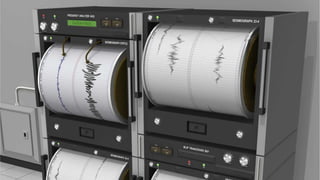
The size or magnitude of an earthquake is measured using a
seismometer; a machine with a seismograph on a revolving
drum.
Earthquakes vibrations are recorded by a sensitive arm with a
pen at the end which moves up and down.
These readings are measured using the Richter Scale for
energy released, which is an open-ended scale.
This is a logarithmic scale, which means that an earthquake
with a measurement of 5 is ten times more powerful than
one with a measurement of 4.
Most serious earthquakes are in the range of 5 to 9.
The earthquake in 1906 was the most powerful recent one,
with a value of 8,6.
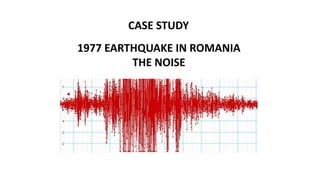
CASE STUDY
1977 EARTHQUAKE IN ROMANIA
THE NOISE
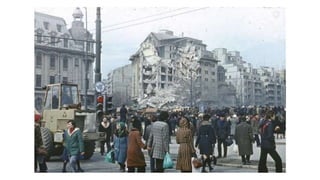
The 1977 Vrancea earthquake occurred on Friday, 4 March
1977, at 21:22 local time, and was felt throughout the Balkans.
It had a magnitude of 7.2, making it the second most powerful
earthquake recorded in Romania in the 20th century.
The epicenter was situated in the Vrancea Mountains, the most
seismically active part of Romania, at a depth of 94 km.
The earthquake killed about 1,578 people (1,424 in Bucharest)
in Romania, and wounded more than 11,300.
About 32,900 buildings were damaged or destroyed.
Immediately after the earthquake, 35,000 families were
without shelter.
The economic losses are believed to have been as high as two
billion US dollars.
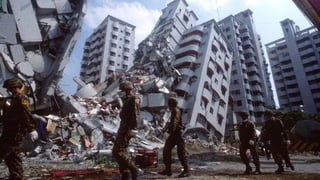
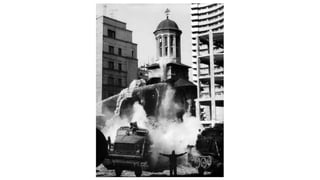
Most of the damage was concentrated in Romania's capital,
Bucharest, where about 33 large buildings collapsed.
Most of those buildings were built before World War II, and
were not reinforced.
After the earthquake, the Romanian government imposed
tougher construction standards.
The world's largest earthquake with an instrumentally
documented magnitude occurred on May 22, 1960 near
Valdivia, in southern Chile.
It was assigned a magnitude of 9.5 by the United States
Geological Survey.
It is referred to as the "Great Chilean Earthquake" and the
"1960 Valdivia Earthquake."
The United States Geological Survey reports this event as the
"largest earthquake of the 20th Century."
Other earthquakes in recorded history may have been larger;
however, this is the largest earthquake that has occurred since
accurate estimates of magnitude became possible.
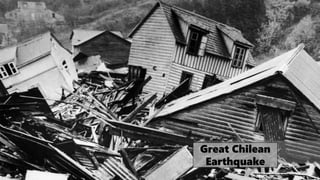
Great Chilean
Earthquake

GEOGRAPHY YEAR 10: EARTHQUAKES

  • 1.
    YEAR 10 GEOGRAPHY PLATETECTONICS 3. EARTHQUAKES
  • 2.
    Floating plates donot sound too harmful. But when the plates come together you can get earthquakes.
  • 4.
    … Destructive orConservative plate margins.
  • 6.
    As two platesmove towards each other, one can be pushed down under the other one and into the mantle. If this plate gets stuck it causes a lot of strain in the surrounding rocks. Sideways-moving plates can also get stuck.
  • 7.
    When this tensionin the rocks is finally released it produce strong shock waves known as seismic waves. This is called an earthquake.
  • 8.
    The shock wavesspread out from the focus – the point where the earthquake starts.
  • 9.
    The epicentre isthe point on the Earth’s surface immediately above the focus. Near the epicentre, the waves are stronger and cause more damage.
  • 10.
    The size ormagnitude of an earthquake is measured using a seismometer; a machine with a seismograph on a revolving drum. Earthquakes vibrations are recorded by a sensitive arm with a pen at the end which moves up and down.
  • 12.
    These readings aremeasured using the Richter Scale for energy released, which is an open-ended scale. This is a logarithmic scale, which means that an earthquake with a measurement of 5 is ten times more powerful than one with a measurement of 4. Most serious earthquakes are in the range of 5 to 9. The earthquake in 1906 was the most powerful recent one, with a value of 8,6.
  • 13.
    CASE STUDY 1977 EARTHQUAKEIN ROMANIA THE NOISE
  • 14.
    The 1977 Vranceaearthquake occurred on Friday, 4 March 1977, at 21:22 local time, and was felt throughout the Balkans. It had a magnitude of 7.2, making it the second most powerful earthquake recorded in Romania in the 20th century. The epicenter was situated in the Vrancea Mountains, the most seismically active part of Romania, at a depth of 94 km. The earthquake killed about 1,578 people (1,424 in Bucharest) in Romania, and wounded more than 11,300.
  • 16.
    About 32,900 buildingswere damaged or destroyed. Immediately after the earthquake, 35,000 families were without shelter. The economic losses are believed to have been as high as two billion US dollars. Most of the damage was concentrated in Romania's capital, Bucharest, where about 33 large buildings collapsed. Most of those buildings were built before World War II, and were not reinforced. After the earthquake, the Romanian government imposed tougher construction standards.
  • 18.
    The world's largestearthquake with an instrumentally documented magnitude occurred on May 22, 1960 near Valdivia, in southern Chile. It was assigned a magnitude of 9.5 by the United States Geological Survey. It is referred to as the "Great Chilean Earthquake" and the "1960 Valdivia Earthquake." The United States Geological Survey reports this event as the "largest earthquake of the 20th Century." Other earthquakes in recorded history may have been larger; however, this is the largest earthquake that has occurred since accurate estimates of magnitude became possible.
  • 19.