Earthquakes!
Big Ideas... What is an earthquake? What causes earthquakes? How are earthquakes measured?  What areas are more susceptible to an earthquake?  Why? What does an earthquake feel like?
Deadliest Earthquakes The earthquake that caused the most destruction in history occurred in the Shansi province of China on January 23,1556.  An estimated 830,000 people were killed. The second most destructive earthquake also occurred in China--in July, 1976--and killed 255,000 people.
Recent 'Quakes -900  -600  -300  -150  -70  -33  0
Recent 'Quakes
 
 
Worldwide 'Quakes
 
The definition of an earthquake is…  vibrations   that cause   the breaking of rocks . These vibrations move in all directions through the earth.  They begin at a point along a  fault . What is an Earthquake?
The earth’s crust is constantly experiencing pressure from forces within and around it.  This pressure builds up over time, and eventually causes the crust to break.  This becomes a  fault .  Let’s experience it… How do faults form?
Faults are divided into three main groups:  Normal fault   - when two plates are moving apart and one side of the fracture moves below the other;  (caused by  tension  forces!) Reverse fault   - when two plates collide and one side of the fracture moves on top of another; (caused by  compression  forces!!) Strike-slip or Lateral   - when two plates slide past each other. (caused by  shear  forces!) Kinds of Faults...
An earthquake begins along a  fault  (a crack in the earth’s surface) at a point called the  focus .   Directly above the focus is a point on the earth’s surface called the  epicenter. What is an Earthquake?
Where does an earthquake begin? Focus Epicenter
Seismologists have stations all over the world that continuously collect information about earthquakes.  This kind of information can help scientists figure out where larger, more destructive earthquakes may strike by mapping out the location of smaller ‘quakes.  They also get a greater understanding of the changes the earth’s crust makes as the earthquakes occur. How do they do this???  Why is the epicenter  important?
When the fault ruptures with a sudden movement energy is released that has built up over the years. This energy is released in the form of vibrations called  'seismic waves '…  earthquakes! It is actually when these seismic waves reach the surface of the earth that most of the destruction occurs, which we associate with earthquakes. What is an Earthquake?
 
Earthquake Waves Primary Wave (P-Wave)  First set of waves Move side to side FASTEST wave Secondary Wave (S-Wave)  Second set of waves Move up and down Travel slow Surface Wave Move up and down & side to side MOST DANGEROUS SLOWEST Wave
Earthquakes can also cause landslides, sudden eruptions as in the case of a hot lava flow from a volcano or giant waves called tsunamis. Sometimes new land mass are also formed. Such earthquakes are attributed with the creation of the greatest undersea mountain range and the longest land mountain range. What Kind of Damage  Do They Do?
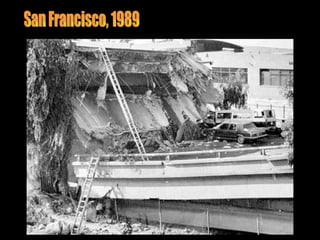
San Francisco, 1989
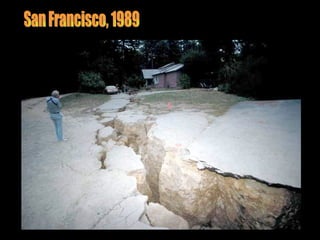
San Francisco, 1989
San Francisco, 1989
San Francisco, 1989
San Francisco, 1989
San Francisco, 1989
San Francisco, 1989
San Francisco, 1989 … And that was just a 7.2 on the Richter scale!
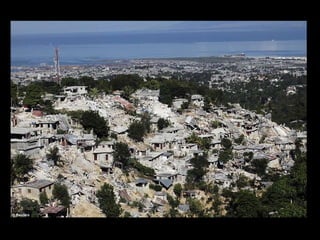
Haiti 2010
 
 
Earthquakes are measured using the Richter Scale.  The strongest earthquake ever measured was a 9.5 on the Richter Scale.  This is a measurement of the amount of energy released from the earthquake.  How are earthquakes  measured?
 
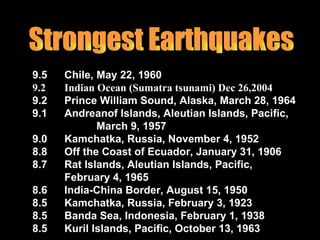
9.5 Chile, May 22, 1960 9.2 Indian Ocean (Sumatra tsunami) Dec 26,2004 9.2 Prince William Sound, Alaska, March 28, 1964 9.1 Andreanof Islands, Aleutian Islands, Pacific,  March 9, 1957 9.0 Kamchatka, Russia, November 4, 1952 8.8 Off the Coast of Ecuador, January 31, 1906 8.7 Rat Islands, Aleutian Islands, Pacific, February 4, 1965 8.6 India-China Border, August 15, 1950 8.5 Kamchatka, Russia, February 3, 1923 8.5 Banda Sea, Indonesia, February 1, 1938 8.5 Kuril Islands, Pacific, October 13, 1963 Strongest Earthquakes
Magnitude   is a number that characterizes the relative  size of earthquakes & is proportional to energy released
...and in the 48 states In the lower 48 states, there is a tie between the February 1812, New Madrid, Missouri earthquake and the January 1857, Fort Tejon, California earthquake--both magnitude 7.9--for the strongest earthquake recorded.
Mercalli Scale
If an earthquake hit New Madrid Mercalli Scale Damage  with a  (new) New Madrid earthquake
Ohio’s Fault Lines
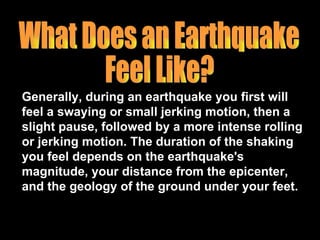
Generally, during an earthquake you first will feel a swaying or small jerking motion, then a slight pause, followed by a more intense rolling or jerking motion. The duration of the shaking you feel depends on the earthquake's magnitude, your distance from the epicenter, and the geology of the ground under your feet. What Does an Earthquake  Feel Like?
For minor earthquakes, ground shaking usually lasts only a few seconds.  Strong shaking from a major earthquake usually lasts less than one minute. For example, shaking in the 1989 magnitude 7.1 Loma Prieta (San Francisco) earthquake lasted 15 seconds;  For the 1906 magnitude 8.3 San Francisco earthquake it lasted about 40 seconds.  Shaking for the 1964 magnitude 9.2 Alaska earthquake, however, lasted  three  minutes. How Long Does an  Earthquake Last?
Aftershocks are smaller earthquakes which occur in the same general area during the days to years following a larger event or "mainshock". As a general rule, aftershocks represent minor readjustments along the portion of a fault that slipped at the time of the main shock. The frequency of these aftershocks decreases with time.  What is an aftershock?
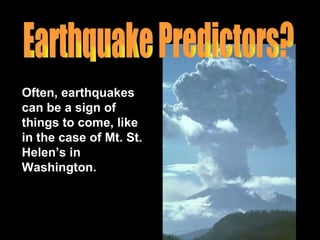
Often, earthquakes can be a sign of things to come, like in the case of Mt. St. Helen’s in Washington.  Earthquake Predictors?
At 8:32 Sunday morning, May 18, 1980, Mount St. Helens erupted.  Shaken by an earthquake measuring 5.1 on the Richter scale, the north face of this tall symmetrical mountain collapsed in a massive rock debris avalanche. Nearly 230 square miles of forest was blown over or left dead and standing. At the same time a mushroom-shaped column of ash rose thousands of feet skyward and drifted downwind, turning day into night as dark, gray ash fell over eastern Washington and beyond. The eruption lasted 9 hours, but Mount St. Helens and the surrounding landscape were dramatically changed within moments.  Mt. St. Helens
Mt. St. Helens This photograph was taken during the 1980 eruption.  Is this volcano active again???  The seismic data says… YES!
Mt. St. Helens Before After
Volcanoes... Notice, this volcano really blew its top…  literally! Mt. St. Helens Today
Anything else you  want to know?!? Visit the classroom blog…

Wow earthquake

  • 1.
  • 2.
    Big Ideas... Whatis an earthquake? What causes earthquakes? How are earthquakes measured? What areas are more susceptible to an earthquake? Why? What does an earthquake feel like?
  • 3.
    Deadliest Earthquakes Theearthquake that caused the most destruction in history occurred in the Shansi province of China on January 23,1556. An estimated 830,000 people were killed. The second most destructive earthquake also occurred in China--in July, 1976--and killed 255,000 people.
  • 4.
    Recent 'Quakes -900 -600 -300 -150 -70 -33 0
  • 5.
  • 6.
  • 7.
  • 8.
  • 9.
  • 10.
    The definition ofan earthquake is… vibrations that cause the breaking of rocks . These vibrations move in all directions through the earth. They begin at a point along a fault . What is an Earthquake?
  • 11.
    The earth’s crustis constantly experiencing pressure from forces within and around it. This pressure builds up over time, and eventually causes the crust to break. This becomes a fault . Let’s experience it… How do faults form?
  • 12.
    Faults are dividedinto three main groups: Normal fault - when two plates are moving apart and one side of the fracture moves below the other; (caused by tension forces!) Reverse fault - when two plates collide and one side of the fracture moves on top of another; (caused by compression forces!!) Strike-slip or Lateral - when two plates slide past each other. (caused by shear forces!) Kinds of Faults...
  • 13.
    An earthquake beginsalong a fault (a crack in the earth’s surface) at a point called the focus . Directly above the focus is a point on the earth’s surface called the epicenter. What is an Earthquake?
  • 14.
    Where does anearthquake begin? Focus Epicenter
  • 15.
    Seismologists have stationsall over the world that continuously collect information about earthquakes. This kind of information can help scientists figure out where larger, more destructive earthquakes may strike by mapping out the location of smaller ‘quakes. They also get a greater understanding of the changes the earth’s crust makes as the earthquakes occur. How do they do this??? Why is the epicenter important?
  • 16.
    When the faultruptures with a sudden movement energy is released that has built up over the years. This energy is released in the form of vibrations called 'seismic waves '… earthquakes! It is actually when these seismic waves reach the surface of the earth that most of the destruction occurs, which we associate with earthquakes. What is an Earthquake?
  • 17.
  • 18.
    Earthquake Waves PrimaryWave (P-Wave) First set of waves Move side to side FASTEST wave Secondary Wave (S-Wave) Second set of waves Move up and down Travel slow Surface Wave Move up and down & side to side MOST DANGEROUS SLOWEST Wave
  • 19.
    Earthquakes can alsocause landslides, sudden eruptions as in the case of a hot lava flow from a volcano or giant waves called tsunamis. Sometimes new land mass are also formed. Such earthquakes are attributed with the creation of the greatest undersea mountain range and the longest land mountain range. What Kind of Damage Do They Do?
  • 20.
  • 21.
  • 22.
  • 23.
  • 24.
  • 25.
  • 26.
  • 27.
    San Francisco, 1989… And that was just a 7.2 on the Richter scale!
  • 28.
  • 29.
  • 30.
  • 31.
    Earthquakes are measuredusing the Richter Scale. The strongest earthquake ever measured was a 9.5 on the Richter Scale. This is a measurement of the amount of energy released from the earthquake. How are earthquakes measured?
  • 32.
  • 33.
    9.5 Chile, May22, 1960 9.2 Indian Ocean (Sumatra tsunami) Dec 26,2004 9.2 Prince William Sound, Alaska, March 28, 1964 9.1 Andreanof Islands, Aleutian Islands, Pacific, March 9, 1957 9.0 Kamchatka, Russia, November 4, 1952 8.8 Off the Coast of Ecuador, January 31, 1906 8.7 Rat Islands, Aleutian Islands, Pacific, February 4, 1965 8.6 India-China Border, August 15, 1950 8.5 Kamchatka, Russia, February 3, 1923 8.5 Banda Sea, Indonesia, February 1, 1938 8.5 Kuril Islands, Pacific, October 13, 1963 Strongest Earthquakes
  • 34.
    Magnitude is a number that characterizes the relative size of earthquakes & is proportional to energy released
  • 35.
    ...and in the48 states In the lower 48 states, there is a tie between the February 1812, New Madrid, Missouri earthquake and the January 1857, Fort Tejon, California earthquake--both magnitude 7.9--for the strongest earthquake recorded.
  • 36.
  • 37.
    If an earthquakehit New Madrid Mercalli Scale Damage with a (new) New Madrid earthquake
  • 38.
  • 39.
    Generally, during anearthquake you first will feel a swaying or small jerking motion, then a slight pause, followed by a more intense rolling or jerking motion. The duration of the shaking you feel depends on the earthquake's magnitude, your distance from the epicenter, and the geology of the ground under your feet. What Does an Earthquake Feel Like?
  • 40.
    For minor earthquakes,ground shaking usually lasts only a few seconds. Strong shaking from a major earthquake usually lasts less than one minute. For example, shaking in the 1989 magnitude 7.1 Loma Prieta (San Francisco) earthquake lasted 15 seconds; For the 1906 magnitude 8.3 San Francisco earthquake it lasted about 40 seconds. Shaking for the 1964 magnitude 9.2 Alaska earthquake, however, lasted three minutes. How Long Does an Earthquake Last?
  • 41.
    Aftershocks are smallerearthquakes which occur in the same general area during the days to years following a larger event or "mainshock". As a general rule, aftershocks represent minor readjustments along the portion of a fault that slipped at the time of the main shock. The frequency of these aftershocks decreases with time. What is an aftershock?
  • 42.
    Often, earthquakes canbe a sign of things to come, like in the case of Mt. St. Helen’s in Washington. Earthquake Predictors?
  • 43.
    At 8:32 Sundaymorning, May 18, 1980, Mount St. Helens erupted. Shaken by an earthquake measuring 5.1 on the Richter scale, the north face of this tall symmetrical mountain collapsed in a massive rock debris avalanche. Nearly 230 square miles of forest was blown over or left dead and standing. At the same time a mushroom-shaped column of ash rose thousands of feet skyward and drifted downwind, turning day into night as dark, gray ash fell over eastern Washington and beyond. The eruption lasted 9 hours, but Mount St. Helens and the surrounding landscape were dramatically changed within moments. Mt. St. Helens
  • 44.
    Mt. St. HelensThis photograph was taken during the 1980 eruption. Is this volcano active again??? The seismic data says… YES!
  • 45.
    Mt. St. HelensBefore After
  • 46.
    Volcanoes... Notice, thisvolcano really blew its top… literally! Mt. St. Helens Today
  • 47.
    Anything else you want to know?!? Visit the classroom blog…