


P.E.S PUBLIC
SCHOOL
NH-206 , Sagar Road , Shimoga
GEOGRAPHY
JET STREAMS AND
OCEAN CURRENTS
CLASS 9
JET STREAMS
JET STREAMS
 Jet streams are fast flowing, narrow air
currents found in the atmospheres of some planets,
including Earth. The main jet streams are located
near the tropopause, the transition between the
troposphere and the stratosphere. The major jet
streams on Earth are westerly winds). Their paths
typically have a meandering shape; jet streams may
start, stop, split into two or more parts, combine into
one stream, or flow in various directions including the
opposite direction of most of the jet. The strongest jet
streams are the polar jets, at around 7–12 km above
sea level, and the higher and somewhat
weaker subtropical jets at around 10–16 km
 TheNorthern Hemisphere and the Southern
Hemisphere each have both a polar jet and
a subtropical jet. The northern hemisphere
polar jet flows over the middle to northern
latitudes of North America, Europe, and
Asia and their intervening oceans, while
the southern hemisphere polar jet mostly
circles Antarctica all year round.
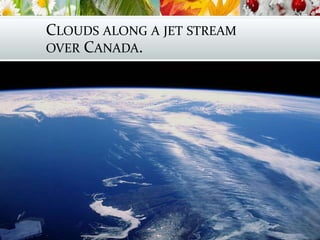
CLOUDS ALONG A JET STREAM
OVER CANADA.
 Jet streams are caused by a combination of a
planet's rotation on its axis and atmospheric heating
(by solar radiation and, on some planets other than
Earth, internal heat). Jet streams form near boundaries of
adjacent air masses with significant differences
in temperature, such as the polar region and the warmer
air towards the equator.[3]
 Other jet streams also exist. During the Northern
Hemisphere summer, easterly jets can form in tropical
regions, typically in a region where dry air encounters
more humid air at high altitudes. Low-level jets also are
typical of various regions such as the central United
States.
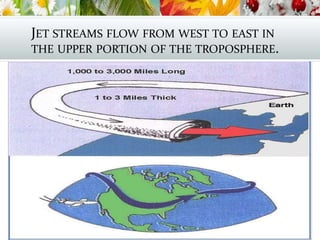
JET STREAMS FLOW FROM WEST TO EAST IN
THE UPPER PORTION OF THE TROPOSPHERE.
 Meteorologists use the location of some of the jet
streams as an aid in weather forecasting. The
main commercial relevance of the jet streams is
in air travel, as flight time can be dramatically
affected by either flying with the flow or against
the flow of a jet stream. Clear-air turbulence, a
potential hazard to aircraft passenger safety, is
often found in a jet stream's vicinity, but it does
not create a substantial alteration on flight times.
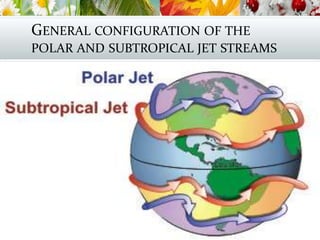
GENERAL CONFIGURATION OF THE
POLAR AND SUBTROPICAL JET STREAMS
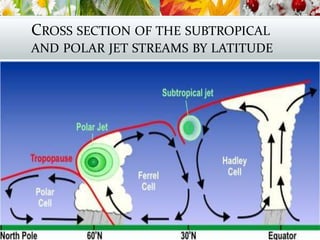
CROSS SECTION OF THE SUBTROPICAL
AND POLAR JET STREAMS BY LATITUDE
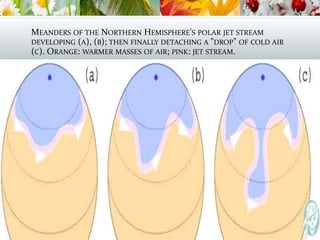
MEANDERS OF THE NORTHERN HEMISPHERE'S POLAR JET STREAM
DEVELOPING (A), (B); THEN FINALLY DETACHING A "DROP" OF COLD AIR
(C). ORANGE: WARMER MASSES OF AIR; PINK: JET STREAM.
OCEAN
CURRENT
An ocean current is a continuous, directed movement of ocean watergenerated by the forces
acting upon this mean flow, such as breaking waves,wind, Coriolis
effect, cabbeling, temperature and salinity differences and tidescaused by the gravitational pull
of the Moon and the Sun. Depth contours,shoreline configurations and interaction with other
currents influence a current's direction and strength. A deep current is any ocean current at a
depth of greater than 100m.[1] A part of oceanography is the science studying ocean currents.
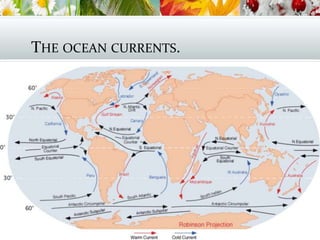
THE OCEAN CURRENTS.
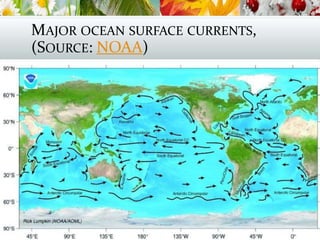
Ocean currents can flow for great distances, and together they create the great flow of the
global conveyor belt which plays a dominant part in determining the climate of many of
the Earth’s regions. Perhaps the most striking example is the Gulf Stream, which
makes northwest Europe much more temperate than any other region at the same latitude.
Another example is Lima, Peru, where the climate is cooler (sub-tropical) than the tropical
latitudes in which the area is located, due to the effect of the Humboldt Current.
MAJOR OCEAN SURFACE CURRENTS,
(SOURCE: NOAA)
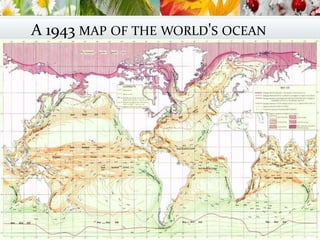
A 1943 MAP OF THE WORLD'S OCEAN
CURRENTS.
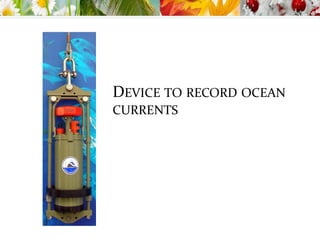
DEVICE TO RECORD OCEAN
CURRENTS
-CHANDAN MB
HARSHITHA SARJI
KARAN KUMAR
KAVYA D SHETTY
MAHESHWARI DAS
Geography; Jet Streams and Ocean Currents

Geography; Jet Streams and Ocean Currents

  • 1.
    P.E.S PUBLIC SCHOOL NH-206 ,Sagar Road , Shimoga
  • 2.
  • 3.
    JET STREAMS AND OCEANCURRENTS CLASS 9
  • 4.
  • 5.
    JET STREAMS  Jetstreams are fast flowing, narrow air currents found in the atmospheres of some planets, including Earth. The main jet streams are located near the tropopause, the transition between the troposphere and the stratosphere. The major jet streams on Earth are westerly winds). Their paths typically have a meandering shape; jet streams may start, stop, split into two or more parts, combine into one stream, or flow in various directions including the opposite direction of most of the jet. The strongest jet streams are the polar jets, at around 7–12 km above sea level, and the higher and somewhat weaker subtropical jets at around 10–16 km
  • 6.
     TheNorthern Hemisphereand the Southern Hemisphere each have both a polar jet and a subtropical jet. The northern hemisphere polar jet flows over the middle to northern latitudes of North America, Europe, and Asia and their intervening oceans, while the southern hemisphere polar jet mostly circles Antarctica all year round.
  • 7.
    CLOUDS ALONG AJET STREAM OVER CANADA.
  • 8.
     Jet streamsare caused by a combination of a planet's rotation on its axis and atmospheric heating (by solar radiation and, on some planets other than Earth, internal heat). Jet streams form near boundaries of adjacent air masses with significant differences in temperature, such as the polar region and the warmer air towards the equator.[3]  Other jet streams also exist. During the Northern Hemisphere summer, easterly jets can form in tropical regions, typically in a region where dry air encounters more humid air at high altitudes. Low-level jets also are typical of various regions such as the central United States.
  • 9.
    JET STREAMS FLOWFROM WEST TO EAST IN THE UPPER PORTION OF THE TROPOSPHERE.
  • 10.
     Meteorologists usethe location of some of the jet streams as an aid in weather forecasting. The main commercial relevance of the jet streams is in air travel, as flight time can be dramatically affected by either flying with the flow or against the flow of a jet stream. Clear-air turbulence, a potential hazard to aircraft passenger safety, is often found in a jet stream's vicinity, but it does not create a substantial alteration on flight times.
  • 11.
    GENERAL CONFIGURATION OFTHE POLAR AND SUBTROPICAL JET STREAMS
  • 12.
    CROSS SECTION OFTHE SUBTROPICAL AND POLAR JET STREAMS BY LATITUDE
  • 13.
    MEANDERS OF THENORTHERN HEMISPHERE'S POLAR JET STREAM DEVELOPING (A), (B); THEN FINALLY DETACHING A "DROP" OF COLD AIR (C). ORANGE: WARMER MASSES OF AIR; PINK: JET STREAM.
  • 14.
  • 15.
    An ocean currentis a continuous, directed movement of ocean watergenerated by the forces acting upon this mean flow, such as breaking waves,wind, Coriolis effect, cabbeling, temperature and salinity differences and tidescaused by the gravitational pull of the Moon and the Sun. Depth contours,shoreline configurations and interaction with other currents influence a current's direction and strength. A deep current is any ocean current at a depth of greater than 100m.[1] A part of oceanography is the science studying ocean currents.
  • 16.
  • 17.
    Ocean currents canflow for great distances, and together they create the great flow of the global conveyor belt which plays a dominant part in determining the climate of many of the Earth’s regions. Perhaps the most striking example is the Gulf Stream, which makes northwest Europe much more temperate than any other region at the same latitude. Another example is Lima, Peru, where the climate is cooler (sub-tropical) than the tropical latitudes in which the area is located, due to the effect of the Humboldt Current.
  • 18.
    MAJOR OCEAN SURFACECURRENTS, (SOURCE: NOAA)
  • 19.
    A 1943 MAPOF THE WORLD'S OCEAN CURRENTS.
  • 20.
    DEVICE TO RECORDOCEAN CURRENTS
  • 21.
    -CHANDAN MB HARSHITHA SARJI KARANKUMAR KAVYA D SHETTY MAHESHWARI DAS