Oceans Current
PRESENTED
BY
BHOOPESH KUMAR PANDEY
A. Surface Currents
1. Ocean water never stands still. Currents
move the water from place to place constantly.
Ocean Currents and Climate
2
A. Surface Currents
2. They exist both at the ocean’s surface and
in deeper water.
Ocean Currents and Climate
3
B. Causes of Surface Currents
1. surface currents are powered by wind and
usually move only the upper few hundred
meters of seawater.
2. Because of Earth’s rotation, ocean currents
do not move in straight lines.
3. Earth’s rotation causes surface ocean
currents in the northern hemisphere to curve
to the right and surface ocean currents in the
southern hemisphere to curve to the left.
Ocean Currents and Climate
4
C. The Gulf Stream
1. One of the most important currents for sailing
east across the North Atlantic Ocean is the
Gulf Stream.
2. The Gulf Stream flows from Florida
northeastward toward North Carolina. There
it curves toward the east and becomes slower
and broader.
Ocean Currents and Climate
5
C. The Gulf Stream
3. Currents on eastern coasts of continents, like the
Gulf Stream, are usually warm, while currents on
western coasts of continents are usually cold.
Ocean Currents and Climate
6
D. Climate
1. Locate Iceland
on the map.
2. Based on its
location and its
name, you
might expect it
to have a cold
climate.
Ocean Currents and Climate
7
D. Climate
4. The current’s
warm water
heats the
surrounding air
and keeps
Iceland’s
climate mild and
its harbors ice
free year-round.
Ocean Currents and Climate
8
3. However, the Gulf Stream flows past Iceland.
E. Cold Surface Currents
Ocean Currents and Climate
9
1. Find the
California
Current off the
west coast of
North America
and the Peru
Current along
the west coast of South America. It carries
cold water from polar regions toward the
equator.
E. Cold Surface Currents
3. San Francisco has cool summers and many
foggy days because of the California Currents.
Ocean Currents and Climate
10
2. Cold surface
current affect
the climate
of coastal
cities.
F. Density Currents
1. A density current forms when a mass of
dense seawater sinks beneath less dense
seawater.
2. Seawater becomes more dense when it gets
colder or becomes more salty.
3. Changes in temperature and salinity work
together to create density currents. A density
current moves very slowly.
Ocean Currents and Climate
11
G. Cold and Salty Water
1. An important density current that affects
many regions of Earth’s oceans begins north
of Iceland.
2. When water freezes, dissolved salts are left
behind in the unfrozen water which is very
dense because it is cold and salty.
Ocean Currents and Climate
12
3. It sinks and slowly flows along the ocean
floor toward the southern Atlantic Ocean.
G. Cold and Salty Water
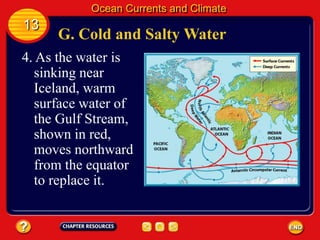
4. As the water is
sinking near
Iceland, warm
surface water of
the Gulf Stream,
shown in red,
moves northward
from the equator
to replace it.
Ocean Currents and Climate
13
H. Density Currents and Climate
Change
1. If Earth’s temperature rose enough, ice
couldn’t easily form near the polar regions.
Ocean Currents and Climate
14
2. Freshwater from melting glaciers on land
also could reduce the salinity of the ocean
water.
H. Density Currents and Climate
Change
Ocean Currents and Climate
15
3. The density currents would weaken or stop. If
density currents stopped flowing southward,
warm equatorial surface water would no longer
flow northward.
4. Earth could face drastic climate shifts,
including changing rainfall patterns and
temperatures.
I. Upwelling
1. An upwelling is a current in the ocean that
brings deep, cold water to the ocean
surface.
Ocean Currents and Climate
16
2. This occurs along some coasts where winds
cause surface water to move away from the
land.
I. Upwelling
Ocean Currents and Climate
17
3. Notice that when surface water is pushed
away from the coast, deep water rises to the
surface to take its
place.
4. This cold, deep
water continually
replaces the surface
water that is pushed
away from the
coast.
I. Upwelling
Ocean Currents and Climate
18
5. The cold water is full of nutrients from dead,
decayed organisms. Tiny marine organisms
thrive in these nutrient-
rich areas, which, in turn,
attract many fish. As a
result, areas of upwelling
are important fishing
grounds because fish are
attracted to the areas to
eat the organisms.
THANK YOU

Ph.d ppt-ppt

  • 1.
  • 2.
    A. Surface Currents 1.Ocean water never stands still. Currents move the water from place to place constantly. Ocean Currents and Climate 2
  • 3.
    A. Surface Currents 2.They exist both at the ocean’s surface and in deeper water. Ocean Currents and Climate 3
  • 4.
    B. Causes ofSurface Currents 1. surface currents are powered by wind and usually move only the upper few hundred meters of seawater. 2. Because of Earth’s rotation, ocean currents do not move in straight lines. 3. Earth’s rotation causes surface ocean currents in the northern hemisphere to curve to the right and surface ocean currents in the southern hemisphere to curve to the left. Ocean Currents and Climate 4
  • 5.
    C. The GulfStream 1. One of the most important currents for sailing east across the North Atlantic Ocean is the Gulf Stream. 2. The Gulf Stream flows from Florida northeastward toward North Carolina. There it curves toward the east and becomes slower and broader. Ocean Currents and Climate 5
  • 6.
    C. The GulfStream 3. Currents on eastern coasts of continents, like the Gulf Stream, are usually warm, while currents on western coasts of continents are usually cold. Ocean Currents and Climate 6
  • 7.
    D. Climate 1. LocateIceland on the map. 2. Based on its location and its name, you might expect it to have a cold climate. Ocean Currents and Climate 7
  • 8.
    D. Climate 4. Thecurrent’s warm water heats the surrounding air and keeps Iceland’s climate mild and its harbors ice free year-round. Ocean Currents and Climate 8 3. However, the Gulf Stream flows past Iceland.
  • 9.
    E. Cold SurfaceCurrents Ocean Currents and Climate 9 1. Find the California Current off the west coast of North America and the Peru Current along the west coast of South America. It carries cold water from polar regions toward the equator.
  • 10.
    E. Cold SurfaceCurrents 3. San Francisco has cool summers and many foggy days because of the California Currents. Ocean Currents and Climate 10 2. Cold surface current affect the climate of coastal cities.
  • 11.
    F. Density Currents 1.A density current forms when a mass of dense seawater sinks beneath less dense seawater. 2. Seawater becomes more dense when it gets colder or becomes more salty. 3. Changes in temperature and salinity work together to create density currents. A density current moves very slowly. Ocean Currents and Climate 11
  • 12.
    G. Cold andSalty Water 1. An important density current that affects many regions of Earth’s oceans begins north of Iceland. 2. When water freezes, dissolved salts are left behind in the unfrozen water which is very dense because it is cold and salty. Ocean Currents and Climate 12 3. It sinks and slowly flows along the ocean floor toward the southern Atlantic Ocean.
  • 13.
    G. Cold andSalty Water 4. As the water is sinking near Iceland, warm surface water of the Gulf Stream, shown in red, moves northward from the equator to replace it. Ocean Currents and Climate 13
  • 14.
    H. Density Currentsand Climate Change 1. If Earth’s temperature rose enough, ice couldn’t easily form near the polar regions. Ocean Currents and Climate 14 2. Freshwater from melting glaciers on land also could reduce the salinity of the ocean water.
  • 15.
    H. Density Currentsand Climate Change Ocean Currents and Climate 15 3. The density currents would weaken or stop. If density currents stopped flowing southward, warm equatorial surface water would no longer flow northward. 4. Earth could face drastic climate shifts, including changing rainfall patterns and temperatures.
  • 16.
    I. Upwelling 1. Anupwelling is a current in the ocean that brings deep, cold water to the ocean surface. Ocean Currents and Climate 16 2. This occurs along some coasts where winds cause surface water to move away from the land.
  • 17.
    I. Upwelling Ocean Currentsand Climate 17 3. Notice that when surface water is pushed away from the coast, deep water rises to the surface to take its place. 4. This cold, deep water continually replaces the surface water that is pushed away from the coast.
  • 18.
    I. Upwelling Ocean Currentsand Climate 18 5. The cold water is full of nutrients from dead, decayed organisms. Tiny marine organisms thrive in these nutrient- rich areas, which, in turn, attract many fish. As a result, areas of upwelling are important fishing grounds because fish are attracted to the areas to eat the organisms.
  • 19.