IGCSE GEOGRAPHY
3. POPULATION STRUCTURE
TYPES OF POPULATION STRUCTURE
POPULATION PYRAMIDS
DEMOGRAPHIC TRANSITION MODEL
CASE STUDY
UK (MEDC) AND MOZAMBIQUE (LEDC)
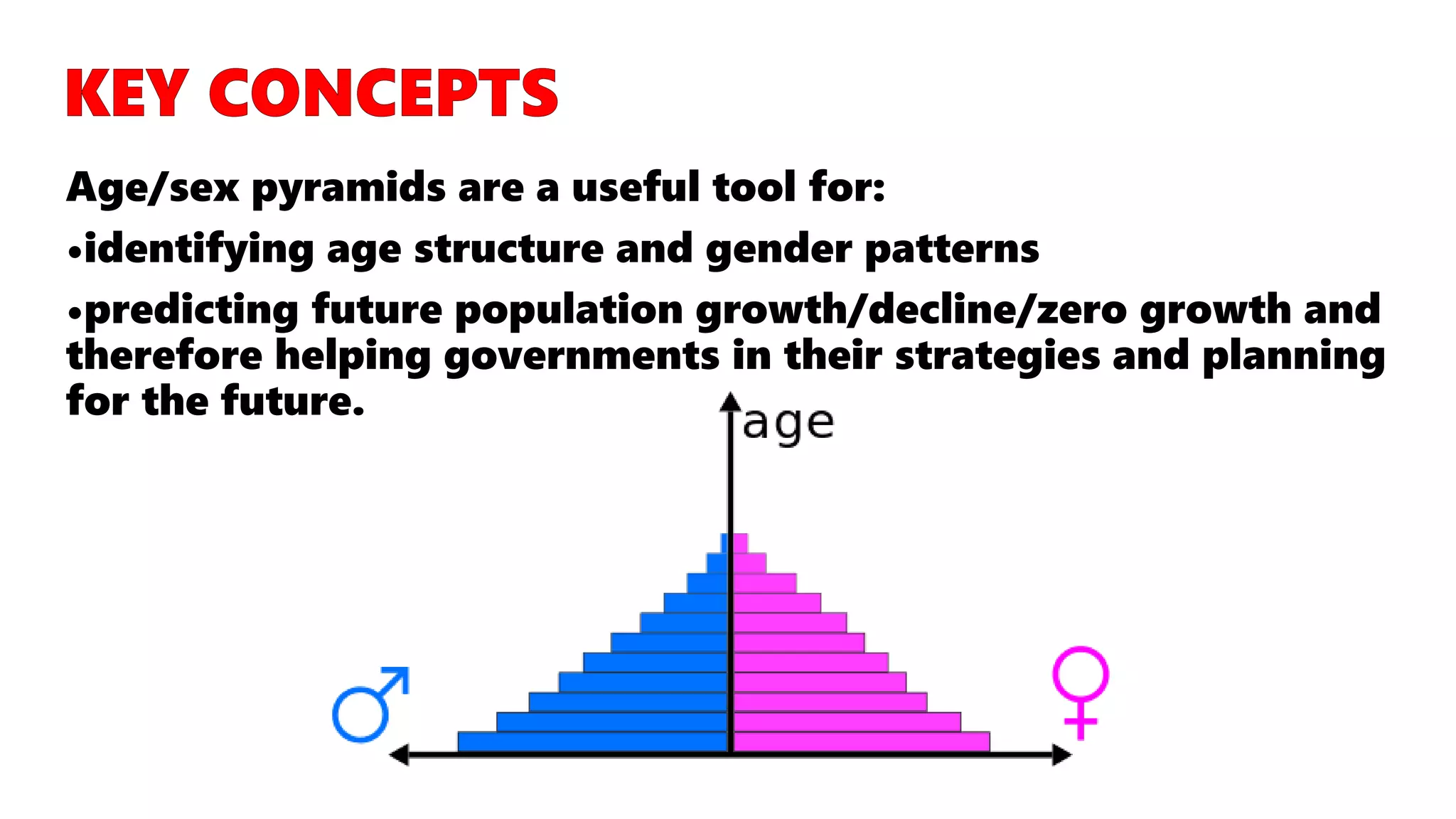
Age/sex pyramids are a useful tool for:
•identifying age structure and gender patterns
•predicting future population growth/decline/zero growth and
therefore helping governments in their strategies and planning
for the future.
A population pyramid, also called an age pyramid or age
picture is a graphical illustration that shows the distribution of
various age groups in a population (country), which forms the
shape of a pyramid when the population is growing.
Population structure means the 'make up' or composition of a
population.
Looking at the population structure of a place shows how the
population is divided up between males and females of
different age groups.
Population structure is usually shown using a population
pyramid.
A population pyramid can be drawn up for any area, from a
whole continent or country to an individual town, city or
village.
It usually consists of two back-to-back histograms, with the
population plotted on the X-axis and age on the Y-axis, one
showing the number of males and one showing females in a
particular population in five-year age groups (also called
cohorts).
Males are conventionally shown on the left and females on the
right, and they may be measured by raw number or as a
percentage of the total population.
The following graphs show the population pyramids of an
MEDC (the UK) and an LEDC (Mozambique), for 2000 and in
2025 using projected figures.
The left side of each pyramid shows the number of men in each
age group, the right side shows the number of women in each
age group.
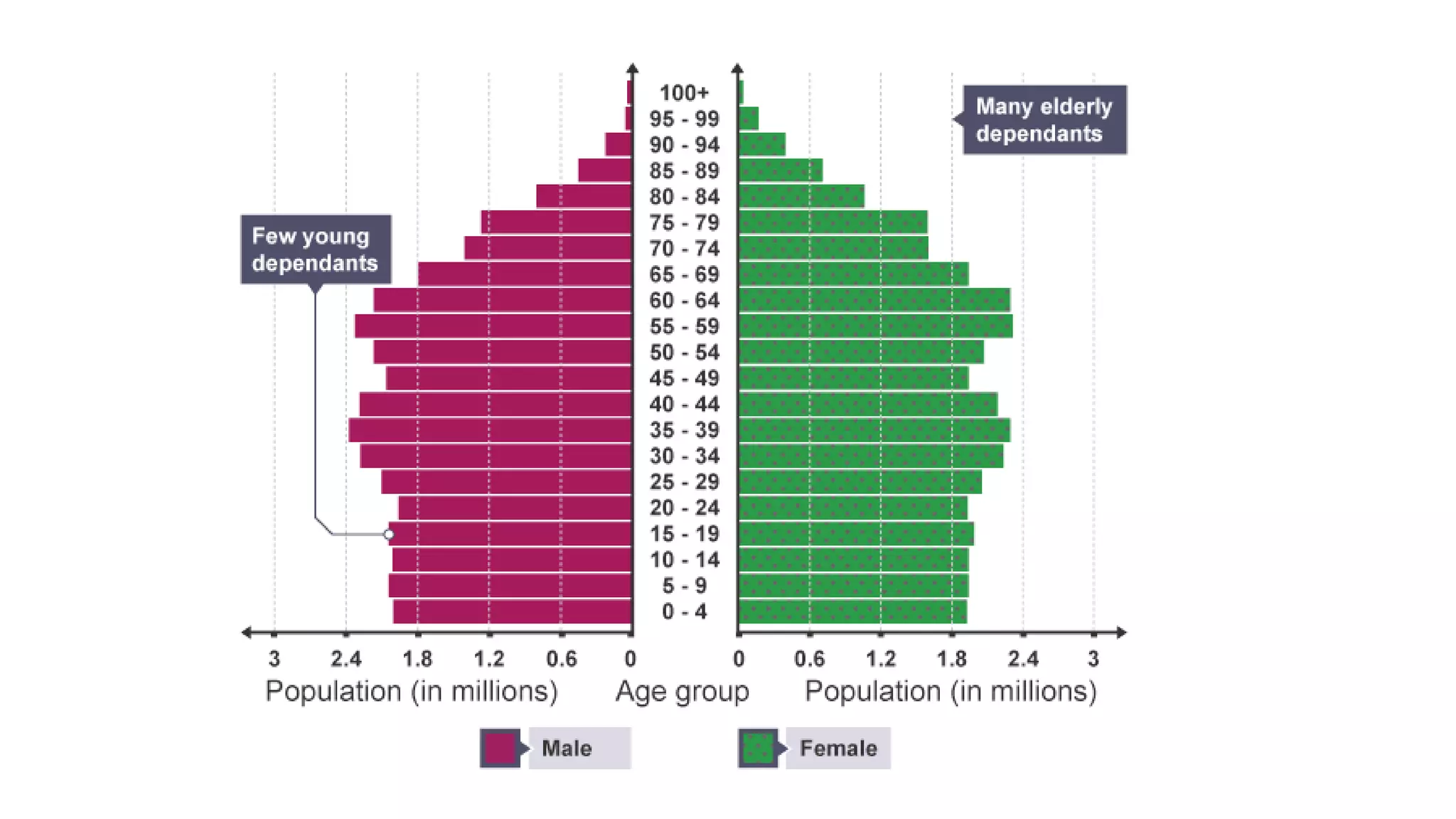
Notice how in the UK 2000 pyramid there is a bulge in the area
of the 30-34 and 35-39 age groups, with the numbers thereafter
reducing fairly steadily as the ages increase.
This matches stage 4 of the demographic transition model.
Compare this to the 2025 pyramid, which would be stage 5 in
the model.
Here the bulge extends much further, covering the age groups
30-64, with the numbers beginning to reduce significantly only
after 64.
Now compare the UK population pyramids with those for
Mozambique:
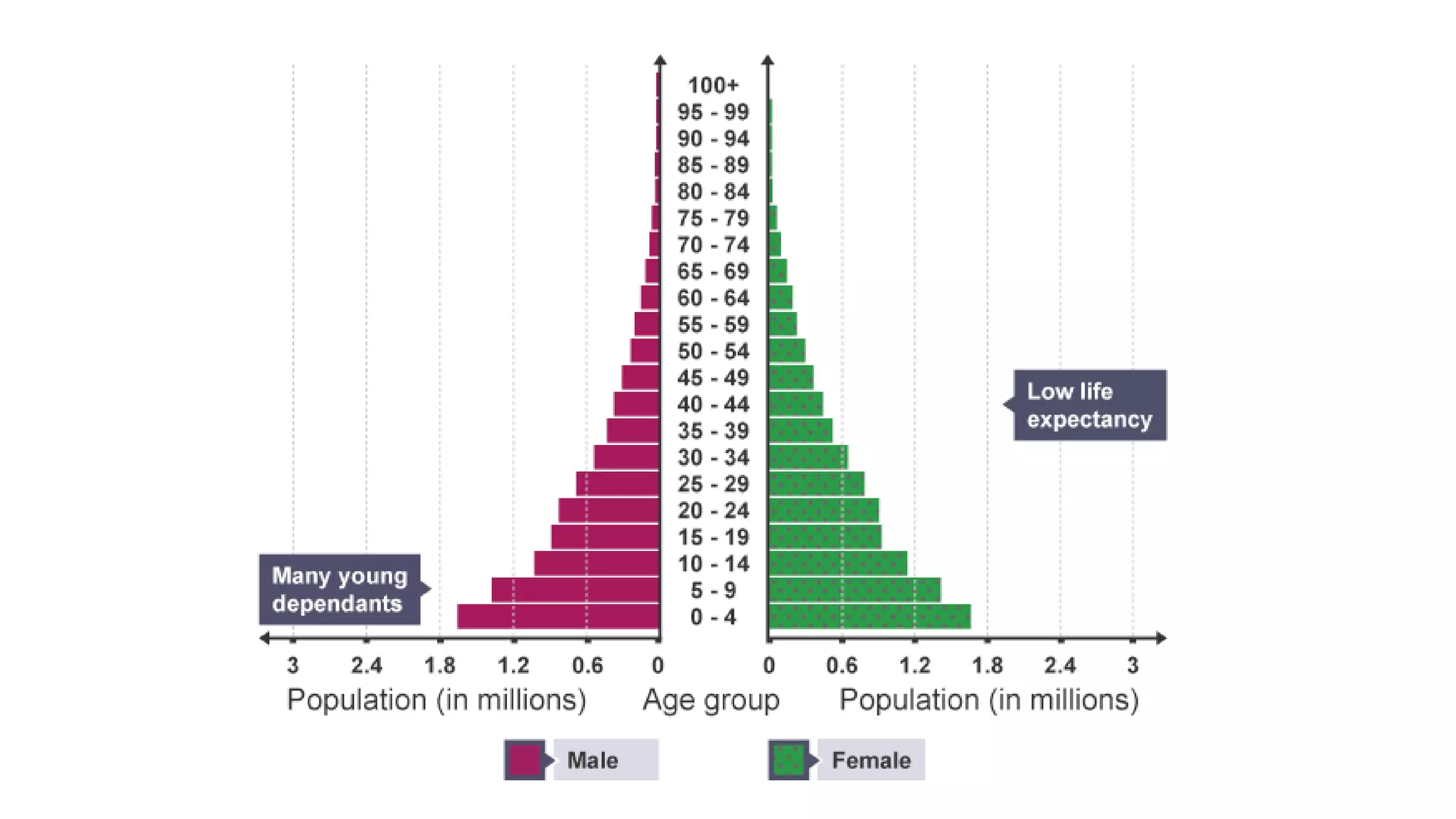
In this graph, notice that in 2000 the 0-4 age group contained
the largest number of people, with the numbers thereafter
declining steadily as the ages increase.
The graph matches stage 1 in the model.
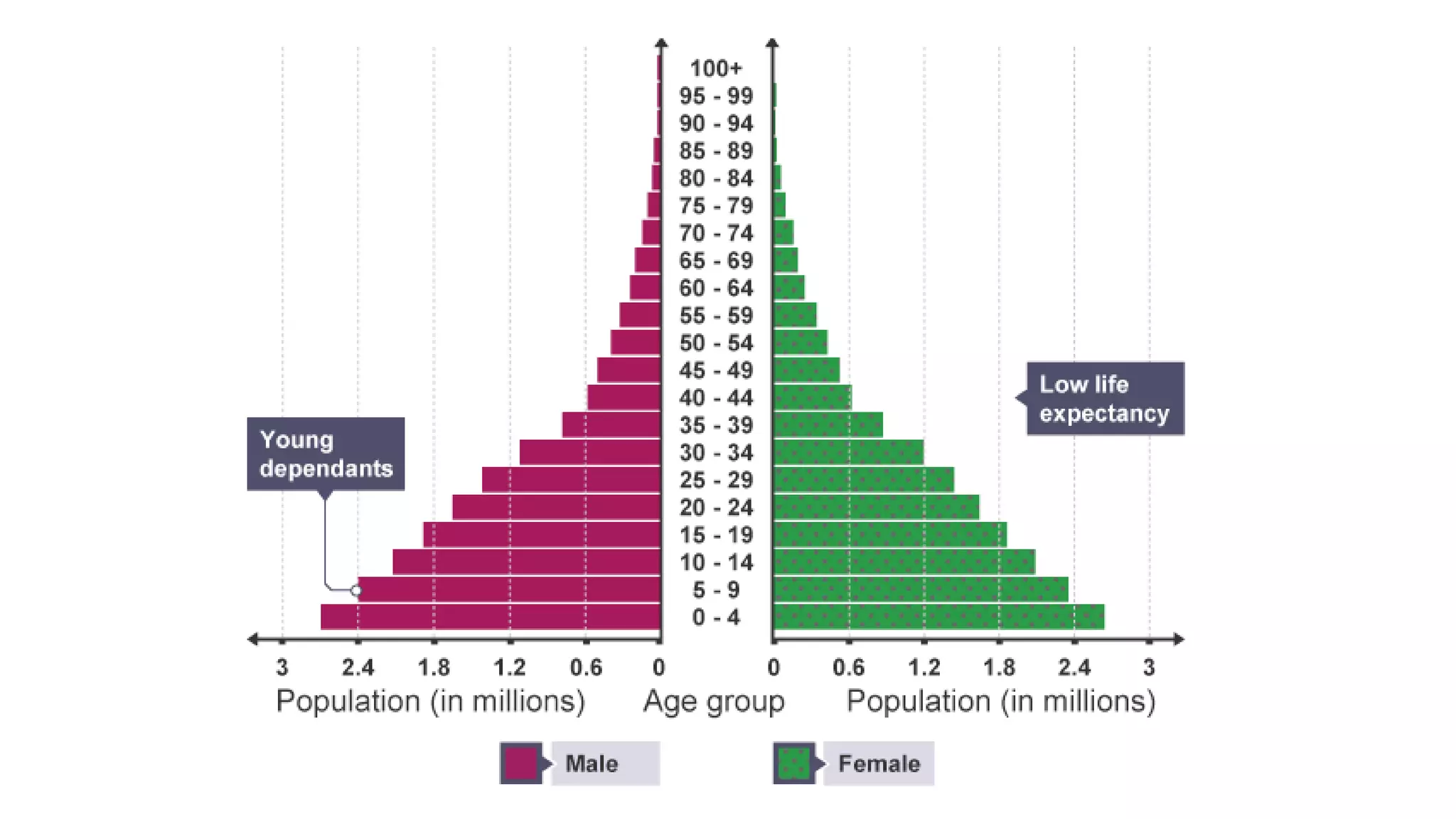
In the second graph, the largest group in Mozambique in 2025
is still the 0-4 age group, but there are nearly as many people in
the 5-29 age groups.
Now the population pyramid matches stage 2.
• The shape of a population pyramid can tell us a lot about an
area's population.
• It gives us information about birth and death rates as well as
life expectancy.
• A population pyramid tells us how many dependants there
are. There are two groups of dependants; young dependants
(aged below 15) and elderly dependants (aged over 65).
• Dependants rely upon the economically active for economic
support.
• Many LEDCs have a high number of young dependants, whilst
many MEDCs have a growing number of elderly dependants.
• A population pyramid that is very triangular (eg Mozambique
in 2000) shows a population with a high number of young
dependants and a low life expectancy.
• A population pyramid that has fairly straight sides (more like
a barrel) shows a population with a falling birth rate and a
rising life expectancy.
• Over time, as a country develops, the shape changes from
triangular to barrel-like.
• Places with an ageing population and a very low birth rate
would have a structure that looks like an upside-down
pyramid.
On average, women live 3 years and 10 months longer than
men.
A census is the procedure of systematically acquiring and
recording information about the members of a given
population.
It is a regularly occurring and official count of a particular
population.
The term is used mostly in connection with national population
and housing censuses; other common censuses include
agriculture, business, and traffic censuses.
The word is of Latin origin: during the Roman Republic, the
census was a list that kept track of all adult males fit for
military service.
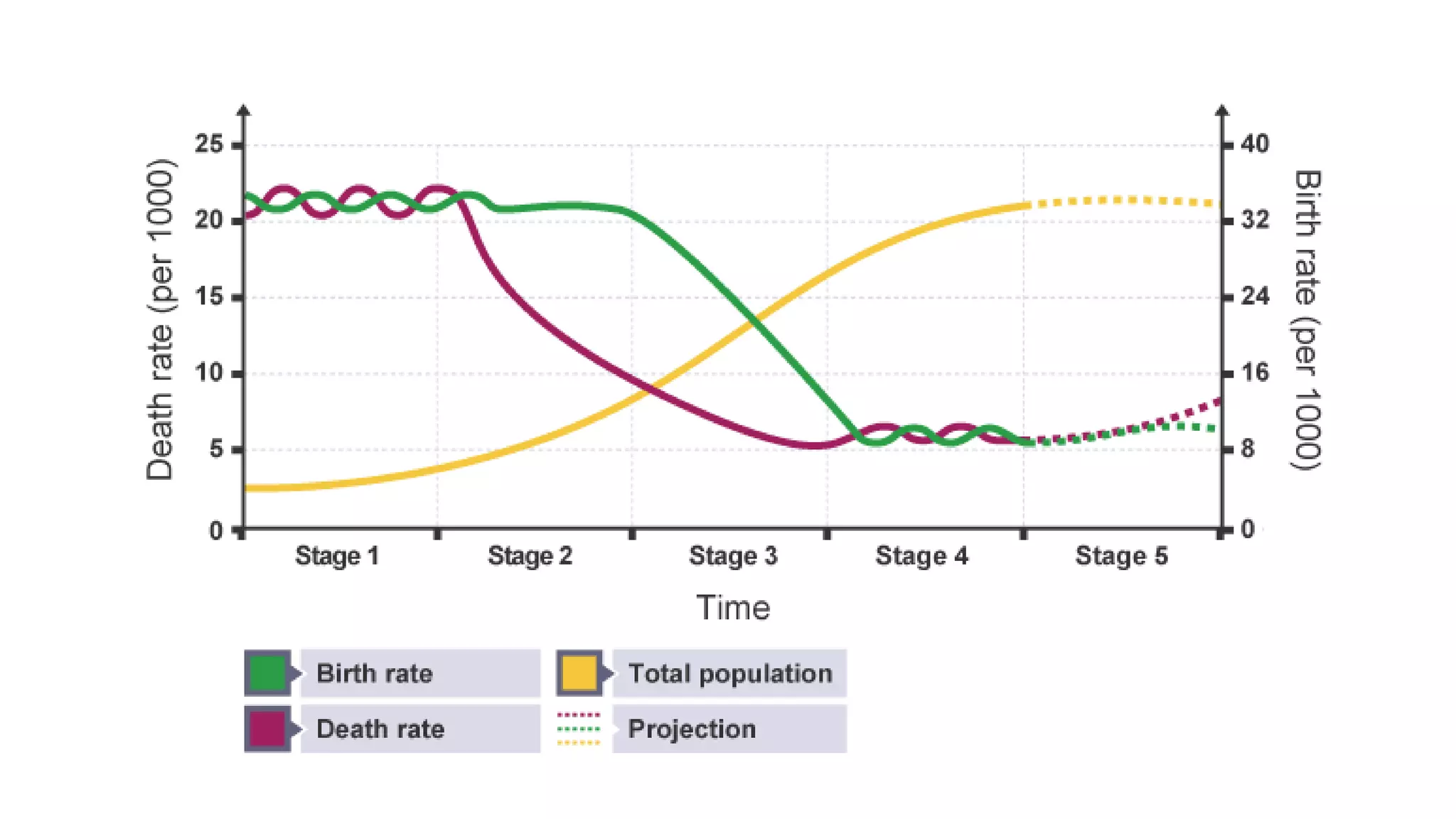
The demographic transition model shows population change
over time.
It studies how birth rate and death rate affect the total
population of a country.
STAGE 1: Total population is low but it is balanced due to
high birth rates and high death rates.
STAGE 2: Total population rises as death rates fall due to
improvements in health care and sanitation. Birth rates
remain high.
STAGE 3: Total population is still rising rapidly. The gap
between birth and death rates narrows due to the availability
of contraception and fewer children being needed to work -
due to the mechanisation of farming. The natural increase is
high.
STAGE 4: Total population is high, but it is balanced by a low
birth rate and a low death rate. Birth control is widely available
and there is a desire for smaller families.
STAGE 5: Total population is high but going into decline due to
an ageing population. There is a continued desire for smaller
families, with people opting to have children later in life.
As a country passes through the demographic transition model,
the total population rises.
Most LEDCs are at stage 2 or 3 (with a growing population and
a high natural increase).
Most MEDCs are now at stage 4 of the model and some such as
Germany have entered stage 5.
As populations move through the stages of the model, the gap
between birth rate and death rate first widens, then narrows.
In stage 1 the two rates are balanced.
In stage 2 they diverge, as the death rate falls relative to the
birth rate.
In stage 3 they converge again, as the birth rate falls relative to
the death rate.
Finally in stage 4 the death and birth rates are balanced again
but at a much lower level.
The model was developed after studying the experiences of
countries in Western Europe and North America.
Conditions might be different for LEDCs in different parts of
the world.
The original model doesn't take into account the fact that some
countries now have a declining population and a 5th stage.
Most texts will now show this stage as it is relevant to an
increasing number of MEDCs in the 21st century.

GEOGRAPHY IGCSE: POPULATION STRUCTURE

  • 1.
    IGCSE GEOGRAPHY 3. POPULATIONSTRUCTURE TYPES OF POPULATION STRUCTURE POPULATION PYRAMIDS DEMOGRAPHIC TRANSITION MODEL CASE STUDY UK (MEDC) AND MOZAMBIQUE (LEDC)
  • 2.
    Age/sex pyramids area useful tool for: •identifying age structure and gender patterns •predicting future population growth/decline/zero growth and therefore helping governments in their strategies and planning for the future.
  • 3.
    A population pyramid,also called an age pyramid or age picture is a graphical illustration that shows the distribution of various age groups in a population (country), which forms the shape of a pyramid when the population is growing.
  • 4.
    Population structure meansthe 'make up' or composition of a population. Looking at the population structure of a place shows how the population is divided up between males and females of different age groups. Population structure is usually shown using a population pyramid. A population pyramid can be drawn up for any area, from a whole continent or country to an individual town, city or village.
  • 5.
    It usually consistsof two back-to-back histograms, with the population plotted on the X-axis and age on the Y-axis, one showing the number of males and one showing females in a particular population in five-year age groups (also called cohorts). Males are conventionally shown on the left and females on the right, and they may be measured by raw number or as a percentage of the total population.
  • 7.
    The following graphsshow the population pyramids of an MEDC (the UK) and an LEDC (Mozambique), for 2000 and in 2025 using projected figures. The left side of each pyramid shows the number of men in each age group, the right side shows the number of women in each age group.
  • 9.
    Notice how inthe UK 2000 pyramid there is a bulge in the area of the 30-34 and 35-39 age groups, with the numbers thereafter reducing fairly steadily as the ages increase. This matches stage 4 of the demographic transition model.
  • 11.
    Compare this tothe 2025 pyramid, which would be stage 5 in the model. Here the bulge extends much further, covering the age groups 30-64, with the numbers beginning to reduce significantly only after 64. Now compare the UK population pyramids with those for Mozambique:
  • 13.
    In this graph,notice that in 2000 the 0-4 age group contained the largest number of people, with the numbers thereafter declining steadily as the ages increase. The graph matches stage 1 in the model.
  • 15.
    In the secondgraph, the largest group in Mozambique in 2025 is still the 0-4 age group, but there are nearly as many people in the 5-29 age groups. Now the population pyramid matches stage 2.
  • 16.
    • The shapeof a population pyramid can tell us a lot about an area's population. • It gives us information about birth and death rates as well as life expectancy. • A population pyramid tells us how many dependants there are. There are two groups of dependants; young dependants (aged below 15) and elderly dependants (aged over 65). • Dependants rely upon the economically active for economic support. • Many LEDCs have a high number of young dependants, whilst many MEDCs have a growing number of elderly dependants.
  • 17.
    • A populationpyramid that is very triangular (eg Mozambique in 2000) shows a population with a high number of young dependants and a low life expectancy. • A population pyramid that has fairly straight sides (more like a barrel) shows a population with a falling birth rate and a rising life expectancy. • Over time, as a country develops, the shape changes from triangular to barrel-like. • Places with an ageing population and a very low birth rate would have a structure that looks like an upside-down pyramid.
  • 18.
    On average, womenlive 3 years and 10 months longer than men.
  • 19.
    A census isthe procedure of systematically acquiring and recording information about the members of a given population. It is a regularly occurring and official count of a particular population. The term is used mostly in connection with national population and housing censuses; other common censuses include agriculture, business, and traffic censuses. The word is of Latin origin: during the Roman Republic, the census was a list that kept track of all adult males fit for military service.
  • 21.
    The demographic transitionmodel shows population change over time. It studies how birth rate and death rate affect the total population of a country.
  • 22.
    STAGE 1: Totalpopulation is low but it is balanced due to high birth rates and high death rates. STAGE 2: Total population rises as death rates fall due to improvements in health care and sanitation. Birth rates remain high. STAGE 3: Total population is still rising rapidly. The gap between birth and death rates narrows due to the availability of contraception and fewer children being needed to work - due to the mechanisation of farming. The natural increase is high.
  • 23.
    STAGE 4: Totalpopulation is high, but it is balanced by a low birth rate and a low death rate. Birth control is widely available and there is a desire for smaller families. STAGE 5: Total population is high but going into decline due to an ageing population. There is a continued desire for smaller families, with people opting to have children later in life.
  • 25.
    As a countrypasses through the demographic transition model, the total population rises. Most LEDCs are at stage 2 or 3 (with a growing population and a high natural increase). Most MEDCs are now at stage 4 of the model and some such as Germany have entered stage 5.
  • 26.
    As populations movethrough the stages of the model, the gap between birth rate and death rate first widens, then narrows. In stage 1 the two rates are balanced. In stage 2 they diverge, as the death rate falls relative to the birth rate. In stage 3 they converge again, as the birth rate falls relative to the death rate. Finally in stage 4 the death and birth rates are balanced again but at a much lower level.
  • 27.
    The model wasdeveloped after studying the experiences of countries in Western Europe and North America. Conditions might be different for LEDCs in different parts of the world. The original model doesn't take into account the fact that some countries now have a declining population and a 5th stage. Most texts will now show this stage as it is relevant to an increasing number of MEDCs in the 21st century.