Geoforum 2014
Using EDINA datasets in a hydrology project
About me
 Background in environmental science
 MSc in GIS, 2013
 Now Spatial Data Analyst at GeoPlace (National Address Gazetteer)
About GeoPlace
 Owned by Local Government Association / Ordnance Survey
 Definitive national address & street gazetteers (datasets)
 380 local authorities working together across GB – includes One Scotland Gazetteer (OSG) managed
by ThinkWhere
 AddressBase products used by emergency services, government agencies, insurance companies
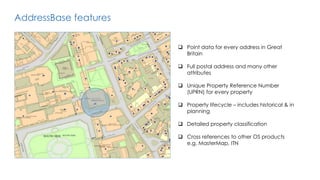
AddressBase features
 Point data for every address in Great
Britain
 Full postal address and many other
attributes
 Unique Property Reference Number
(UPRN) for every property
 Property lifecycle – includes historical & in
planning
 Detailed property classification
 Cross references to other OS products
e.g. MasterMap, ITN
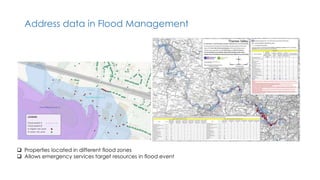
Address data in Flood Management
 Properties located in different flood zones
 Allows emergency services target resources in flood event
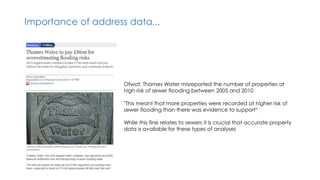
Importance of address data...
Ofwat: Thames Water misreported the number of properties at
high risk of sewer flooding between 2005 and 2010
"This meant that more properties were recorded at higher risk of
sewer flooding than there was evidence to support“
While this fine relates to sewers it is crucial that accurate property
data is available for these types of analyses
Project overview
 Hydrology example (mainly maps)
 EDINA datasets (via. Digimap)
o Land Cover Map 2007
o Digital Terrain Model (DTM) – OS Profile
o OS Strategi
 Other datasets
o Catchment shapefiles (Centre for Ecology & Hydrology / CEH)
o River flows data (HiFlows / Environment Agency)
Project aims
 Aim of project was to calculate a regression-based equation for PROPWET (soil moisture value)
 Currently engineers use constant value for catchment PROPWET (Flood Estimation Handbook)
 Test & develop a regression-based equation using GIS, following initial Halcrow analysis
 Particular relevance to natural flood management
Natural Flood Management (NFM)
 NFM involves mitigating flooding using nature, currently difficult to analyse
 Increasing flooding (climate change) and increasing costs
 Regression-based PROPWET allows simulations of different ground conditions e.g. increased
vegetation
 SEPA projects eg Eddleston Water, Scottish Borders
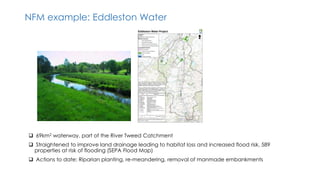
NFM example: Eddleston Water
 69km2 waterway, part of the River Tweed Catchment
 Straightened to improve land drainage leading to habitat loss and increased flood risk, 589
properties at risk of flooding (SEPA Flood Map)
 Actions to date: Riparian planting, re-meandering, removal of manmade embankments
PROPWET (soil moisture)
 Soil moisture important for flood estimates and the PROPortion of time
soils are WET (PROPWET) is an important catchment descriptor
 PROPWET range 0-1, e.g. wet catchment 0.8, dry catchment 0.1
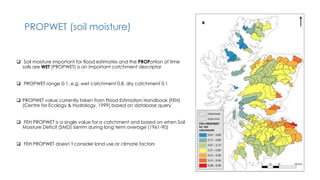
 PROPWET value currently taken from Flood Estimation Handbook (FEH)
(Centre for Ecology & Hydrology, 1999) based on database query
 FEH PROPWET is a single value for a catchment and based on when Soil
Moisture Deficit (SMD) ≤6mm during long term average (1961-90)
 FEH PROPWET doesn’t consider land use or climate factors
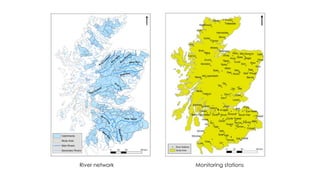
Monitoring stationsRiver network
Halcrow analysis
 Initial regression-based equation proposed based on 43 catchments (Halcrow, 2012)
PROPWET = 0.5365Log10[SAAR – (PE x LAI4.70 x r 0.79 x 2.003E - 5)] - 0.998
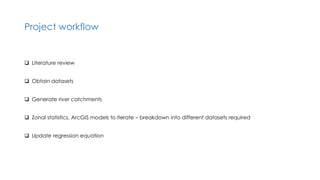
Project workflow
 Literature review
 Obtain datasets
 Generate river catchments
 Zonal statistics, ArcGIS models to iterate – breakdown into different datasets required
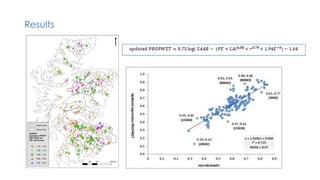
 Update regression equation
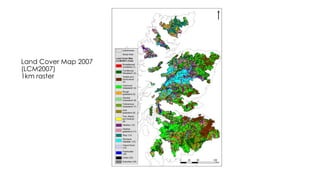
Land Cover Map 2007
(LCM2007)
1km raster
Land Cover Map 2007 (LCM2007)
 LCM2007 is a parcel-based classification of 23 land cover classes based on the UK’s terrestrial Broad
Habitats
 Classifying summer-winter composite images captured by satellite sensors with 20-30m pixels
 LCM represents land cover type and not land use, although the two are often synonymous in practise
Land Cover Map 2007 (LCM2007)
 Obtained vector & 1km raster (aggregated vector, dominant class per 1x1km pixel)
 Vector dataset better metadata but long geo-processing times for country wide queries, vector
manipulated using ogr2ogr
 Vector would have been fine in my desktop GIS if had a smaller study area
 Raster clipped against river catchments after resampling to 100x100m to obtain better fit, each
catchment containing an average of 9 different land cover types
Catchment delineation
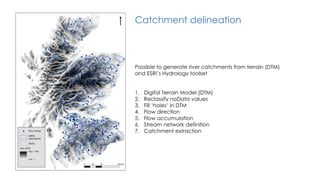
Possible to generate river catchments from terrain (DTM)
and ESRI’s Hydrology toolset
1. Digital Terrain Model (DTM)
2. Reclassify noData values
3. Fill ‘holes’ in DTM
4. Flow direction
5. Flow accumulation
6. Stream network definition
7. Catchment extraction
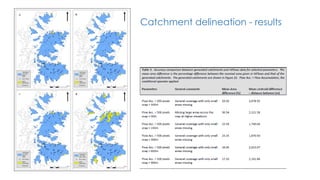
Catchment delineation - results
Geoprocessing
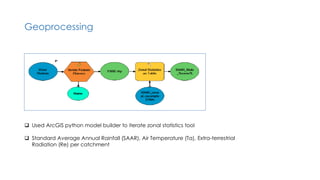
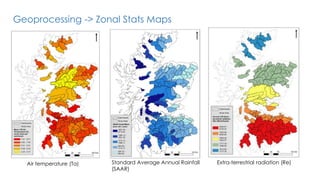
 Used ArcGIS python model builder to iterate zonal statistics tool
 Standard Average Annual Rainfall (SAAR), Air Temperature (Ta), Extra-terrestrial
Radiation (Re) per catchment
Geoprocessing -> Zonal Stats Maps
Standard Average Annual Rainfall
(SAAR)
Extra-terrestrial radiation (Re)Air temperature (Ta)
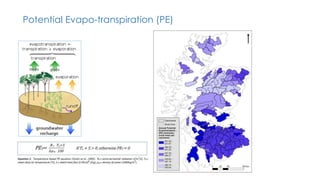
Potential Evapo-transpiration (PE)
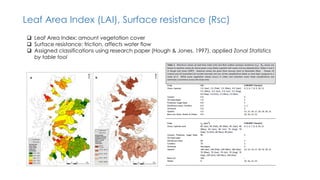
Leaf Area Index (LAI), Surface resistance (Rsc)
 Leaf Area Index: amount vegetation cover
 Surface resistance: friction, affects water flow
 Assigned classifications using research paper (Hough & Jones, 1997), applied Zonal Statistics
by table tool
Results
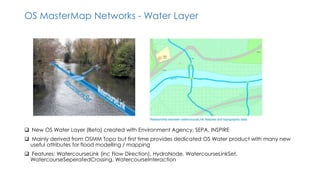
OS MasterMap Networks - Water Layer
 New OS Water Layer (Beta) created with Environment Agency, SEPA, INSPIRE
 Mainly derived from OSMM Topo but first time provides dedicated OS Water product with many new
useful attributes for flood modelling / mapping
 Features: WatercourseLink (inc Flow Direction), HydroNode, WatercourseLinkSet,
WatercourseSeperatedCrossing, WatercourseInteraction
Thank you...
Any questions?
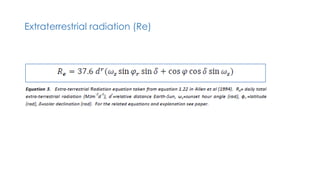
Extraterrestrial radiation (Re)

Using EDINA Datasets in a Hydrology Project - Darius Bazazi

  • 1.
    Geoforum 2014 Using EDINAdatasets in a hydrology project
  • 2.
    About me  Backgroundin environmental science  MSc in GIS, 2013  Now Spatial Data Analyst at GeoPlace (National Address Gazetteer)
  • 3.
    About GeoPlace  Ownedby Local Government Association / Ordnance Survey  Definitive national address & street gazetteers (datasets)  380 local authorities working together across GB – includes One Scotland Gazetteer (OSG) managed by ThinkWhere  AddressBase products used by emergency services, government agencies, insurance companies
  • 4.
    AddressBase features  Pointdata for every address in Great Britain  Full postal address and many other attributes  Unique Property Reference Number (UPRN) for every property  Property lifecycle – includes historical & in planning  Detailed property classification  Cross references to other OS products e.g. MasterMap, ITN
  • 5.
    Address data inFlood Management  Properties located in different flood zones  Allows emergency services target resources in flood event
  • 6.
    Importance of addressdata... Ofwat: Thames Water misreported the number of properties at high risk of sewer flooding between 2005 and 2010 "This meant that more properties were recorded at higher risk of sewer flooding than there was evidence to support“ While this fine relates to sewers it is crucial that accurate property data is available for these types of analyses
  • 7.
    Project overview  Hydrologyexample (mainly maps)  EDINA datasets (via. Digimap) o Land Cover Map 2007 o Digital Terrain Model (DTM) – OS Profile o OS Strategi  Other datasets o Catchment shapefiles (Centre for Ecology & Hydrology / CEH) o River flows data (HiFlows / Environment Agency)
  • 8.
    Project aims  Aimof project was to calculate a regression-based equation for PROPWET (soil moisture value)  Currently engineers use constant value for catchment PROPWET (Flood Estimation Handbook)  Test & develop a regression-based equation using GIS, following initial Halcrow analysis  Particular relevance to natural flood management
  • 9.
    Natural Flood Management(NFM)  NFM involves mitigating flooding using nature, currently difficult to analyse  Increasing flooding (climate change) and increasing costs  Regression-based PROPWET allows simulations of different ground conditions e.g. increased vegetation  SEPA projects eg Eddleston Water, Scottish Borders
  • 10.
    NFM example: EddlestonWater  69km2 waterway, part of the River Tweed Catchment  Straightened to improve land drainage leading to habitat loss and increased flood risk, 589 properties at risk of flooding (SEPA Flood Map)  Actions to date: Riparian planting, re-meandering, removal of manmade embankments
  • 11.
    PROPWET (soil moisture) Soil moisture important for flood estimates and the PROPortion of time soils are WET (PROPWET) is an important catchment descriptor  PROPWET range 0-1, e.g. wet catchment 0.8, dry catchment 0.1  PROPWET value currently taken from Flood Estimation Handbook (FEH) (Centre for Ecology & Hydrology, 1999) based on database query  FEH PROPWET is a single value for a catchment and based on when Soil Moisture Deficit (SMD) ≤6mm during long term average (1961-90)  FEH PROPWET doesn’t consider land use or climate factors
  • 12.
  • 13.
    Halcrow analysis  Initialregression-based equation proposed based on 43 catchments (Halcrow, 2012) PROPWET = 0.5365Log10[SAAR – (PE x LAI4.70 x r 0.79 x 2.003E - 5)] - 0.998
  • 14.
    Project workflow  Literaturereview  Obtain datasets  Generate river catchments  Zonal statistics, ArcGIS models to iterate – breakdown into different datasets required  Update regression equation
  • 15.
    Land Cover Map2007 (LCM2007) 1km raster
  • 16.
    Land Cover Map2007 (LCM2007)  LCM2007 is a parcel-based classification of 23 land cover classes based on the UK’s terrestrial Broad Habitats  Classifying summer-winter composite images captured by satellite sensors with 20-30m pixels  LCM represents land cover type and not land use, although the two are often synonymous in practise
  • 17.
    Land Cover Map2007 (LCM2007)  Obtained vector & 1km raster (aggregated vector, dominant class per 1x1km pixel)  Vector dataset better metadata but long geo-processing times for country wide queries, vector manipulated using ogr2ogr  Vector would have been fine in my desktop GIS if had a smaller study area  Raster clipped against river catchments after resampling to 100x100m to obtain better fit, each catchment containing an average of 9 different land cover types
  • 18.
    Catchment delineation Possible togenerate river catchments from terrain (DTM) and ESRI’s Hydrology toolset 1. Digital Terrain Model (DTM) 2. Reclassify noData values 3. Fill ‘holes’ in DTM 4. Flow direction 5. Flow accumulation 6. Stream network definition 7. Catchment extraction
  • 19.
  • 20.
    Geoprocessing  Used ArcGISpython model builder to iterate zonal statistics tool  Standard Average Annual Rainfall (SAAR), Air Temperature (Ta), Extra-terrestrial Radiation (Re) per catchment
  • 21.
    Geoprocessing -> ZonalStats Maps Standard Average Annual Rainfall (SAAR) Extra-terrestrial radiation (Re)Air temperature (Ta)
  • 22.
  • 23.
    Leaf Area Index(LAI), Surface resistance (Rsc)  Leaf Area Index: amount vegetation cover  Surface resistance: friction, affects water flow  Assigned classifications using research paper (Hough & Jones, 1997), applied Zonal Statistics by table tool
  • 24.
  • 25.
    OS MasterMap Networks- Water Layer  New OS Water Layer (Beta) created with Environment Agency, SEPA, INSPIRE  Mainly derived from OSMM Topo but first time provides dedicated OS Water product with many new useful attributes for flood modelling / mapping  Features: WatercourseLink (inc Flow Direction), HydroNode, WatercourseLinkSet, WatercourseSeperatedCrossing, WatercourseInteraction
  • 26.
  • 27.