ecosystem Modelling And Scaling
infrasTructure (eMAST)
- Where models and data become one
Presentation by Brad Evans based on contributions by Colin
Prentice, Michael Hutchinson, Gab Abramowitz, Ben Evans,
Rhys Whitley, Julie Pauwels
eMAST’s objectives 2013-2015
DELIVER research data infrastructure to
integrate TERN (and other) data streams on the
National Computing Infrastructure

ENABLE data assimilation, model evaluation and
accreditation and ecosystem model optimization
DRIVE advances in ecosystem science, impact
assessment and land management
Driving science questions
CARBON: How much CO2 is exchanged? How
much carbon can be stored and where?
WATER: What drives water use by ecosystems,
and runoff in rivers?
CLIMATE CHANGE: How does it change the
rules?
LAND MANAGEMENT: What will work, in a
changing climate?
More driving science questions
FIRE: What are the risks? How can they be
mitigated?
CLIMATE FEEDBACKS: How will ecosystem
changes influence the exchanges of carbon,
water and energy with the atmosphere?
BIODIVERSITY: What species are threatened?
Where are likely refugia? Is there a tipping
point?
Our target market
Ecosystem scientists
Australian Government e.g.
BoM, DCCEE, SEWPAC

Natural resource managers
Conservation organizations
Answering questions at all scales
Addressing tradeoffs – carbon, water, biodiversity
What eMAST is delivering
High-resolution data products: climate, canopy
conductance, water use, primary production
Tools for interpolation, downscaling, upscaling,
hindcasting, forecasting
A state-of-the-art data assimilation system for
ecosystem model optimization
Software for model evaluation (based on PALS)
Top-level ecosystem drivers and targets for
models
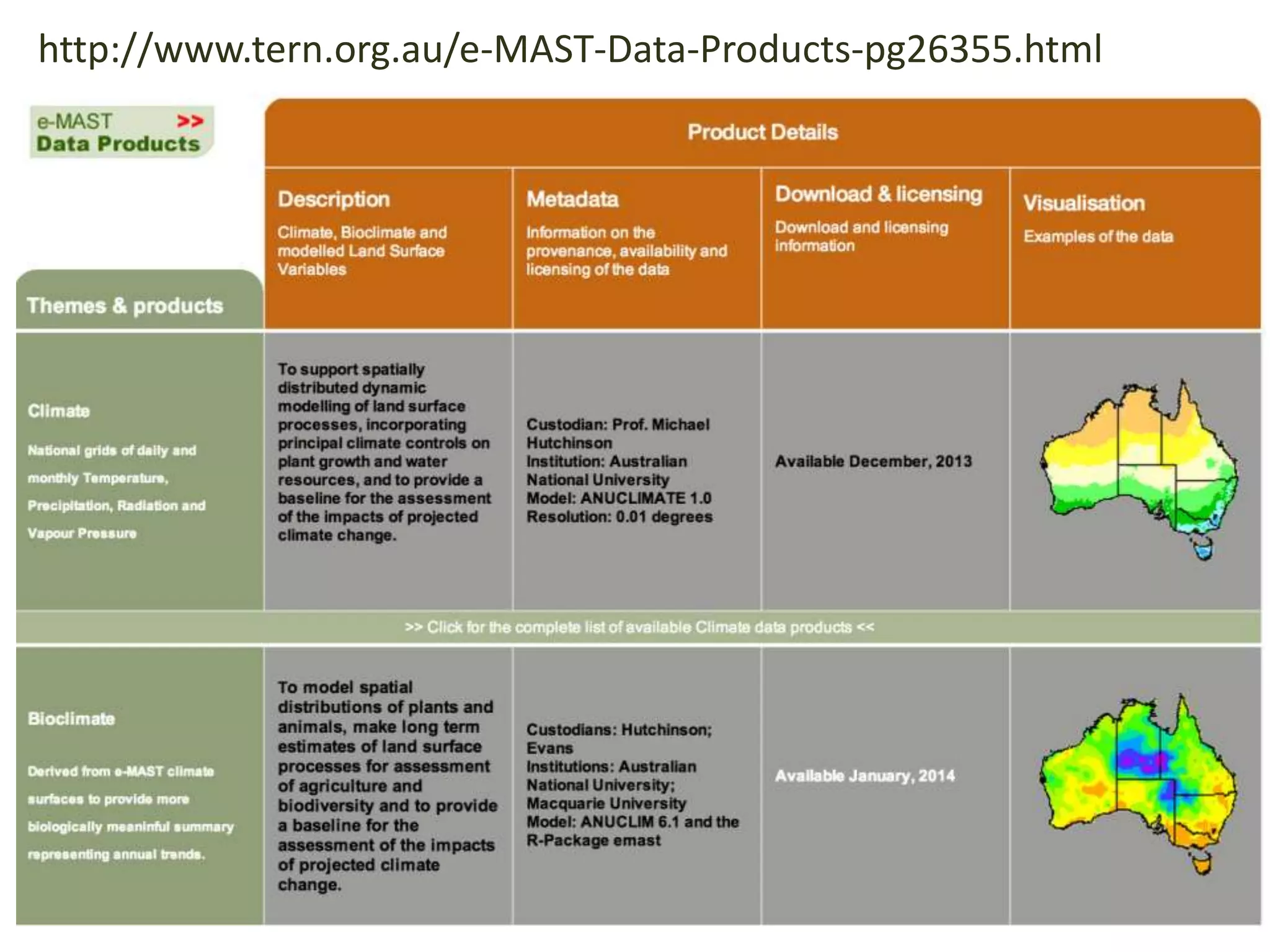
http://www.tern.org.au/e-MAST-Data-Products-pg26355.html
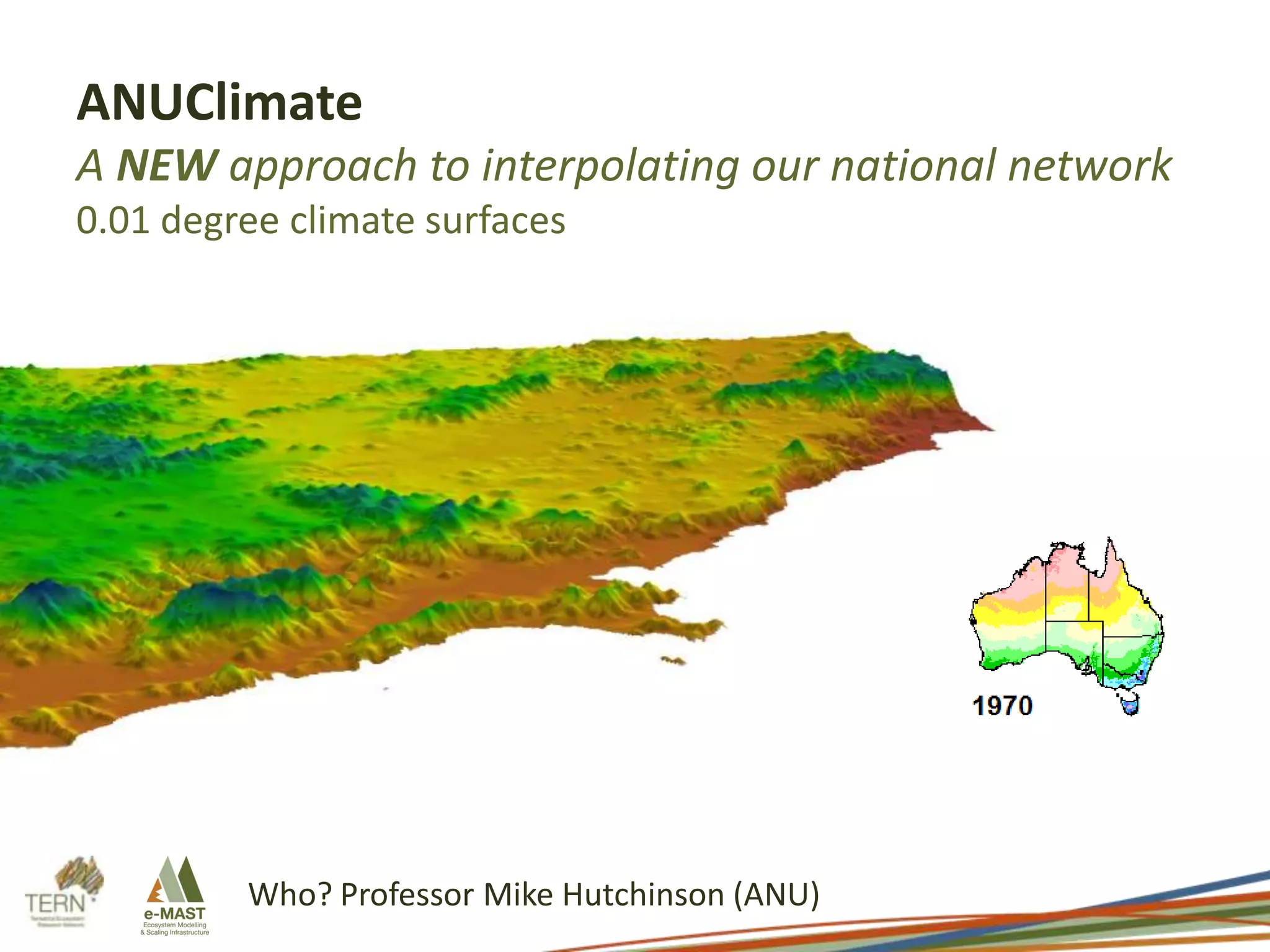
ANUClimate
A NEW approach to interpolating our national network
0.01 degree climate surfaces

Who? Professor Mike Hutchinson (ANU)
Climate data sets (1 km)
Tmin

Tmax

vp

P

daily
✔
1970-2011

✔

✔

✔

monthly
✔
1970-2011

✔

✔

✔

✔

mean
monthly

pan
evap.

wet
days

✔

✔

✔

✔

✔

✔

solar
rad.

wind
speed

✔

✔
ANUClimate

When? Delivery timeline…
Complete set of Climate and
Bioclimatic data available on
RDSI
RDSI opendap netCDF CF
& Metadata store complete
= public release
Data starts propagating
to RDSI*
ADVANCED USER ACCESS
DOI’s NOT YET AVAILABLE = NO PUBLISH

30 Nov 2013

24 Dec 2013

31 Jan 2013

*Currently experiencing delays in RDSI allocation – delays in the Raijin cloud roll out etc…
ANUClimate

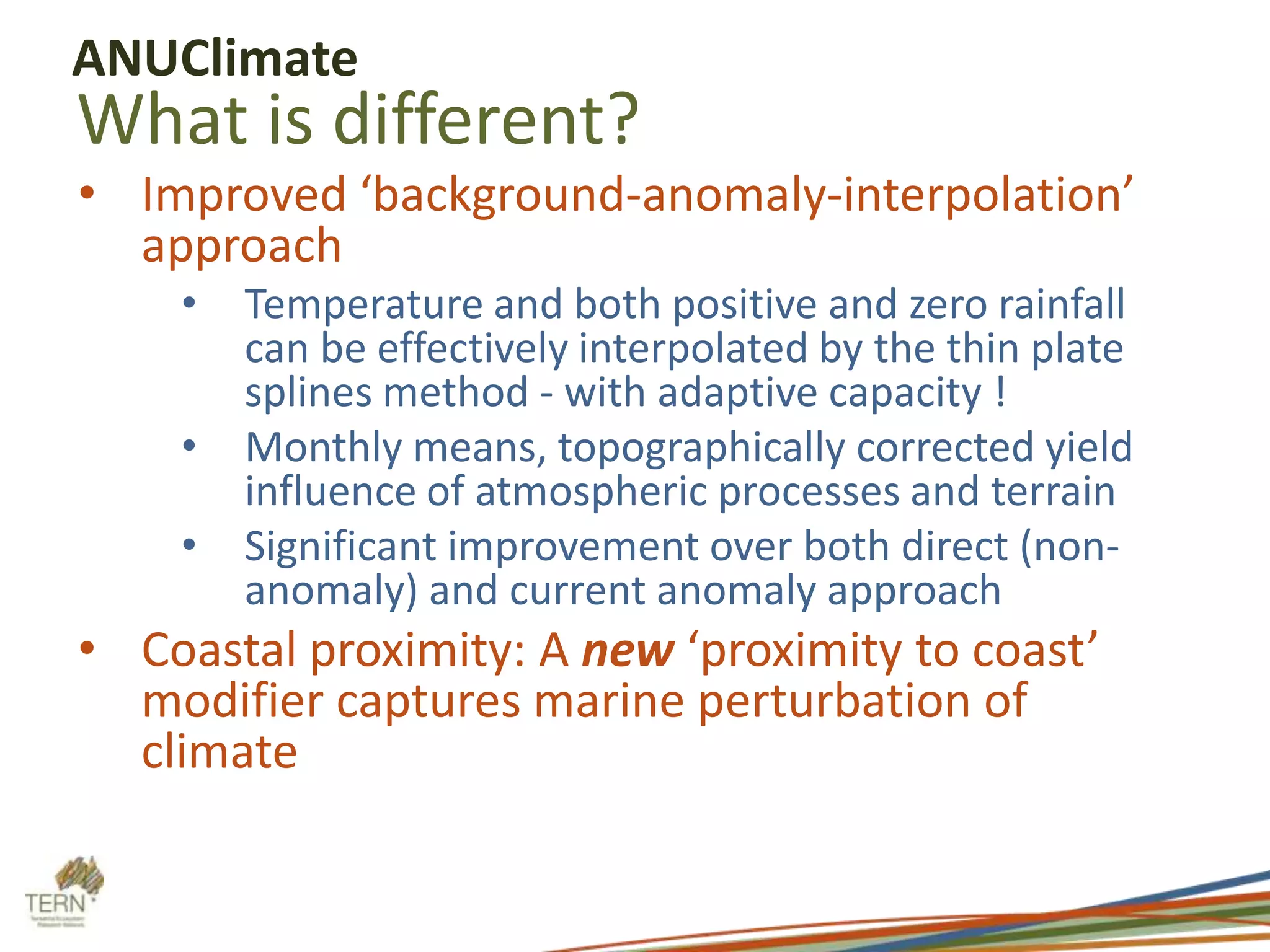
What is different?

• Improved ‘background-anomaly-interpolation’
approach
•

•
•

Temperature and both positive and zero rainfall
can be effectively interpolated by the thin plate
splines method - with adaptive capacity !
Monthly means, topographically corrected yield
influence of atmospheric processes and terrain
Significant improvement over both direct (nonanomaly) and current anomaly approach

• Coastal proximity: A new ‘proximity to coast’
modifier captures marine perturbation of
climate
ANUClimate

What can we expect?
• Temperature estimates improved by around
25% compared to Jones et al. 2009 (RMSE
cross validation)
• Precipitation estimates a modest, but
significant, improvement (7-15% RMSE cross
validation)
The model makes no further improvement on
accuracy beyond the 1km mark !
ANUClimate

How is it done?
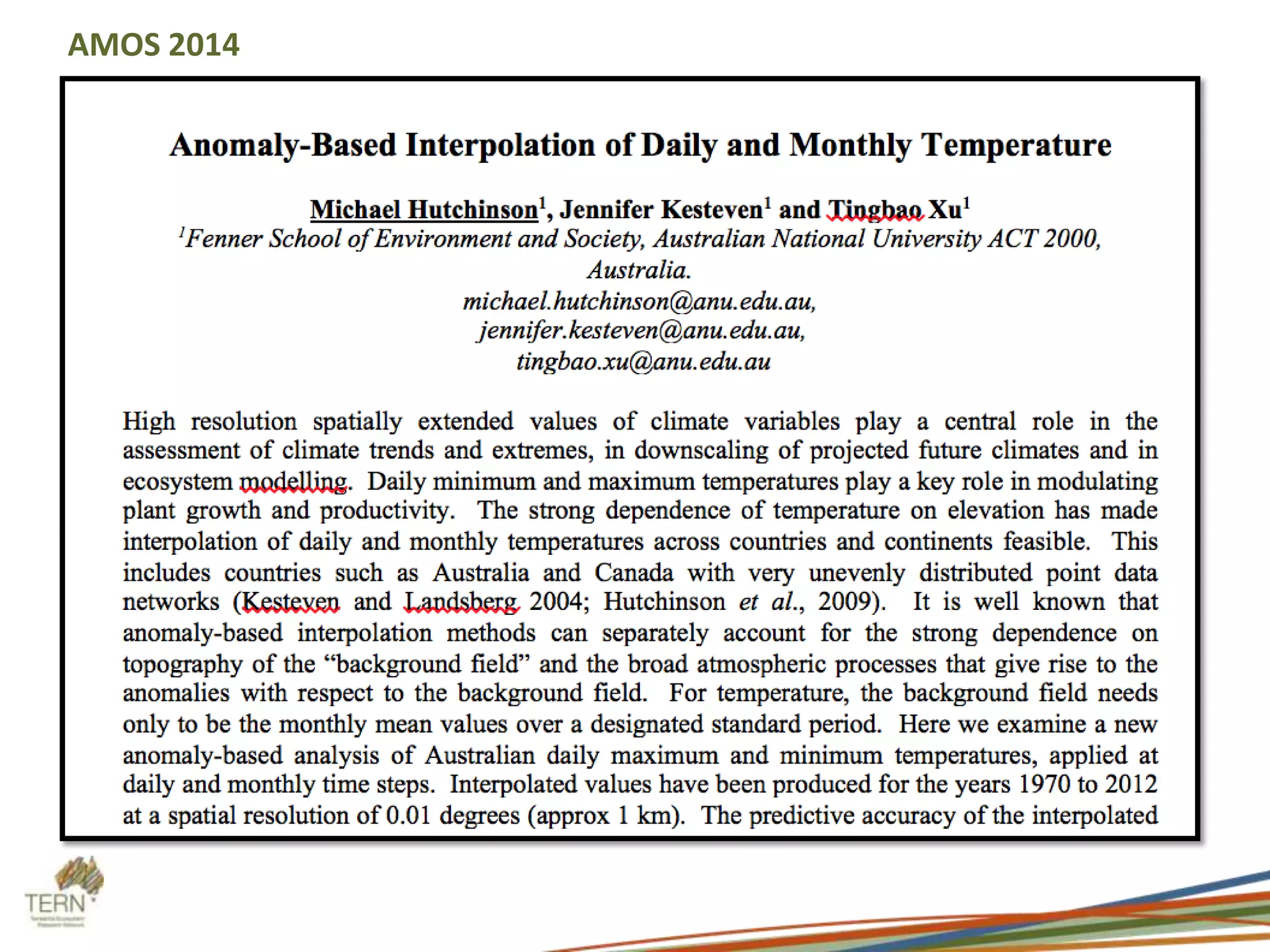
AMOS 2014
Bioclimate data sets (1 km T, P and R)
ecosystem Production in Space and
Time: ePiSaT
eMAST: How does gross primary
productivity (GPP) vary in space and time
across Australia?
Colin: How can we ‘simply’ estimate
GPP across Australia?
What data does TERN provide that
might be useful for addressing this
research question?
User workflow: ePiSaT GPP
Choose the ePiSaT
model from the TERN
portal

Produce continental
scale estimates of GPP
and evaluate them

Obtain OzFlux data via
the TERN/ OzFlux
portals

Obtain climate (eMAST)
and satellite data
(AusCover) to scale the
ePiSaT parameters

Run the ePiSaT model –
generate estimates of
ecosystem parameters,
evaluate them
http://episat-software.blogspot.com.au/
OzFlux
ePiSaT : Flux tower scaling
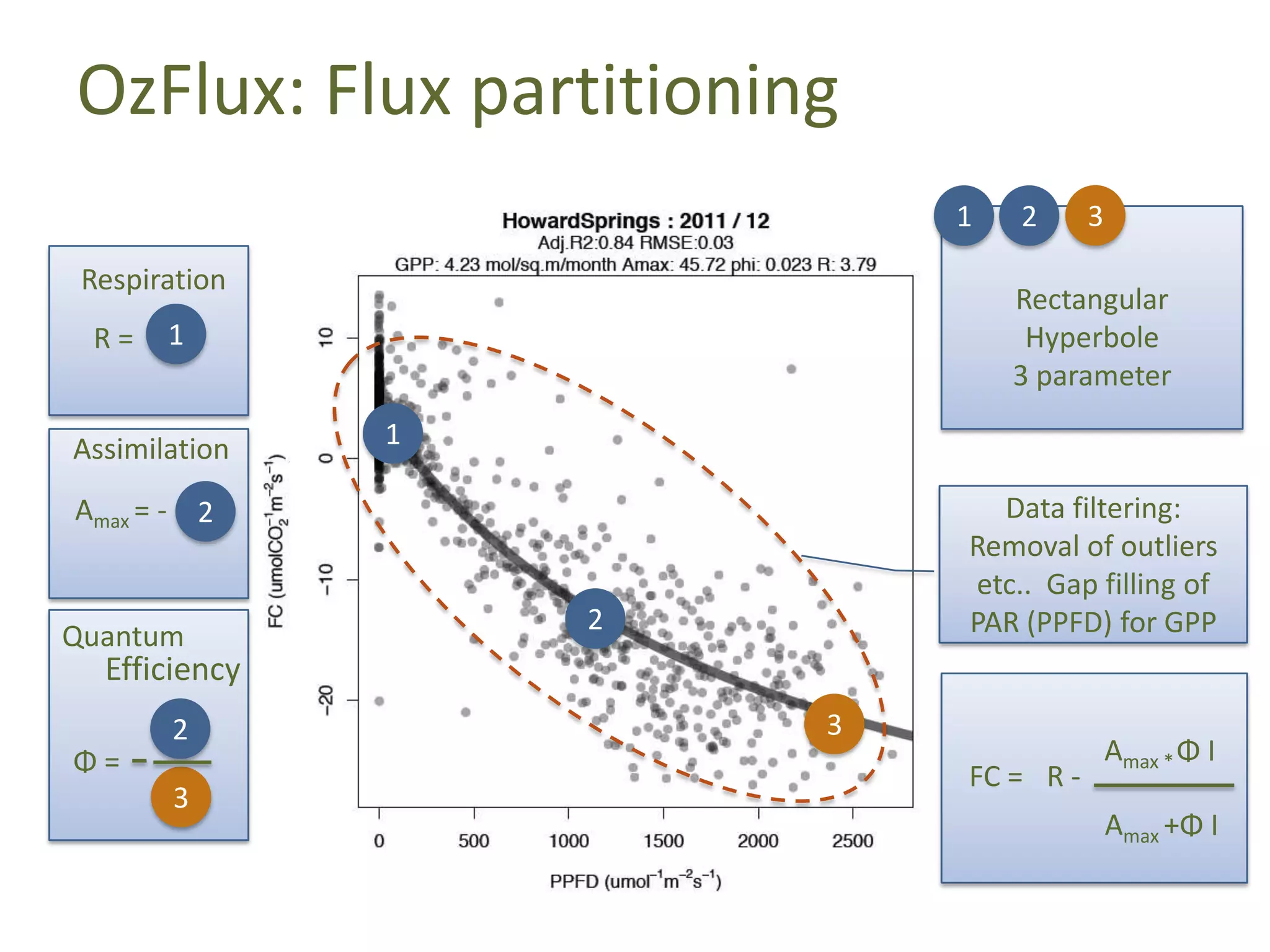
OzFlux: Flux partitioning
1
Respiration
R=

1
Data filtering:
Removal of outliers
etc.. Gap filling of
PAR (PPFD) for GPP

Amax = - 2

Quantum

3

Rectangular
Hyperbole
3 parameter

1

Assimilation

2

2

Efficiency
2

Φ=
3

3

FC = R -

Amax * Φ I
Amax +Φ I
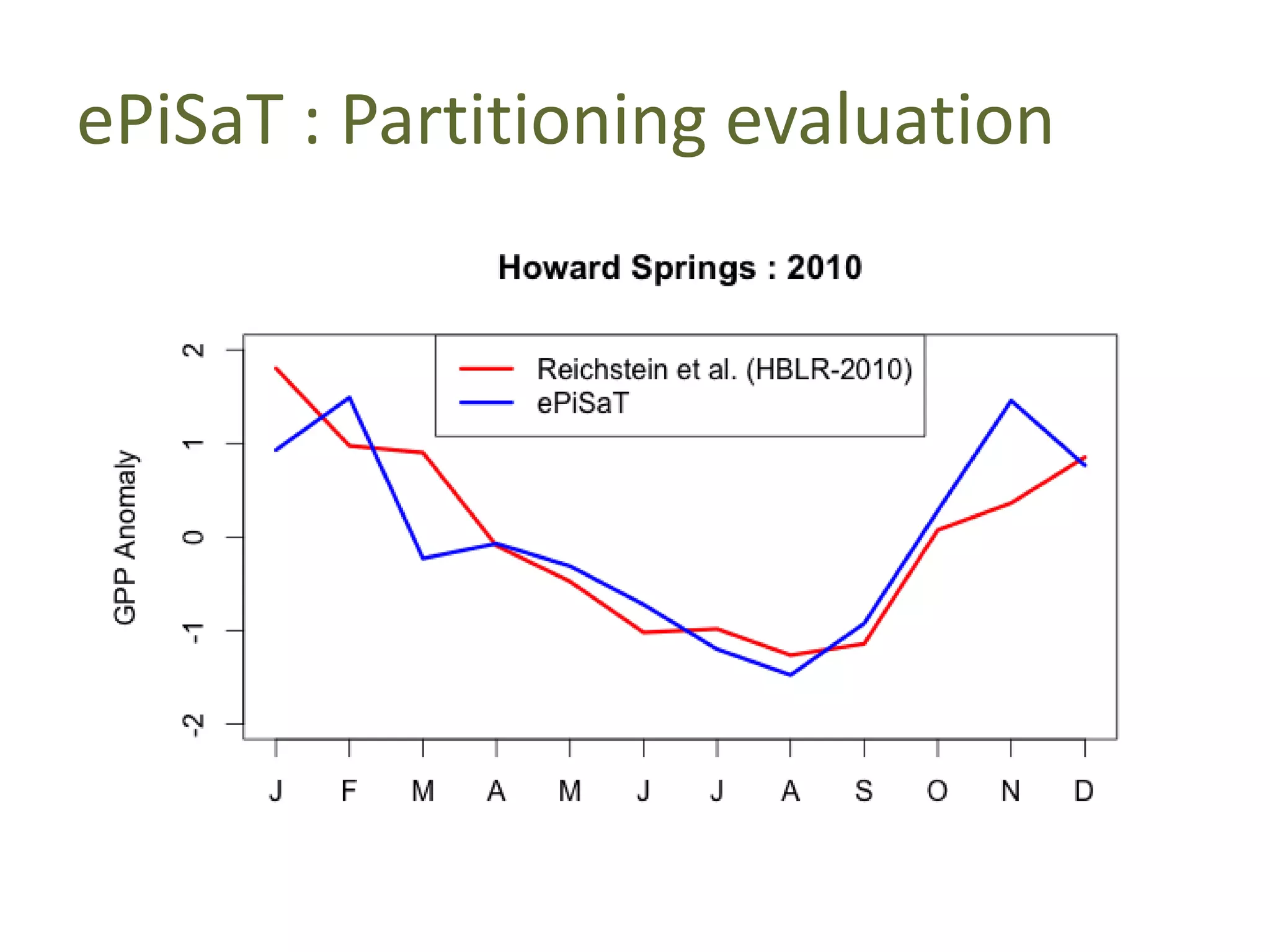
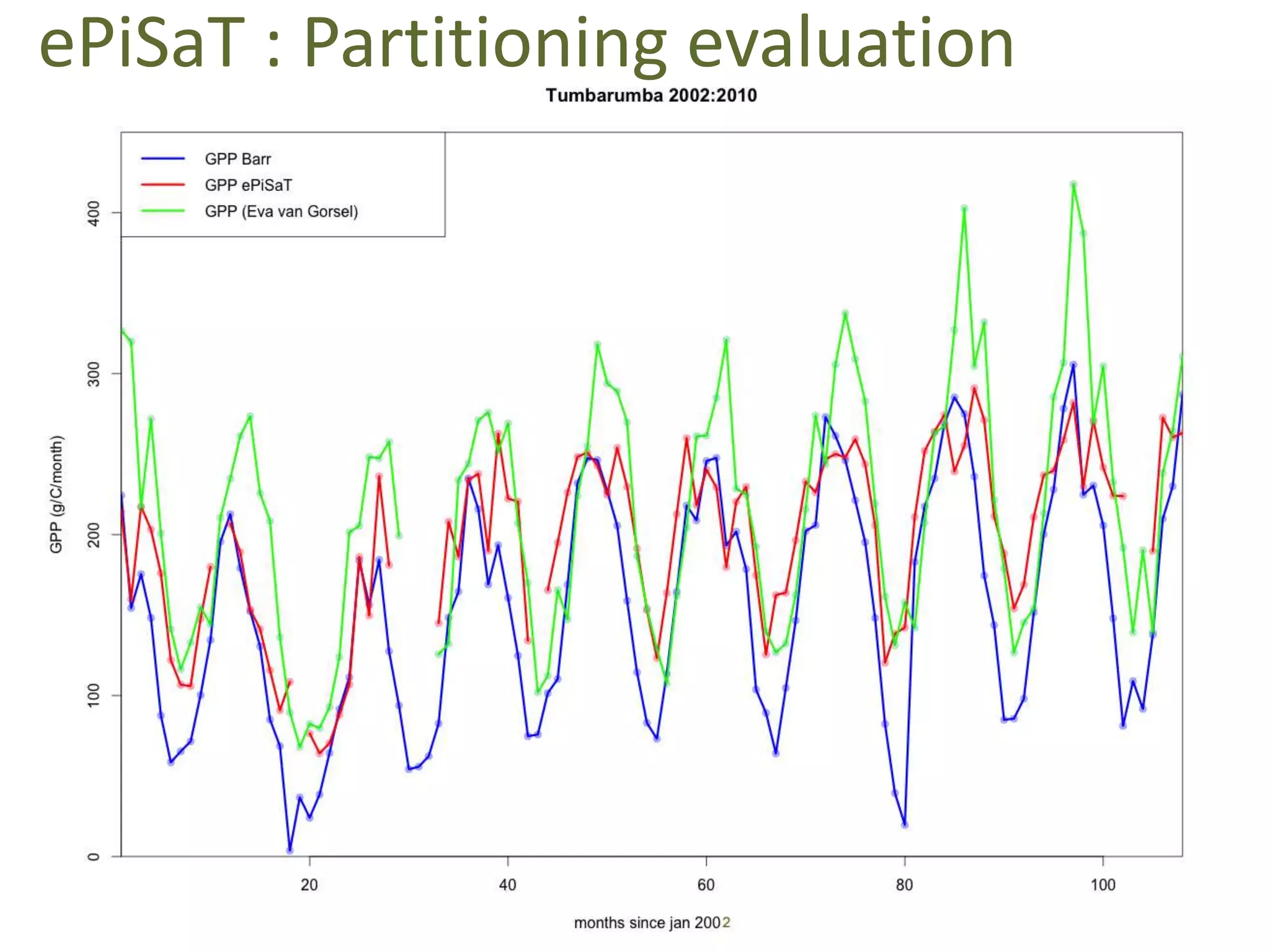
ePiSaT : Partitioning evaluation
Model data evaluation

from Gab Abramowitz (UNSW)
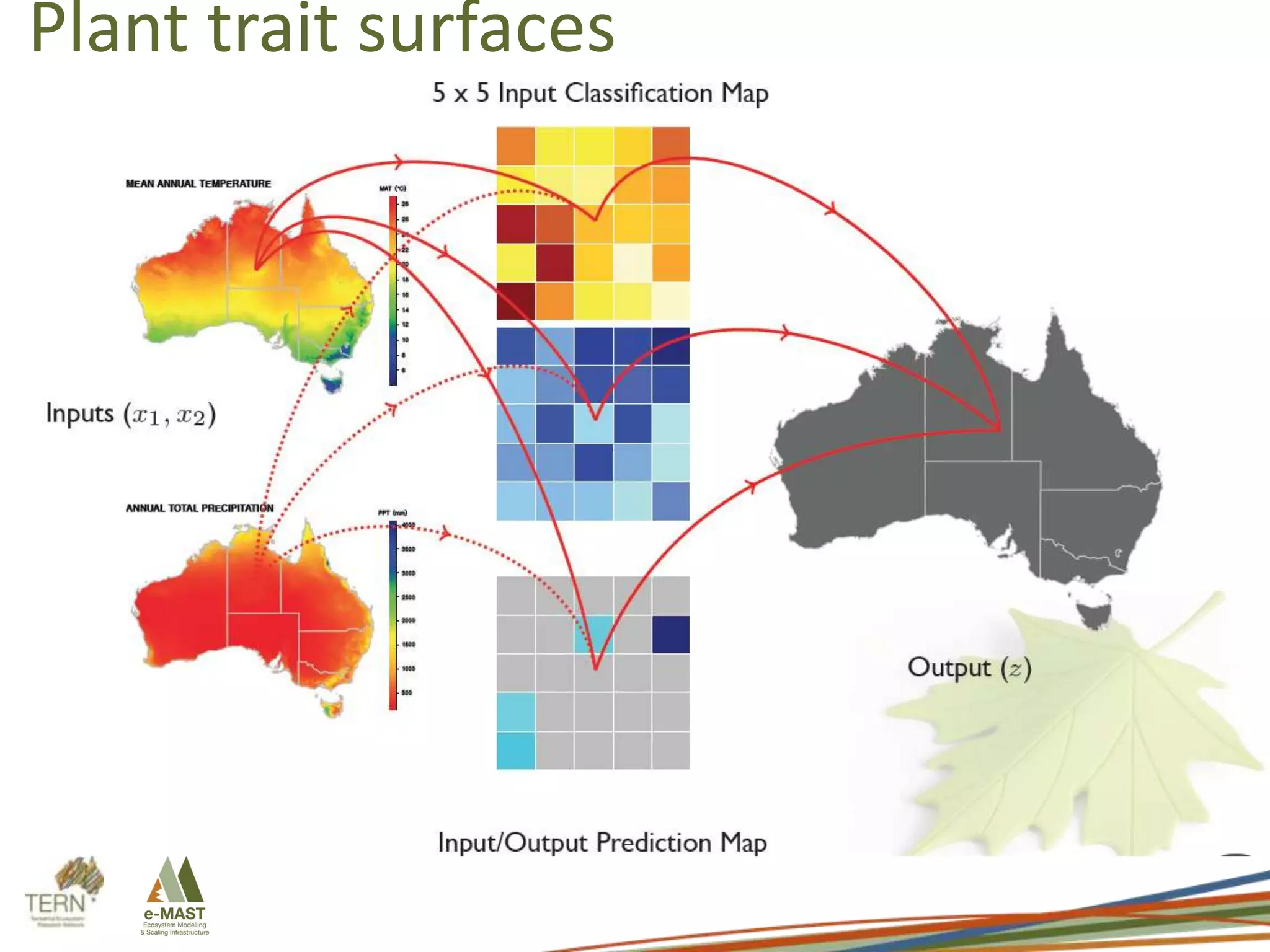
Plant trait surfaces
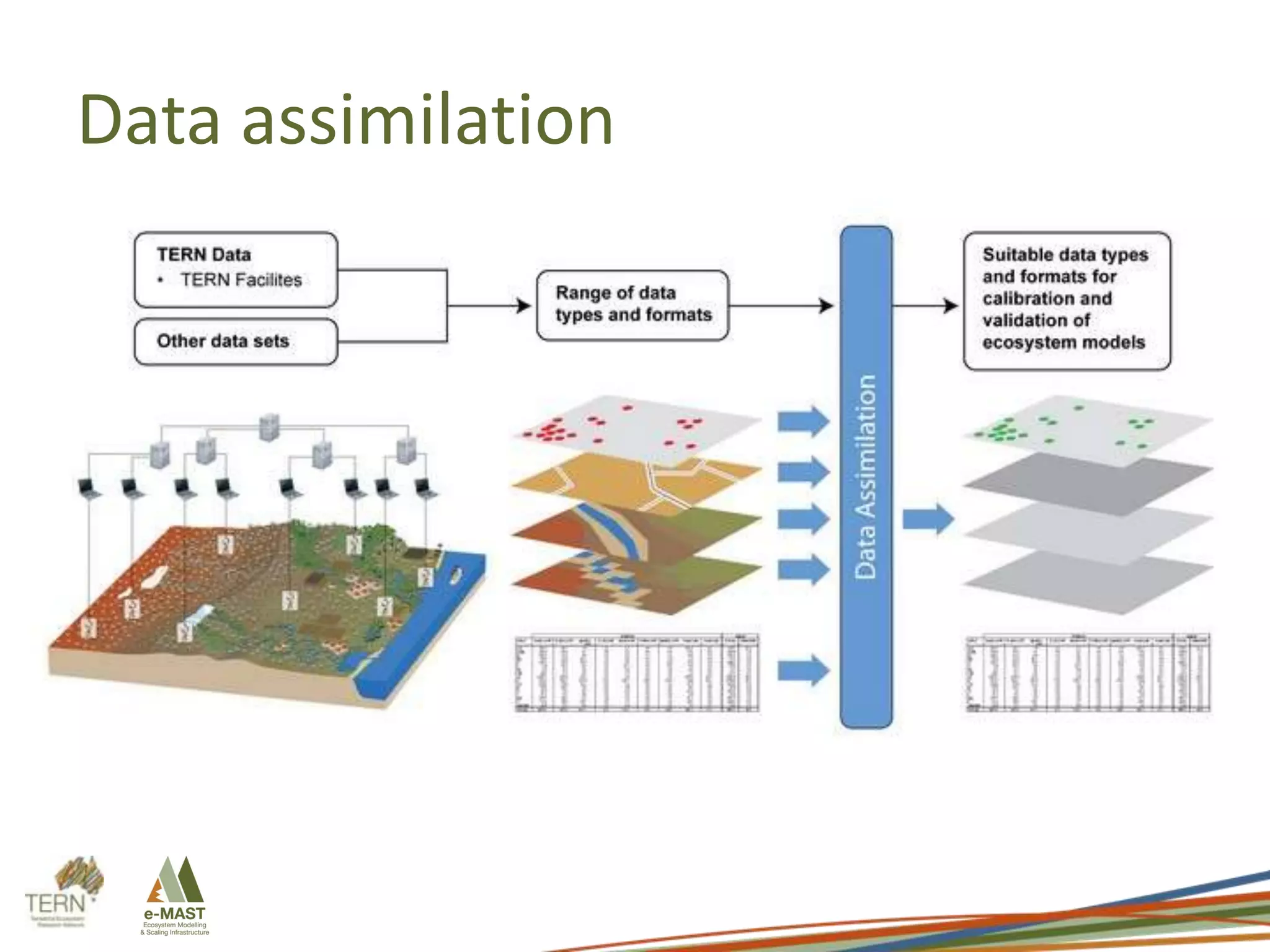
Data assimilation
NEON, TERN and ????
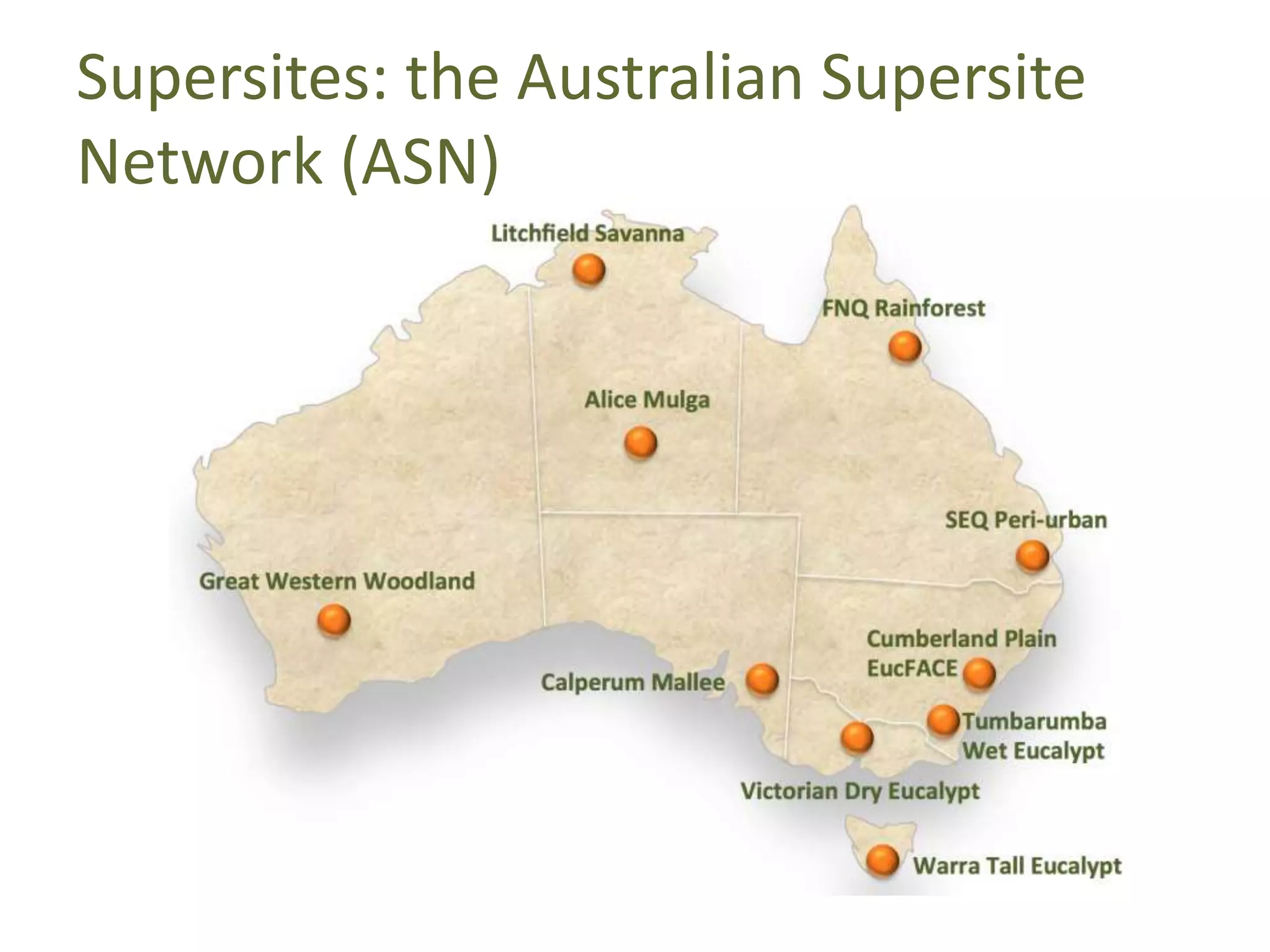
Supersites: the Australian Supersite
Network (ASN)
Long term transects
LTERN
Summary: Data-model fusion tools
Data assimilation collaboration with NEON and
NCAR, CSIRO, Macquarie University and the
Australian National University
eMAST : An R-Package ‘emast’ for the computation
and visualization of bioclimatic indices
ePiSaT : Collaboration with OzFlux and AusCover to
model Gross Primary Production across the
landscape, another R-Package ‘ePiSaT’.
Protocol for the Analysis of Land Surface Models
(PALS) for evaluation of data and models
Downscale climate change scenarios
Status of the facility
Delivery of our key datasets through the
RDSI, Data Discovery, Visualization &
Exploitation… consolidation of our tools and
porting them to Raijin.
eMAST in 2014
Delivery of our key datasets through the RDSI,
Data Discovery, Visualization & Exploitation…
consolidation of our tools and porting them to
Raijin.

EcoTas13 BradEvans e-MAST

  • 1.
    ecosystem Modelling AndScaling infrasTructure (eMAST) - Where models and data become one Presentation by Brad Evans based on contributions by Colin Prentice, Michael Hutchinson, Gab Abramowitz, Ben Evans, Rhys Whitley, Julie Pauwels
  • 2.
    eMAST’s objectives 2013-2015 DELIVERresearch data infrastructure to integrate TERN (and other) data streams on the National Computing Infrastructure ENABLE data assimilation, model evaluation and accreditation and ecosystem model optimization DRIVE advances in ecosystem science, impact assessment and land management
  • 3.
    Driving science questions CARBON:How much CO2 is exchanged? How much carbon can be stored and where? WATER: What drives water use by ecosystems, and runoff in rivers? CLIMATE CHANGE: How does it change the rules? LAND MANAGEMENT: What will work, in a changing climate?
  • 4.
    More driving sciencequestions FIRE: What are the risks? How can they be mitigated? CLIMATE FEEDBACKS: How will ecosystem changes influence the exchanges of carbon, water and energy with the atmosphere? BIODIVERSITY: What species are threatened? Where are likely refugia? Is there a tipping point?
  • 5.
    Our target market Ecosystemscientists Australian Government e.g. BoM, DCCEE, SEWPAC Natural resource managers Conservation organizations Answering questions at all scales Addressing tradeoffs – carbon, water, biodiversity
  • 6.
    What eMAST isdelivering High-resolution data products: climate, canopy conductance, water use, primary production Tools for interpolation, downscaling, upscaling, hindcasting, forecasting A state-of-the-art data assimilation system for ecosystem model optimization Software for model evaluation (based on PALS) Top-level ecosystem drivers and targets for models
  • 7.
  • 9.
    ANUClimate A NEW approachto interpolating our national network 0.01 degree climate surfaces Who? Professor Mike Hutchinson (ANU)
  • 10.
    Climate data sets(1 km) Tmin Tmax vp P daily ✔ 1970-2011 ✔ ✔ ✔ monthly ✔ 1970-2011 ✔ ✔ ✔ ✔ mean monthly pan evap. wet days ✔ ✔ ✔ ✔ ✔ ✔ solar rad. wind speed ✔ ✔
  • 11.
    ANUClimate When? Delivery timeline… Completeset of Climate and Bioclimatic data available on RDSI RDSI opendap netCDF CF & Metadata store complete = public release Data starts propagating to RDSI* ADVANCED USER ACCESS DOI’s NOT YET AVAILABLE = NO PUBLISH 30 Nov 2013 24 Dec 2013 31 Jan 2013 *Currently experiencing delays in RDSI allocation – delays in the Raijin cloud roll out etc…
  • 12.
    ANUClimate What is different? •Improved ‘background-anomaly-interpolation’ approach • • • Temperature and both positive and zero rainfall can be effectively interpolated by the thin plate splines method - with adaptive capacity ! Monthly means, topographically corrected yield influence of atmospheric processes and terrain Significant improvement over both direct (nonanomaly) and current anomaly approach • Coastal proximity: A new ‘proximity to coast’ modifier captures marine perturbation of climate
  • 13.
    ANUClimate What can weexpect? • Temperature estimates improved by around 25% compared to Jones et al. 2009 (RMSE cross validation) • Precipitation estimates a modest, but significant, improvement (7-15% RMSE cross validation) The model makes no further improvement on accuracy beyond the 1km mark !
  • 14.
  • 15.
  • 16.
    Bioclimate data sets(1 km T, P and R)
  • 17.
    ecosystem Production inSpace and Time: ePiSaT eMAST: How does gross primary productivity (GPP) vary in space and time across Australia? Colin: How can we ‘simply’ estimate GPP across Australia? What data does TERN provide that might be useful for addressing this research question?
  • 18.
    User workflow: ePiSaTGPP Choose the ePiSaT model from the TERN portal Produce continental scale estimates of GPP and evaluate them Obtain OzFlux data via the TERN/ OzFlux portals Obtain climate (eMAST) and satellite data (AusCover) to scale the ePiSaT parameters Run the ePiSaT model – generate estimates of ecosystem parameters, evaluate them
  • 19.
  • 20.
  • 21.
    ePiSaT : Fluxtower scaling
  • 22.
    OzFlux: Flux partitioning 1 Respiration R= 1 Datafiltering: Removal of outliers etc.. Gap filling of PAR (PPFD) for GPP Amax = - 2 Quantum 3 Rectangular Hyperbole 3 parameter 1 Assimilation 2 2 Efficiency 2 Φ= 3 3 FC = R - Amax * Φ I Amax +Φ I
  • 23.
  • 24.
  • 25.
    Model data evaluation fromGab Abramowitz (UNSW)
  • 26.
  • 27.
  • 28.
  • 29.
  • 30.
    Supersites: the AustralianSupersite Network (ASN)
  • 32.
  • 33.
  • 34.
    Summary: Data-model fusiontools Data assimilation collaboration with NEON and NCAR, CSIRO, Macquarie University and the Australian National University eMAST : An R-Package ‘emast’ for the computation and visualization of bioclimatic indices ePiSaT : Collaboration with OzFlux and AusCover to model Gross Primary Production across the landscape, another R-Package ‘ePiSaT’. Protocol for the Analysis of Land Surface Models (PALS) for evaluation of data and models Downscale climate change scenarios
  • 35.
    Status of thefacility Delivery of our key datasets through the RDSI, Data Discovery, Visualization & Exploitation… consolidation of our tools and porting them to Raijin.
  • 36.
    eMAST in 2014 Deliveryof our key datasets through the RDSI, Data Discovery, Visualization & Exploitation… consolidation of our tools and porting them to Raijin.