Paul Walk
Head of Technology Strategy and Planning,
EDINA
p.walk@ed.ac.uk
@paulwalk
RIOXX: a Modern Metadata Application
Profile
what is RIOXX?
why build RIOXX?
• new policies from RCUK and HEFCE mandate that any journal article
funded by research grants be made publicly accessible in a repository
• these policies require that universities make metadata about such papers
easily discoverable
• the available metadata formats were inadequate
• OAI-DC was not rich enough
• OpenAIRE was better but demanded project IDs be encoded in particular
syntax not compatible with project IDs from UK Research Councils
• OpenAIRE syntax
• info:eu-
repo/grantAgreement/Funder/FundingProgram/ProjectID/[Jurisdiction
]/[ProjectName]/[ProjectAcronym]
• RCUK syntax:
• OpaqueProjectID/version
particular concerns
• how to represent the funder
• how to represent the project/grant
• how to represent unambiguous licenses
• how to represent the persistent identifier of the item described
• provisions of identifier(s) pointing to related dataset(s)
• how to represent the rights of use of the item described
• an application profile using properties from 4 namespaces:
• 11 properties from Dublin Core (dc and dcterms)
• 2 properties from NISO Open Access Metadata and Indicators
• 8 from a new namespace - ‘rioxxterms’
• constraints imposed through several controlled vocabularies
• it has one purpose: to provide a mechanism to help institutional repositories
in the UK comply with the RCUK policy on open access.
• it is not designed to provide general interoperability!!
• Version 2.0 released in January 2015
very rapid tour of some
specific properties
dc:identifier
• identifies the open access item being described by the RIOXX metadata
record.
• regardless of where it is located
• recommended to identify the resource itself, not a ‘splash page’
• this will not always be possible or desirable
• whatever it identifies, it MUST be an HTTP URI
• Example:
<dc:identifier>
http://oro.open.ac.uk/2/1/LIBARTVICEprints.pdf
</dc:identifier>
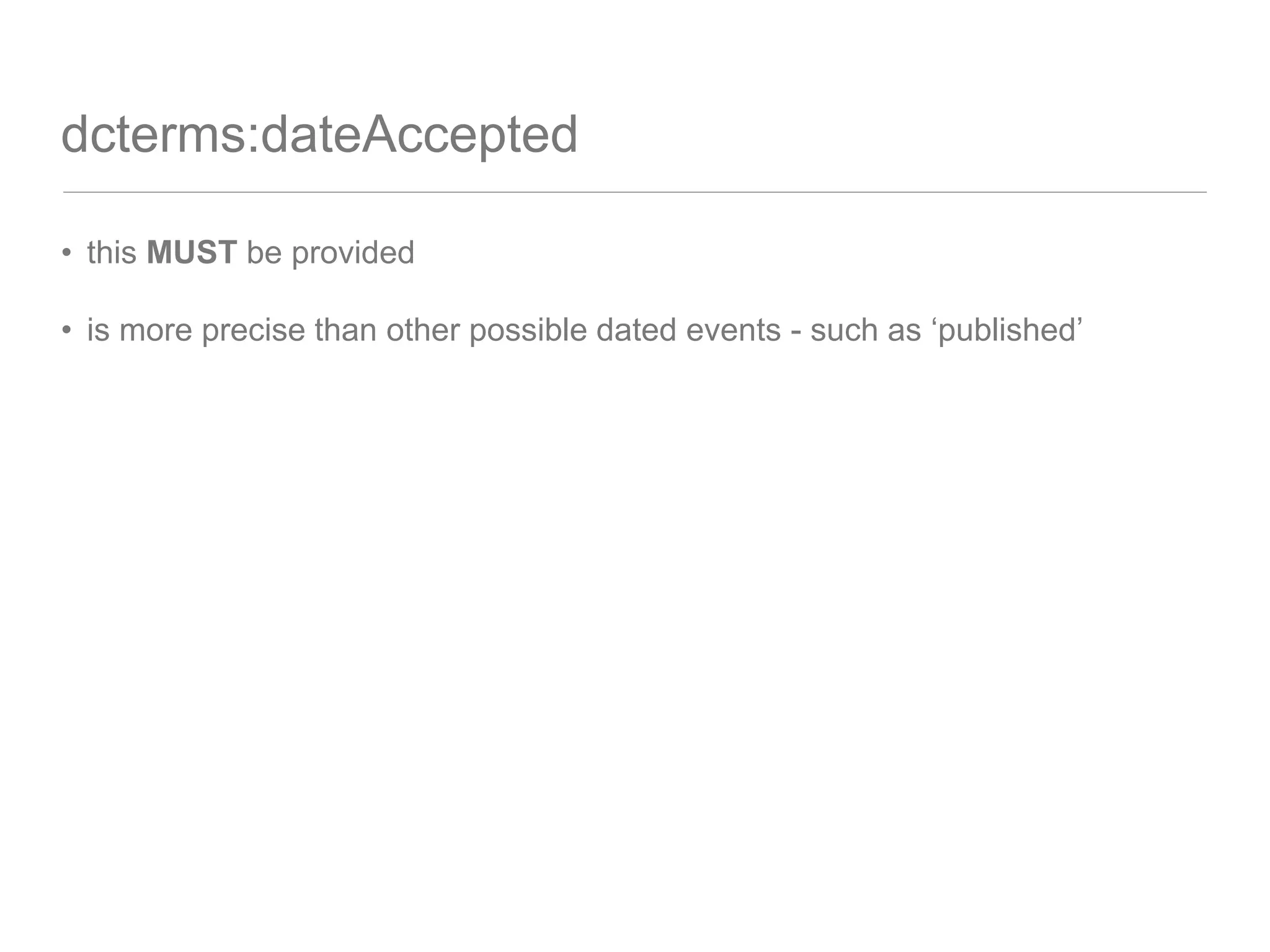
dcterms:dateAccepted
• this MUST be provided
• is more precise than other possible dated events - such as ‘published’
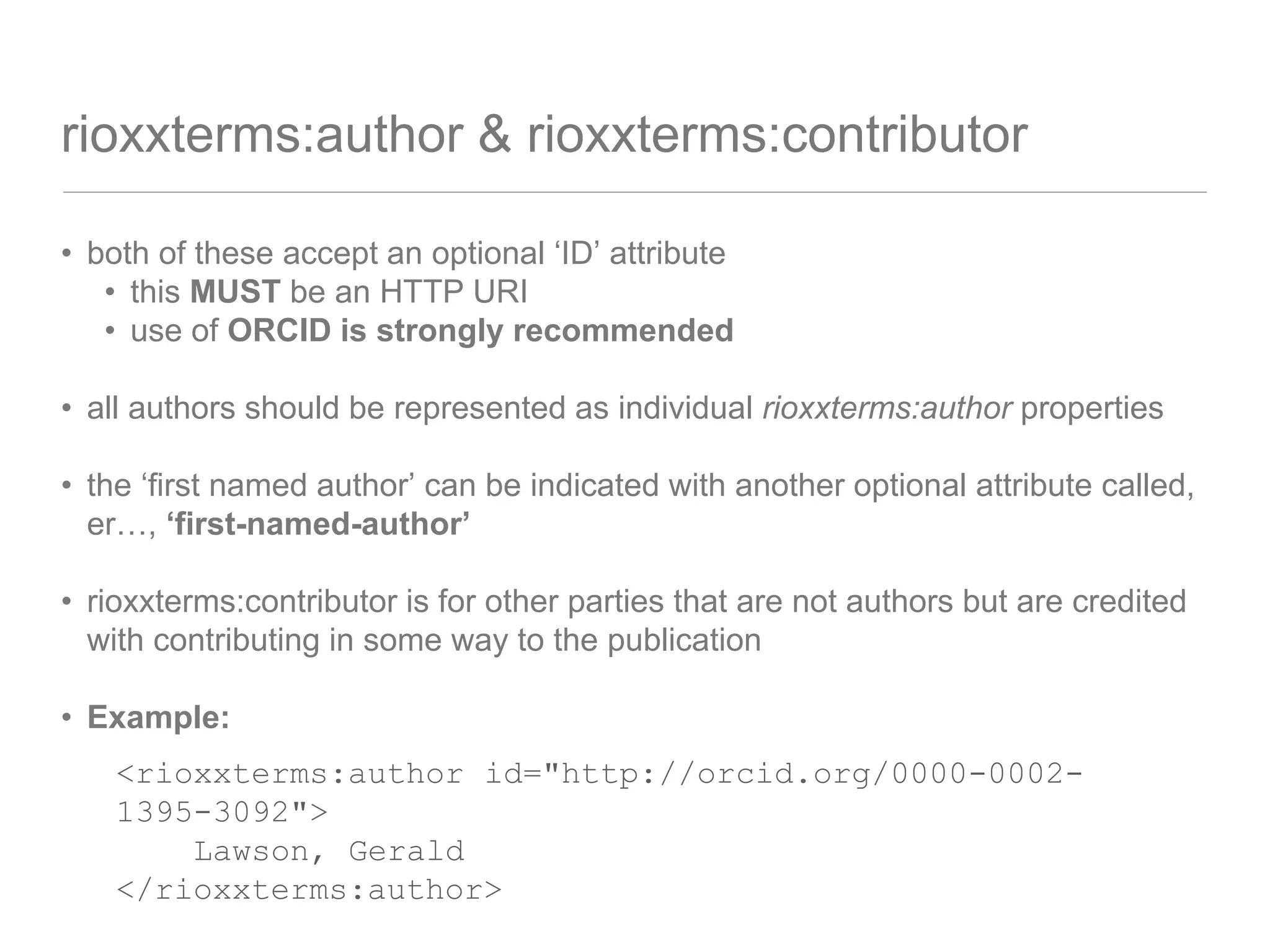
rioxxterms:author & rioxxterms:contributor
• both of these accept an optional ‘ID’ attribute
• this MUST be an HTTP URI
• use of ORCID is strongly recommended
• all authors should be represented as individual rioxxterms:author properties
• the ‘first named author’ can be indicated with another optional attribute called,
er…, ‘first-named-author’
• rioxxterms:contributor is for other parties that are not authors but are credited
with contributing in some way to the publication
• Example:
<rioxxterms:author id="http://orcid.org/0000-0002-
1395-3092">
Lawson, Gerald
</rioxxterms:author>
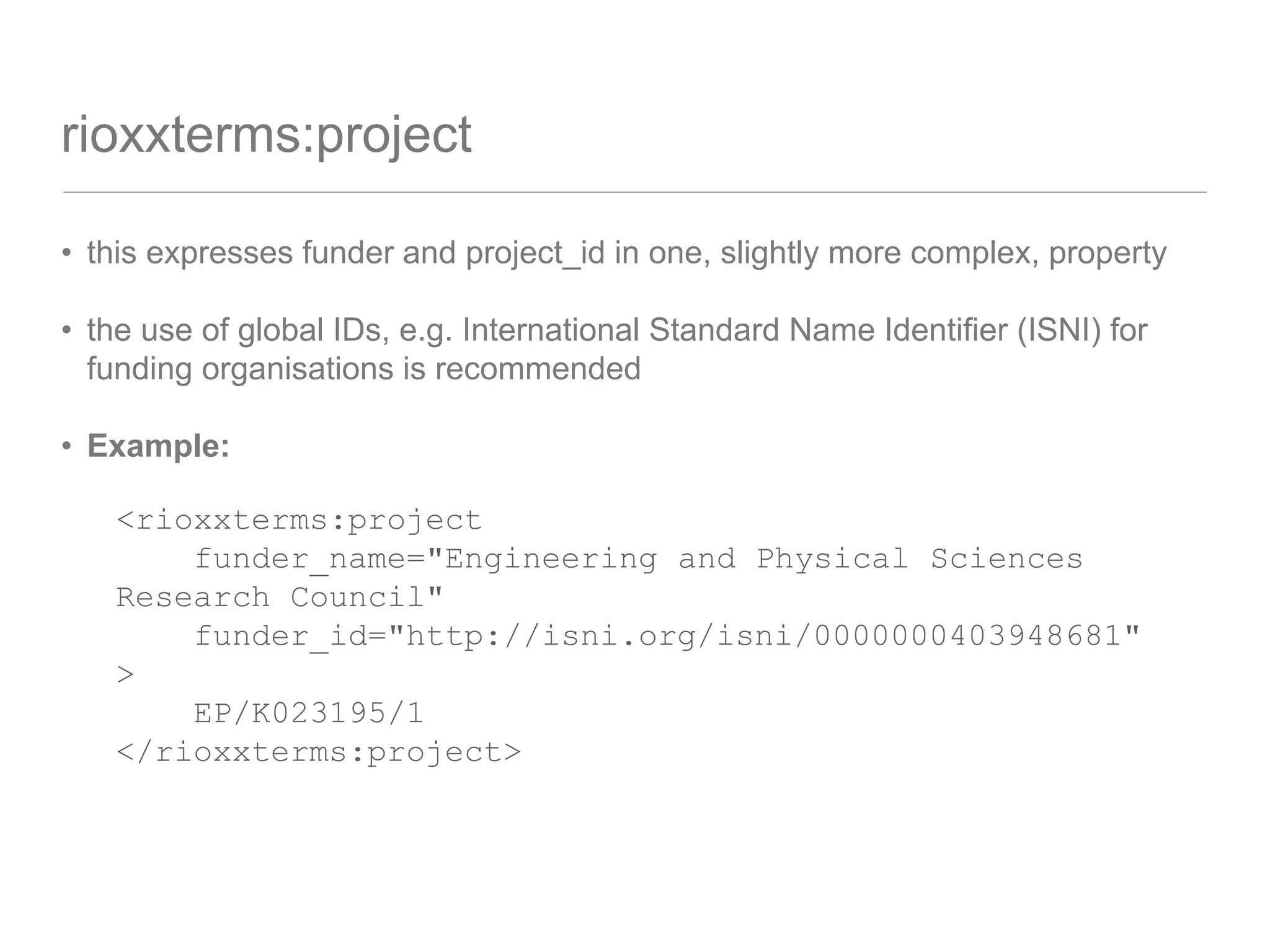
rioxxterms:project
• this expresses funder and project_id in one, slightly more complex, property
• the use of global IDs, e.g. International Standard Name Identifier (ISNI) for
funding organisations is recommended
• Example:
<rioxxterms:project
funder_name="Engineering and Physical Sciences
Research Council"
funder_id="http://isni.org/isni/0000000403948681"
>
EP/K023195/1
</rioxxterms:project>
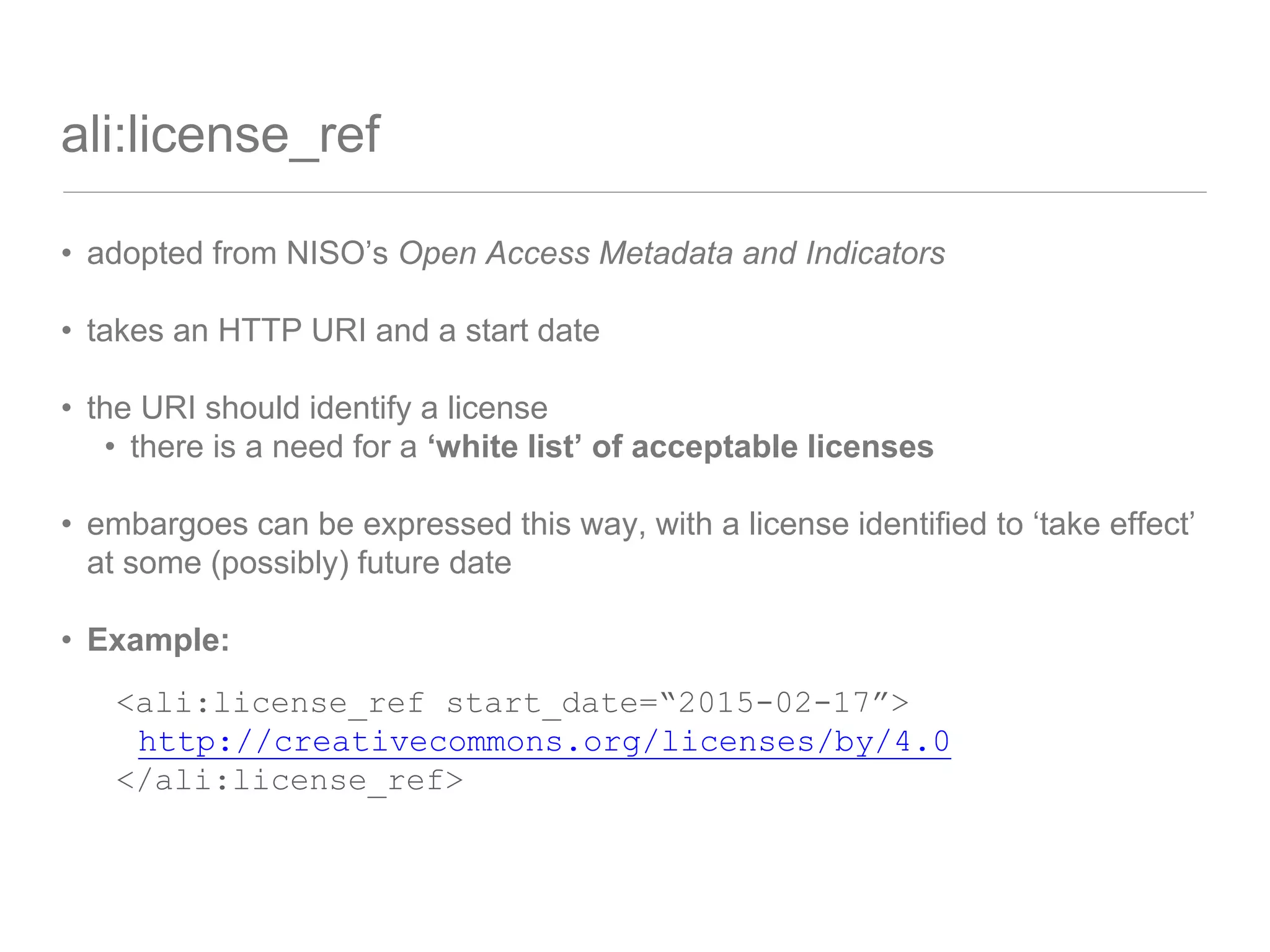
ali:license_ref
• adopted from NISO’s Open Access Metadata and Indicators
• takes an HTTP URI and a start date
• the URI should identify a license
• there is a need for a ‘white list’ of acceptable licenses
• embargoes can be expressed this way, with a license identified to ‘take effect’
at some (possibly) future date
• Example:
<ali:license_ref start_date=“2015-02-17”>
http://creativecommons.org/licenses/by/4.0
</ali:license_ref>
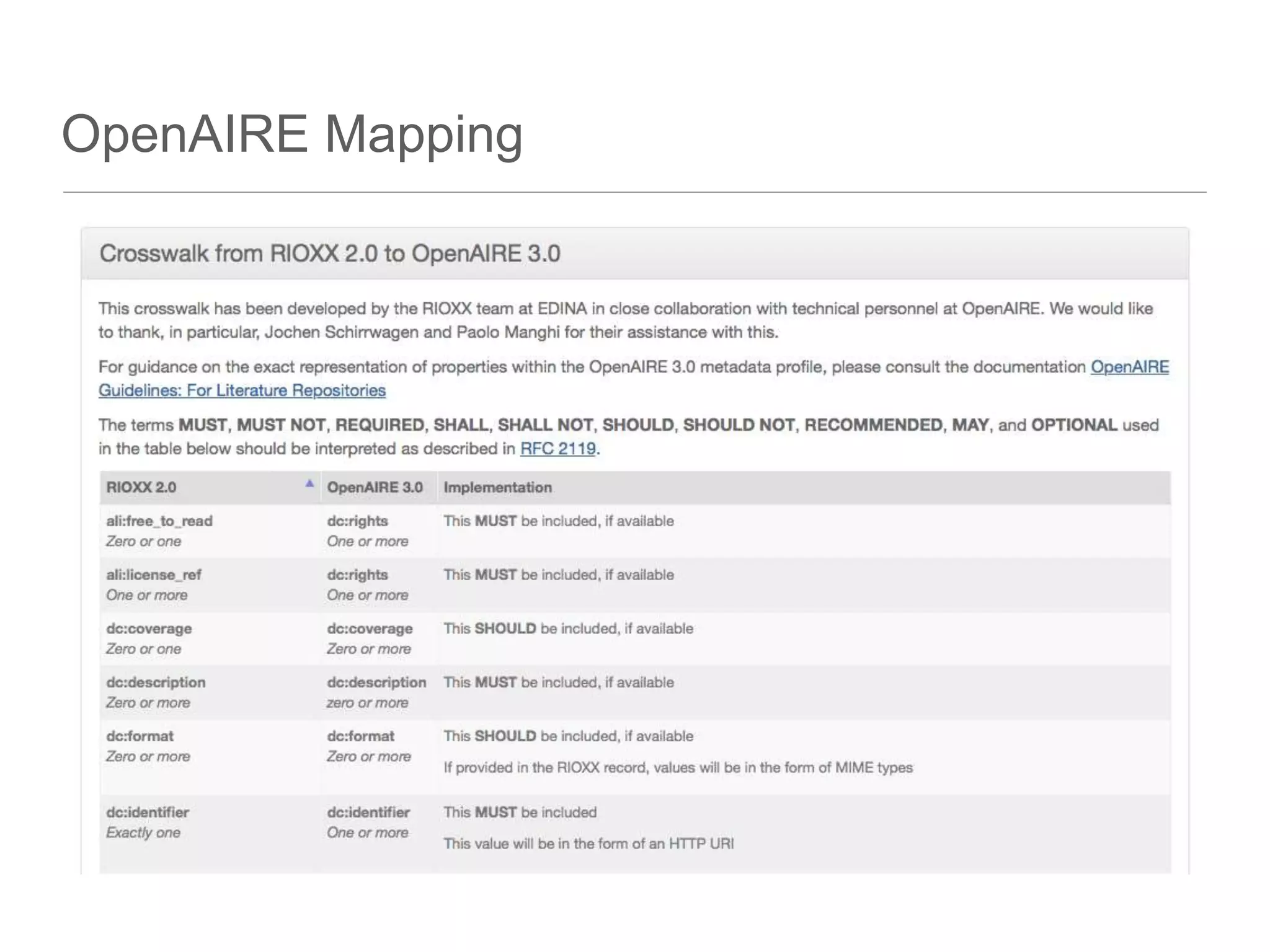
OpenAIRE Mapping
question:
how is RIOXX being
developed?
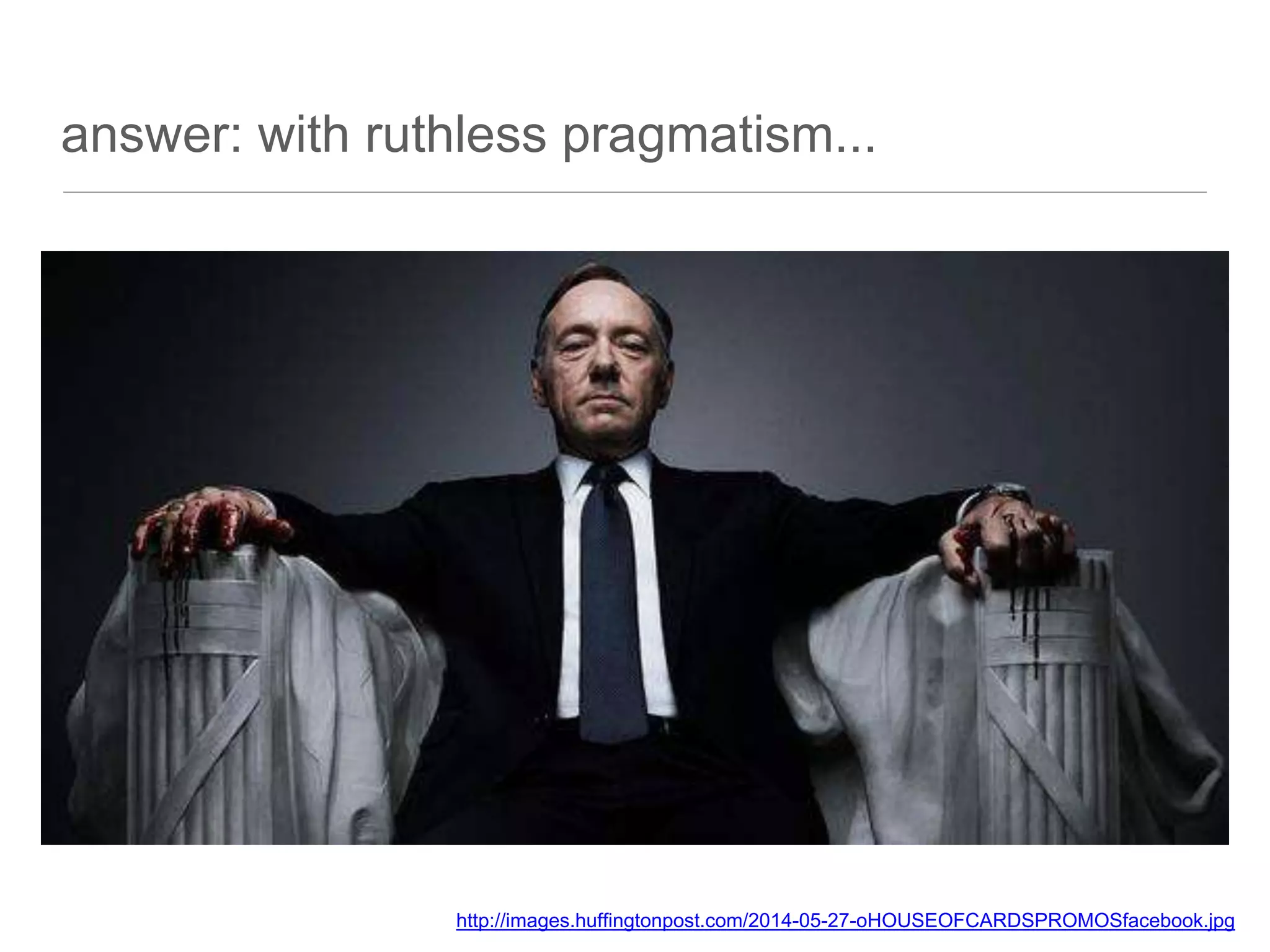
answer: with ruthless pragmatism...
http://images.huffingtonpost.com/2014-05-27-oHOUSEOFCARDSPROMOSfacebook.jpg
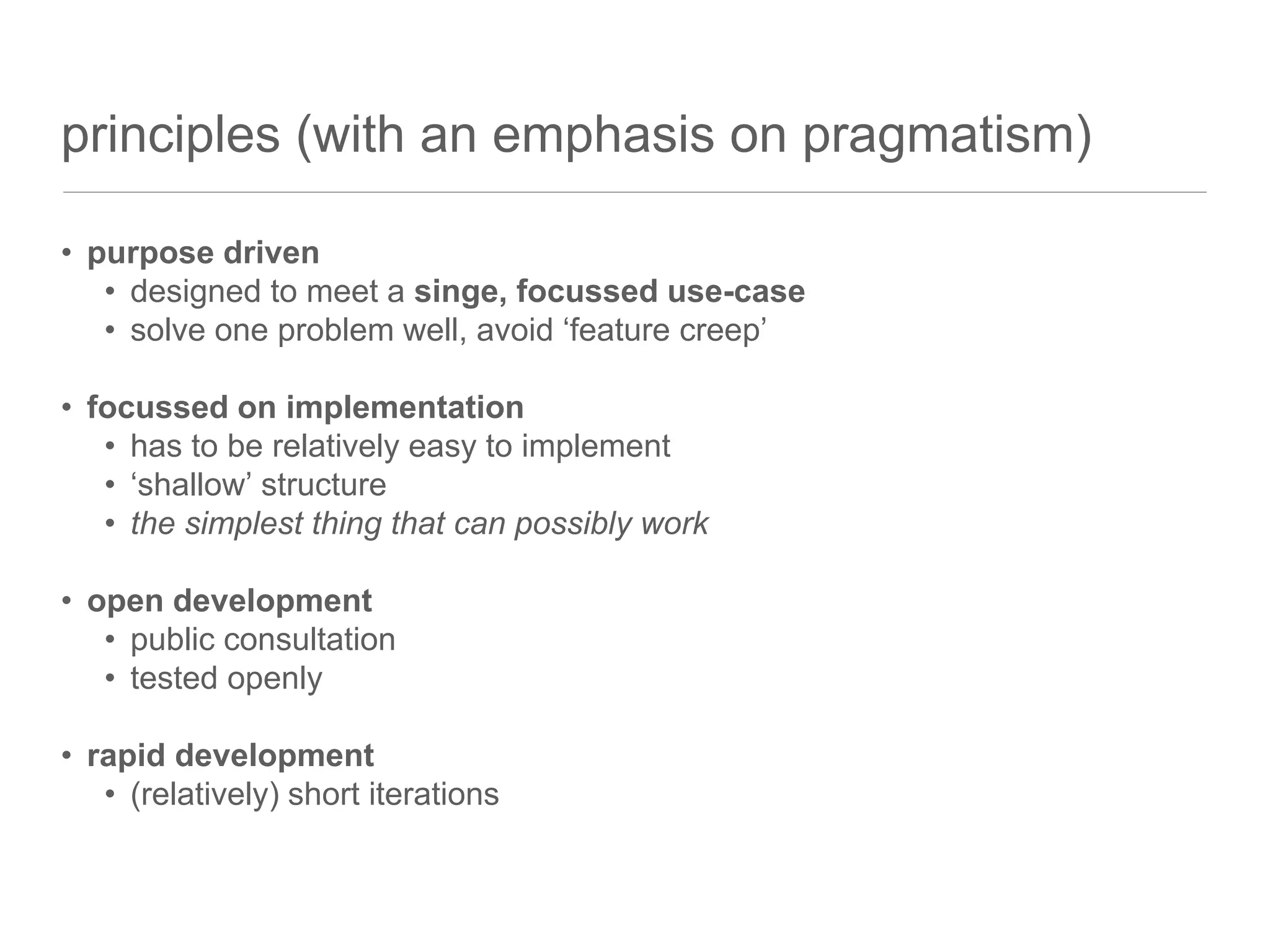
principles (with an emphasis on pragmatism)
• purpose driven
• designed to meet a singe, focussed use-case
• solve one problem well, avoid ‘feature creep’
• focussed on implementation
• has to be relatively easy to implement
• ‘shallow’ structure
• the simplest thing that can possibly work
• open development
• public consultation
• tested openly
• rapid development
• (relatively) short iterations
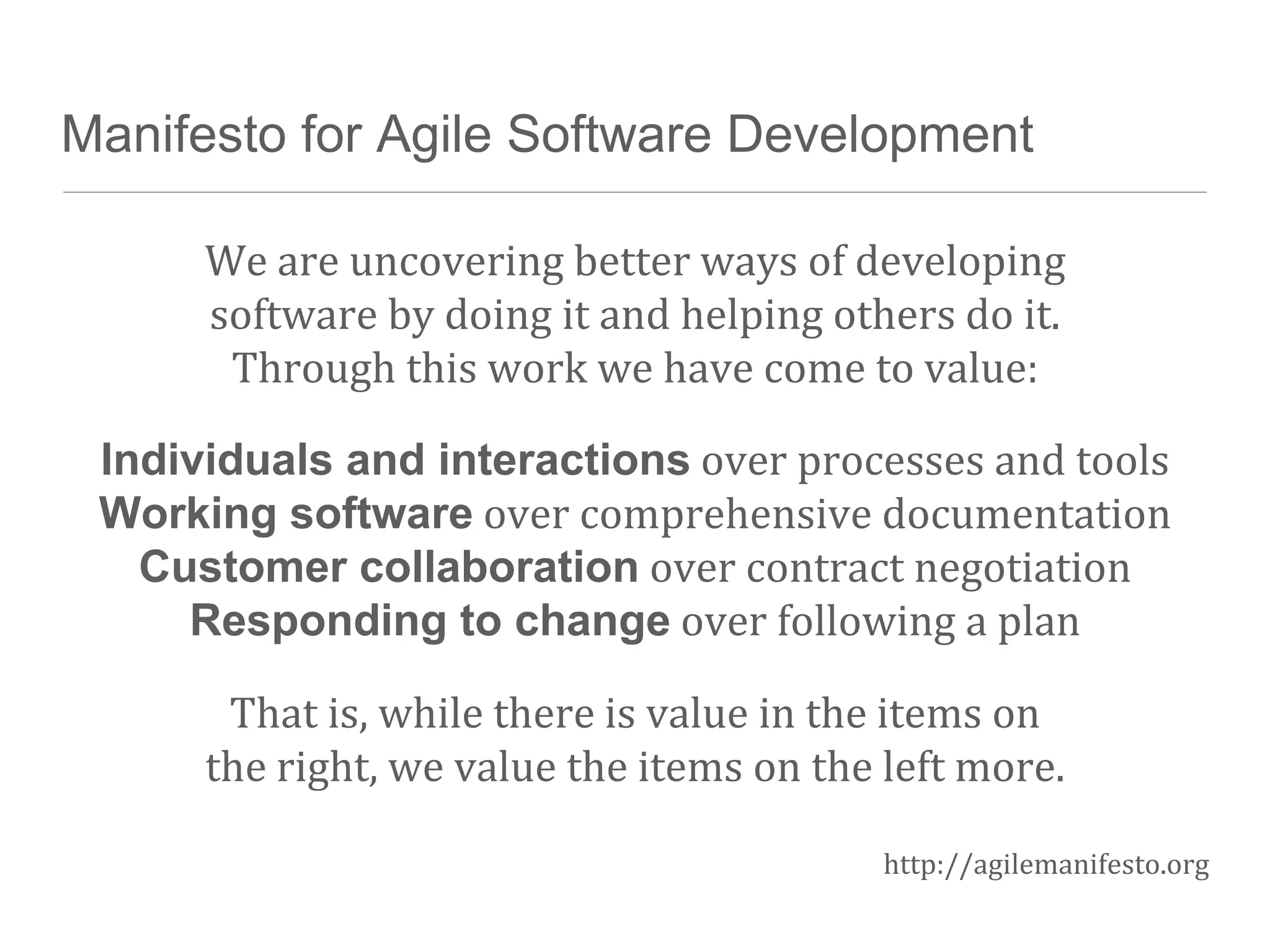
Manifesto for Agile Software Development
We are uncovering better ways of developing
software by doing it and helping others do it.
Through this work we have come to value:
Individuals and interactions over processes and tools
Working software over comprehensive documentation
Customer collaboration over contract negotiation
Responding to change over following a plan
That is, while there is value in the items on
the right, we value the items on the left more.
http://agilemanifesto.org
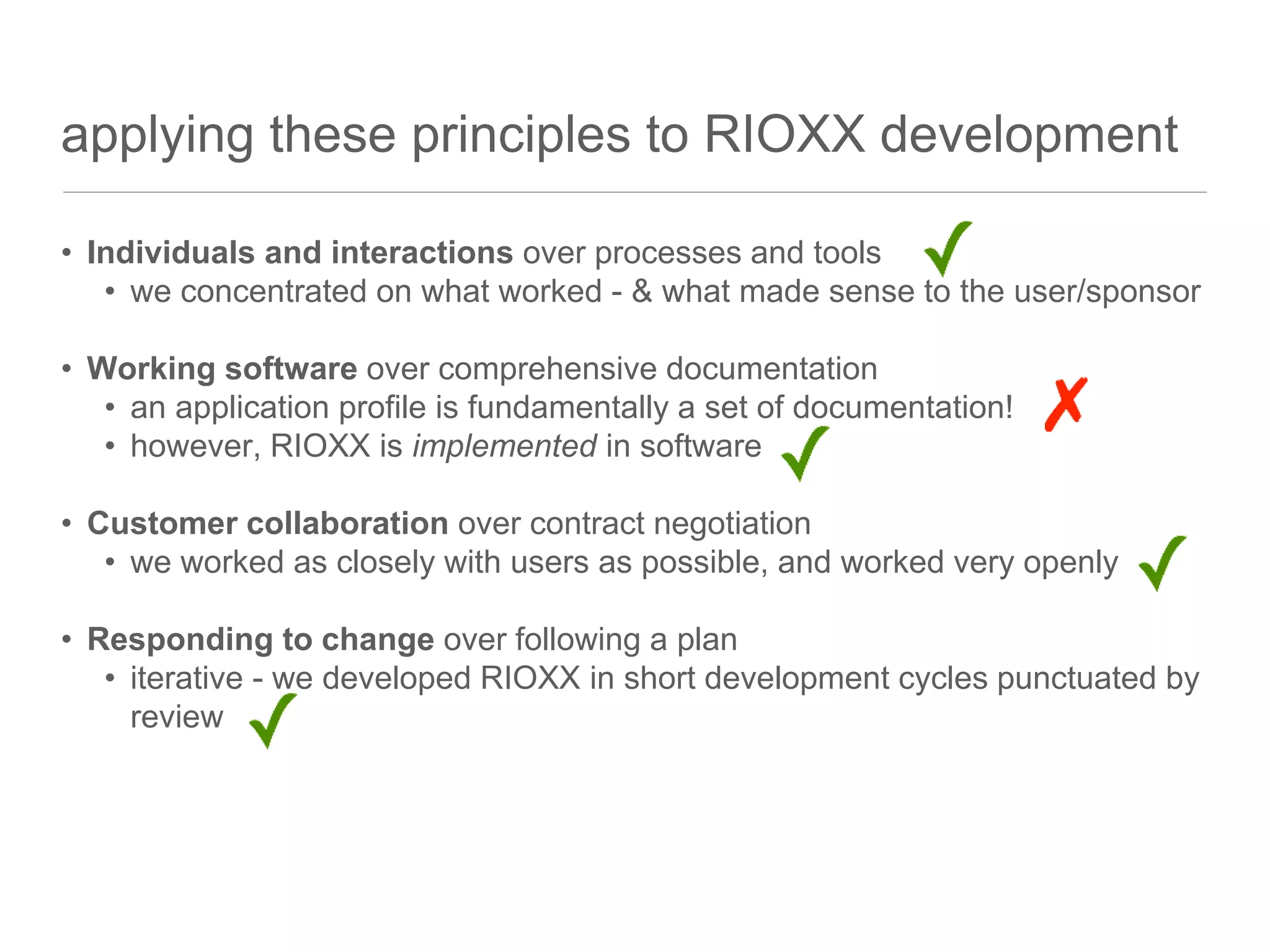
applying these principles to RIOXX development
• Individuals and interactions over processes and tools
• we concentrated on what worked - & what made sense to the user/sponsor
• Working software over comprehensive documentation
• an application profile is fundamentally a set of documentation!
• however, RIOXX is implemented in software
• Customer collaboration over contract negotiation
• we worked as closely with users as possible, and worked very openly
• Responding to change over following a plan
• iterative - we developed RIOXX in short development cycles punctuated by
review
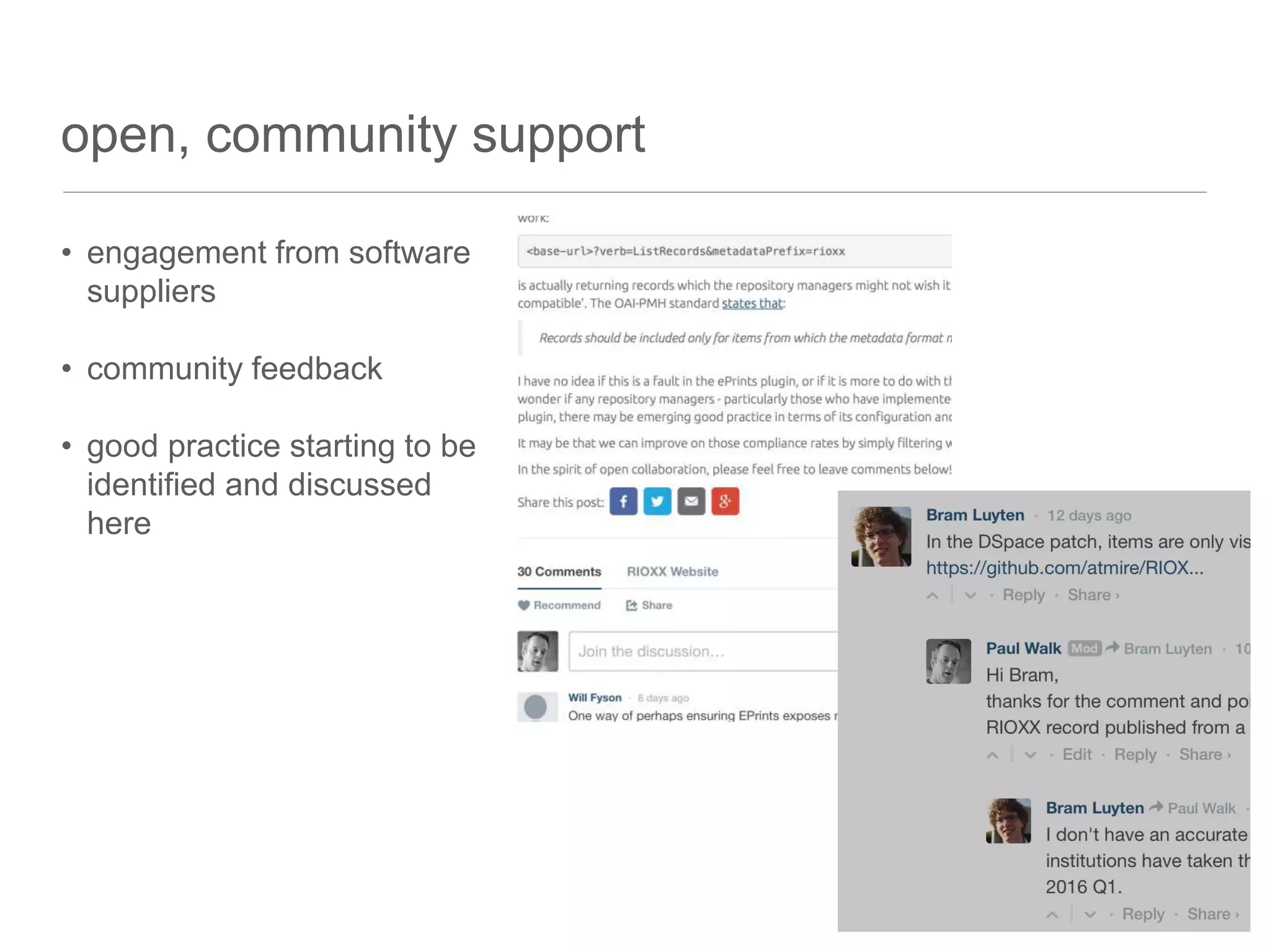
open, community support
• engagement from software
suppliers
• community feedback
• good practice starting to be
identified and discussed
here
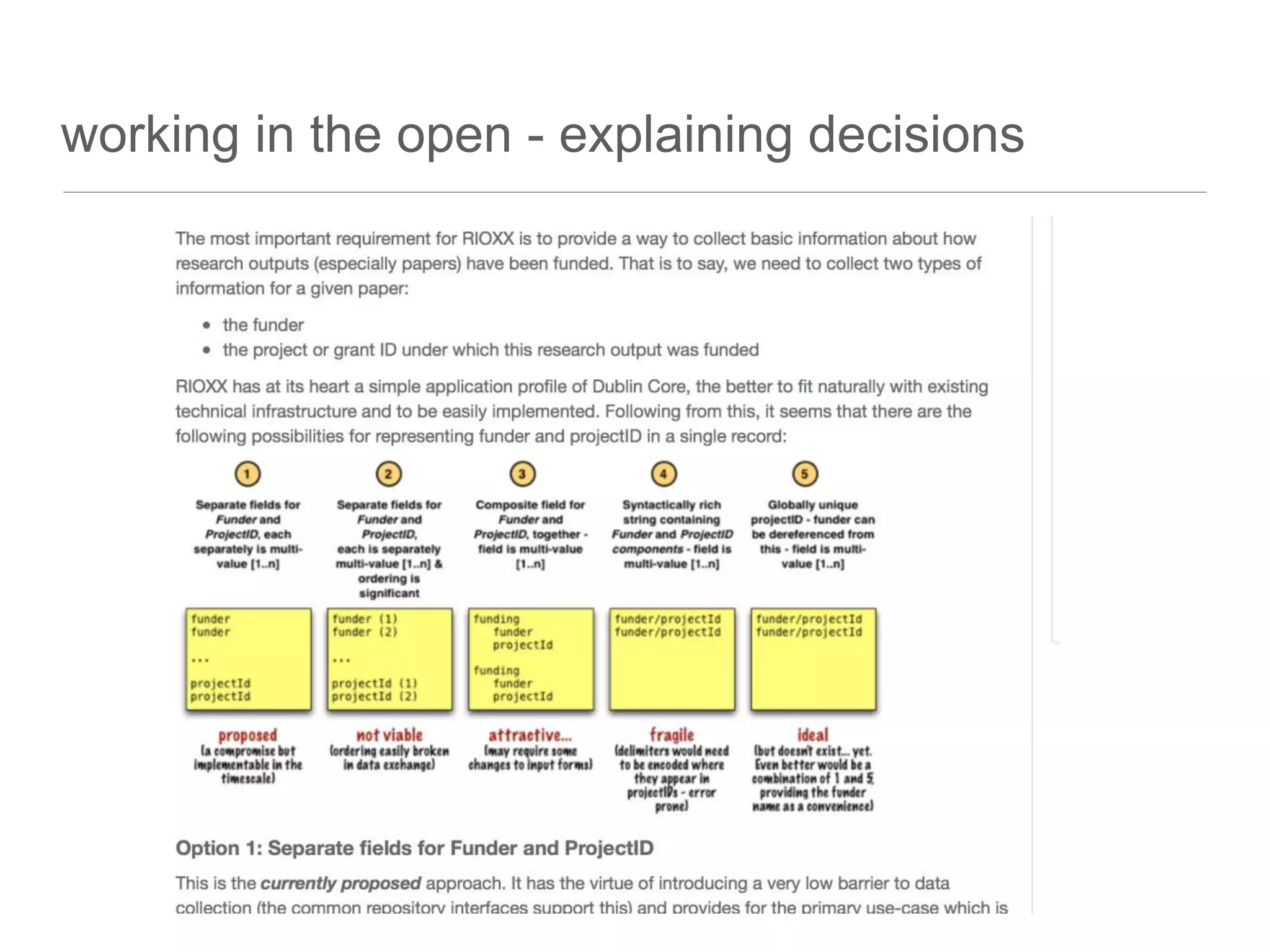
working in the open - explaining decisions
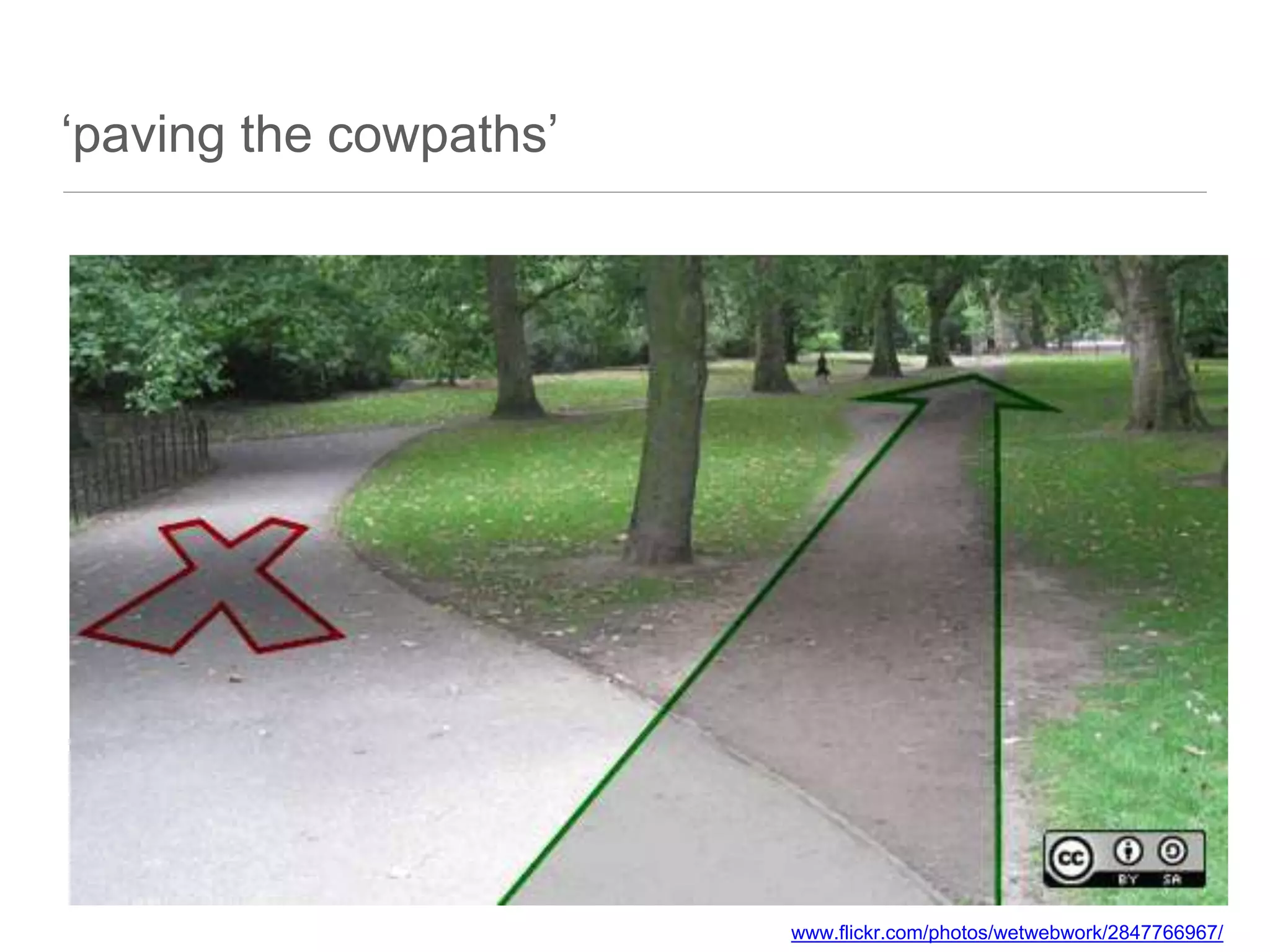
‘paving the cowpaths’
www.flickr.com/photos/wetwebwork/2847766967/
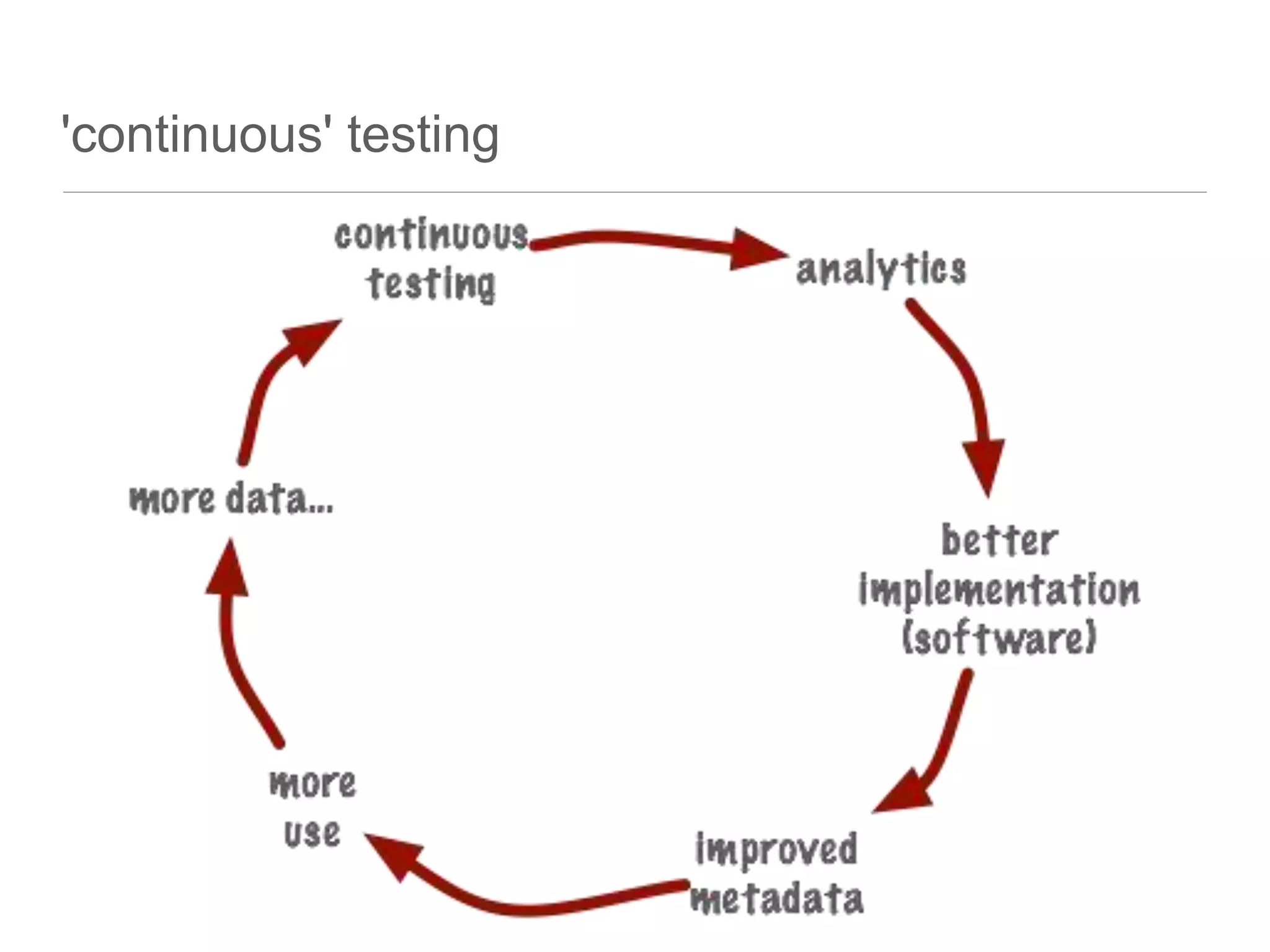
'continuous' testing
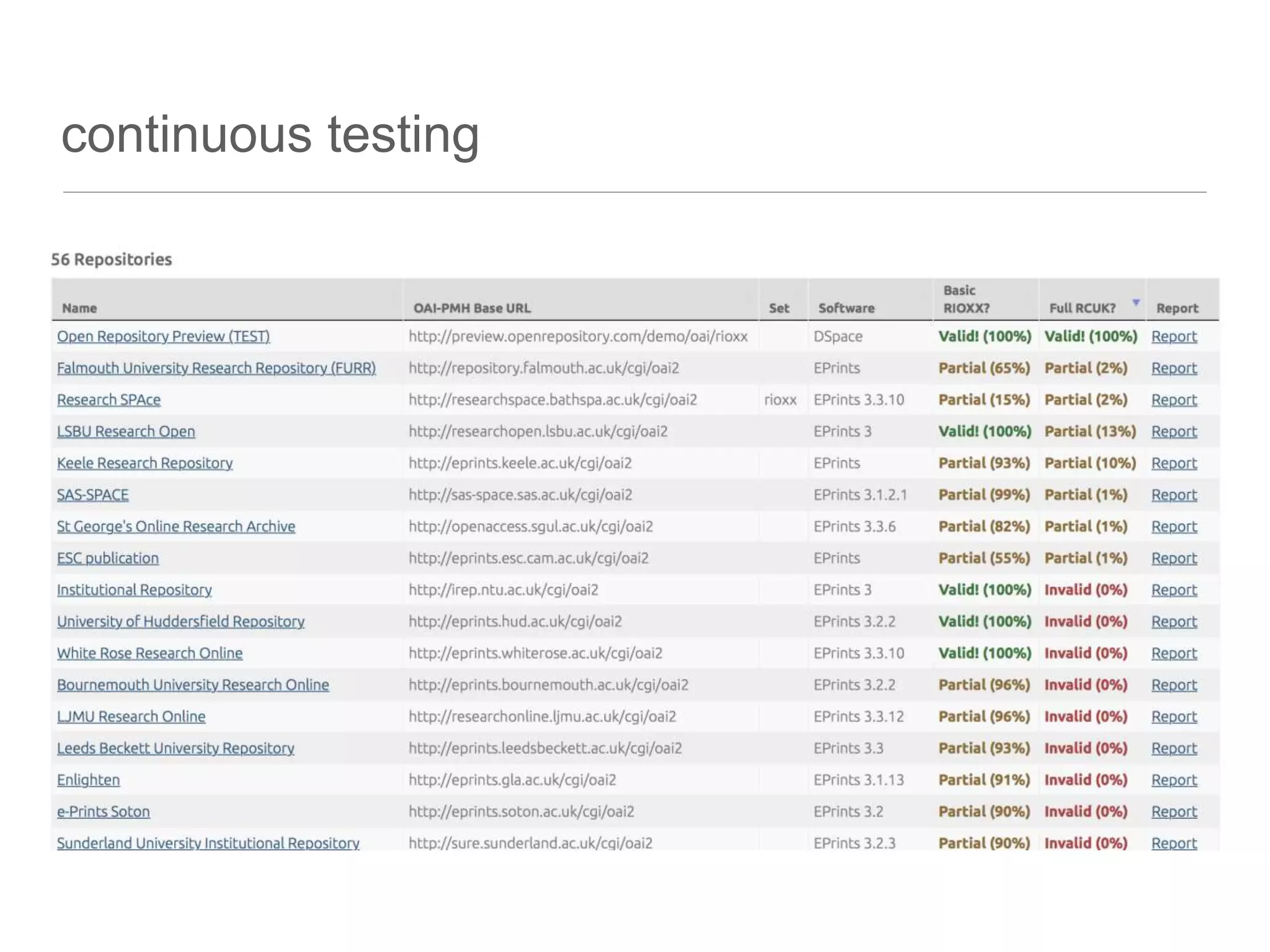
continuous testing
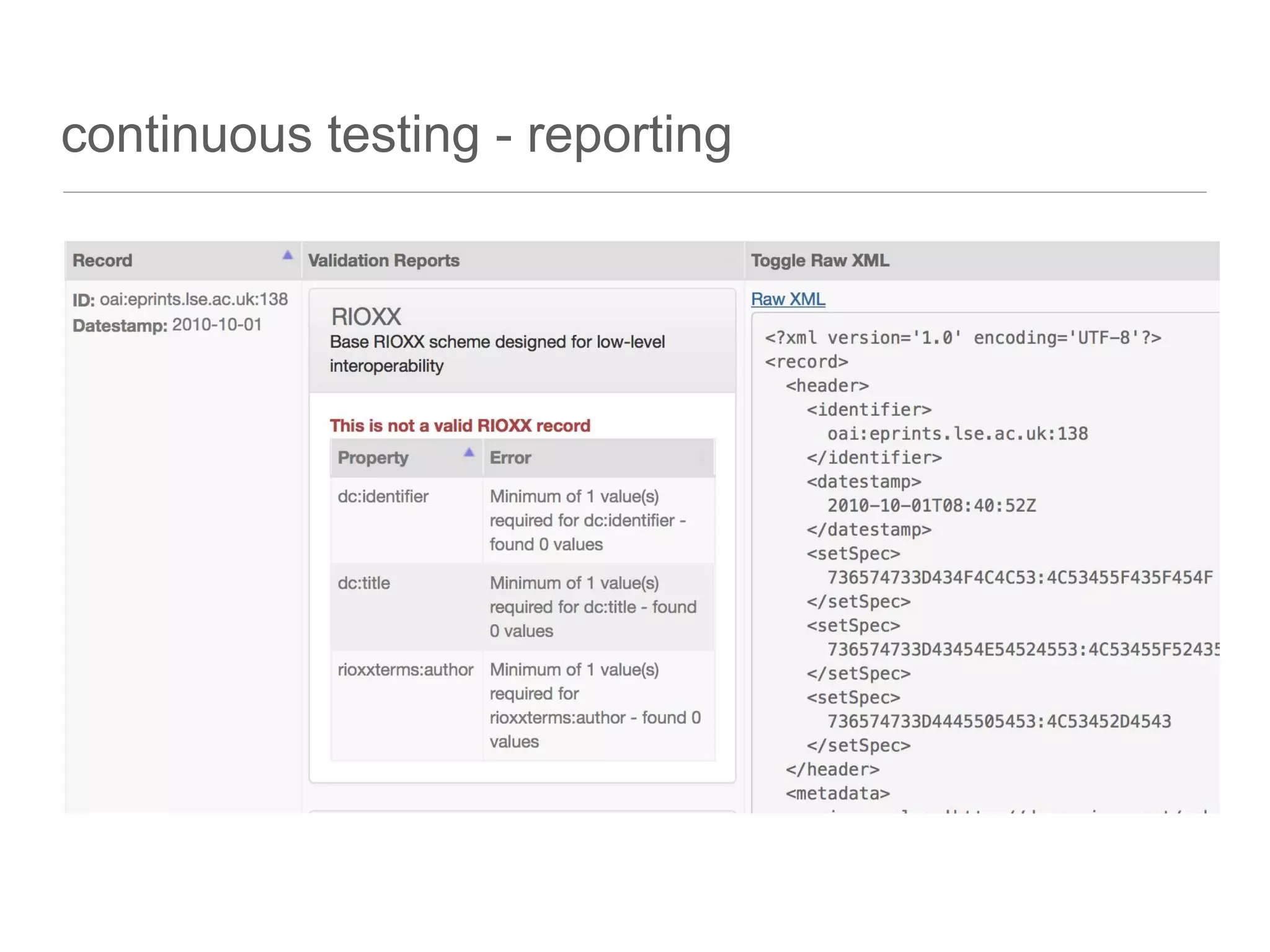
continuous testing - reporting
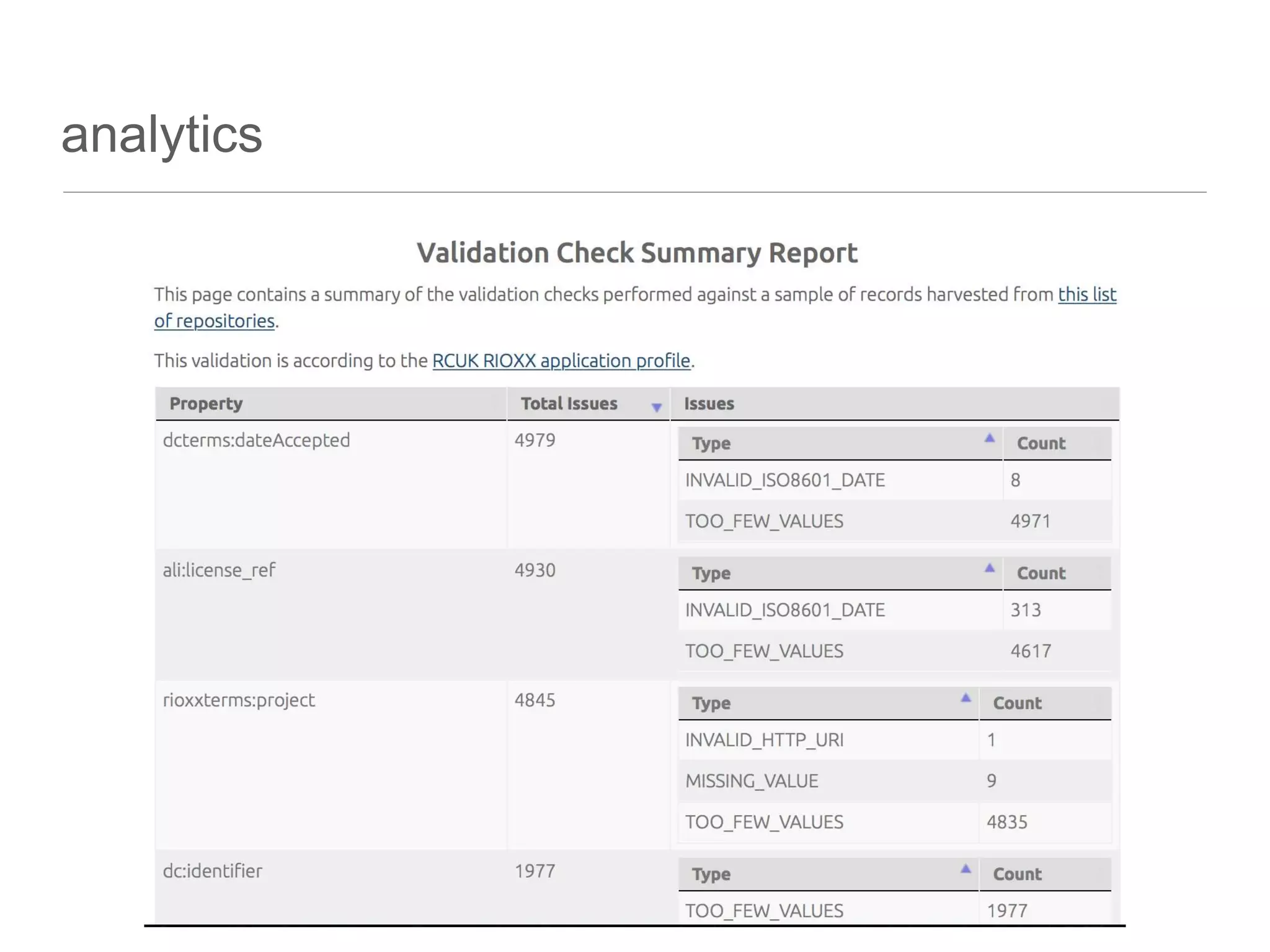
analytics
summary
• RIOXX has been created to help universities address open-access reporting
requirements from the UK Research & Funding Councils
• it has been developed using agile approaches and techniques borrowed from
software-developers
• it has been implemented in 56 known repositories since January 2015
• now also being harvested by CORE
• adoption of RIOXX is growing steadily :-)
Future development?
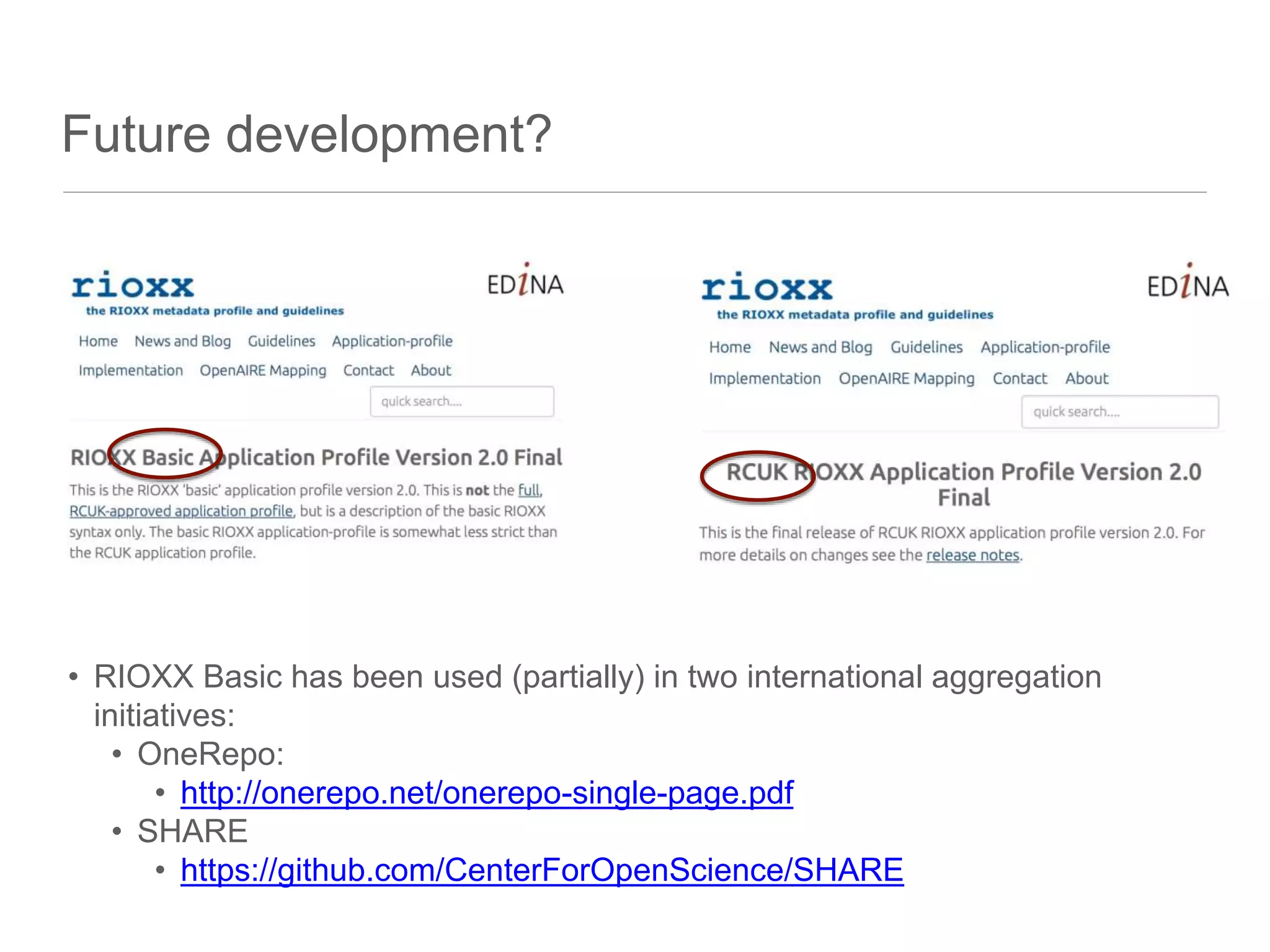
• RIOXX Basic has been used (partially) in two international aggregation
initiatives:
• OneRepo:
• http://onerepo.net/onerepo-single-page.pdf
• SHARE
• https://github.com/CenterForOpenScience/SHARE
Paul Walk
Head of Technology Strategy and Planning,
EDINA
p.walk@ed.ac.uk
@paulwalk
thanks for listening!
the RIOXX metadata application profile is maintained &
supported by EDINA:
http://www.rioxx.net

RIOXX: a Modern Metadata Application Profile

  • 1.
    Paul Walk Head ofTechnology Strategy and Planning, EDINA p.walk@ed.ac.uk @paulwalk RIOXX: a Modern Metadata Application Profile
  • 2.
  • 3.
    why build RIOXX? •new policies from RCUK and HEFCE mandate that any journal article funded by research grants be made publicly accessible in a repository • these policies require that universities make metadata about such papers easily discoverable • the available metadata formats were inadequate • OAI-DC was not rich enough • OpenAIRE was better but demanded project IDs be encoded in particular syntax not compatible with project IDs from UK Research Councils • OpenAIRE syntax • info:eu- repo/grantAgreement/Funder/FundingProgram/ProjectID/[Jurisdiction ]/[ProjectName]/[ProjectAcronym] • RCUK syntax: • OpaqueProjectID/version
  • 4.
    particular concerns • howto represent the funder • how to represent the project/grant • how to represent unambiguous licenses • how to represent the persistent identifier of the item described • provisions of identifier(s) pointing to related dataset(s) • how to represent the rights of use of the item described
  • 5.
    • an applicationprofile using properties from 4 namespaces: • 11 properties from Dublin Core (dc and dcterms) • 2 properties from NISO Open Access Metadata and Indicators • 8 from a new namespace - ‘rioxxterms’ • constraints imposed through several controlled vocabularies • it has one purpose: to provide a mechanism to help institutional repositories in the UK comply with the RCUK policy on open access. • it is not designed to provide general interoperability!! • Version 2.0 released in January 2015
  • 6.
    very rapid tourof some specific properties
  • 7.
    dc:identifier • identifies theopen access item being described by the RIOXX metadata record. • regardless of where it is located • recommended to identify the resource itself, not a ‘splash page’ • this will not always be possible or desirable • whatever it identifies, it MUST be an HTTP URI • Example: <dc:identifier> http://oro.open.ac.uk/2/1/LIBARTVICEprints.pdf </dc:identifier>
  • 8.
    dcterms:dateAccepted • this MUSTbe provided • is more precise than other possible dated events - such as ‘published’
  • 9.
    rioxxterms:author & rioxxterms:contributor •both of these accept an optional ‘ID’ attribute • this MUST be an HTTP URI • use of ORCID is strongly recommended • all authors should be represented as individual rioxxterms:author properties • the ‘first named author’ can be indicated with another optional attribute called, er…, ‘first-named-author’ • rioxxterms:contributor is for other parties that are not authors but are credited with contributing in some way to the publication • Example: <rioxxterms:author id="http://orcid.org/0000-0002- 1395-3092"> Lawson, Gerald </rioxxterms:author>
  • 10.
    rioxxterms:project • this expressesfunder and project_id in one, slightly more complex, property • the use of global IDs, e.g. International Standard Name Identifier (ISNI) for funding organisations is recommended • Example: <rioxxterms:project funder_name="Engineering and Physical Sciences Research Council" funder_id="http://isni.org/isni/0000000403948681" > EP/K023195/1 </rioxxterms:project>
  • 11.
    ali:license_ref • adopted fromNISO’s Open Access Metadata and Indicators • takes an HTTP URI and a start date • the URI should identify a license • there is a need for a ‘white list’ of acceptable licenses • embargoes can be expressed this way, with a license identified to ‘take effect’ at some (possibly) future date • Example: <ali:license_ref start_date=“2015-02-17”> http://creativecommons.org/licenses/by/4.0 </ali:license_ref>
  • 12.
  • 13.
    question: how is RIOXXbeing developed?
  • 14.
    answer: with ruthlesspragmatism... http://images.huffingtonpost.com/2014-05-27-oHOUSEOFCARDSPROMOSfacebook.jpg
  • 15.
    principles (with anemphasis on pragmatism) • purpose driven • designed to meet a singe, focussed use-case • solve one problem well, avoid ‘feature creep’ • focussed on implementation • has to be relatively easy to implement • ‘shallow’ structure • the simplest thing that can possibly work • open development • public consultation • tested openly • rapid development • (relatively) short iterations
  • 16.
    Manifesto for AgileSoftware Development We are uncovering better ways of developing software by doing it and helping others do it. Through this work we have come to value: Individuals and interactions over processes and tools Working software over comprehensive documentation Customer collaboration over contract negotiation Responding to change over following a plan That is, while there is value in the items on the right, we value the items on the left more. http://agilemanifesto.org
  • 17.
    applying these principlesto RIOXX development • Individuals and interactions over processes and tools • we concentrated on what worked - & what made sense to the user/sponsor • Working software over comprehensive documentation • an application profile is fundamentally a set of documentation! • however, RIOXX is implemented in software • Customer collaboration over contract negotiation • we worked as closely with users as possible, and worked very openly • Responding to change over following a plan • iterative - we developed RIOXX in short development cycles punctuated by review
  • 18.
    open, community support •engagement from software suppliers • community feedback • good practice starting to be identified and discussed here
  • 19.
    working in theopen - explaining decisions
  • 20.
  • 21.
  • 22.
  • 23.
  • 24.
  • 25.
    summary • RIOXX hasbeen created to help universities address open-access reporting requirements from the UK Research & Funding Councils • it has been developed using agile approaches and techniques borrowed from software-developers • it has been implemented in 56 known repositories since January 2015 • now also being harvested by CORE • adoption of RIOXX is growing steadily :-)
  • 26.
    Future development? • RIOXXBasic has been used (partially) in two international aggregation initiatives: • OneRepo: • http://onerepo.net/onerepo-single-page.pdf • SHARE • https://github.com/CenterForOpenScience/SHARE
  • 27.
    Paul Walk Head ofTechnology Strategy and Planning, EDINA p.walk@ed.ac.uk @paulwalk thanks for listening! the RIOXX metadata application profile is maintained & supported by EDINA: http://www.rioxx.net

Editor's Notes

  • #2 I'm going to talk about RIOXX, and more particularly the approach we have taken to developing it
  • #4 open access policies in UK relating to public-grant funded research
  • #6 RIOXX addresses these concerns these are the organisations which have been involved in its development
  • #7 very rapid!
  • #8 the decision to require an HTTP URI gives us two advantages: we don’t need to specify the schema beyond this requirement - we can identify the schema from the URI - e.g. DOI
  • #9 acceptance date represents a more clearly identifiable ‘business event’
  • #10 encouraging the use of globally unique identifiers such as ORCID and ISNI
  • #11 links the publication to a project, and therefore to a funder encouraging the use of globally unique identifiers such as ISNI
  • #12 unambiguous licensing is the goal with the start date property, this gives us a strategy to indicate embargoes
  • #13 working closely with the OpenAIRE team, we have provided a mapping between RIOXX 2.0 and OpenAIRE 3.0 thanks to Jochen and Paolo from OpenAIRE!
  • #14 now to talk about the more interesting part....
  • #15 Who is that? Frank Underwood. We have resisted anything that gets in the way of our primary (and only!) use case. However....
  • #16 implementation is key. Previous efforts in this space have not been implemented...
  • #17 ‘Agile’ has become an overloaded term, but it’s important to remember that it started somewhere with some principles: Agile Manifesto couches itself in a series of ‘preferences’ - the phrases in bold towards the left worth noting this is now 14 years old!
  • #18 be Agile. Agile development is not a good fit necessarily for standards development, but it has something to offer the development of application profiles, especially if they are very focussed and tightly coupled to a specific problem
  • #19 30 comments! A mailing list tends to attract a community - and communities can be exclusive. RIOXX does not have a community as such - it has been developed with the collaboration of people with vested interests and comments to make
  • #20 an important aspect of working openly is explaining the rationale behind decisions - here we described all the options for the representation of a particular property, and explained why we chose the one we did. This allows us to get real engagement with users as well as developers
  • #21 If users have already started to go in a certain direction, recognise this and adapt accordingly. Implementation - 'running code' is really important.
  • #22 extremely important should be mechanistic, or semi-automated, wherever possible, so that it actually gets done! should deliver immediate and useful feedback not just the usual XML schema validation - this is often important, but it is not enough
  • #23 this is testing sample data from all known RIOXX implementations on a regular basis - and it’s completely automated doing this openly on the web creates incentives for people to fix things!!
  • #24 a detailed report is generated for each of the systems tested this shows both the system developers and the end-users exactly which aspects of the AP have been invalidated even shows them the raw metadata where these issues have occurred
  • #25 can be used to inform future development of the profile as well as the application profile itself.
  • #26 almost all implementations are ePrints systems so far - expecting DSpace repos using a patch developed by Atmire to come on stream soon
  • #27 experimenting with 2 flavours of RIOXX - a relaxed basic (non RCUK) version for more general use more general cases, such as describing research data sets? international aggregations