Genodermatosis
Neurofibromatosis
 relatively common, 1 in 3000
 Autosomal dominant
 There are two main types:
1. Von Recklinghausen’s
neurofibromatosis (NF1; 85% of all
cases)
2. Bilateral acoustic neurofibromatosis
(NF2)
NF1
Cause
 Mutation of NF1 gene, localized to
chromosome 17q11.1.
 The NF1 gene is a tumour suppressor gene,
the product of which, neurofibromin, interacts
with the product of the RAS proto-oncogene.
This may explain the susceptibility of NF1
patients to a variety of tumours.
 Inheritence as autosomal dominant trait
 about half of index cases have no preceding
family history.
Clinical features
 The physical signs include the following.
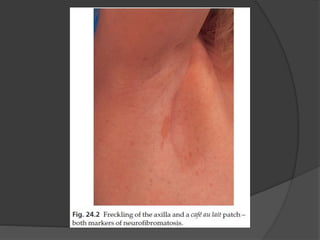
1. Café au lait patches
 Six or more (light brown oval macules, usually developing in the first
year of life.
2. Axillary freckling
 in two-thirds of affected individuals (Crowe’s sign).
3. Neurofibromas
 Any number
 some small and superficial, others larger and deeper
 Most are dome-like nodules, but others are irregular raised plaques.
Some are firm, some soft and compressible through a deficient dermis
(‘button-hole’ sign); others feel ‘knotty’ or ‘wormy’.
 may not appear until puberty and become larger and more numerous
with age.
4. Lisch nodules
 Small circular pigmented hamartomas of the iris, appear in early
childhood.
Clinical features, cont.
 Nearly all NF1 patients meet the criteria
for diagnosis by the age of 8 years, and
all do so by 20 years.
 The usual order of appearance of the
clinical features is:
1. café au lait macules
2. axillary freckling
3. Lisch nodules
4. neurofibromas.
Clinical features, cont.
 A segmental form of NF1 is caused by a
post-zygotic mutation.
 Isolated neurofibromas are not
uncommon in individuals without
neurofibromatosis and are of little
consequence unless they are painful.
Complications
1. A neurofibroma will occasionally change
into a neurofibrosarcoma
2. Kyphoscoliosis
3. Learning impairment
4. Epilepsy
5. Renal artery stenosis
6. an association with
phaeochromocytoma
Management
 Ugly or painful lesions, and any
suspected of undergoing malignant
change, should be removed.
 The chance of a child of an affected
adult developing the disorder is 1 in 2
 blood pressure checked regularly.
Tuberous sclerosis
 uncommon condition, with a prevalence
about 1 in 12000 in children under 10
years
 autosomal dominant trait
 Fertility is reduced, so transmission
through more than two generations is
rare.
Cause
 Inactivating mutations at two different
loci can, independently, cause clinically
identical tuberous sclerosis.
 Both genes are tumour suppressors.
1. (TSC1 on chromosome 9q34)
2. (TSC2 on 16p13.3)
 TSC2 gene mutations are responsible
for 80–90% of cases.
Clinical features
 The skin changes include the following.
1. Ash leaf macules
 Small oval white patches
 occur in 80% of those affected
 may be the only manifestation at birth.
2. Angiofibromas (known as adenoma
sebaceum)
 occur in 85% of those affected
 develop at puberty as pink or yellowish
acne-like papules on the face, often around
the nose.
Clinical features, cont.
3. Periungual fibromas
 occur in 50% of patients
 develop in adult life as small pink sausage-
like lesions emerging from the nail folds.
4. Connective tissue naevi (‘shagreen
patches’)
 Are seen in 40% of patients.
 Cobblestone, somewhat yellow plaques
often arise in the skin over the base of the
spine.
Other features
may include:
1. Epilepsy (in 75% of patients)
2. Mental retardation (in 50% of patients)
3. Ocular signs, including retinal phakomas
and pigmentary abnormalities (in 50% of
patients)
4. Hyperplastic gums
5. gliomas along the lateral walls of the
lateral ventricles (80% of cases) and
calcification of the basal ganglia
6. Renal and heart tumours.
Diagnosis and differential
diagnosis
 Any baby with unexplained epilepsy
should be examined with a Wood’s light
to look for ash leaf macules.
 Skull X-rays and computed tomography
scans of CNS and kidneys.
 The lesions of adenoma sebaceum (a
misnomer, as histologically they are
angiofibromas) may be mistaken for
acne.
Management
 Genetic counselling
 Facial angiofibromas may improve
cosmetically after electrodessication,
dermabrasion or destruction by laser but
tend to recur
Xeroderma pigmentosum
 heterogeneous group of autosomal
recessive disorders, characterized by
the defective repair of DNA after its
damage by ultraviolet radiation.
 rare, affecting about 5 per million in
Europe.
Clinical features, cont.
 There are many variants but all follow the
same pattern.
1. The skin is normal at birth.
2. Multiple freckles, roughness and keratoses
on exposed skin appear between the ages
of 6 months and 2 years
3. Photosensitivity increases thereafter.
4. The atrophic facial skin shows
telangiectases and small angiomas.
Clinical features, cont.
5. Many tumours develop on light-damaged
skin: BCC, SCC, MM
 Many patients die before the age of 20
years.
6. Eye problems are common and include
photophobia, conjunctivitis and ectropion.
7. The condition may be associated with
microcephaly, mental deficiency, dwarfism,
deafness and ataxia (De Sanctis–
Cacchione syndrome).
Treatment
 Strict avoidance of sunlight, the use of
protective clothing, widebrimmed hats
and of reflectant sunscreens and dark
glasses.
 If possible, patients should not go out by
day.
 Early and complete removal of all
tumours is essential.
 Radiotherapy should be avoided
Genodermatosis

Genodermatosis

  • 1.
  • 2.
    Neurofibromatosis  relatively common,1 in 3000  Autosomal dominant  There are two main types: 1. Von Recklinghausen’s neurofibromatosis (NF1; 85% of all cases) 2. Bilateral acoustic neurofibromatosis (NF2)
  • 3.
    NF1 Cause  Mutation ofNF1 gene, localized to chromosome 17q11.1.  The NF1 gene is a tumour suppressor gene, the product of which, neurofibromin, interacts with the product of the RAS proto-oncogene. This may explain the susceptibility of NF1 patients to a variety of tumours.  Inheritence as autosomal dominant trait  about half of index cases have no preceding family history.
  • 4.
    Clinical features  Thephysical signs include the following. 1. Café au lait patches  Six or more (light brown oval macules, usually developing in the first year of life. 2. Axillary freckling  in two-thirds of affected individuals (Crowe’s sign). 3. Neurofibromas  Any number  some small and superficial, others larger and deeper  Most are dome-like nodules, but others are irregular raised plaques. Some are firm, some soft and compressible through a deficient dermis (‘button-hole’ sign); others feel ‘knotty’ or ‘wormy’.  may not appear until puberty and become larger and more numerous with age. 4. Lisch nodules  Small circular pigmented hamartomas of the iris, appear in early childhood.
  • 8.
    Clinical features, cont. Nearly all NF1 patients meet the criteria for diagnosis by the age of 8 years, and all do so by 20 years.  The usual order of appearance of the clinical features is: 1. café au lait macules 2. axillary freckling 3. Lisch nodules 4. neurofibromas.
  • 9.
    Clinical features, cont. A segmental form of NF1 is caused by a post-zygotic mutation.  Isolated neurofibromas are not uncommon in individuals without neurofibromatosis and are of little consequence unless they are painful.
  • 10.
    Complications 1. A neurofibromawill occasionally change into a neurofibrosarcoma 2. Kyphoscoliosis 3. Learning impairment 4. Epilepsy 5. Renal artery stenosis 6. an association with phaeochromocytoma
  • 11.
    Management  Ugly orpainful lesions, and any suspected of undergoing malignant change, should be removed.  The chance of a child of an affected adult developing the disorder is 1 in 2  blood pressure checked regularly.
  • 12.
    Tuberous sclerosis  uncommoncondition, with a prevalence about 1 in 12000 in children under 10 years  autosomal dominant trait  Fertility is reduced, so transmission through more than two generations is rare.
  • 13.
    Cause  Inactivating mutationsat two different loci can, independently, cause clinically identical tuberous sclerosis.  Both genes are tumour suppressors. 1. (TSC1 on chromosome 9q34) 2. (TSC2 on 16p13.3)  TSC2 gene mutations are responsible for 80–90% of cases.
  • 14.
    Clinical features  Theskin changes include the following. 1. Ash leaf macules  Small oval white patches  occur in 80% of those affected  may be the only manifestation at birth. 2. Angiofibromas (known as adenoma sebaceum)  occur in 85% of those affected  develop at puberty as pink or yellowish acne-like papules on the face, often around the nose.
  • 16.
    Clinical features, cont. 3.Periungual fibromas  occur in 50% of patients  develop in adult life as small pink sausage- like lesions emerging from the nail folds. 4. Connective tissue naevi (‘shagreen patches’)  Are seen in 40% of patients.  Cobblestone, somewhat yellow plaques often arise in the skin over the base of the spine.
  • 18.
    Other features may include: 1.Epilepsy (in 75% of patients) 2. Mental retardation (in 50% of patients) 3. Ocular signs, including retinal phakomas and pigmentary abnormalities (in 50% of patients) 4. Hyperplastic gums 5. gliomas along the lateral walls of the lateral ventricles (80% of cases) and calcification of the basal ganglia 6. Renal and heart tumours.
  • 19.
    Diagnosis and differential diagnosis Any baby with unexplained epilepsy should be examined with a Wood’s light to look for ash leaf macules.  Skull X-rays and computed tomography scans of CNS and kidneys.  The lesions of adenoma sebaceum (a misnomer, as histologically they are angiofibromas) may be mistaken for acne.
  • 20.
    Management  Genetic counselling Facial angiofibromas may improve cosmetically after electrodessication, dermabrasion or destruction by laser but tend to recur
  • 21.
    Xeroderma pigmentosum  heterogeneousgroup of autosomal recessive disorders, characterized by the defective repair of DNA after its damage by ultraviolet radiation.  rare, affecting about 5 per million in Europe.
  • 22.
    Clinical features, cont. There are many variants but all follow the same pattern. 1. The skin is normal at birth. 2. Multiple freckles, roughness and keratoses on exposed skin appear between the ages of 6 months and 2 years 3. Photosensitivity increases thereafter. 4. The atrophic facial skin shows telangiectases and small angiomas.
  • 23.
    Clinical features, cont. 5.Many tumours develop on light-damaged skin: BCC, SCC, MM  Many patients die before the age of 20 years. 6. Eye problems are common and include photophobia, conjunctivitis and ectropion. 7. The condition may be associated with microcephaly, mental deficiency, dwarfism, deafness and ataxia (De Sanctis– Cacchione syndrome).
  • 25.
    Treatment  Strict avoidanceof sunlight, the use of protective clothing, widebrimmed hats and of reflectant sunscreens and dark glasses.  If possible, patients should not go out by day.  Early and complete removal of all tumours is essential.  Radiotherapy should be avoided