ORAL VESICULO-BULLOUS
LESION : A case presentation
INTRODUCTION
Auto-immune, mucocutaneous conditions can frequently present
with oral lesions. The severity of these lesions can have a
dramatic impact on the quality of life of a patient.
The clinical presentation of these lesions may vary from minute
vesicles or bullae to multiple erosive or ulcerative areas.
Hence, it is important to know the distinguishing features of such
lesions to reach a conclusive diagnosis.
A 45 year old female patient named Samyukhta, complained of
multiple fluid- filled itchy lesions for the past 1 week over her
limbs and face.
CHIEF COMPLAINT
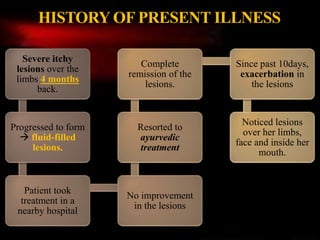
Severe itchy
lesions over the
limbs 4 months
back.
Progressed to form
 fluid-filled
lesions.
Patient took
treatment in a
nearby hospital
No improvement
in the lesions
Resorted to
ayurvedic
treatment
Complete
remission of the
lesions.
Since past 10days,
exacerbation in
the lesions
Noticed lesions
over her limbs,
face and inside her
mouth.
HISTORY OF PRESENT ILLNESS
? Previous episode
of lesions
? History of
lesions in the eye
? History of
scarring in the
affected areas
? History of
trauma in the sites
affected before
lesions appeared
HISTORY OF PRESENT ILLNESS
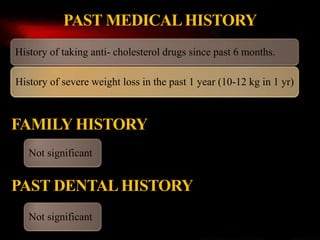
History of taking anti- cholesterol drugs since past 6 months.
History of severe weight loss in the past 1 year (10-12 kg in 1 yr)
PAST MEDICALHISTORY
FAMILY HISTORY
PAST DENTALHISTORY
Not significant
Not significant
PERSONALHISTORY
Vegetarian diet, good appetite
Sleep: undisturbed
Brushes twice daily with a brush and
toothpaste.
No adverse habits reported.
EXAMINATION OF THE PATIENT
GENERALEXAMINATION
-Moderate
built
-Moderately
nourished
-Alert
-Conscious
-Cooperative
Pallor (+)
Icterus (-)
Cyanosis (-)
Clubbing (-)
Lymphadenopathy(+)
Edema (-)
VITAL SIGNS:-
-Pulse: 80 / minute
-B.P: 120/80 mm Hg
-Respiratory rate:15
breaths/ minute.
-Temperature:Afebrile
• Multiple areas Tense, fluid- filled lesions
CUTANEOUS EXAMINATION
Abdomen
Relative sparing of palms and soles
CUTANEOUS EXAMINATION
Right submandiibular
lymphnodes 
palpable, non-tender,
mobile
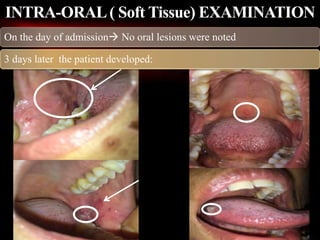
On the day of admission No oral lesions were noted
3 days later the patient developed:
INTRA-ORAL( Soft Tissue) EXAMINATION
PEMPHIGOID Lesions
CLINICALDIAGNOSIS
Pemphigus
vulgaris
Lichen Planus
Pemphigoides
Linear IgA
disease
Epidermolysis
Bullosa Acquisita
DIFFERENTIALDIAGNOSIS
Hb- 12 gm/dl
TLC- 11,600/ mm3
DLC-
N-
70.4 %
L-
11.2%
E-
12.4 %
M-
5.5 %
PLATELETS - 2.33 l/ mm3
RBS - 78mg/dl
UREA - 12mg/dl
CREATININE - 0.7mg/dl
TOTAL PROTEIN - 5.8g/dl
ALBUMIN - 3.1g/dl
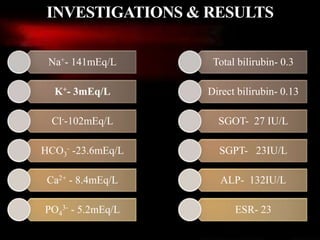
INVESTIGATIONS & RESULTS
Na+- 141mEq/L
K+- 3mEq/L
Cl--102mEq/L
HCO3
- -23.6mEq/L
Ca2+ - 8.4mEq/L
PO4
3- - 5.2mEq/L
Total bilirubin- 0.3
Direct bilirubin- 0.13
SGOT- 27 IU/L
SGPT- 23IU/L
ALP- 132IU/L
ESR- 23
INVESTIGATIONS & RESULTS
Dermo- epidermal
clefting
HISTOPATHOLOGICALPICTURE
• Linear staining of Basement membrane zone (BMZ) with
IgG & C3
IMMUNOFLUORESCENCE TEST
• BULLOUS PEMPHIGOID
FINALDIAGNOSIS
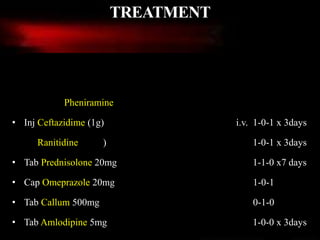
Medications administered when patient was admitted.
• Inj AVIL/ Pheniramine (1cc/ ½ amp) i.m. 1-0-1 x 3days
• Inj Ceftazidime (1g) i.v. 1-0-1 x 3days
• Inj Ranitidine(1amp) i.v. 1-0-1 x 3days
• Tab Prednisolone 20mg 1-1-0 x7 days
• Cap Omeprazole 20mg 1-0-1
• Tab Callum 500mg 0-1-0
• Tab Amlodipine 5mg 1-0-0 x 3days
TREATMENT
• Treatment for the oral lesions was started on the 2nd day of
appearance of oral lesions.
• Topical 0.1% Triamcinolone acetonide ointment
1-1-1 x 7days
• Mouthwash Lidocam 1-1-1 x 7days
TREATMENT
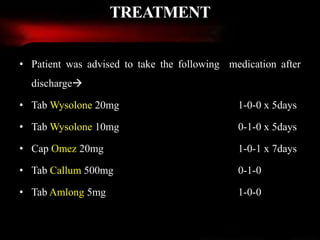
• Patient was advised to take the following medication after
discharge
• Tab Wysolone 20mg 1-0-0 x 5days
• Tab Wysolone 10mg 0-1-0 x 5days
• Cap Omez 20mg 1-0-1 x 7days
• Tab Callum 500mg 0-1-0
• Tab Amlong 5mg 1-0-0
TREATMENT
• INTRODUCTION-
• Bullous Pemphigoid (BP) is a blistering disease.
• Initially
• Later large, tense blisters develop on both
• NORMAL &
• ERYTHEMATOUS areas.
• Mucosal involvement is rare presents with blisters & erosions
Pruritis
Urticaria
Erythema
DISCUSSION
• PATHOGENESIS-
• Autoantibodies hemidesmosomes-associated proteins.
• BP230, BP180 2 major antigens associated with bullous pemphigoid.
Auto-antibody deposition leads to blistering
Disruption of HEMIDESMOSOMES
“BLISTER FORMATION”
DISCUSSION
• CLINICAL FEATURES-
• AGE- > 60 years; < 5years ( can occur in < 40years patients)
• RISK of developing BP- Increases with Age
• ♂ > ♀
• Initially ITCHING, NON-
SPECIFIC RASH
URTICARIA
- LIKE
Lasts for 1-3weeks before
BLISTERS develop
ECZEMATO
US
NO BLISTERS for several
months
DISCUSSION
• CLINICAL FEATURES-
• FLUID-
• Clear, serous exudate may be blood-stained.
• If BLISTERS REMAIN INTACT for several days
Jelly-like coagulated fibrin.
Erythema may persist at the site of blister for many
weeks or months.
DISCUSSION
• ORAL MANIFESTATIONS-
• Oral lesions Rare
• If they do occur :
APPEARANCE-
DISCUSSION
Small blisters: may remain intact When ruptures ulcerations
SITE-
• Gingival involvement
• Exceedingly painful
• Erythematous & desquamate minor frictional
trauma
• Buccal mucosa, palate, floor of the mouth, tongue.
DISCUSSION
• ORAL MANIFESTATIONS-
HISTOPATHOLOGICALAPPEARANCE
• Bullae- subepidermal
• No acantholysis
• Epithelium normal
• Fibrinous exudate, inflammatory cells
ELECTRON MICROSCOPY REVEALS
• Basement membrane attached to connective
tissue.
• Acute phase Leukocytosis & Eosinophilia
DISCUSSION
Clinical
Features →
Diseases↓
Age
(yrs)
Cutaneous
Involvement
Mucosal
Involvement
Lesions Clinical Signs Prognosis
Bullous
Pemphigoi
d
>60
< 5
Trunk,
limbs,
flexures
Minor
Urticated
plaques, tense
blisters, milia
3-6yrs
Pemphigus
Vulgaris
50-60
Scalp, face,
flexures,
may be
generalised
Always
oropharynx,
conjunctiva,
genital
Flaccid
blisters,
erosions,
flexural
vegetations
Variable,
may
remit
Pemphigus
vegetans
40-50
Flexural
areas
Oral
Vesicles,
pustules,
erosions,
vegetating
plaques
Variable,
may
remit
Cicatricial
Pemphigoi
d
40-50
Infrequent
(30%)
Major,
severe
Erosions,
blisters,
scarring,
gingivitis
Chronic
DIFFERENTIALDIAGNOSIS
Clinical
Features→
Diseases↓
Age
(yrs)
Cutaneous
Involvement
Mucosal
Involvement
Lesions
Clinical
Signs
Prognosis
(yrs)
Lichen
Planus
>60 or
< 5
Trunk,
limbs,
flexures
Minor Plaques, 3-6
Chronic
Bullous
Disease of
Childhood
Children
Face,
Trunks,
limbs
Majority
(few severe)
Urticated
plaques, annular
lesions, tense
blisters
3-4
Adult
Linear Ig A
disease
Young
adults to
elderly
Trunk,
limbs
Majority
(few severe)
Urticated
plaques, tense
blisters, papulo-
vesicles
3-6
Epidermol
ysis Bullosa
Adults
&
children
Generalised
, variable
Some (few
severe)
Urticated
plaques, tense
blisters,
Persists
DIFFERENTIALDIAGNOSIS
1.) Untreated Bullous Pemphigoid
• Self-limiting disease
• Over a number of months or years
2.) Acute Blistering Phase of Bullous Pemphigoid
• FATAL
3.)Poor Prognostic factors
• Age
• Generalised disease
• Low Albumin
PROGNOSIS
• Initial Dosage 20- 70mg/day
• After a few weeks 15-20mg/day
• Majority managed <10mg/day
TOPICAL &
SYSTEMIC
CORTICOSTEROIDS
• Azathioprine
• Methotrexate ( if psoriasis is also
present)
IMMUNOSUPPRESS
ANTS
TREATMENT
Since most of vesiculo-bullous lesions initially present with oral
lesions, we as oral physicians are most often the first ones to
notice these lesions
Hence, it is important to know the different conditions that can
cause these multiple lesions so that an early intervention can be
highly beneficial in these debilitating conditions.
CONCLUSION
CASE REPORT
SYSTEMIC EXAMINATION
• Respiratory System- Normal
Vesicular Breath sounds were
present
• CVS- Normal heart sounds
present
• P/A- Soft, non-tender
• CNS- No abnormality was
detected

Bullous Pemphigoid

  • 1.
    ORAL VESICULO-BULLOUS LESION :A case presentation
  • 2.
    INTRODUCTION Auto-immune, mucocutaneous conditionscan frequently present with oral lesions. The severity of these lesions can have a dramatic impact on the quality of life of a patient. The clinical presentation of these lesions may vary from minute vesicles or bullae to multiple erosive or ulcerative areas. Hence, it is important to know the distinguishing features of such lesions to reach a conclusive diagnosis.
  • 3.
    A 45 yearold female patient named Samyukhta, complained of multiple fluid- filled itchy lesions for the past 1 week over her limbs and face. CHIEF COMPLAINT
  • 4.
    Severe itchy lesions overthe limbs 4 months back. Progressed to form  fluid-filled lesions. Patient took treatment in a nearby hospital No improvement in the lesions Resorted to ayurvedic treatment Complete remission of the lesions. Since past 10days, exacerbation in the lesions Noticed lesions over her limbs, face and inside her mouth. HISTORY OF PRESENT ILLNESS
  • 5.
    ? Previous episode oflesions ? History of lesions in the eye ? History of scarring in the affected areas ? History of trauma in the sites affected before lesions appeared HISTORY OF PRESENT ILLNESS
  • 6.
    History of takinganti- cholesterol drugs since past 6 months. History of severe weight loss in the past 1 year (10-12 kg in 1 yr) PAST MEDICALHISTORY FAMILY HISTORY PAST DENTALHISTORY Not significant Not significant
  • 7.
    PERSONALHISTORY Vegetarian diet, goodappetite Sleep: undisturbed Brushes twice daily with a brush and toothpaste. No adverse habits reported.
  • 8.
  • 9.
    GENERALEXAMINATION -Moderate built -Moderately nourished -Alert -Conscious -Cooperative Pallor (+) Icterus (-) Cyanosis(-) Clubbing (-) Lymphadenopathy(+) Edema (-) VITAL SIGNS:- -Pulse: 80 / minute -B.P: 120/80 mm Hg -Respiratory rate:15 breaths/ minute. -Temperature:Afebrile
  • 10.
    • Multiple areasTense, fluid- filled lesions CUTANEOUS EXAMINATION
  • 11.
    Abdomen Relative sparing ofpalms and soles CUTANEOUS EXAMINATION Right submandiibular lymphnodes  palpable, non-tender, mobile
  • 12.
    On the dayof admission No oral lesions were noted 3 days later the patient developed: INTRA-ORAL( Soft Tissue) EXAMINATION
  • 13.
  • 14.
  • 15.
    Hb- 12 gm/dl TLC-11,600/ mm3 DLC- N- 70.4 % L- 11.2% E- 12.4 % M- 5.5 % PLATELETS - 2.33 l/ mm3 RBS - 78mg/dl UREA - 12mg/dl CREATININE - 0.7mg/dl TOTAL PROTEIN - 5.8g/dl ALBUMIN - 3.1g/dl INVESTIGATIONS & RESULTS
  • 16.
    Na+- 141mEq/L K+- 3mEq/L Cl--102mEq/L HCO3 --23.6mEq/L Ca2+ - 8.4mEq/L PO4 3- - 5.2mEq/L Total bilirubin- 0.3 Direct bilirubin- 0.13 SGOT- 27 IU/L SGPT- 23IU/L ALP- 132IU/L ESR- 23 INVESTIGATIONS & RESULTS
  • 17.
  • 18.
    • Linear stainingof Basement membrane zone (BMZ) with IgG & C3 IMMUNOFLUORESCENCE TEST
  • 19.
  • 20.
    Medications administered whenpatient was admitted. • Inj AVIL/ Pheniramine (1cc/ ½ amp) i.m. 1-0-1 x 3days • Inj Ceftazidime (1g) i.v. 1-0-1 x 3days • Inj Ranitidine(1amp) i.v. 1-0-1 x 3days • Tab Prednisolone 20mg 1-1-0 x7 days • Cap Omeprazole 20mg 1-0-1 • Tab Callum 500mg 0-1-0 • Tab Amlodipine 5mg 1-0-0 x 3days TREATMENT
  • 21.
    • Treatment forthe oral lesions was started on the 2nd day of appearance of oral lesions. • Topical 0.1% Triamcinolone acetonide ointment 1-1-1 x 7days • Mouthwash Lidocam 1-1-1 x 7days TREATMENT
  • 22.
    • Patient wasadvised to take the following medication after discharge • Tab Wysolone 20mg 1-0-0 x 5days • Tab Wysolone 10mg 0-1-0 x 5days • Cap Omez 20mg 1-0-1 x 7days • Tab Callum 500mg 0-1-0 • Tab Amlong 5mg 1-0-0 TREATMENT
  • 23.
    • INTRODUCTION- • BullousPemphigoid (BP) is a blistering disease. • Initially • Later large, tense blisters develop on both • NORMAL & • ERYTHEMATOUS areas. • Mucosal involvement is rare presents with blisters & erosions Pruritis Urticaria Erythema DISCUSSION
  • 24.
    • PATHOGENESIS- • Autoantibodieshemidesmosomes-associated proteins. • BP230, BP180 2 major antigens associated with bullous pemphigoid. Auto-antibody deposition leads to blistering Disruption of HEMIDESMOSOMES “BLISTER FORMATION” DISCUSSION
  • 25.
    • CLINICAL FEATURES- •AGE- > 60 years; < 5years ( can occur in < 40years patients) • RISK of developing BP- Increases with Age • ♂ > ♀ • Initially ITCHING, NON- SPECIFIC RASH URTICARIA - LIKE Lasts for 1-3weeks before BLISTERS develop ECZEMATO US NO BLISTERS for several months DISCUSSION
  • 26.
    • CLINICAL FEATURES- •FLUID- • Clear, serous exudate may be blood-stained. • If BLISTERS REMAIN INTACT for several days Jelly-like coagulated fibrin. Erythema may persist at the site of blister for many weeks or months. DISCUSSION
  • 27.
    • ORAL MANIFESTATIONS- •Oral lesions Rare • If they do occur : APPEARANCE- DISCUSSION Small blisters: may remain intact When ruptures ulcerations
  • 28.
    SITE- • Gingival involvement •Exceedingly painful • Erythematous & desquamate minor frictional trauma • Buccal mucosa, palate, floor of the mouth, tongue. DISCUSSION • ORAL MANIFESTATIONS-
  • 29.
    HISTOPATHOLOGICALAPPEARANCE • Bullae- subepidermal •No acantholysis • Epithelium normal • Fibrinous exudate, inflammatory cells ELECTRON MICROSCOPY REVEALS • Basement membrane attached to connective tissue. • Acute phase Leukocytosis & Eosinophilia DISCUSSION
  • 30.
    Clinical Features → Diseases↓ Age (yrs) Cutaneous Involvement Mucosal Involvement Lesions ClinicalSigns Prognosis Bullous Pemphigoi d >60 < 5 Trunk, limbs, flexures Minor Urticated plaques, tense blisters, milia 3-6yrs Pemphigus Vulgaris 50-60 Scalp, face, flexures, may be generalised Always oropharynx, conjunctiva, genital Flaccid blisters, erosions, flexural vegetations Variable, may remit Pemphigus vegetans 40-50 Flexural areas Oral Vesicles, pustules, erosions, vegetating plaques Variable, may remit Cicatricial Pemphigoi d 40-50 Infrequent (30%) Major, severe Erosions, blisters, scarring, gingivitis Chronic DIFFERENTIALDIAGNOSIS
  • 31.
    Clinical Features→ Diseases↓ Age (yrs) Cutaneous Involvement Mucosal Involvement Lesions Clinical Signs Prognosis (yrs) Lichen Planus >60 or < 5 Trunk, limbs, flexures MinorPlaques, 3-6 Chronic Bullous Disease of Childhood Children Face, Trunks, limbs Majority (few severe) Urticated plaques, annular lesions, tense blisters 3-4 Adult Linear Ig A disease Young adults to elderly Trunk, limbs Majority (few severe) Urticated plaques, tense blisters, papulo- vesicles 3-6 Epidermol ysis Bullosa Adults & children Generalised , variable Some (few severe) Urticated plaques, tense blisters, Persists DIFFERENTIALDIAGNOSIS
  • 32.
    1.) Untreated BullousPemphigoid • Self-limiting disease • Over a number of months or years 2.) Acute Blistering Phase of Bullous Pemphigoid • FATAL 3.)Poor Prognostic factors • Age • Generalised disease • Low Albumin PROGNOSIS
  • 33.
    • Initial Dosage20- 70mg/day • After a few weeks 15-20mg/day • Majority managed <10mg/day TOPICAL & SYSTEMIC CORTICOSTEROIDS • Azathioprine • Methotrexate ( if psoriasis is also present) IMMUNOSUPPRESS ANTS TREATMENT
  • 34.
    Since most ofvesiculo-bullous lesions initially present with oral lesions, we as oral physicians are most often the first ones to notice these lesions Hence, it is important to know the different conditions that can cause these multiple lesions so that an early intervention can be highly beneficial in these debilitating conditions. CONCLUSION
  • 36.
    CASE REPORT SYSTEMIC EXAMINATION •Respiratory System- Normal Vesicular Breath sounds were present • CVS- Normal heart sounds present • P/A- Soft, non-tender • CNS- No abnormality was detected