Rous Sarcoma Virus
BY MICKINZIE METZ
Case Study
 Bob Rooster is the owner of a chicken farm, one day he noticed some of his
chickens were moving stiff, look distressed and were failing to thrive. On one of
the first chickens that died the farmer observed masses on its body and sent the
chicken away for testing.
 In the lab they ground up the tumors and passed then through a filter that not
even bacteria can fit through to identify this infection as a virus.
Rous Sarcoma Virus
 Class VI enveloped virus
 Discovered by Peyton Rous in 1911. Awarded Noble Prize for Physiology or
Medicine in 1966.
 First oncovirus to be described
 oncoRNA viruses are called simple viruses whereas a virus like HIV is a complex
retrovirus
 Simple retroviruses only contain the gag, pol and env genes
 Simple viruses encode only singly spliced or unspliced RNA
Entry
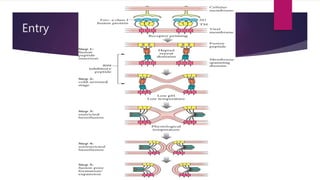
 Need one or more receptors
 Env proteins have a N term SU unit involved in receptor binding and a C term TM
unit which is a trans-membrane anchor. They are metastable structures.
 When Env binds to its receptor, the SU dissociates from the TM, exposing the
fusion peptide. The fusion peptide inserts into the target cell membrane
 Hemifusion intermediate: In the endosome the heptad repeats “zipper back”
folding into six helical bundles, pulling the cell and viral membranes closer.
Entry
Replication
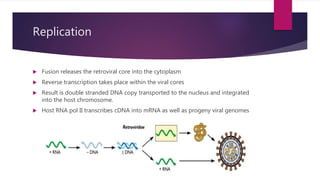
 Fusion releases the retroviral core into the cytoplasm
 Reverse transcription takes place within the viral cores
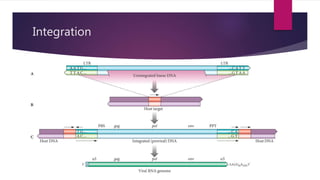
 Result is double stranded DNA copy transported to the nucleus and integrated
into the host chromosome.
 Host RNA pol II transcribes cDNA into mRNA as well as progeny viral genomes
Replication
 Has only 4 genes
 gag, which encodes the capsid protein
 pol, which encodes the reverse transcriptase
 env, which encodes the envelope protein
 src, which encodes a tyrosine kinase, an enzyme that attaches phosphate
groups to Tyr residues on a variety of host cell proteins. This is what causes the
virus to be oncogenic.
Integration
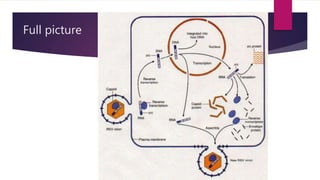
Full picture
Treatment
 Since the oncogenic activation of the virus is still being studied there is no
effective treatment at the time.
 Research is being conducted to study the influence of 2',5' adenosine nucleotides
on the replication and transformation of cells by Rous sarcoma virus (RSV).
Treatment with certain nucleotides, ppp2',5'A4 and 2',5'A4, causes a striking
reduction (50-fold) in the yield of infectious progeny virus. With this reduction it
could possibly knock out the oncogenic gene.
References
 Kimboll’s Biology Pages (2015). http://www.biology-pages.info/R/RSV.html
 The Journal of Experimental Medicine (2011).
https://www.ncbi.nlm.nih.gov/pmc/articles/PMC3256973/
 PubMed (2012). https://www.ncbi.nlm.nih.gov/pubmed/6191438

Rous Sarcoma Virus

  • 1.
    Rous Sarcoma Virus BYMICKINZIE METZ
  • 2.
    Case Study  BobRooster is the owner of a chicken farm, one day he noticed some of his chickens were moving stiff, look distressed and were failing to thrive. On one of the first chickens that died the farmer observed masses on its body and sent the chicken away for testing.  In the lab they ground up the tumors and passed then through a filter that not even bacteria can fit through to identify this infection as a virus.
  • 3.
    Rous Sarcoma Virus Class VI enveloped virus  Discovered by Peyton Rous in 1911. Awarded Noble Prize for Physiology or Medicine in 1966.  First oncovirus to be described  oncoRNA viruses are called simple viruses whereas a virus like HIV is a complex retrovirus  Simple retroviruses only contain the gag, pol and env genes  Simple viruses encode only singly spliced or unspliced RNA
  • 4.
    Entry  Need oneor more receptors  Env proteins have a N term SU unit involved in receptor binding and a C term TM unit which is a trans-membrane anchor. They are metastable structures.  When Env binds to its receptor, the SU dissociates from the TM, exposing the fusion peptide. The fusion peptide inserts into the target cell membrane  Hemifusion intermediate: In the endosome the heptad repeats “zipper back” folding into six helical bundles, pulling the cell and viral membranes closer.
  • 5.
  • 6.
    Replication  Fusion releasesthe retroviral core into the cytoplasm  Reverse transcription takes place within the viral cores  Result is double stranded DNA copy transported to the nucleus and integrated into the host chromosome.  Host RNA pol II transcribes cDNA into mRNA as well as progeny viral genomes
  • 7.
    Replication  Has only4 genes  gag, which encodes the capsid protein  pol, which encodes the reverse transcriptase  env, which encodes the envelope protein  src, which encodes a tyrosine kinase, an enzyme that attaches phosphate groups to Tyr residues on a variety of host cell proteins. This is what causes the virus to be oncogenic.
  • 8.
  • 9.
  • 10.
    Treatment  Since theoncogenic activation of the virus is still being studied there is no effective treatment at the time.  Research is being conducted to study the influence of 2',5' adenosine nucleotides on the replication and transformation of cells by Rous sarcoma virus (RSV). Treatment with certain nucleotides, ppp2',5'A4 and 2',5'A4, causes a striking reduction (50-fold) in the yield of infectious progeny virus. With this reduction it could possibly knock out the oncogenic gene.
  • 11.
    References  Kimboll’s BiologyPages (2015). http://www.biology-pages.info/R/RSV.html  The Journal of Experimental Medicine (2011). https://www.ncbi.nlm.nih.gov/pmc/articles/PMC3256973/  PubMed (2012). https://www.ncbi.nlm.nih.gov/pubmed/6191438