GMO
Genetically Modified
Organisms
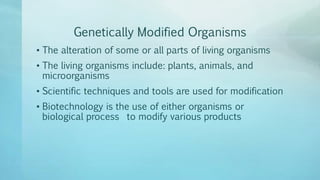
Genetically Modified Organisms
• The alteration of some or all parts of living organisms
• The living organisms include: plants, animals, and
microorganisms
• Scientific techniques and tools are used for modification
• Biotechnology is the use of either organisms or
biological process to modify various products
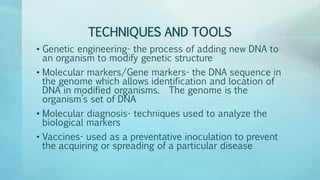
TECHNIQUES AND TOOLS
• Genetic engineering- the process of adding new DNA to
an organism to modify genetic structure
• Molecular markers/Gene markers- the DNA sequence in
the genome which allows identification and location of
DNA in modified organisms. The genome is the
organism’s set of DNA
• Molecular diagnosis- techniques used to analyze the
biological markers
• Vaccines- used as a preventative inoculation to prevent
the acquiring or spreading of a particular disease
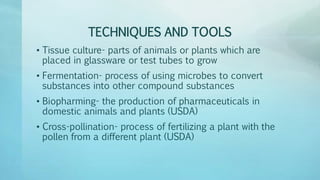
TECHNIQUES AND TOOLS
• Tissue culture- parts of animals or plants which are
placed in glassware or test tubes to grow
• Fermentation- process of using microbes to convert
substances into other compound substances
• Biopharming- the production of pharmaceuticals in
domestic animals and plants (USDA)
• Cross-pollination- process of fertilizing a plant with the
pollen from a different plant (USDA)
TECHNIQUES AND TOOLS
• Bt/Bacillus thuringiensis- the use of soil bacterium to
produce toxins which kills some insects and pests (USDA)
• ELISA/Enzyme-linked immunosorbent assay- a techniques
which detects certain proteins with the use of antibodies
(USDA)
• Plant breeding- using the process of cross-pollination on
certain plants to create various new plants with certain
traits/characteristics (USDA)
• Selective breeding- the process of crossing/mating
organisms to create an offspring with a particular
characteristic
RISKS
• Possibility of being toxic (Schlenker & Roth, 2011)
• Possibility of causing an allergic reaction (Schlenker & Roth,
2011)
• Could harm the environment by impacting insects, birds,
mammals, waters, etc. (Schlenker & Roth, 2011)
• The possibility of unknown health concerns for humans
• Possible destruction of the natural ecosystems
• Food companies conduct their own tests not the FDA
RISKS
• Ethnical concerns- man playing God by manipulation and/or
modifying organisms, plants, and animals
• Possibility of new diseases being introduced into the
community
• All foods/produce are not labeled to inform the consumers
of genetically modified foods
• Genetically modified foods could cause abnormal
conditions/problems for those suffering from chronic illness
• (Creative commons, 2017)
BENEFITS
• Resistance to certain diseases and insects (Schlenker &
Roth, 2011)
• A stronger tolerance to certain weather conditions (drought,
cold, etc.)
• Opportunity to increase the nutritional value of certain foods
(Schlenker & Roth, 2011)
• More production of crops
• More food to feed the hungry and decrease
hunger/starvation
• Certain foods last longer than normal
BENEFITS
• More crops are produced
• Plants are resistant to herbicides which kill weeds (USDA,
2008)
• Higher level of tolerance to various environmental issues
(droughts, extreme cold, etc.)
• Resistance to pests/insects (USDA)
• Could make certain foods more nutritious with the
addition of minerals and vitamins to the foods
• Food/crops last longer (USDA)
BENEFITS
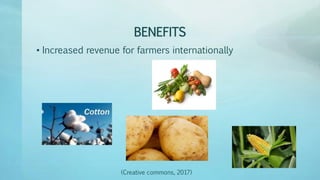
• Increased revenue for farmers internationally
(Creative commons, 2017)
Benefits
• Some GMO foods taste better
• Possibility of growing more food in a small area
• Ecologically- possibility of better waste management
• Environmentally friendly
REFERENCES
• U.S. Department of Agriculture. Biotechnology
Frequently Asked Question (FAQs). Retrieved from U.S.
Department of Agriculture:
https://www.usda.gov/topics/biotechnology-frequently-
asked-question-faqs
• Schlenker, E.D., Roth, S.L. (2011). Williams’ Essentials of
Nutrition and Diet Therapy. 10th ed. St Louis, MO:
Elsevier Mosby.

Gmo pros and cons

  • 1.
  • 2.
    Genetically Modified Organisms •The alteration of some or all parts of living organisms • The living organisms include: plants, animals, and microorganisms • Scientific techniques and tools are used for modification • Biotechnology is the use of either organisms or biological process to modify various products
  • 3.
    TECHNIQUES AND TOOLS •Genetic engineering- the process of adding new DNA to an organism to modify genetic structure • Molecular markers/Gene markers- the DNA sequence in the genome which allows identification and location of DNA in modified organisms. The genome is the organism’s set of DNA • Molecular diagnosis- techniques used to analyze the biological markers • Vaccines- used as a preventative inoculation to prevent the acquiring or spreading of a particular disease
  • 4.
    TECHNIQUES AND TOOLS •Tissue culture- parts of animals or plants which are placed in glassware or test tubes to grow • Fermentation- process of using microbes to convert substances into other compound substances • Biopharming- the production of pharmaceuticals in domestic animals and plants (USDA) • Cross-pollination- process of fertilizing a plant with the pollen from a different plant (USDA)
  • 5.
    TECHNIQUES AND TOOLS •Bt/Bacillus thuringiensis- the use of soil bacterium to produce toxins which kills some insects and pests (USDA) • ELISA/Enzyme-linked immunosorbent assay- a techniques which detects certain proteins with the use of antibodies (USDA) • Plant breeding- using the process of cross-pollination on certain plants to create various new plants with certain traits/characteristics (USDA) • Selective breeding- the process of crossing/mating organisms to create an offspring with a particular characteristic
  • 6.
    RISKS • Possibility ofbeing toxic (Schlenker & Roth, 2011) • Possibility of causing an allergic reaction (Schlenker & Roth, 2011) • Could harm the environment by impacting insects, birds, mammals, waters, etc. (Schlenker & Roth, 2011) • The possibility of unknown health concerns for humans • Possible destruction of the natural ecosystems • Food companies conduct their own tests not the FDA
  • 7.
    RISKS • Ethnical concerns-man playing God by manipulation and/or modifying organisms, plants, and animals • Possibility of new diseases being introduced into the community • All foods/produce are not labeled to inform the consumers of genetically modified foods • Genetically modified foods could cause abnormal conditions/problems for those suffering from chronic illness • (Creative commons, 2017)
  • 8.
    BENEFITS • Resistance tocertain diseases and insects (Schlenker & Roth, 2011) • A stronger tolerance to certain weather conditions (drought, cold, etc.) • Opportunity to increase the nutritional value of certain foods (Schlenker & Roth, 2011) • More production of crops • More food to feed the hungry and decrease hunger/starvation • Certain foods last longer than normal
  • 9.
    BENEFITS • More cropsare produced • Plants are resistant to herbicides which kill weeds (USDA, 2008) • Higher level of tolerance to various environmental issues (droughts, extreme cold, etc.) • Resistance to pests/insects (USDA) • Could make certain foods more nutritious with the addition of minerals and vitamins to the foods • Food/crops last longer (USDA)
  • 10.
    BENEFITS • Increased revenuefor farmers internationally (Creative commons, 2017)
  • 11.
    Benefits • Some GMOfoods taste better • Possibility of growing more food in a small area • Ecologically- possibility of better waste management • Environmentally friendly
  • 12.
    REFERENCES • U.S. Departmentof Agriculture. Biotechnology Frequently Asked Question (FAQs). Retrieved from U.S. Department of Agriculture: https://www.usda.gov/topics/biotechnology-frequently- asked-question-faqs • Schlenker, E.D., Roth, S.L. (2011). Williams’ Essentials of Nutrition and Diet Therapy. 10th ed. St Louis, MO: Elsevier Mosby.