TRANSGENESIS METHODS
AND APPLICATION
Suprabha Panda
Asst. Prof. of Zoology
Government degree college for women,Begumpet.
Hyderabad.
Introduction
• A transgenic animal is one whose genome has been altered by
the transfer of a gene or genes from another species or breed.
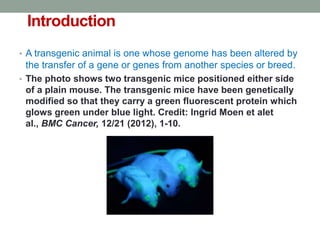
• The photo shows two transgenic mice positioned either side
of a plain mouse. The transgenic mice have been genetically
modified so that they carry a green fluorescent protein which
glows green under blue light. Credit: Ingrid Moen et alet
al., BMC Cancer, 12/21 (2012), 1-10.
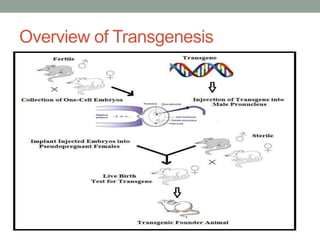
Overview of Transgenesis
History
• Transgenic animals are routinely used in the laboratory as models in biomedical
research. Over 95 per cent of those used are genetically modified rodents,
predominantly mice.
• They are important tools for researching human disease, being used to understand
gene function in the context of disease susceptibility, progression and to determine
responses to a therapeutic intervention.
• The ability to produce transgenic animals is reliant on a number of components.
One of the first things needed to generate transgenic animals is the ability to
transfer embryos.
• The first successful transfer of embryos was achieved by Walter Heape in Angora
rabbits in 1891.
• In vitro manipulation of embryos in mice was first reported in the 1940s using a
culture system.
• What is also vital is the ability to manipulate eggs. This was made possible through
the efforts of Ralph Brinster, attached to the University of Pennsylvania, who in
1963 devised a reliable system to culture eggs, and that of Teh Ping Lin, based at
the California School of Medicine, who in 1966 outlined a technique to micro-inject
fertilised mouse eggs which enabled the accurate insertion of foreign DNA.
• The first genetic modification of animals was reported in 1974 by the virologist
Rudolph Jaenisch, then at the Salk Institute, and the mouse embryologist Beatrice
Mintz at Fox Chase Cancer Center.
Methods Used for Creation of Transgenic Animals
The five principal methods are:
(1) Physical Transfection
(2) Chemical Transfection
(3) Retrovirus-Mediated Gene Transfer
(4) Virus Vector and
(5) DNA Packaged inside a Bacterium.
Physical Transfection or DNA Microinjection
• It is one of the first methods that proved to be effective in mammals.
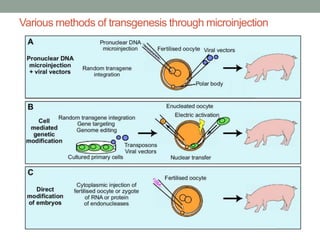
• DNA microinjection is the dominating technique leading to random
integration of a transgene via the introduction of DNA into the
pronucleus of a developing zygote.
• The introduced DNA may lead to the over- or under-expression of
certain genes or to the expression of genes entirely new to the animal
species.
• The insertion of DNA is, however, a random process, and there is a
high probability that the introduced gene will not insert itself into a site
on the host DNA that will permit its expression.
• The manipulated fertilized ovum is transferred into the oviduct of a
recipient female or foster mother that has been induced to act as a
recipient by mating with a vasectomized male.
• A major advantage of this method is its applicability to a wide variety
of species. Other transfection methods include particle bombardment,
ultrasound and electroporation.
Various methods of transgenesis through microinjection
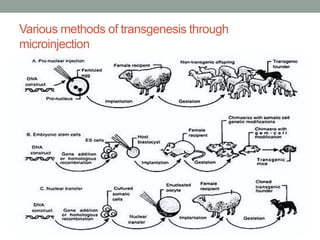
Various methods of transgenesis through
microinjection
Chemical Transfection:
• There are several chemical transfection techniques for animal cells but
all are based on similar principles.
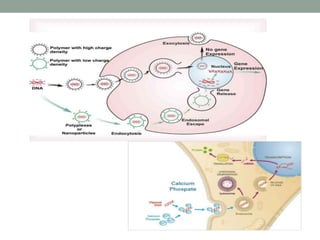
• The calcium phosphate mediated DNA uptake involves the formation of a
co-precipitate which is taken up by endocytosis. The ability of
mammalian cells to take up exogenous DNA from the cultured medium
was first reported in 1962.
• Formation of a fine DNA and calcium phosphate co-precipitate (should be
prepared fresh) facilitates DNA uptake by endocytosis. Some of the DNA
fragments which enter the cell may reach the nucleus and get integrated.
• Expression of such genes confers the transfection.
• The transformation frequency of calcium precipitate method is generally
low (1-2%), therefore use of soluble complexes (polyplexes) or liposomes
and lipoplexes (fusogenic) phospholipid are used to package DNA inside
these vehicles.
• The desired gene is transferred in plasmid and it may be used directly for
chemical transfection or inserted in a bacterium for delivery into a
mammalian cell.
• Yeast cells with the cell wall removed (spheroplast) therefore have been
used to introduce YAC DNA into mouse, using liposomes and embryonic
stem cells for the production of YAC transgenic mice.
Retrovirus-Mediated Gene Transfer:
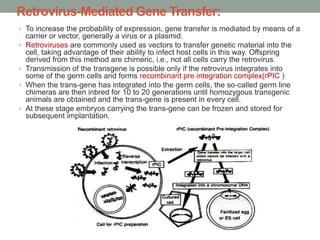
• To increase the probability of expression, gene transfer is mediated by means of a
carrier or vector, generally a virus or a plasmid.
• Retroviruses are commonly used as vectors to transfer genetic material into the
cell, taking advantage of their ability to infect host cells in this way. Offspring
derived from this method are chimeric, i.e., not all cells carry the retrovirus.
• Transmission of the transgene is possible only if the retrovirus integrates into
some of the germ cells and forms recombinant pre integration complex(rPIC )
• When the trans-gene has integrated into the germ cells, the so-called germ line
chimeras are then inbred for 10 to 20 generations until homozygous transgenic
animals are obtained and the trans-gene is present in every cell.
• At these stage embryos carrying the trans-gene can be frozen and stored for
subsequent implantation.
Virus Vector:
• Viruses have a natural ability to absorb to the surface of host cells
and infect. This property can be exploited to deliver rDNA into animal
cells.
• The viral system is efficient in transfer, expressed well and replicate
rapidly in the host cells. Several classes of viral vectors have been
developed for use in human gene therapy and at least eight have
been used in clinical trials.
• Trans-gene may be incorporated into viral vectors as additional gene
or as replacement to certain genes of viral genome by ligation or
homology recombination.
• If virus can propagate independently it is called helper independent. If
essential viral genes are replaced by trans-gene then virus need a
replication gene in Trans position (another virus similar to binary
vectors) and virus is called ‘helper-dependent’.
• It is necessary to prevent replication as well as recombination of
helper virus.
• Icosahedral viruses such as adenovirus and retroviruses package
their genome into preformed capsid, their volume is fixed with defined
amount of DNA can be packaged.
• Rod shaped baculo-viruses form the capsid around the genome, so
there are no such size constraints. There is no ideal virus, each has
his own advantages or disadvantages.
• Adenoviruses are also used as gene therapy vectors because the
virions are taken up efficiently by cells in vivo and adenovirus derived
vaccines have been used in humans with no reported side effects.
DNA Packaged inside a Bacterium
(Bactofection):
• Generally, Agrobacterium tumefaciens mediated transfer of
DNA is a common practice in plant system.
• It has been shown by Kunik and co -workers (2001) that this
bacterium can transfer DNA in cultured human cells.
• It was established in mid-1990 that several bacteria infect
human cells and undergo lysis releasing plasmid in host cells
e.g., Salmonella spp., Listeria spp. and Shigella spp.
• The plasmid DNA then finds its way to the host cell nucleus,
where it is integrated in the genome and expressed.
• Another method of DNA transfer is by conjugation [the transfer
of DNA through a pilus (plural pilli)]. This pilus is formed by
bacterial cell.
• When live bacteria are used, it is necessary that the bacteria
are attenuated. This is because the gene transfer system uses
the natural ability of bacteria to infect eukaryotic cells. The
bacteria may multiply and destroy host cells.
Examples of Transgenic Animals
Dolly Sheep
• Dolly the sheep was the first mammal to be cloned from an adult cell.
In this, the udder cells from a 6-year-old Finn Dorset white sheep
were injected into an unfertilized egg from a Scottish Blackface ewe,
which had its nucleus removed. The cell was made to fuse by
electrical pulses. After the fusion of the nucleus of the cell with the
egg, the resultant embryo was cultured for six to seven days. It was
then implanted into another Scottish Blackface ewe which gave birth
to the transgenic sheep, Dolly.
Transgenic Mice
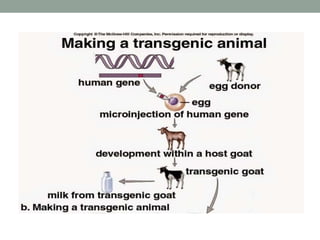
• Transgenic mice are formed by injecting DNA into the oocytes or one
or two-celled embryos obtained from female mice after hormonal
treatment. After injecting the DNA, the embryo is implanted into the
uterus of receptive females.
Transgenic fish:
• These fish were developed using a variety of transgenes, methods, and
species since the first transgenic fish were produced in China in 1985.
Since that time, transgenic gene knockout and gene editing technologies
have been adapted for fish experimentation.
• Early research emphasized refinement of transgenic methodology and
development of novel strains of fish with commercially beneficial traits
with emphasis on growth enhancement.
• The production of transgenic fish has since expanded to research
focused on five general applications:
• to enhance traits of commercially important species,
• to develop fish as bioreactors to produce biomedically important proteins,
• to enhance the utility of fish as indicators of adverse health
effects associated with exposure to toxicants in aquatic environments,
• to develop new non mammalian animal models for comparative
biomedical research and for functional genomics studies.
• Transgenic fish were produced that could benefit the aquaculture
industry, but regulatory agencies have yet to approve them for
commercial application.
• Zebra fish is the model fish for transgenesis.
Applications Of Transgenic Animals
• The transgenic animals are created because of the benefits they provide to the man. Let us
discuss a few of them here.
Normal Physiology and Development
• In transgenic animals, a foreign gene is introduced due to which the growth factor is altered.
Hence, these animals facilitate the study of gene regulation and their effect on the everyday
functions of the body.
Study of Diseases
• Transgenic animals are specially designed to study the role of genes in the development of
certain diseases. Moreover, in order to devise a cure for these diseases, the transgenic
animals are used as model organisms. These transgenic models are used in research for the
development of medicines. For example, we have transgenic models for diseases such as
Alzheimer’s and cancer.
Biological Products
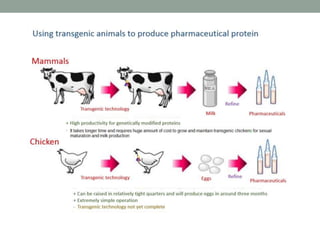
• A number of biological products such as medicines and nutritional supplements are obtained
from transgenic animals. Research for the manufacture of medicines to treat diseases such
as phenylketonuria (PKU) and hereditary emphysema is going on. The first transgenic cow,
Rosie, in 1997, produced milk which was rich in human protein (2.4 grams per litre). This milk
contains the human gene alpha-lactalbumin and could be given to babies as an alternative to
natural cow milk.
Vaccine Safety
• Transgenic animals are used as model organisms for testing the safety of vaccines before
they are injected into humans. This was conventionally done on monkey

Transgenesis methods and applications

  • 1.
    TRANSGENESIS METHODS AND APPLICATION SuprabhaPanda Asst. Prof. of Zoology Government degree college for women,Begumpet. Hyderabad.
  • 2.
    Introduction • A transgenicanimal is one whose genome has been altered by the transfer of a gene or genes from another species or breed. • The photo shows two transgenic mice positioned either side of a plain mouse. The transgenic mice have been genetically modified so that they carry a green fluorescent protein which glows green under blue light. Credit: Ingrid Moen et alet al., BMC Cancer, 12/21 (2012), 1-10.
  • 3.
  • 4.
    History • Transgenic animalsare routinely used in the laboratory as models in biomedical research. Over 95 per cent of those used are genetically modified rodents, predominantly mice. • They are important tools for researching human disease, being used to understand gene function in the context of disease susceptibility, progression and to determine responses to a therapeutic intervention. • The ability to produce transgenic animals is reliant on a number of components. One of the first things needed to generate transgenic animals is the ability to transfer embryos. • The first successful transfer of embryos was achieved by Walter Heape in Angora rabbits in 1891. • In vitro manipulation of embryos in mice was first reported in the 1940s using a culture system. • What is also vital is the ability to manipulate eggs. This was made possible through the efforts of Ralph Brinster, attached to the University of Pennsylvania, who in 1963 devised a reliable system to culture eggs, and that of Teh Ping Lin, based at the California School of Medicine, who in 1966 outlined a technique to micro-inject fertilised mouse eggs which enabled the accurate insertion of foreign DNA. • The first genetic modification of animals was reported in 1974 by the virologist Rudolph Jaenisch, then at the Salk Institute, and the mouse embryologist Beatrice Mintz at Fox Chase Cancer Center.
  • 5.
    Methods Used forCreation of Transgenic Animals The five principal methods are: (1) Physical Transfection (2) Chemical Transfection (3) Retrovirus-Mediated Gene Transfer (4) Virus Vector and (5) DNA Packaged inside a Bacterium.
  • 6.
    Physical Transfection orDNA Microinjection • It is one of the first methods that proved to be effective in mammals. • DNA microinjection is the dominating technique leading to random integration of a transgene via the introduction of DNA into the pronucleus of a developing zygote. • The introduced DNA may lead to the over- or under-expression of certain genes or to the expression of genes entirely new to the animal species. • The insertion of DNA is, however, a random process, and there is a high probability that the introduced gene will not insert itself into a site on the host DNA that will permit its expression. • The manipulated fertilized ovum is transferred into the oviduct of a recipient female or foster mother that has been induced to act as a recipient by mating with a vasectomized male. • A major advantage of this method is its applicability to a wide variety of species. Other transfection methods include particle bombardment, ultrasound and electroporation.
  • 7.
    Various methods oftransgenesis through microinjection
  • 8.
    Various methods oftransgenesis through microinjection
  • 9.
    Chemical Transfection: • Thereare several chemical transfection techniques for animal cells but all are based on similar principles. • The calcium phosphate mediated DNA uptake involves the formation of a co-precipitate which is taken up by endocytosis. The ability of mammalian cells to take up exogenous DNA from the cultured medium was first reported in 1962. • Formation of a fine DNA and calcium phosphate co-precipitate (should be prepared fresh) facilitates DNA uptake by endocytosis. Some of the DNA fragments which enter the cell may reach the nucleus and get integrated. • Expression of such genes confers the transfection. • The transformation frequency of calcium precipitate method is generally low (1-2%), therefore use of soluble complexes (polyplexes) or liposomes and lipoplexes (fusogenic) phospholipid are used to package DNA inside these vehicles. • The desired gene is transferred in plasmid and it may be used directly for chemical transfection or inserted in a bacterium for delivery into a mammalian cell. • Yeast cells with the cell wall removed (spheroplast) therefore have been used to introduce YAC DNA into mouse, using liposomes and embryonic stem cells for the production of YAC transgenic mice.
  • 11.
    Retrovirus-Mediated Gene Transfer: •To increase the probability of expression, gene transfer is mediated by means of a carrier or vector, generally a virus or a plasmid. • Retroviruses are commonly used as vectors to transfer genetic material into the cell, taking advantage of their ability to infect host cells in this way. Offspring derived from this method are chimeric, i.e., not all cells carry the retrovirus. • Transmission of the transgene is possible only if the retrovirus integrates into some of the germ cells and forms recombinant pre integration complex(rPIC ) • When the trans-gene has integrated into the germ cells, the so-called germ line chimeras are then inbred for 10 to 20 generations until homozygous transgenic animals are obtained and the trans-gene is present in every cell. • At these stage embryos carrying the trans-gene can be frozen and stored for subsequent implantation.
  • 12.
    Virus Vector: • Viruseshave a natural ability to absorb to the surface of host cells and infect. This property can be exploited to deliver rDNA into animal cells. • The viral system is efficient in transfer, expressed well and replicate rapidly in the host cells. Several classes of viral vectors have been developed for use in human gene therapy and at least eight have been used in clinical trials. • Trans-gene may be incorporated into viral vectors as additional gene or as replacement to certain genes of viral genome by ligation or homology recombination. • If virus can propagate independently it is called helper independent. If essential viral genes are replaced by trans-gene then virus need a replication gene in Trans position (another virus similar to binary vectors) and virus is called ‘helper-dependent’. • It is necessary to prevent replication as well as recombination of helper virus. • Icosahedral viruses such as adenovirus and retroviruses package their genome into preformed capsid, their volume is fixed with defined amount of DNA can be packaged.
  • 13.
    • Rod shapedbaculo-viruses form the capsid around the genome, so there are no such size constraints. There is no ideal virus, each has his own advantages or disadvantages. • Adenoviruses are also used as gene therapy vectors because the virions are taken up efficiently by cells in vivo and adenovirus derived vaccines have been used in humans with no reported side effects.
  • 14.
    DNA Packaged insidea Bacterium (Bactofection): • Generally, Agrobacterium tumefaciens mediated transfer of DNA is a common practice in plant system. • It has been shown by Kunik and co -workers (2001) that this bacterium can transfer DNA in cultured human cells. • It was established in mid-1990 that several bacteria infect human cells and undergo lysis releasing plasmid in host cells e.g., Salmonella spp., Listeria spp. and Shigella spp. • The plasmid DNA then finds its way to the host cell nucleus, where it is integrated in the genome and expressed. • Another method of DNA transfer is by conjugation [the transfer of DNA through a pilus (plural pilli)]. This pilus is formed by bacterial cell. • When live bacteria are used, it is necessary that the bacteria are attenuated. This is because the gene transfer system uses the natural ability of bacteria to infect eukaryotic cells. The bacteria may multiply and destroy host cells.
  • 18.
    Examples of TransgenicAnimals Dolly Sheep • Dolly the sheep was the first mammal to be cloned from an adult cell. In this, the udder cells from a 6-year-old Finn Dorset white sheep were injected into an unfertilized egg from a Scottish Blackface ewe, which had its nucleus removed. The cell was made to fuse by electrical pulses. After the fusion of the nucleus of the cell with the egg, the resultant embryo was cultured for six to seven days. It was then implanted into another Scottish Blackface ewe which gave birth to the transgenic sheep, Dolly. Transgenic Mice • Transgenic mice are formed by injecting DNA into the oocytes or one or two-celled embryos obtained from female mice after hormonal treatment. After injecting the DNA, the embryo is implanted into the uterus of receptive females.
  • 19.
    Transgenic fish: • Thesefish were developed using a variety of transgenes, methods, and species since the first transgenic fish were produced in China in 1985. Since that time, transgenic gene knockout and gene editing technologies have been adapted for fish experimentation. • Early research emphasized refinement of transgenic methodology and development of novel strains of fish with commercially beneficial traits with emphasis on growth enhancement. • The production of transgenic fish has since expanded to research focused on five general applications: • to enhance traits of commercially important species, • to develop fish as bioreactors to produce biomedically important proteins, • to enhance the utility of fish as indicators of adverse health effects associated with exposure to toxicants in aquatic environments, • to develop new non mammalian animal models for comparative biomedical research and for functional genomics studies. • Transgenic fish were produced that could benefit the aquaculture industry, but regulatory agencies have yet to approve them for commercial application. • Zebra fish is the model fish for transgenesis.
  • 20.
    Applications Of TransgenicAnimals • The transgenic animals are created because of the benefits they provide to the man. Let us discuss a few of them here. Normal Physiology and Development • In transgenic animals, a foreign gene is introduced due to which the growth factor is altered. Hence, these animals facilitate the study of gene regulation and their effect on the everyday functions of the body. Study of Diseases • Transgenic animals are specially designed to study the role of genes in the development of certain diseases. Moreover, in order to devise a cure for these diseases, the transgenic animals are used as model organisms. These transgenic models are used in research for the development of medicines. For example, we have transgenic models for diseases such as Alzheimer’s and cancer. Biological Products • A number of biological products such as medicines and nutritional supplements are obtained from transgenic animals. Research for the manufacture of medicines to treat diseases such as phenylketonuria (PKU) and hereditary emphysema is going on. The first transgenic cow, Rosie, in 1997, produced milk which was rich in human protein (2.4 grams per litre). This milk contains the human gene alpha-lactalbumin and could be given to babies as an alternative to natural cow milk. Vaccine Safety • Transgenic animals are used as model organisms for testing the safety of vaccines before they are injected into humans. This was conventionally done on monkey