Role of genetic as medicine
(gene therapy)
by-
Vanlalmawia
rol.no-12
What is genetic disorder/ diseases
 caused by an abnormality in an
individual's DNA.
 Abnormalities can be as small as a
single-base mutation in just one gene,
 or they can involve the addition or
subtraction of entire chromosomes.
Types of Genetic Disorders
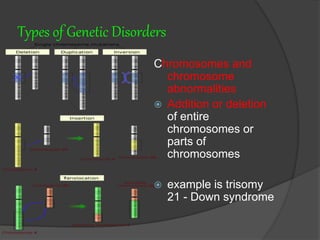
Chromosomes and
chromosome
abnormalities
 Addition or deletion
of entire
chromosomes or
parts of
chromosomes
 example is trisomy
21 - Down syndrome
Types of Genetic Disorders
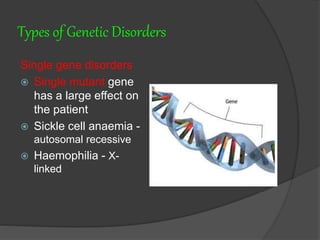
Single gene disorders
 Single mutant gene
has a large effect on
the patient
 Sickle cell anaemia -
autosomal recessive
 Haemophilia - X-
linked
Types of Genetic Disorders
Polygenic Disorders
 The most common yet still the least
understood of human genetic diseases
 Result from an interaction of multiple
genes, each with a minor effect
 Type I and type II diabetes, autism,
osteoarthritis
Types of Genetic Disorders
Mutation and human disease
 Three principal types of mutation
 Single-base changes
 Deletions/Insertions
 Unstable repeat units
 Two main effects
 Loss of function
 Gain of function
What is Gene Therapy
 correcting defective genes that are
responsible for disease development
 inserting a normal gene to replace an
abnormal gene.
What’s gene therapy?
Imagine that you
accidentally broke one
of your neighbor's
windows.
I. Stay silent
II. Repair it with some
tape
III. Put in a new
window
Many medical conditions result
from flaws, or mutations, in one
or more of a person's genes. So,
if a flawed gene caused our
"broken window," can you "fix" it?
What are your options?
I. Stay silent
II. Try to treat the disorder with
drugs or other approaches
III. Put in a normal, functioning
copy of the gene
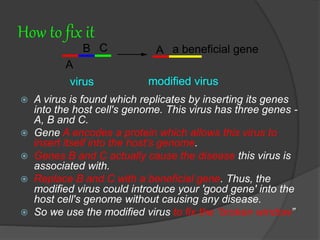
How to fix it
A
B C a beneficial geneA
virus modified virus
 A virus is found which replicates by inserting its genes
into the host cell's genome. This virus has three genes -
A, B and C.
 Gene A encodes a protein which allows this virus to
insert itself into the host's genome.
 Genes B and C actually cause the disease this virus is
associated with.
 Replace B and C with a beneficial gene. Thus, the
modified virus could introduce your 'good gene' into the
host cell's genome without causing any disease.
 So we use the modified virus to fix the “broken window”
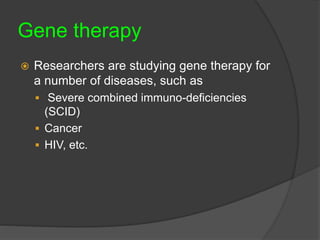
Gene therapy
 Researchers are studying gene therapy for
a number of diseases, such as
 Severe combined immuno-deficiencies
(SCID)
 Cancer
 HIV, etc.
HISTORYANDDEVELOPMENTOF GENETHERAPY
 1960: The concepts of Gene Therapy was introduced
 1970: Friedmann and Roblin author of a paper in
Science titled "Gene therapy for human genetic
disease?” cite the first attempt to perform gene
therapy
 1990:
 The first approved gene therapy case at the
National Institute of Health, U.K. It was performed
on a four year old girl named Ashanti DaSilva. It
was a treatment for a genetic defect that left her
with an immune system deficiency
 Sickle cell disease is successfully treated in mice
 2006: Scientists at the National Institutes of Health
(Bethesda, Maryland) have successfully treated metastatic
melanoma in two patients. This study constitutes one of the
first demonstrations that gene therapy can be effective in
treating cancer.
 2007- 2011: Research is still ongoing and the number of
diseases that has been treated successfully by gene therapy
increases.
 Retinal disease
 Color blindness
 Adrenoleukodystrophy
 2011: Medical community accepted that it can cure HIV as in
2008, Gero Hutter has cured a man from HIV using gene
therapy
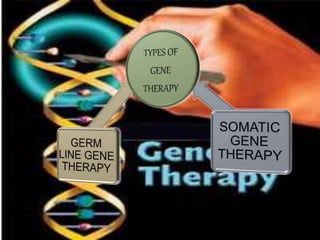
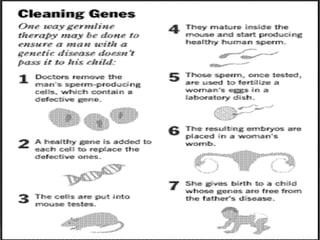
GERM LINE GENE THERAPY
 Result in permanent changes.
 Potential for offering a permanent therapeutic
effect for all who inherit the target gene.
 Possibility of eliminating some diseases from a
particular family.
 Also raises controversy:
 Some people view this type of therapy as
unnatural, and liken it to "playing God”.
 Others have concerns about the technical
aspects.
SOMATIC GENE THERAPY
 Affects only the targeted cells in the
patient, and is not passed to future
generations.
 Short-lived because the cells of most
tissues ultimately die and are replaced by
new cells.
 Transporting the gene to the target cells or
tissue is also problematic.
 Appropriate and acceptable for many
disorders, including cystic fibrosis,
muscular dystrophy, cancer, and certain
infectious diseases.
Types of somatic gene therapy
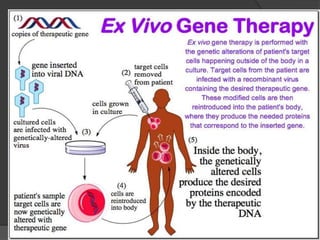
 Ex vivo
 cells are modified
outside the body and
then transplanted
back in again
 called ex vivo
because the cells are
treated outside the
body
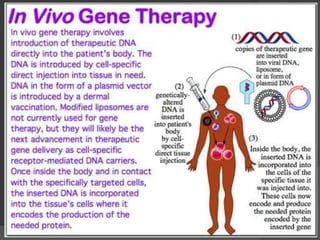
 In vivo
 genes are changed in
cells when the cells
are still in the body
 called in vivo because
the gene is
transferred to cells
inside the patient’s
body
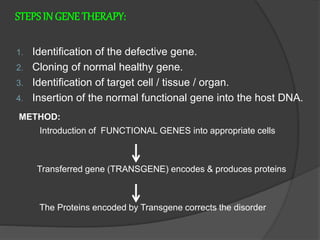
STEPSIN GENE THERAPY:
1. Identification of the defective gene.
2. Cloning of normal healthy gene.
3. Identification of target cell / tissue / organ.
4. Insertion of the normal functional gene into the host DNA.
METHOD:
Introduction of FUNCTIONAL GENES into appropriate cells
Transferred gene (TRANSGENE) encodes & produces proteins
The Proteins encoded by Transgene corrects the disorder
METHODS OF GENE DELIVERY:
1. PHYSICAL METHODS:
-Microinjection
-Aerosol
-Gene gun
2. CHEMICAL METHODS:
-Liposomes
3. BIOLOGICAL METHODS:
Viral Vectors like
-Retrovirus -Adenovirus
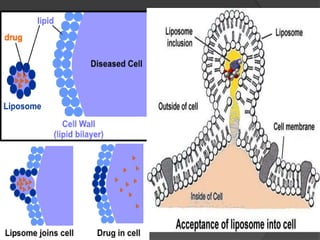
LIPOSOMES:
 These are lipid bilayers surrounding an aqueous vesicle.
 Can be used to introduce foreign DNA into a target cell.
Advantages:
 Safer when compared to Viral vectors.
 Can carry large DNA molecules.
Disadvantages:
 Inefficient transfer.
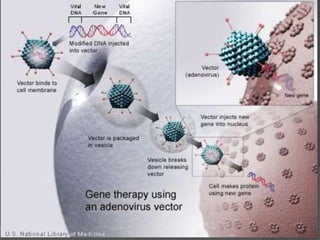
ADENO VIRUSES:
 Second most commonly used delivery system in gene
therapy.
 Adenoviruses can be produced at high titres in cultures.
Advantages:
 Can infect non-dividing cells , thus suitable for gene
therapy.
 Efficient gene transfer.
Disadvantages:.
 Provokes immune response.
VARIOUS STRATEGIES in GENE THERAPY:
1. GENE AUGMENTATION THERAPY
2. TARGETED MUTATION CORRECTION
3. INHIBITION OF GENE EXPRESSION
4. GENE THERAPY TO ACHIEVE
PHARMACOLOGICAL EFFECTS
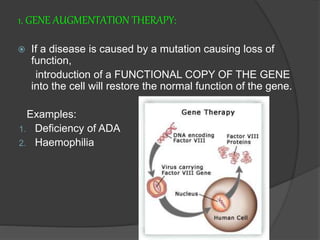
1. GENE AUGMENTATION THERAPY:
 If a disease is caused by a mutation causing loss of
function,
introduction of a FUNCTIONAL COPY OF THE GENE
into the cell will restore the normal function of the gene.
Examples:
1. Deficiency of ADA
2. Haemophilia
2. TARGETED MUTATION CORRECTION:
 Correction of mutation, by changing the mutated
nucleotide sequence to normal.
 Practically difficult, but in principle can be done by
homologous recombination.
3. INHIBITION OF GENE EXPRESSION
 In case of mutations that have a negative dominant effect,
the expression of the mutated gene can be blocked at the
DNA / RNA / protein level.
Examples:
This strategy is useful in Cancers caused by
inappropriate expression of a gene.
4. GENE THERAPY TO ACHIEVE PHARMACOLOGICAL EFFECTS:
 Examples:
1. Introduction of a gene that makes cancer cells
susceptible
to anticancer drugs.
2. Introduction of a toxic gene whose expression kills
cancer
cells.
3. Genes of cytokines can be introduced into cells of
immune
system to enhance their potential to kill diseased
cells.
ADVANTAGES OF GENE THERAPY
 Give a chance of a normal life to baby
born with genetic disease.
 Give hope of healthy life to cancer
patient.
 For certain disease that do not have any
cure except gene therapy, it could save
many lives
RISKS OF GENE THERAPY:
 1.Adverse reactions due to the virus or new
genes.
 2.Activation of proto-oncogene leading to
formation of ontogeny.
 3.Introduction of a mutation to the next
generation.
Any question
Genetic as medicine

Genetic as medicine

  • 1.
    Role of geneticas medicine (gene therapy) by- Vanlalmawia rol.no-12
  • 2.
    What is geneticdisorder/ diseases  caused by an abnormality in an individual's DNA.  Abnormalities can be as small as a single-base mutation in just one gene,  or they can involve the addition or subtraction of entire chromosomes.
  • 3.
    Types of GeneticDisorders Chromosomes and chromosome abnormalities  Addition or deletion of entire chromosomes or parts of chromosomes  example is trisomy 21 - Down syndrome
  • 4.
    Types of GeneticDisorders Single gene disorders  Single mutant gene has a large effect on the patient  Sickle cell anaemia - autosomal recessive  Haemophilia - X- linked
  • 5.
    Types of GeneticDisorders Polygenic Disorders  The most common yet still the least understood of human genetic diseases  Result from an interaction of multiple genes, each with a minor effect  Type I and type II diabetes, autism, osteoarthritis
  • 6.
    Types of GeneticDisorders Mutation and human disease  Three principal types of mutation  Single-base changes  Deletions/Insertions  Unstable repeat units  Two main effects  Loss of function  Gain of function
  • 7.
    What is GeneTherapy  correcting defective genes that are responsible for disease development  inserting a normal gene to replace an abnormal gene.
  • 8.
    What’s gene therapy? Imaginethat you accidentally broke one of your neighbor's windows. I. Stay silent II. Repair it with some tape III. Put in a new window Many medical conditions result from flaws, or mutations, in one or more of a person's genes. So, if a flawed gene caused our "broken window," can you "fix" it? What are your options? I. Stay silent II. Try to treat the disorder with drugs or other approaches III. Put in a normal, functioning copy of the gene
  • 9.
    How to fixit A B C a beneficial geneA virus modified virus  A virus is found which replicates by inserting its genes into the host cell's genome. This virus has three genes - A, B and C.  Gene A encodes a protein which allows this virus to insert itself into the host's genome.  Genes B and C actually cause the disease this virus is associated with.  Replace B and C with a beneficial gene. Thus, the modified virus could introduce your 'good gene' into the host cell's genome without causing any disease.  So we use the modified virus to fix the “broken window”
  • 10.
    Gene therapy  Researchersare studying gene therapy for a number of diseases, such as  Severe combined immuno-deficiencies (SCID)  Cancer  HIV, etc.
  • 11.
    HISTORYANDDEVELOPMENTOF GENETHERAPY  1960:The concepts of Gene Therapy was introduced  1970: Friedmann and Roblin author of a paper in Science titled "Gene therapy for human genetic disease?” cite the first attempt to perform gene therapy  1990:  The first approved gene therapy case at the National Institute of Health, U.K. It was performed on a four year old girl named Ashanti DaSilva. It was a treatment for a genetic defect that left her with an immune system deficiency  Sickle cell disease is successfully treated in mice
  • 12.
     2006: Scientistsat the National Institutes of Health (Bethesda, Maryland) have successfully treated metastatic melanoma in two patients. This study constitutes one of the first demonstrations that gene therapy can be effective in treating cancer.  2007- 2011: Research is still ongoing and the number of diseases that has been treated successfully by gene therapy increases.  Retinal disease  Color blindness  Adrenoleukodystrophy  2011: Medical community accepted that it can cure HIV as in 2008, Gero Hutter has cured a man from HIV using gene therapy
  • 14.
    GERM LINE GENETHERAPY  Result in permanent changes.  Potential for offering a permanent therapeutic effect for all who inherit the target gene.  Possibility of eliminating some diseases from a particular family.  Also raises controversy:  Some people view this type of therapy as unnatural, and liken it to "playing God”.  Others have concerns about the technical aspects.
  • 16.
    SOMATIC GENE THERAPY Affects only the targeted cells in the patient, and is not passed to future generations.  Short-lived because the cells of most tissues ultimately die and are replaced by new cells.  Transporting the gene to the target cells or tissue is also problematic.  Appropriate and acceptable for many disorders, including cystic fibrosis, muscular dystrophy, cancer, and certain infectious diseases.
  • 17.
    Types of somaticgene therapy  Ex vivo  cells are modified outside the body and then transplanted back in again  called ex vivo because the cells are treated outside the body  In vivo  genes are changed in cells when the cells are still in the body  called in vivo because the gene is transferred to cells inside the patient’s body
  • 20.
    STEPSIN GENE THERAPY: 1.Identification of the defective gene. 2. Cloning of normal healthy gene. 3. Identification of target cell / tissue / organ. 4. Insertion of the normal functional gene into the host DNA. METHOD: Introduction of FUNCTIONAL GENES into appropriate cells Transferred gene (TRANSGENE) encodes & produces proteins The Proteins encoded by Transgene corrects the disorder
  • 21.
    METHODS OF GENEDELIVERY: 1. PHYSICAL METHODS: -Microinjection -Aerosol -Gene gun 2. CHEMICAL METHODS: -Liposomes 3. BIOLOGICAL METHODS: Viral Vectors like -Retrovirus -Adenovirus
  • 22.
    LIPOSOMES:  These arelipid bilayers surrounding an aqueous vesicle.  Can be used to introduce foreign DNA into a target cell. Advantages:  Safer when compared to Viral vectors.  Can carry large DNA molecules. Disadvantages:  Inefficient transfer.
  • 24.
    ADENO VIRUSES:  Secondmost commonly used delivery system in gene therapy.  Adenoviruses can be produced at high titres in cultures. Advantages:  Can infect non-dividing cells , thus suitable for gene therapy.  Efficient gene transfer. Disadvantages:.  Provokes immune response.
  • 26.
    VARIOUS STRATEGIES inGENE THERAPY: 1. GENE AUGMENTATION THERAPY 2. TARGETED MUTATION CORRECTION 3. INHIBITION OF GENE EXPRESSION 4. GENE THERAPY TO ACHIEVE PHARMACOLOGICAL EFFECTS
  • 27.
    1. GENE AUGMENTATIONTHERAPY:  If a disease is caused by a mutation causing loss of function, introduction of a FUNCTIONAL COPY OF THE GENE into the cell will restore the normal function of the gene. Examples: 1. Deficiency of ADA 2. Haemophilia
  • 28.
    2. TARGETED MUTATIONCORRECTION:  Correction of mutation, by changing the mutated nucleotide sequence to normal.  Practically difficult, but in principle can be done by homologous recombination.
  • 29.
    3. INHIBITION OFGENE EXPRESSION  In case of mutations that have a negative dominant effect, the expression of the mutated gene can be blocked at the DNA / RNA / protein level. Examples: This strategy is useful in Cancers caused by inappropriate expression of a gene.
  • 30.
    4. GENE THERAPYTO ACHIEVE PHARMACOLOGICAL EFFECTS:  Examples: 1. Introduction of a gene that makes cancer cells susceptible to anticancer drugs. 2. Introduction of a toxic gene whose expression kills cancer cells. 3. Genes of cytokines can be introduced into cells of immune system to enhance their potential to kill diseased cells.
  • 31.
    ADVANTAGES OF GENETHERAPY  Give a chance of a normal life to baby born with genetic disease.  Give hope of healthy life to cancer patient.  For certain disease that do not have any cure except gene therapy, it could save many lives
  • 32.
    RISKS OF GENETHERAPY:  1.Adverse reactions due to the virus or new genes.  2.Activation of proto-oncogene leading to formation of ontogeny.  3.Introduction of a mutation to the next generation.
  • 33.