Generative Adversarial
Networks
Palacode Narayana Iyer Anantharaman
29 Oct 2018
References
• https://github.com/lukedeo/keras-acgan/blob/master/acgan-analysis.ipynb
• https://github.com/keras-team/keras/blob/master/examples/mnist_acgan.py
• https://skymind.ai/wiki/generative-adversarial-network-gan
• https://junyanz.github.io/CycleGAN/
• Self Attention Generative Adversarial Networks: Zhang et al
Why GAN?
• GANs can learn to mimic any distribution and generate data
• The data may be images, speech or music
• The outputs from GANs are found to be quite realistic and impressive
• Thus, GANs have a number of applications: From being a feature in products like
Photoshop to generating synthetic datasets for image augmentation
GAN Architecture
GAN Architecture
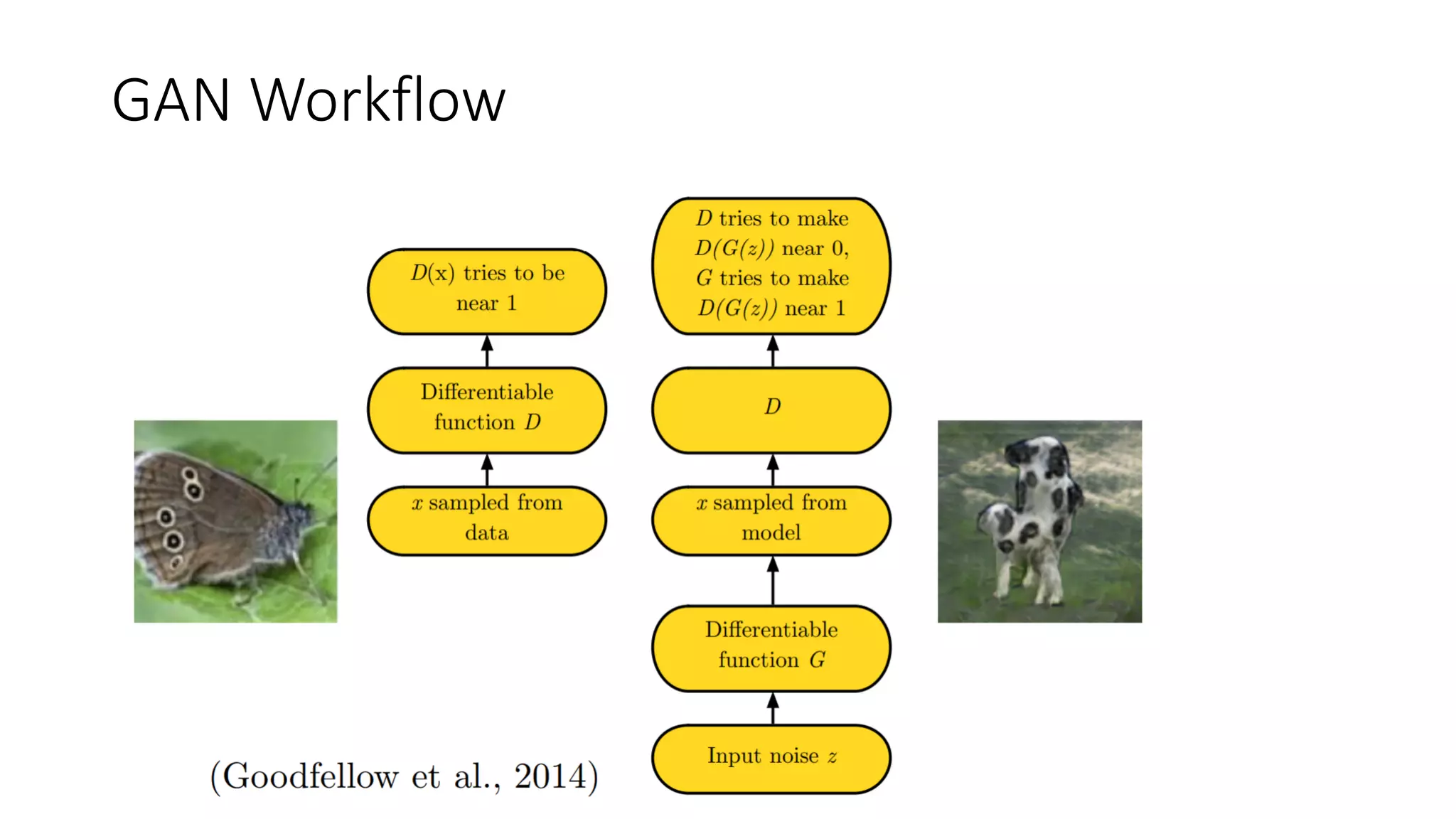
GAN Workflow
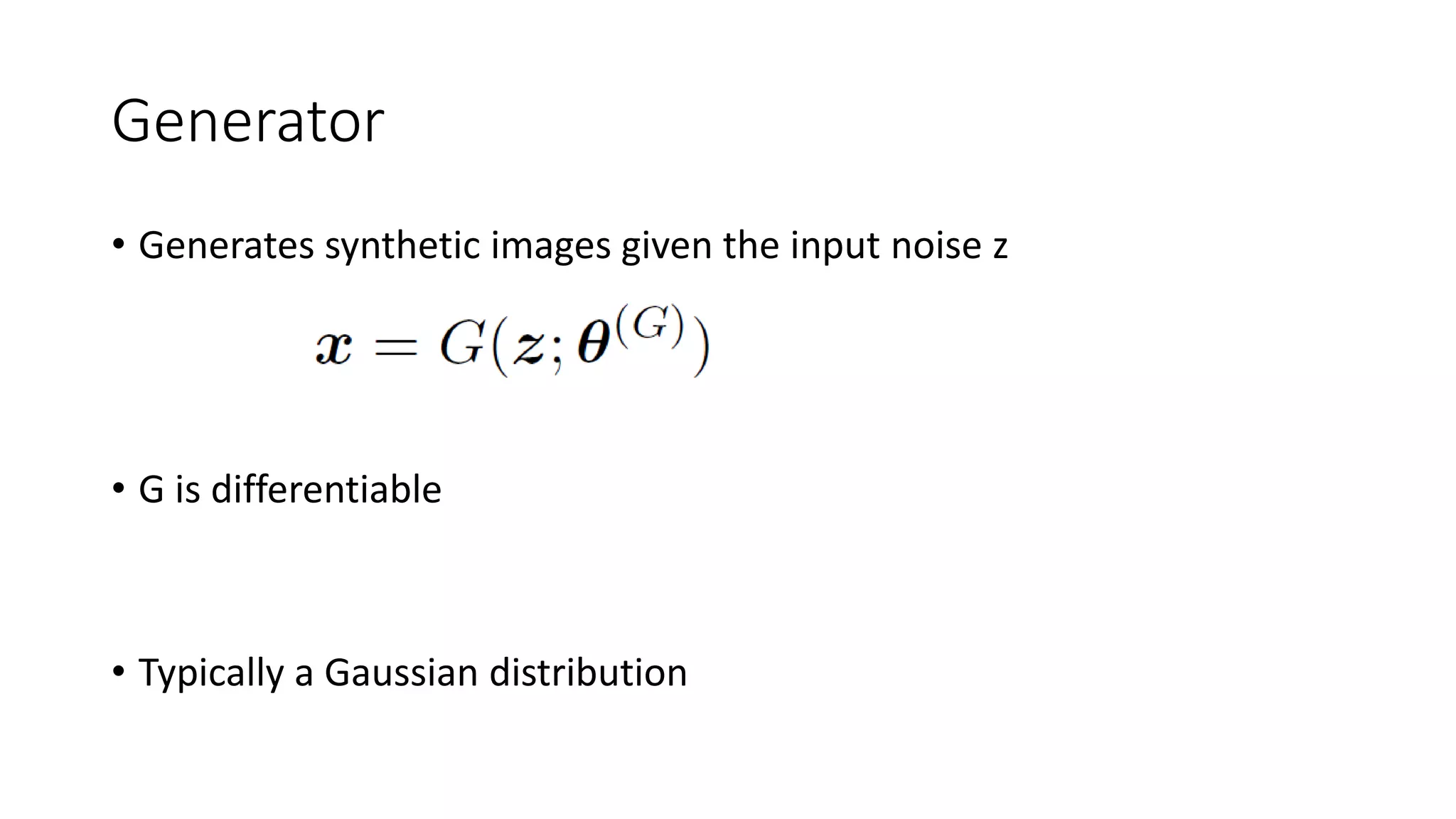
Generator
• Generates synthetic images given the input noise z
• G is differentiable
• Typically a Gaussian distribution
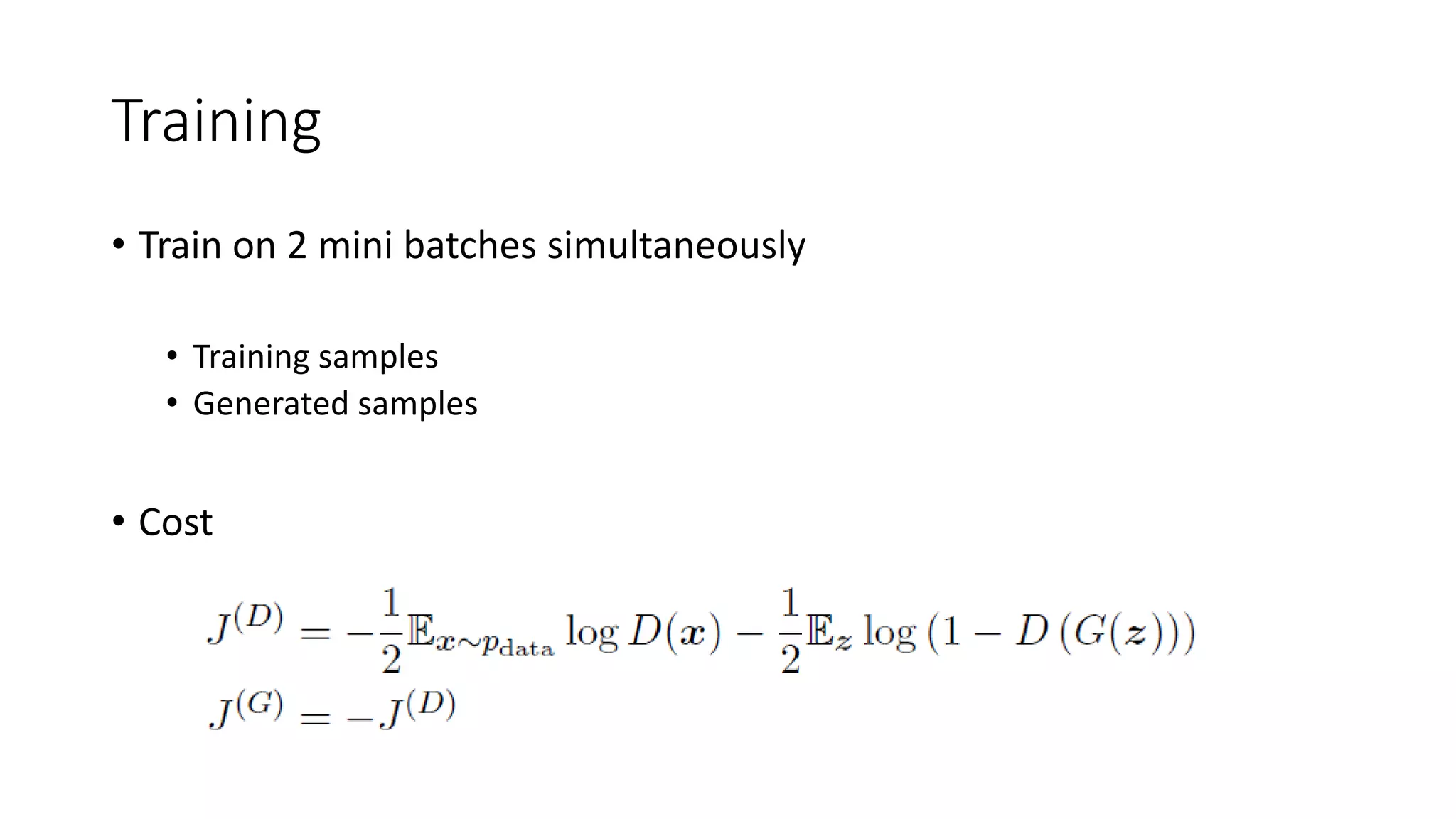
Training
• Train on 2 mini batches simultaneously
• Training samples
• Generated samples
• Cost
Cost Function
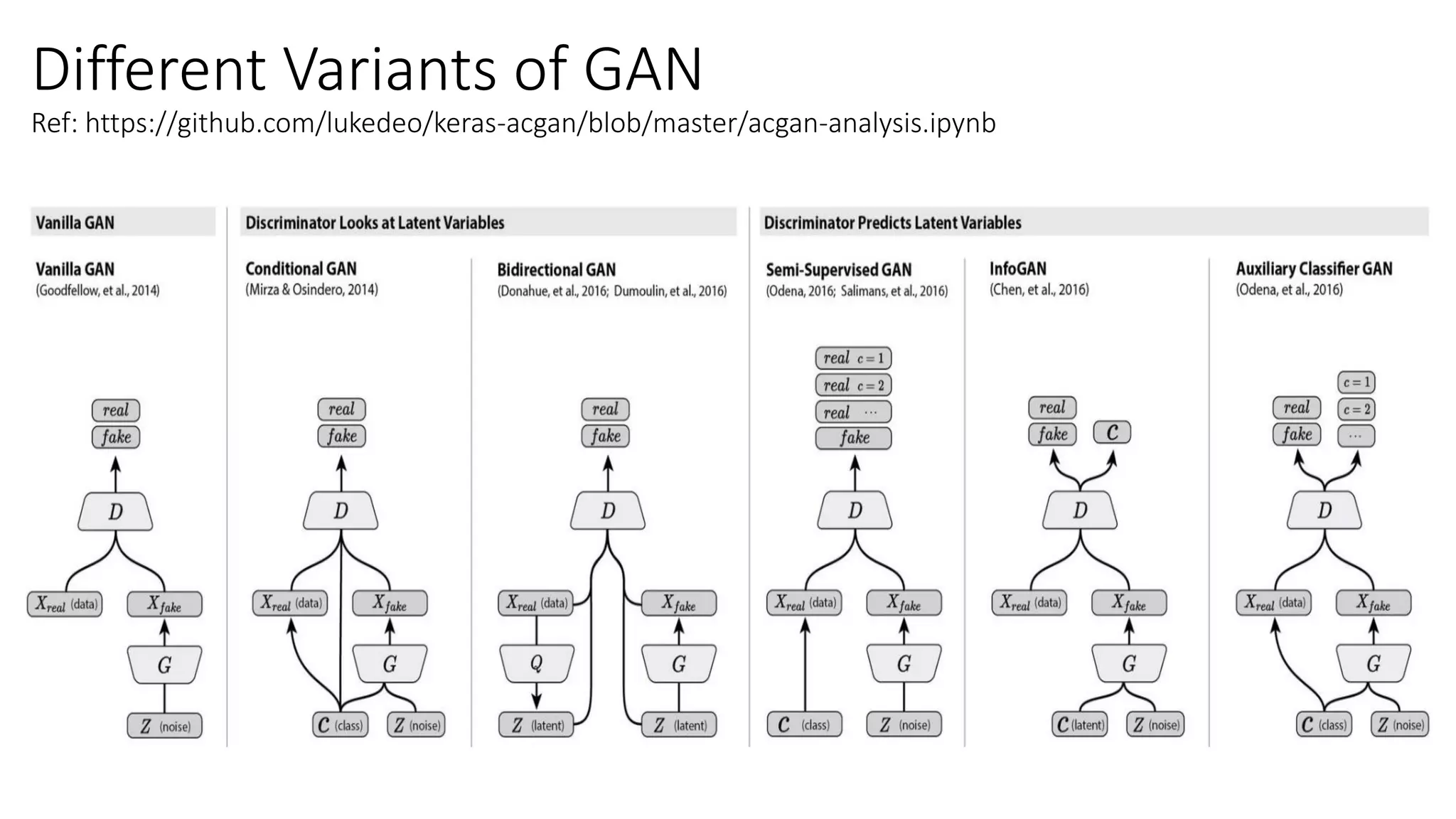
Different Variants of GAN
Ref: https://github.com/lukedeo/keras-acgan/blob/master/acgan-analysis.ipynb
Cycle GAN (2017)
• Original Paper: “Unpaired Image-to-Image Translation using Cycle-Consistent
Adversarial Networks”, Zhu et al
Image to Image Translation
• Image to image translation is aimed at finding a mapping
between an input image (X) and its corresponding output
image (Y), where the pair X, Y are provided in the dataset
• This assumes that we are provided with such a labelled
dataset with pairings
• CycleGAN attempts to find a mapping between images from
source and target domains in the absence of paired
examples
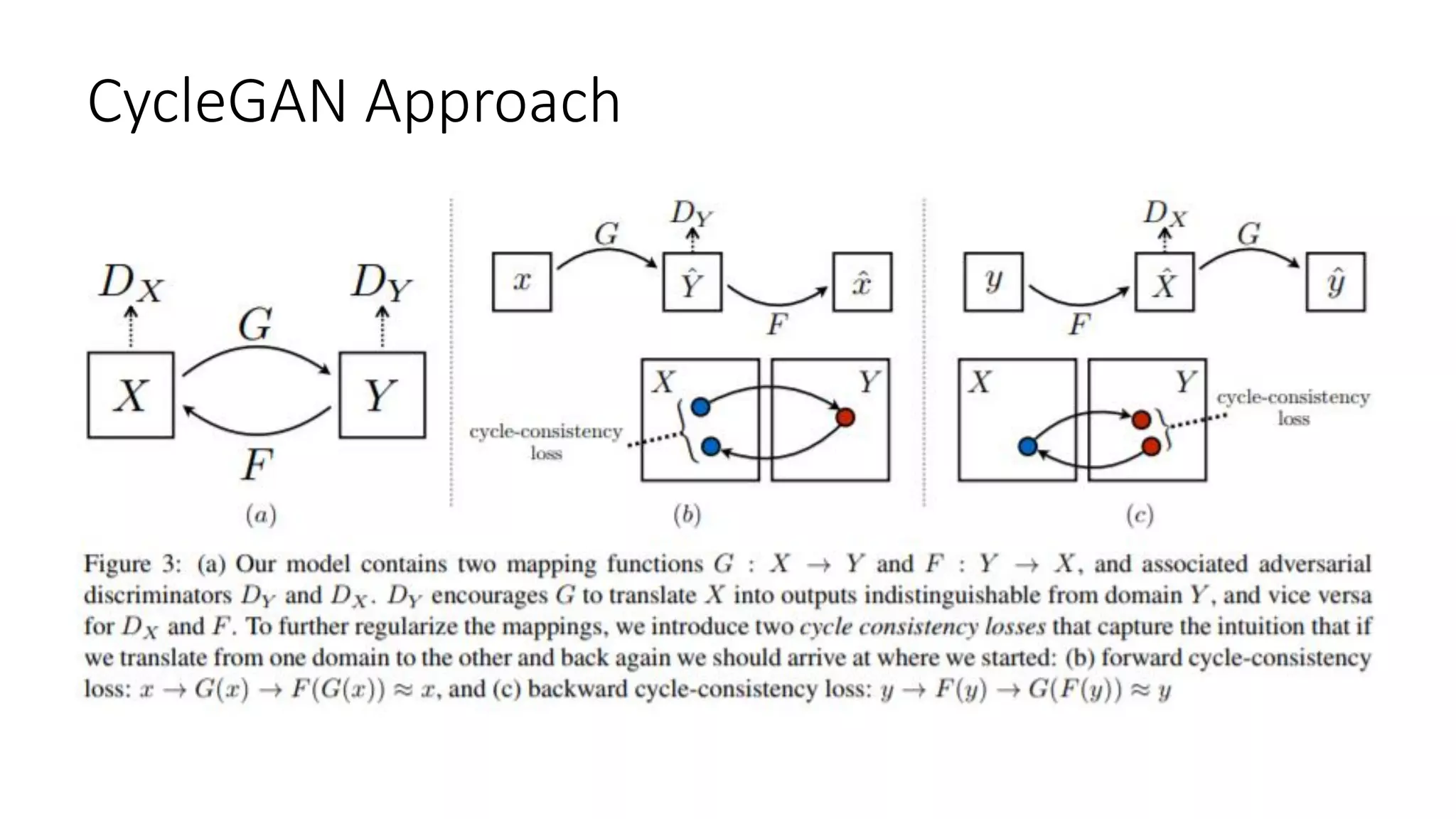
Learn G: X → Y such that the distribution of images from G(X) is
indistinguishable from the distribution Y using an adversarial
loss.
Couple this with an inverse mapping F: Y → X and enforce a
cycle consistency loss to enforce F(G(X)) ≈ X
CycleGAN Approach
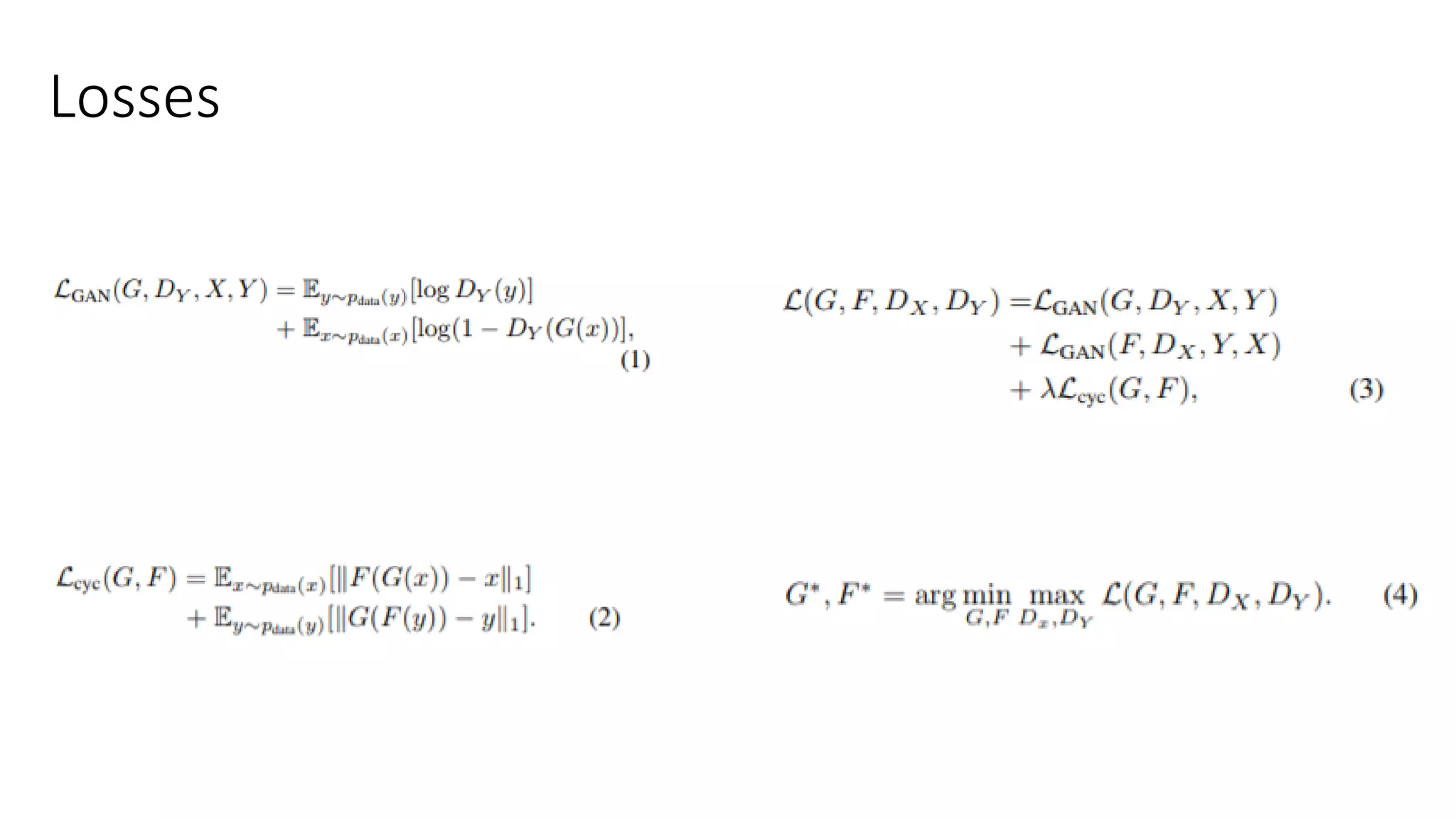
Cycle GAN: Objective Function
• Two discriminators: Dx and Dy where Dx aims to distinguish between images {x}
and translated images {F(y)}. In the same way Dy aims to discriminate between {y}
and {G(x)}
• The objective function has 2 parts representing the losses:
• adversarial losses for matching the distribution of generated images to the data distribution
in the target domain
• Cycle consistency losses that prevent the learned mappings G and F from contradicting each
other
Losses
Exercises
• Go through the original paper and answer the following:
• How is the model evaluated? What are the metrics?
• What are the main applications discussed in the paper?
• What are the limitations and future work?
SAGAN (2018) Zhang et al Abstract
• GANs often use a CNN as a generator
• CNNs capture short range dependencies very well (local receptive fields) but not
effective to capture long distance correlations
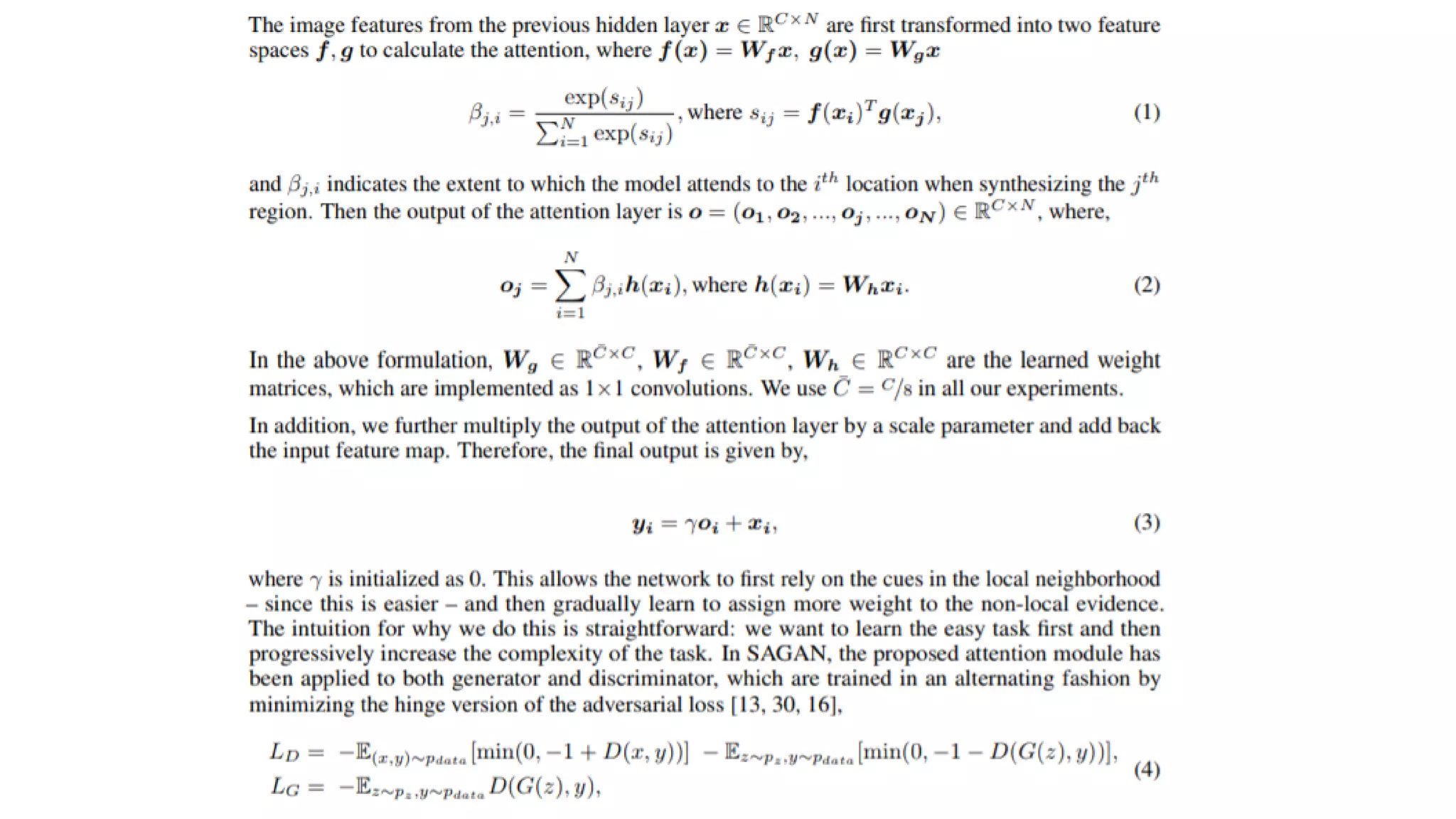
• Self Attention Generative Adversarial Networks (SAGAN) is aimed at generating
images that take in to account both short and long distance dependencies in the
source images
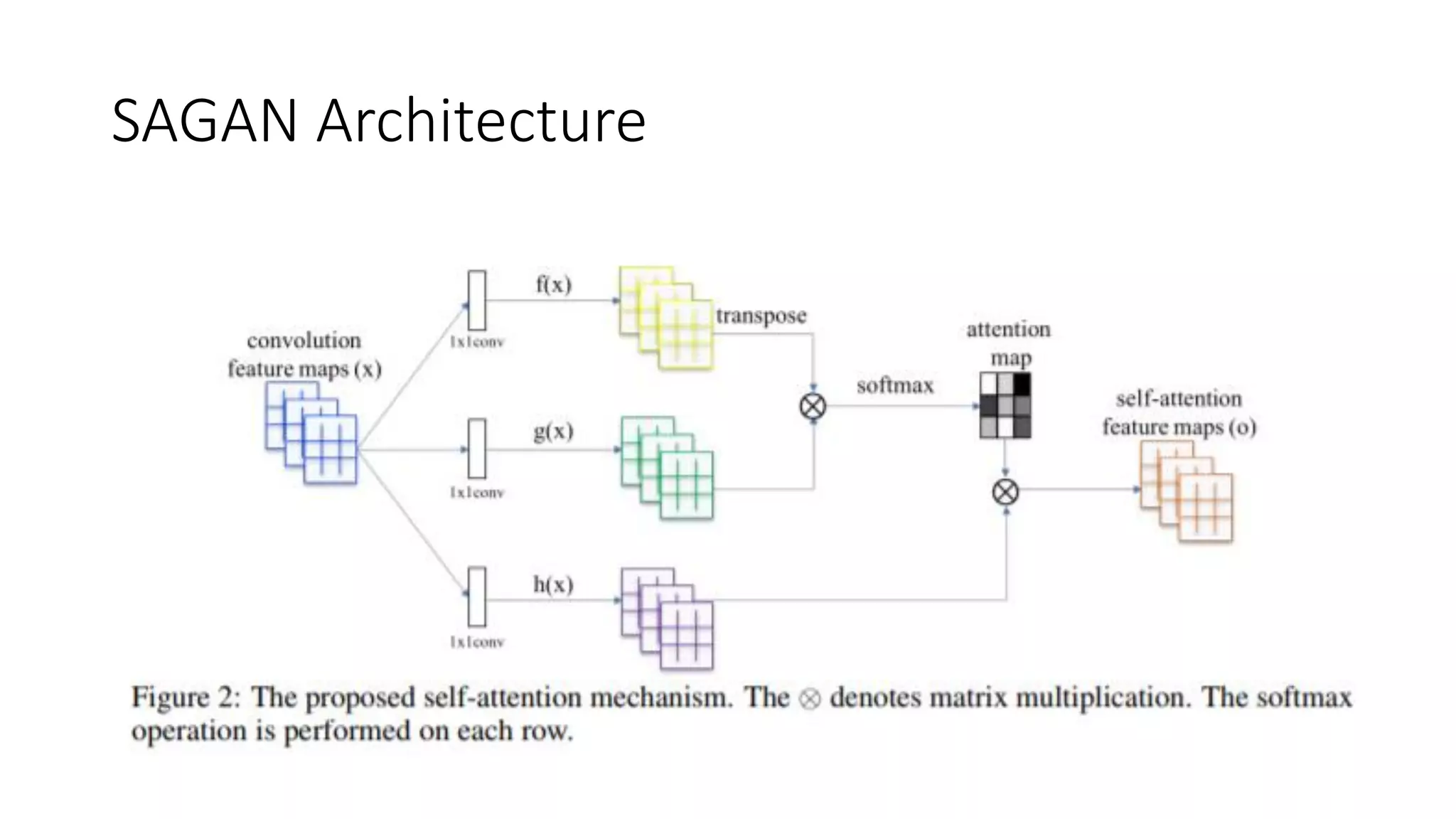
SAGAN
SAGAN Architecture
Generative Adversarial Networks : Basic architecture and variants

Generative Adversarial Networks : Basic architecture and variants

  • 1.
  • 2.
    References • https://github.com/lukedeo/keras-acgan/blob/master/acgan-analysis.ipynb • https://github.com/keras-team/keras/blob/master/examples/mnist_acgan.py •https://skymind.ai/wiki/generative-adversarial-network-gan • https://junyanz.github.io/CycleGAN/ • Self Attention Generative Adversarial Networks: Zhang et al
  • 3.
    Why GAN? • GANscan learn to mimic any distribution and generate data • The data may be images, speech or music • The outputs from GANs are found to be quite realistic and impressive • Thus, GANs have a number of applications: From being a feature in products like Photoshop to generating synthetic datasets for image augmentation
  • 4.
  • 5.
  • 6.
  • 7.
    Generator • Generates syntheticimages given the input noise z • G is differentiable • Typically a Gaussian distribution
  • 8.
    Training • Train on2 mini batches simultaneously • Training samples • Generated samples • Cost
  • 9.
  • 10.
    Different Variants ofGAN Ref: https://github.com/lukedeo/keras-acgan/blob/master/acgan-analysis.ipynb
  • 11.
    Cycle GAN (2017) •Original Paper: “Unpaired Image-to-Image Translation using Cycle-Consistent Adversarial Networks”, Zhu et al
  • 12.
    Image to ImageTranslation • Image to image translation is aimed at finding a mapping between an input image (X) and its corresponding output image (Y), where the pair X, Y are provided in the dataset • This assumes that we are provided with such a labelled dataset with pairings • CycleGAN attempts to find a mapping between images from source and target domains in the absence of paired examples Learn G: X → Y such that the distribution of images from G(X) is indistinguishable from the distribution Y using an adversarial loss. Couple this with an inverse mapping F: Y → X and enforce a cycle consistency loss to enforce F(G(X)) ≈ X
  • 13.
  • 14.
    Cycle GAN: ObjectiveFunction • Two discriminators: Dx and Dy where Dx aims to distinguish between images {x} and translated images {F(y)}. In the same way Dy aims to discriminate between {y} and {G(x)} • The objective function has 2 parts representing the losses: • adversarial losses for matching the distribution of generated images to the data distribution in the target domain • Cycle consistency losses that prevent the learned mappings G and F from contradicting each other
  • 15.
  • 16.
    Exercises • Go throughthe original paper and answer the following: • How is the model evaluated? What are the metrics? • What are the main applications discussed in the paper? • What are the limitations and future work?
  • 17.
    SAGAN (2018) Zhanget al Abstract • GANs often use a CNN as a generator • CNNs capture short range dependencies very well (local receptive fields) but not effective to capture long distance correlations • Self Attention Generative Adversarial Networks (SAGAN) is aimed at generating images that take in to account both short and long distance dependencies in the source images
  • 18.
  • 19.