Context-aware Preference
Modeling with Factorization
Balázs Hidasi
RecSys’15, Doctoral Symposium
19. September 2015
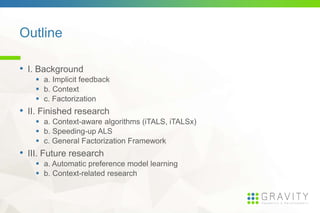
Outline
• I. Background
a. Implicit feedback
b. Context
c. Factorization
• II. Finished research
a. Context-aware algorithms (iTALS, iTALSx)
b. Speeding-up ALS
c. General Factorization Framework
• III. Future research
a. Automatic preference model learning
b. Context-related research
Background
Implicit feedback
• + The practical scenario
• + Collected by passive monitoring
• + Available in large quantities
• - Preferences are not explicit
• - Noisy positive feedback
• - No negative feedback
• - Missing feedback needs to be handled
Context
• Context: Additional side information that can help refining
the recommendations and tailoring them in order to fit the
users’ actual needs better.
• Context helps:
Dealing with context related effects during training
Adapting recommendation lists during recommendation time
• Types
User side information: user metadata, social networks, etc.
Item side information: item metadata, etc.
Context of transactions: time, location, device, etc.
Factorization
• Project entities into a low dimensional latent feature
space
• The interaction between the representations estimate
the preferences
Research
Context-aware algorithms [1,2]
• iTALS / iTALSx
Pointwise preference estimation
ALS learning
Scales linearly with the number of transactions
Different models
• Models for different problems
Low number of features, sparser data
iTALSx
Denser data, using higher number of
features is possible iTALS
User-
item-
context
relation
Item feature
matrix
Userfeature
matrix
≈ Preference
tensor
(R)
Item feature
matrixUserfeature
matrix
≈
Items
Users
User-item
realtion
Item-context
relation
User-context
relation
N-way model (iTALS) Pairwise interaction model (iTALSx)
Speeding up ALS [3]
• ALS scales cubically (quadratically in practice) with the
number of features
Bottleneck: solving a system of linear equations
Highly impractical to use high factor models
• Approximate solutions for speed-up
ALS-CG: conjugate gradient based direct approximation of ALS
o Efficiency depends on matrix-vector multiplication
ALS-CD: optimize on a feature-by-feature basis (instead of
computing whole feature vectors)
o Implicit case: lots of negative examples compression
Speed-up results
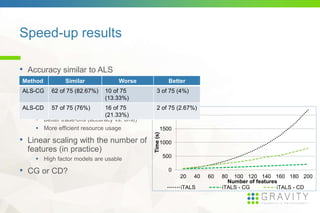
• Accuracy similar to ALS
• Significant speed-up
Better trade-offs (accuracy vs. time)
More efficient resource usage
• Linear scaling with the number of
features (in practice)
High factor models are usable
• CG or CD? 0
500
1000
1500
2000
20 40 60 80 100 120 140 160 180 200
Time(s)
Number of features
iTALS iTALS - CG iTALS - CD
Method Similar Worse Better
ALS-CG 62 of 75 (82.67%) 10 of 75 (13.33%) 3 of 75 (4%)
ALS-CD 57 of 75 (76%) 16 of 75 (21.33%) 2 of 75 (2.67%)
GFF: General Factorization Framework [4]
• An algorithm that allows experimentation with novel models for the context-
aware recommendation problem, that are not restricted to the two main model
classes used by the state-of-the-art.
• Motivation
dimensions lots of different possible preference models
Standard models not necessarily fit the problem (e.q. asymmetry)
Lack of tool that has this flexibility
• Features
No restriction on the context
Large preference model class
Data type independence
Flexibility
Scalability
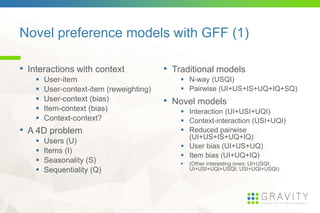
Novel preference models with GFF (1)
• Interactions with context
User-item
User-context-item
(reweighting)
User-context (bias)
Item-context (bias)
Context-context?
• A 4D problem
Users (U)
Items (I)
Seasonality (S)
Sequentiality (Q)
• Traditional models
N-way (USQI)
Pairwise (UI+US+IS+UQ+IQ+SQ)
• Novel models
Interaction (UI+USI+UQI)
Context-interaction (USI+UQI)
Reduced pairwise
(UI+US+IS+UQ+IQ)
User bias (UI+US+UQ)
Item bias (UI+UQ+IQ)
(Other interesting ones: UI+USQI;
UI+USI+UQI+USQI; USI+UQI+USQI)
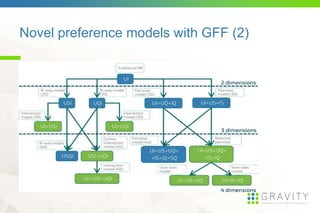
Novel preference models with GFF (2)
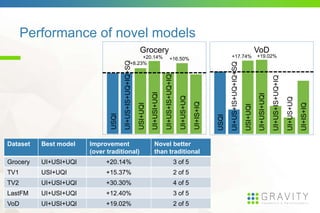
Performance of novel models
Dataset Best model Improvement
(over traditional)
Novel better
than traditional
Grocery UI+USI+UQI +20.14% 3 of 5
TV1 USI+UQI +15.37% 2 of 5
TV2 UI+USI+UQI +30.30% 4 of 5
LastFM UI+USI+UQI +12.40% 3 of 5
VoD UI+USI+UQI +19.02% 2 of 5
Grocery VoD
USQI
UI+US+IS+UQ+IQ+SQ
USI+UQI
UI+USI+UQI
UI+US+IS+UQ+IQ
UI+US+UQ
UI+IS+IQ
USQI
UI+US+IS+UQ+IQ+SQ
USI+UQI
UI+USI+UQI
UI+US+IS+UQ+IQ
UI+US+UQ
UI+IS+IQ
+8.23%
+20.14% +16.50% +17.74% +19.02%
Future research
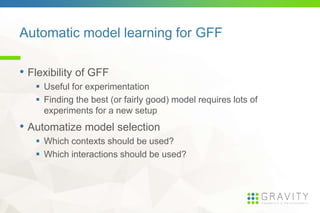
Automatic model learning for GFF
• Flexibility of GFF
Useful for experimentation
Finding the best (or fairly good) model requires lots of
experiments for a new setup
• Automatize model selection
Which contexts should be used?
Which interactions should be used?
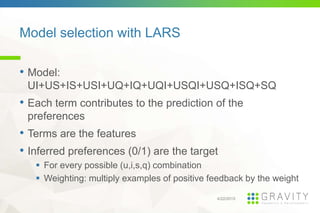
Model selection with LARS
4/22/2015
• Model: UI+US+IS+USI+UQ+IQ+UQI+USQI+USQ+ISQ+SQ
• Each term contributes to the prediction of the
preferences
• Terms are the features
• Inferred preferences (0/1) are the target
For every possible (u,i,s,q) combination
Weighting: multiply examples of positive feedback by the
weight
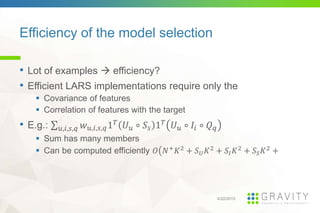
Efficiency of the model selection
4/22/2015
• Lot of examples efficiency?
• Efficient LARS implementations require only the
Covariance of features
Correlation of features with the target
• E.g.: ∑ , , , 1 ∘ 1 ∘ ∘, , ,
Sum has many members
Can be computed efficiently
Precomputed covariance matrices and sums of vectors required
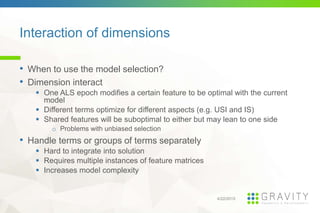
Interaction of dimensions
4/22/2015
• When to use the model selection?
• Dimension interact
One ALS epoch modifies a certain feature to be optimal with the current
model
Different terms optimize for different aspects (e.g. USI and IS)
Shared features will be suboptimal to either but may lean to one side
o Problems with unbiased selection
• Handle terms or groups of terms separately
Hard to integrate into solution
Requires multiple instances of feature matrices
Increases model complexity
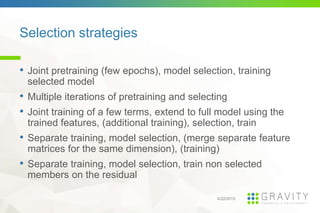
Selection strategies
4/22/2015
• Joint pretraining (few epochs), model selection, training
selected model
• Multiple iterations of pretraining and selecting
• Joint training of a few terms, extend to full model using the
trained features, (additional training), selection, train
• Separate training, model selection, (merge separate feature
matrices for the same dimension), (training)
• Separate training, model selection, train non selected
members on the residual
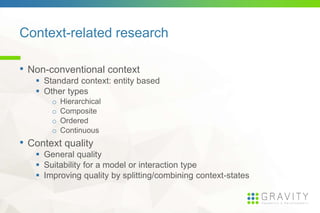
Context-related research
• Non-conventional context
Standard context: entity based
Other types
o Hierarchical
o Composite
o Ordered
o Continuous
• Context quality
General quality
Suitability for a model or interaction type
Improving quality by splitting/combining context-states
Thank you!
References (papers can be downloaded from http://hidasi.eu)
[1] Balázs Hidasi and Domonkos Tikk: Fast ALS-based tensor factorization for context-aware recommendation from implicit
feedback. ECML-PKDD (2012)
[2] Balázs Hidasi: Factorization models for context-aware recommendations. Infocommunications Journal VI(4) (2014)
[3] Balázs Hidasi and Domonkos Tikk: Speeding up ALS learning via approximate methods for context-aware
recommendations. Knowledge and Information Systems (2015)
[4] Balázs Hidasi and Domonkos Tikk: General factorization framework for context-aware recommendations. Data Mining and
Knowledge Discovery (2015)

Context-aware preference modeling with factorization

  • 1.
    Context-aware Preference Modeling withFactorization Balázs Hidasi RecSys’15, Doctoral Symposium 19. September 2015
  • 2.
    Outline • I. Background a.Implicit feedback b. Context c. Factorization • II. Finished research a. Context-aware algorithms (iTALS, iTALSx) b. Speeding-up ALS c. General Factorization Framework • III. Future research a. Automatic preference model learning b. Context-related research
  • 3.
  • 4.
    Implicit feedback • +The practical scenario • + Collected by passive monitoring • + Available in large quantities • - Preferences are not explicit • - Noisy positive feedback • - No negative feedback • - Missing feedback needs to be handled
  • 5.
    Context • Context: Additionalside information that can help refining the recommendations and tailoring them in order to fit the users’ actual needs better. • Context helps: Dealing with context related effects during training Adapting recommendation lists during recommendation time • Types User side information: user metadata, social networks, etc. Item side information: item metadata, etc. Context of transactions: time, location, device, etc.
  • 6.
    Factorization • Project entitiesinto a low dimensional latent feature space • The interaction between the representations estimate the preferences
  • 7.
  • 8.
    Context-aware algorithms [1,2] •iTALS / iTALSx Pointwise preference estimation ALS learning Scales linearly with the number of transactions Different models • Models for different problems Low number of features, sparser data iTALSx Denser data, using higher number of features is possible iTALS User- item- context relation Item feature matrix Userfeature matrix ≈ Preference tensor (R) Item feature matrixUserfeature matrix ≈ Items Users User-item realtion Item-context relation User-context relation N-way model (iTALS) Pairwise interaction model (iTALSx)
  • 9.
    Speeding up ALS[3] • ALS scales cubically (quadratically in practice) with the number of features Bottleneck: solving a system of linear equations Highly impractical to use high factor models • Approximate solutions for speed-up ALS-CG: conjugate gradient based direct approximation of ALS o Efficiency depends on matrix-vector multiplication ALS-CD: optimize on a feature-by-feature basis (instead of computing whole feature vectors) o Implicit case: lots of negative examples compression
  • 10.
    Speed-up results • Accuracysimilar to ALS • Significant speed-up Better trade-offs (accuracy vs. time) More efficient resource usage • Linear scaling with the number of features (in practice) High factor models are usable • CG or CD? 0 500 1000 1500 2000 20 40 60 80 100 120 140 160 180 200 Time(s) Number of features iTALS iTALS - CG iTALS - CD Method Similar Worse Better ALS-CG 62 of 75 (82.67%) 10 of 75 (13.33%) 3 of 75 (4%) ALS-CD 57 of 75 (76%) 16 of 75 (21.33%) 2 of 75 (2.67%)
  • 11.
    GFF: General FactorizationFramework [4] • An algorithm that allows experimentation with novel models for the context- aware recommendation problem, that are not restricted to the two main model classes used by the state-of-the-art. • Motivation dimensions lots of different possible preference models Standard models not necessarily fit the problem (e.q. asymmetry) Lack of tool that has this flexibility • Features No restriction on the context Large preference model class Data type independence Flexibility Scalability
  • 12.
    Novel preference modelswith GFF (1) • Interactions with context User-item User-context-item (reweighting) User-context (bias) Item-context (bias) Context-context? • A 4D problem Users (U) Items (I) Seasonality (S) Sequentiality (Q) • Traditional models N-way (USQI) Pairwise (UI+US+IS+UQ+IQ+SQ) • Novel models Interaction (UI+USI+UQI) Context-interaction (USI+UQI) Reduced pairwise (UI+US+IS+UQ+IQ) User bias (UI+US+UQ) Item bias (UI+UQ+IQ) (Other interesting ones: UI+USQI; UI+USI+UQI+USQI; USI+UQI+USQI)
  • 13.
  • 14.
    Performance of novelmodels Dataset Best model Improvement (over traditional) Novel better than traditional Grocery UI+USI+UQI +20.14% 3 of 5 TV1 USI+UQI +15.37% 2 of 5 TV2 UI+USI+UQI +30.30% 4 of 5 LastFM UI+USI+UQI +12.40% 3 of 5 VoD UI+USI+UQI +19.02% 2 of 5 Grocery VoD USQI UI+US+IS+UQ+IQ+SQ USI+UQI UI+USI+UQI UI+US+IS+UQ+IQ UI+US+UQ UI+IS+IQ USQI UI+US+IS+UQ+IQ+SQ USI+UQI UI+USI+UQI UI+US+IS+UQ+IQ UI+US+UQ UI+IS+IQ +8.23% +20.14% +16.50% +17.74% +19.02%
  • 15.
  • 16.
    Automatic model learningfor GFF • Flexibility of GFF Useful for experimentation Finding the best (or fairly good) model requires lots of experiments for a new setup • Automatize model selection Which contexts should be used? Which interactions should be used?
  • 17.
    Model selection withLARS 4/22/2015 • Model: UI+US+IS+USI+UQ+IQ+UQI+USQI+USQ+ISQ+SQ • Each term contributes to the prediction of the preferences • Terms are the features • Inferred preferences (0/1) are the target For every possible (u,i,s,q) combination Weighting: multiply examples of positive feedback by the weight
  • 18.
    Efficiency of themodel selection 4/22/2015 • Lot of examples efficiency? • Efficient LARS implementations require only the Covariance of features Correlation of features with the target • E.g.: ∑ , , , 1 ∘ 1 ∘ ∘, , , Sum has many members Can be computed efficiently Precomputed covariance matrices and sums of vectors required
  • 19.
    Interaction of dimensions 4/22/2015 •When to use the model selection? • Dimension interact One ALS epoch modifies a certain feature to be optimal with the current model Different terms optimize for different aspects (e.g. USI and IS) Shared features will be suboptimal to either but may lean to one side o Problems with unbiased selection • Handle terms or groups of terms separately Hard to integrate into solution Requires multiple instances of feature matrices Increases model complexity
  • 20.
    Selection strategies 4/22/2015 • Jointpretraining (few epochs), model selection, training selected model • Multiple iterations of pretraining and selecting • Joint training of a few terms, extend to full model using the trained features, (additional training), selection, train • Separate training, model selection, (merge separate feature matrices for the same dimension), (training) • Separate training, model selection, train non selected members on the residual
  • 21.
    Context-related research • Non-conventionalcontext Standard context: entity based Other types o Hierarchical o Composite o Ordered o Continuous • Context quality General quality Suitability for a model or interaction type Improving quality by splitting/combining context-states
  • 22.
    Thank you! References (paperscan be downloaded from http://hidasi.eu) [1] Balázs Hidasi and Domonkos Tikk: Fast ALS-based tensor factorization for context-aware recommendation from implicit feedback. ECML-PKDD (2012) [2] Balázs Hidasi: Factorization models for context-aware recommendations. Infocommunications Journal VI(4) (2014) [3] Balázs Hidasi and Domonkos Tikk: Speeding up ALS learning via approximate methods for context-aware recommendations. Knowledge and Information Systems (2015) [4] Balázs Hidasi and Domonkos Tikk: General factorization framework for context-aware recommendations. Data Mining and Knowledge Discovery (2015)