Linear Models
Palacode Narayana Iyer Anantharaman
Narayana dot Anantharaman at gmail dot com
23 Aug 2017
Copyright 2016 JNResearch, All Rights Reserved
Linear Models
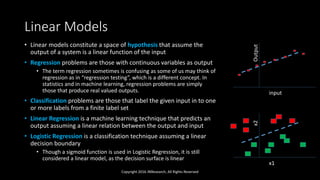
• Linear models constitute a space of hypothesis that assume the
output of a system is a linear function of the input
• Regression problems are those with continuous variables as output
• The term regression sometimes is confusing as some of us may think of
regression as in “regression testing”, which is a different concept. In
statistics and in machine learning, regression problems are simply
those that produce real valued outputs.
• Classification problems are those that label the given input in to one
or more labels from a finite label set
• Linear Regression is a machine learning technique that predicts an
output assuming a linear relation between the output and input
• Logistic Regression is a classification technique assuming a linear
decision boundary
• Though a sigmoid function is used in Logistic Regression, it is still
considered a linear model, as the decision surface is linear
Copyright 2016 JNResearch, All Rights Reserved
input
Output
x1
x2
Some Example applications of Linear Regression
• Time series predictions
• TV advertising: Given the TRP rating data across a number of TV programs, can we determine the serial to advertise?
• You are the director of a mega serial and you have the viewership information from past weeks. Can you predict the
future trends and do some intervention as needed?
• Evaluating trends and making forecasts
• Suppose your company offers infrastructure as a service over cloud and you are required to plan periodic upgrades to
the hardware. Given the customer acquisition rate, usage patterns, etc. can you predict the capacity upgrade?
• Assessing credit limits
• If you are a bank and have received a home loan application, can you determine the optimal loan amount and a
custom EMI scheme that maximizes mutual benefit?
• Predict the onset of a disease
• Given the historical data on patients with diabetes, predict the probability of a new patient getting this disease
Copyright 2016 JNResearch, All Rights Reserved
Example: Banking Sector (Ref ToI, 12th July 2016)
Understanding Machine Learning Models
• What does the model compute?
• Hypothesis
• How do we learn the parameters?
• Training
• How do we ensure we learnt the right parameters?
• Validation
• Given a trained model, how do we predict?
• Inference
• What can affect the performance of the model?
• Overfitting, Underfitting
• How do we measure the performance of the model?
• What are the limitations of the model?
• Precision, Recall, F1 Score, Confusion Matrix
Copyright 2016 JNResearch, All Rights Reserved
Measures
Copyright 2016 JNResearch, All Rights Reserved
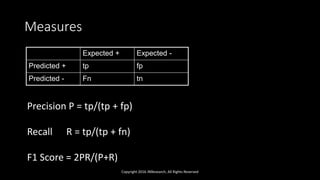
Expected + Expected -
Predicted + tp fp
Predicted - Fn tn
Precision P = tp/(tp + fp)
Recall R = tp/(tp + fn)
F1 Score = 2PR/(P+R)
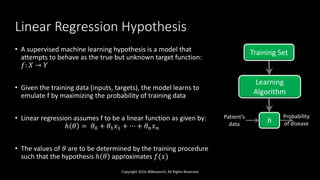
Linear Regression Hypothesis
• A supervised machine learning hypothesis is a model that
attempts to behave as the true but unknown target function:
𝑓: 𝑋 → 𝑌
• Given the training data (inputs, targets), the model learns to
emulate f by maximizing the probability of training data
• Linear regression assumes f to be a linear function as given by:
ℎ 𝜃 = 𝜃0 + 𝜃1 𝑥1 + ⋯ + 𝜃 𝑛 𝑥 𝑛
• The values of 𝜃 are to be determined by the training procedure
such that the hypothesis ℎ 𝜃 approximates 𝑓(𝑥)
Copyright 2016 JNResearch, All Rights Reserved
Training Set
Learning
Algorithm
h
Patient’s
data
Probability
of disease
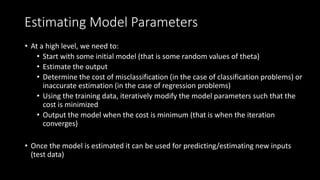
Estimating Model Parameters
• At a high level, we need to:
• Start with some initial model (that is some random values of theta)
• Estimate the output
• Determine the cost of misclassification (in the case of classification problems) or
inaccurate estimation (in the case of regression problems)
• Using the training data, iteratively modify the model parameters such that the
cost is minimized
• Output the model when the cost is minimum (that is when the iteration
converges)
• Once the model is estimated it can be used for predicting/estimating new inputs
(test data)
Cost Function for Linear Regression
• The cost function is often dictated by the requirements of the application.
Though several widely used cost functions (e.g. mean squared error) exist, one
may come up with his/her own if needed
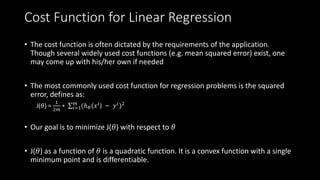
• The most commonly used cost function for regression problems is the squared
error, defines as:
J(𝜃) =
1
2𝑚
∗ 𝑖=1
𝑚
(ℎ 𝜃(𝑥 𝑖) − 𝑦 𝑖)2
• Our goal is to minimize J(𝜃) with respect to 𝜃
• J(𝜃) as a function of 𝜃 is a quadratic function. It is a convex function with a single
minimum point and is differentiable.
Finding the minimum of J(𝜃)
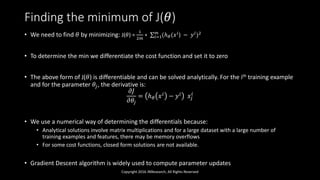
• We need to find 𝜃 by minimizing: J(𝜃) =
1
2𝑚
∗ 𝑖=1
𝑚
(ℎ 𝜃(𝑥 𝑖
) − 𝑦 𝑖
)2
• To determine the min we differentiate the cost function and set it to zero
• The above form of J(𝜃) is differentiable and can be solved analytically. For the ith training example
and for the parameter 𝜃𝑗, the derivative is:
𝜕𝐽
𝜕𝜃𝑗
= ℎ 𝜃 𝑥 𝑖 − 𝑦 𝑖 𝑥𝑗
𝑖
• We use a numerical way of determining the differentials because:
• Analytical solutions involve matrix multiplications and for a large dataset with a large number of
training examples and features, there may be memory overflows
• For some cost functions, closed form solutions are not available.
• Gradient Descent algorithm is widely used to compute parameter updates
Copyright 2016 JNResearch, All Rights Reserved
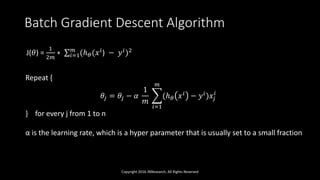
Batch Gradient Descent Algorithm
Copyright 2016 JNResearch, All Rights Reserved
J(𝜃) =
1
2𝑚
∗ 𝑖=1
𝑚
(ℎ 𝜃(𝑥 𝑖) − 𝑦 𝑖)2
Repeat {
𝜃𝑗 = 𝜃𝑗 − 𝛼
1
𝑚
𝑖=1
𝑚
(ℎ 𝜃 𝑥 𝑖 − 𝑦 𝑖)𝑥𝑗
𝑖
} for every j from 1 to n
α is the learning rate, which is a hyper parameter that is usually set to a small fraction
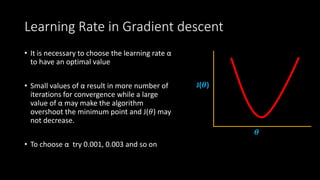
Learning Rate in Gradient descent
• It is necessary to choose the learning rate α
to have an optimal value
• Small values of α result in more number of
iterations for convergence while a large
value of α may make the algorithm
overshoot the minimum point and J(𝜃) may
not decrease.
• To choose α try 0.001, 0.003 and so on
J(𝜽)
𝜽
Effect of initialization
• Does the parameter initialization have an impact on determining the
right model that has minimum cost?
• What happens if we set all parameters to zero during initialization?
Copyright 2016 JNResearch, All Rights Reserved
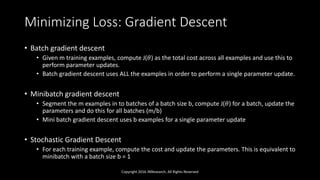
Minimizing Loss: Gradient Descent
• Batch gradient descent
• Given m training examples, compute J(𝜃) as the total cost across all examples and use this to
perform parameter updates.
• Batch gradient descent uses ALL the examples in order to perform a single parameter update.
• Minibatch gradient descent
• Segment the m examples in to batches of a batch size b, compute J(𝜃) for a batch, update the
parameters and do this for all batches (m/b)
• Mini batch gradient descent uses b examples for a single parameter update
• Stochastic Gradient Descent
• For each training example, compute the cost and update the parameters. This is equivalent to
minibatch with a batch size b = 1
Copyright 2016 JNResearch, All Rights Reserved
Applying Linear Regression to classification
• As described, linear regression produces the output as a continuous variable.
That is both h(x) as well as y are continuous variables.
• If we constrain y to be discrete, say -1 or 1, then the same linear regression model
can be applied to classification problems also.
• However the decision surfaces are inflexible
• They can be used to generate the initial model parameters to another more
specialized classification algorithm
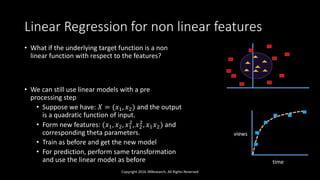
Linear Regression for non linear features
• What if the underlying target function is a non
linear function with respect to the features?
• We can still use linear models with a pre
processing step
• Suppose we have: 𝑋 = (𝑥1, 𝑥2) and the output
is a quadratic function of input.
• Form new features: (𝑥1, 𝑥2, 𝑥1
2
, 𝑥2
2
, 𝑥1 𝑥2) and
corresponding theta parameters.
• Train as before and get the new model
• For prediction, perform same transformation
and use the linear model as before
Copyright 2016 JNResearch, All Rights Reserved
time
views
Case Study
Copyright 2016 JNResearch, All Rights Reserved
• Problem
• Suppose we have videos of a TV serial that get uploaded on the YouTube on a daily basis
• Each day there will be a new episode and will be uploaded
• Our goal is to predict the number of views of any given episode on the day 3 after it was
uploaded.
• Assume that we don’t have access to the special analytics that YouTube may be providing to their
customers
• Solution
• Model the growth rate of the number of views with respect to time. This can be done by
visualizing the data and arriving at a suitable model.
• Perform the transformation of input vectors as needed
• Train the system with the data available from recent episodes
• Validate, test
Logistic Regression
Copyright 2016 JNResearch, All Rights Reserved
• Used for addressing classification problems
• Examples:
• Email Spam classification
• Loan approvals
• Text classification
• Here the output is a discrete value. For binary classification, where the output is
either 0 or 1, we have:
𝑦 ∈ {0, 1}
Logistic Regression: 0 ≤ ℎ 𝜃(𝑥) ≤ 1
Logistic Regression Hypothesis
Copyright 2016 JNResearch, All Rights Reserved
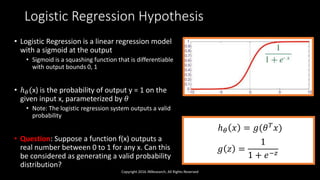
• Logistic Regression is a linear regression model
with a sigmoid at the output
• Sigmoid is a squashing function that is differentiable
with output bounds 0, 1
• ℎ 𝜃(x) is the probability of output y = 1 on the
given input x, parameterized by 𝜃
• Note: The logistic regression system outputs a valid
probability
• Question: Suppose a function f(x) outputs a
real number between 0 to 1 for any x. Can this
be considered as generating a valid probability
distribution?
ℎ 𝜃 𝑥 = 𝑔(𝜃 𝑇
𝑥)
𝑔 𝑧 =
1
1 + 𝑒−𝑧
Logistic Regression: Decision Boundary
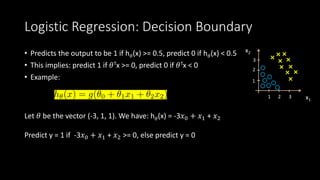
• Predicts the output to be 1 if h 𝜃(x) >= 0.5, predict 0 if h 𝜃(x) < 0.5
• This implies: predict 1 if 𝜃Tx >= 0, predict 0 if 𝜃Tx < 0
• Example:
Let 𝜃 be the vector (-3, 1, 1). We have: h 𝜃(x) = -3𝑥0 + 𝑥1 + 𝑥2
Predict y = 1 if -3𝑥0 + 𝑥1 + 𝑥2 >= 0, else predict y = 0
x1
x2
1 2 3
1
2
3
Logistic Regression Cost Function
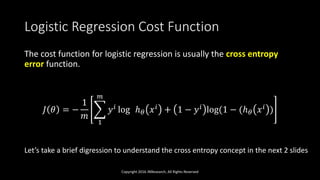
The cost function for logistic regression is usually the cross entropy
error function.
𝐽 𝜃 = −
1
𝑚
1
𝑚
𝑦 𝑖 log ℎ 𝜃 𝑥 𝑖 + 1 − 𝑦 𝑖 log(1 − (ℎ 𝜃 𝑥 𝑖 )
Copyright 2016 JNResearch, All Rights Reserved
Let’s take a brief digression to understand the cross entropy concept in the next 2 slides
Cost Function - intuition
𝐽 𝜃 = −
1
𝑚
1
𝑚
𝑦 𝑖 log ℎ 𝜃 𝑥 𝑖 + 1 − 𝑦 𝑖 log(1 − (ℎ 𝜃 𝑥 𝑖 )
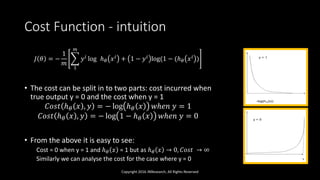
• The cost can be split in to two parts: cost incurred when
true output y = 0 and the cost when y = 1
𝐶𝑜𝑠𝑡 ℎ 𝜃 𝑥 , 𝑦 = − log ℎ 𝜃 𝑥 𝑤ℎ𝑒𝑛 𝑦 = 1
𝐶𝑜𝑠𝑡 ℎ 𝜃 𝑥 , 𝑦 = − log 1 − ℎ 𝜃 𝑥 𝑤ℎ𝑒𝑛 𝑦 = 0
• From the above it is easy to see:
Cost = 0 when y = 1 and ℎ 𝜃 𝑥 = 1 but as ℎ 𝜃 𝑥 → 0, 𝐶𝑜𝑠𝑡 → ∞
Similarly we can analyse the cost for the case where y = 0
Copyright 2016 JNResearch, All Rights Reserved
Gradient Descent for logistic regression
• Using the cross entropy error function with the logistic regression
hypothesis function, we can show that the derivatives turn out to be
of the same form as linear regression
• Hence the same gradient descent algorithm works for logistic
regression with ℎ 𝜃 𝑥 replaced with the sigmoid
Copyright 2016 JNResearch, All Rights Reserved
Overfitting and Underfitting
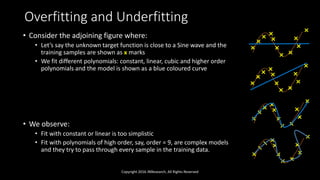
• Consider the adjoining figure where:
• Let’s say the unknown target function is close to a Sine wave and the
training samples are shown as x marks
• We fit different polynomials: constant, linear, cubic and higher order
polynomials and the model is shown as a blue coloured curve
• We observe:
• Fit with constant or linear is too simplistic
• Fit with polynomials of high order, say, order = 9, are complex models
and they try to pass through every sample in the training data.
Copyright 2016 JNResearch, All Rights Reserved
Underfitting: High Bias Problem
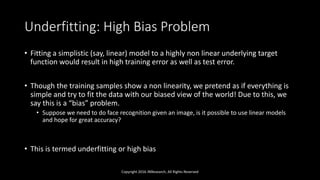
• Fitting a simplistic (say, linear) model to a highly non linear underlying target
function would result in high training error as well as test error.
• Though the training samples show a non linearity, we pretend as if everything is
simple and try to fit the data with our biased view of the world! Due to this, we
say this is a “bias” problem.
• Suppose we need to do face recognition given an image, is it possible to use linear models
and hope for great accuracy?
• This is termed underfitting or high bias
Copyright 2016 JNResearch, All Rights Reserved
Overfitting: High Variance Problem
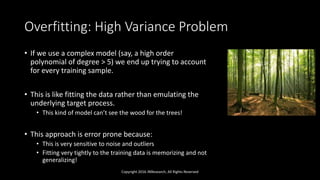
• If we use a complex model (say, a high order
polynomial of degree > 5) we end up trying to account
for every training sample.
• This is like fitting the data rather than emulating the
underlying target process.
• This kind of model can’t see the wood for the trees!
• This approach is error prone because:
• This is very sensitive to noise and outliers
• Fitting very tightly to the training data is memorizing and not
generalizing!
Copyright 2016 JNResearch, All Rights Reserved
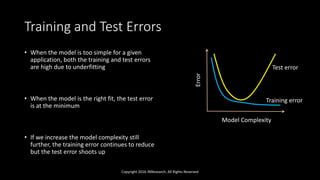
Training and Test Errors
• When the model is too simple for a given
application, both the training and test errors
are high due to underfitting
• When the model is the right fit, the test error
is at the minimum
• If we increase the model complexity still
further, the training error continues to reduce
but the test error shoots up
Copyright 2016 JNResearch, All Rights Reserved
Model Complexity
Error
Training error
Test error
If a model fits the training data well, it doesn’t
automatically mean that it would fit the test data well
Copyright 2016 JNResearch, All Rights Reserved
How to avoid underfitting?
• Assuming we have adequate amount of training data, we could
increase the model complexity
• Use a higher order polynomial to fit the data
• Use a more powerful model (Neural Nets, Deep Learning, etc)
• Add more relevant features
Copyright 2016 JNResearch, All Rights Reserved
How to avoid overfitting?
• When we use a complex model such as the one with higher order polynomials,
we need to keep the weights (theta values) small.
• Without any constraints in choosing the parameters, complex models tend to
have larger weights when they attempt to fit every training example.
• This is similar to having too many knobs to turn and each knob set to whatever value without
constraints in order to fit the data
• One way to minimize the impact of overfitting is to use regularization
Copyright 2016 JNResearch, All Rights Reserved
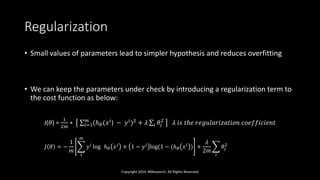
Regularization
• Small values of parameters lead to simpler hypothesis and reduces overfitting
• We can keep the parameters under check by introducing a regularization term to
the cost function as below:
J(𝜃) =
1
2𝑚
∗ 𝑖=1
𝑚
(ℎ 𝜃(𝑥 𝑖
) − 𝑦 𝑖
)2
+ 𝜆 𝑖 𝜃𝑗
2
𝜆 𝑖𝑠 𝑡ℎ𝑒 𝑟𝑒𝑔𝑢𝑙𝑎𝑟𝑖𝑧𝑎𝑡𝑖𝑜𝑛 𝑐𝑜𝑒𝑓𝑓𝑖𝑐𝑖𝑒𝑛𝑡
Copyright 2016 JNResearch, All Rights Reserved
𝐽 𝜃 = −
1
𝑚
1
𝑚
𝑦 𝑖
log ℎ 𝜃 𝑥 𝑖
+ 1 − 𝑦 𝑖
log(1 − (ℎ 𝜃 𝑥 𝑖
) +
𝜆
2𝑚
𝑖
𝜃𝑗
2
Multiclass Classification
• The logistic regression we discussed is a binary classifier
• Many real world applications may require a multi class classification
• Examples
• Text classification: Suppose we want to categorize a document in to (Technical, General,
Sports, Movies, Business). If there is a news article that reads something like: “Sachin
Tendulkar was awarded Bharat Ratna”, we might label this both as general news as well as an
item pertaining to sports.
Copyright 2016 JNResearch, All Rights Reserved
One vs All Logistic Classifier
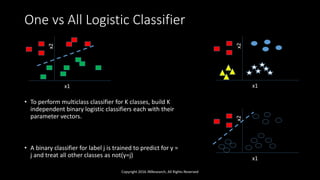
• To perform multiclass classifier for K classes, build K
independent binary logistic classifiers each with their
parameter vectors.
• A binary classifier for label j is trained to predict for y =
j and treat all other classes as not(y=j)
Copyright 2016 JNResearch, All Rights Reserved
x1
x2
x1
x2
x1
x2
How does Naïve Bayes Relates to Logistic
Regression?
• Some interesting questions to think about are:
• Does logistic regression have equivalence to Naïve Bayes Classifier?
• What kind of decision surface does the Naïve Bayes classify?
• With a few simple mathematical steps the equivalence between the
two models can be demonstrated
Copyright 2016 JNResearch, All Rights Reserved
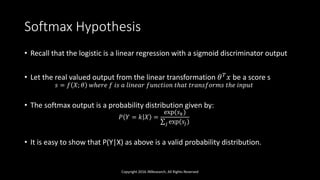
Softmax Classifier
• A multiclass logistic regression allows labelling over K classes (instead of just
binary) by running K independent regressors in parallel.
• Thus, the outputs 𝑖 ∈ 𝐾 𝑎𝑛𝑑 𝑗 ∈ 𝐾 𝑤ℎ𝑒𝑟𝑒 𝑖 ≠ 𝑗 are produced independently,
except that they share the same input.
• On many situations, it may be more useful to generate a probability distribution
over the output classes for a given input.
• Softmax classifier is a multinomial logistic regression classifier that addresses this
requirement
Copyright 2016 JNResearch, All Rights Reserved
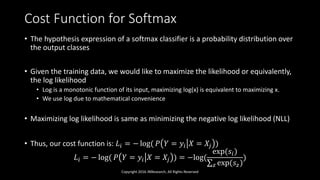
Softmax Hypothesis
• Recall that the logistic is a linear regression with a sigmoid discriminator output
• Let the real valued output from the linear transformation 𝜃 𝑇
𝑥 be a score s
𝑠 = 𝑓 𝑋; 𝜃 𝑤ℎ𝑒𝑟𝑒 𝑓 𝑖𝑠 𝑎 𝑙𝑖𝑛𝑒𝑎𝑟 𝑓𝑢𝑛𝑐𝑡𝑖𝑜𝑛 𝑡ℎ𝑎𝑡 𝑡𝑟𝑎𝑛𝑠𝑓𝑜𝑟𝑚𝑠 𝑡ℎ𝑒 𝑖𝑛𝑝𝑢𝑡
• The softmax output is a probability distribution given by:
𝑃 𝑌 = 𝑘 𝑋 =
exp(𝑠 𝑘)
𝑗 exp(𝑠𝑗)
• It is easy to show that P(Y|X) as above is a valid probability distribution.
Copyright 2016 JNResearch, All Rights Reserved
Cost Function for Softmax
• The hypothesis expression of a softmax classifier is a probability distribution over
the output classes
• Given the training data, we would like to maximize the likelihood or equivalently,
the log likelihood
• Log is a monotonic function of its input, maximizing log(x) is equivalent to maximizing x.
• We use log due to mathematical convenience
• Maximizing log likelihood is same as minimizing the negative log likelihood (NLL)
• Thus, our cost function is: 𝐿𝑖 = − log( 𝑃 𝑌 = 𝑦𝑖 𝑋 = 𝑋𝑗 )
𝐿𝑖 = − log( 𝑃 𝑌 = 𝑦𝑖 𝑋 = 𝑋𝑗 ) = −log(
exp(𝑠𝑖)
𝑧 exp(𝑠𝑧)
)
Copyright 2016 JNResearch, All Rights Reserved
Code Walkthrough
Copyright 2016 JNResearch, All Rights Reserved
Linear Models: Hands on
• We will work on 2 sample datasets:
• A toy dataset using a simulator
• Mobile devices specs dataset
• Our goal is to perform both regression and classification tasks on each of these
datasets
Copyright 2016 JNResearch, All Rights Reserved
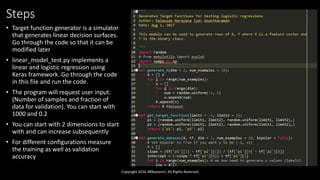
Steps
• Target function generator is a simulator
that generates linear decision surfaces.
Go through the code so that it can be
modified later
• linear_model_test.py implements a
linear and logistic regression using
Keras framework. Go through the code
in this file and run the code.
• The program will request user input:
(Number of samples and fraction of
data for validation). You can start with
1000 and 0.2
• You can start with 2 dimensions to start
with and can increase subsequently
• For different configurations measure
the training as well as validation
accuracy
Copyright 2016 JNResearch, All Rights Reserved
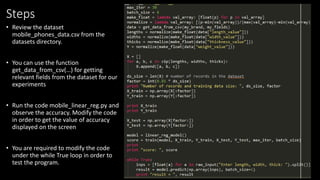
Steps
• Review the dataset
mobile_phones_data.csv from the
datasets directory.
• You can use the function
get_data_from_csv(…) for getting
relevant fields from the dataset for our
experiments
• Run the code mobile_linear_reg.py and
observe the accuracy. Modify the code
in order to get the value of accuracy
displayed on the screen
• You are required to modify the code
under the while True loop in order to
test the program.
Generative Versus Discriminative Models
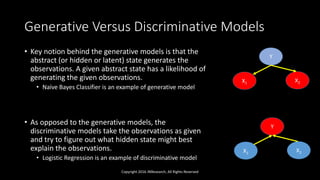
• Key notion behind the generative models is that the
abstract (or hidden or latent) state generates the
observations. A given abstract state has a likelihood of
generating the given observations.
• Naïve Bayes Classifier is an example of generative model
• As opposed to the generative models, the
discriminative models take the observations as given
and try to figure out what hidden state might best
explain the observations.
• Logistic Regression is an example of discriminative model
Copyright 2016 JNResearch, All Rights Reserved
Y
X1 X2
Y
X1 X2
Generative Versus Discriminative Models
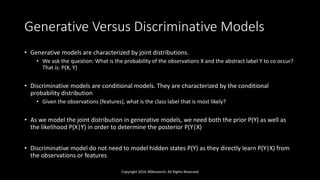
• Generative models are characterized by joint distributions.
• We ask the question: What is the probability of the observations X and the abstract label Y to co occur?
That is: P(X, Y)
• Discriminative models are conditional models. They are characterized by the conditional
probability distribution
• Given the observations (features), what is the class label that is most likely?
• As we model the joint distribution in generative models, we need both the prior P(Y) as well as
the likelihood P(X|Y) in order to determine the posterior P(Y|X)
• Discriminative model do not need to model hidden states P(Y) as they directly learn P(Y|X) from
the observations or features
Copyright 2016 JNResearch, All Rights Reserved
Back to the earlier case study…
• How do we apply logistic or softmax regression to the twitter search problem we discussed?
• For a domain specific problem like this (where the labels are fixed and given), we can take advantage of some
prior knowledge, instead of depending only on observed data
• Example of prior knowledge: The term “democrats” is associated with US Congress, Sonia with Indian National
Congress, Internet with Mobile World Congress and so on.
Copyright 2016 JNResearch, All Rights Reserved
Using Logistic for text classification problem
• A key issue to handle when using logistic or softmax for NLP applications is the
arbitrary variable length of sentences.
• When we use the words in a sentence as features (as we did in the case of Naïve
Bayes), the feature length n becomes a variable
• Logistic requires a fixed number of features and the associated theta parameters.
• Some options to consider to fit the input to a logistic:
• Regardless of the size of the input sentence, always form an n-feature vector. If the sentence
length is > n, chop off extra words and if it is < n, pad it suitably
• Split a long sentence in fixed size blocks of n
• As we observe, such pre processing of input for the sake of fitting it in to a
Logistic regression might degrade the prediction accuracy
• Solution: Use a different model 
Copyright 2016 JNResearch, All Rights Reserved
MaxEnt Models
• MaxEnt models support an elegant way to map a variable length input in to a
fixed size feature vector.
• This is a powerful model that has equivalence to logistic regression
• Many NLP problems can be reformulated as classification problems
• E.g. Language Modelling, Tagging Problems (these will be covered in detail later)
• MaxEnt is widely used for various text processing tasks.
• Task is to estimate the probability of a class given the context
• The term context may refer to a single word or group of words
• The key idea is to use a bunch of “feature functions” that map the input in to a
fixed length feature vector. Often these are Boolean functions.
• MaxEnt models are also termed as log-linear models
Copyright 2016 JNResearch, All Rights Reserved
Summary
• Linear models assume a linear decision boundary and are simple
models
• Though the models are simple, they are extensively used as:
• Stand alone classifiers
• As a layer or a building block in multi layer models (such as Neural Networks,
CNNs, RNNs)
• MaxEnt models are widely used in NLP applications
Copyright 2016 JNResearch, All Rights Reserved

Artificial Intelligence Course: Linear models

  • 1.
    Linear Models Palacode NarayanaIyer Anantharaman Narayana dot Anantharaman at gmail dot com 23 Aug 2017 Copyright 2016 JNResearch, All Rights Reserved
  • 2.
    Linear Models • Linearmodels constitute a space of hypothesis that assume the output of a system is a linear function of the input • Regression problems are those with continuous variables as output • The term regression sometimes is confusing as some of us may think of regression as in “regression testing”, which is a different concept. In statistics and in machine learning, regression problems are simply those that produce real valued outputs. • Classification problems are those that label the given input in to one or more labels from a finite label set • Linear Regression is a machine learning technique that predicts an output assuming a linear relation between the output and input • Logistic Regression is a classification technique assuming a linear decision boundary • Though a sigmoid function is used in Logistic Regression, it is still considered a linear model, as the decision surface is linear Copyright 2016 JNResearch, All Rights Reserved input Output x1 x2
  • 3.

    Some Example applicationsof Linear Regression • Time series predictions • TV advertising: Given the TRP rating data across a number of TV programs, can we determine the serial to advertise? • You are the director of a mega serial and you have the viewership information from past weeks. Can you predict the future trends and do some intervention as needed? • Evaluating trends and making forecasts • Suppose your company offers infrastructure as a service over cloud and you are required to plan periodic upgrades to the hardware. Given the customer acquisition rate, usage patterns, etc. can you predict the capacity upgrade? • Assessing credit limits • If you are a bank and have received a home loan application, can you determine the optimal loan amount and a custom EMI scheme that maximizes mutual benefit? • Predict the onset of a disease • Given the historical data on patients with diabetes, predict the probability of a new patient getting this disease Copyright 2016 JNResearch, All Rights Reserved
  • 4.
    Copyright 2016 JNResearch,All Rights Reserved Example: Banking Sector (Ref ToI, 12th July 2016)
  • 5.
    Understanding Machine LearningModels • What does the model compute? • Hypothesis • How do we learn the parameters? • Training • How do we ensure we learnt the right parameters? • Validation • Given a trained model, how do we predict? • Inference • What can affect the performance of the model? • Overfitting, Underfitting • How do we measure the performance of the model? • What are the limitations of the model? • Precision, Recall, F1 Score, Confusion Matrix Copyright 2016 JNResearch, All Rights Reserved
  • 6.
    Measures Copyright 2016 JNResearch,All Rights Reserved Expected + Expected - Predicted + tp fp Predicted - Fn tn Precision P = tp/(tp + fp) Recall R = tp/(tp + fn) F1 Score = 2PR/(P+R)
  • 7.
    Linear Regression Hypothesis •A supervised machine learning hypothesis is a model that attempts to behave as the true but unknown target function: 𝑓: 𝑋 → 𝑌 • Given the training data (inputs, targets), the model learns to emulate f by maximizing the probability of training data • Linear regression assumes f to be a linear function as given by: ℎ 𝜃 = 𝜃0 + 𝜃1 𝑥1 + ⋯ + 𝜃 𝑛 𝑥 𝑛 • The values of 𝜃 are to be determined by the training procedure such that the hypothesis ℎ 𝜃 approximates 𝑓(𝑥) Copyright 2016 JNResearch, All Rights Reserved Training Set Learning Algorithm h Patient’s data Probability of disease
  • 8.
    Estimating Model Parameters •At a high level, we need to: • Start with some initial model (that is some random values of theta) • Estimate the output • Determine the cost of misclassification (in the case of classification problems) or inaccurate estimation (in the case of regression problems) • Using the training data, iteratively modify the model parameters such that the cost is minimized • Output the model when the cost is minimum (that is when the iteration converges) • Once the model is estimated it can be used for predicting/estimating new inputs (test data)
  • 9.
    Cost Function forLinear Regression • The cost function is often dictated by the requirements of the application. Though several widely used cost functions (e.g. mean squared error) exist, one may come up with his/her own if needed • The most commonly used cost function for regression problems is the squared error, defines as: J(𝜃) = 1 2𝑚 ∗ 𝑖=1 𝑚 (ℎ 𝜃(𝑥 𝑖) − 𝑦 𝑖)2 • Our goal is to minimize J(𝜃) with respect to 𝜃 • J(𝜃) as a function of 𝜃 is a quadratic function. It is a convex function with a single minimum point and is differentiable.
  • 10.
    Finding the minimumof J(𝜃) • We need to find 𝜃 by minimizing: J(𝜃) = 1 2𝑚 ∗ 𝑖=1 𝑚 (ℎ 𝜃(𝑥 𝑖 ) − 𝑦 𝑖 )2 • To determine the min we differentiate the cost function and set it to zero • The above form of J(𝜃) is differentiable and can be solved analytically. For the ith training example and for the parameter 𝜃𝑗, the derivative is: 𝜕𝐽 𝜕𝜃𝑗 = ℎ 𝜃 𝑥 𝑖 − 𝑦 𝑖 𝑥𝑗 𝑖 • We use a numerical way of determining the differentials because: • Analytical solutions involve matrix multiplications and for a large dataset with a large number of training examples and features, there may be memory overflows • For some cost functions, closed form solutions are not available. • Gradient Descent algorithm is widely used to compute parameter updates Copyright 2016 JNResearch, All Rights Reserved
  • 11.
    Batch Gradient DescentAlgorithm Copyright 2016 JNResearch, All Rights Reserved J(𝜃) = 1 2𝑚 ∗ 𝑖=1 𝑚 (ℎ 𝜃(𝑥 𝑖) − 𝑦 𝑖)2 Repeat { 𝜃𝑗 = 𝜃𝑗 − 𝛼 1 𝑚 𝑖=1 𝑚 (ℎ 𝜃 𝑥 𝑖 − 𝑦 𝑖)𝑥𝑗 𝑖 } for every j from 1 to n α is the learning rate, which is a hyper parameter that is usually set to a small fraction
  • 12.
    Learning Rate inGradient descent • It is necessary to choose the learning rate α to have an optimal value • Small values of α result in more number of iterations for convergence while a large value of α may make the algorithm overshoot the minimum point and J(𝜃) may not decrease. • To choose α try 0.001, 0.003 and so on J(𝜽) 𝜽
  • 13.
    Effect of initialization •Does the parameter initialization have an impact on determining the right model that has minimum cost? • What happens if we set all parameters to zero during initialization? Copyright 2016 JNResearch, All Rights Reserved
  • 14.
    Minimizing Loss: GradientDescent • Batch gradient descent • Given m training examples, compute J(𝜃) as the total cost across all examples and use this to perform parameter updates. • Batch gradient descent uses ALL the examples in order to perform a single parameter update. • Minibatch gradient descent • Segment the m examples in to batches of a batch size b, compute J(𝜃) for a batch, update the parameters and do this for all batches (m/b) • Mini batch gradient descent uses b examples for a single parameter update • Stochastic Gradient Descent • For each training example, compute the cost and update the parameters. This is equivalent to minibatch with a batch size b = 1 Copyright 2016 JNResearch, All Rights Reserved
  • 15.
    Applying Linear Regressionto classification • As described, linear regression produces the output as a continuous variable. That is both h(x) as well as y are continuous variables. • If we constrain y to be discrete, say -1 or 1, then the same linear regression model can be applied to classification problems also. • However the decision surfaces are inflexible • They can be used to generate the initial model parameters to another more specialized classification algorithm
  • 16.
    Linear Regression fornon linear features • What if the underlying target function is a non linear function with respect to the features? • We can still use linear models with a pre processing step • Suppose we have: 𝑋 = (𝑥1, 𝑥2) and the output is a quadratic function of input. • Form new features: (𝑥1, 𝑥2, 𝑥1 2 , 𝑥2 2 , 𝑥1 𝑥2) and corresponding theta parameters. • Train as before and get the new model • For prediction, perform same transformation and use the linear model as before Copyright 2016 JNResearch, All Rights Reserved time views
  • 17.
    Case Study Copyright 2016JNResearch, All Rights Reserved • Problem • Suppose we have videos of a TV serial that get uploaded on the YouTube on a daily basis • Each day there will be a new episode and will be uploaded • Our goal is to predict the number of views of any given episode on the day 3 after it was uploaded. • Assume that we don’t have access to the special analytics that YouTube may be providing to their customers • Solution • Model the growth rate of the number of views with respect to time. This can be done by visualizing the data and arriving at a suitable model. • Perform the transformation of input vectors as needed • Train the system with the data available from recent episodes • Validate, test
  • 18.
    Logistic Regression Copyright 2016JNResearch, All Rights Reserved • Used for addressing classification problems • Examples: • Email Spam classification • Loan approvals • Text classification • Here the output is a discrete value. For binary classification, where the output is either 0 or 1, we have: 𝑦 ∈ {0, 1} Logistic Regression: 0 ≤ ℎ 𝜃(𝑥) ≤ 1
  • 19.
    Logistic Regression Hypothesis Copyright2016 JNResearch, All Rights Reserved • Logistic Regression is a linear regression model with a sigmoid at the output • Sigmoid is a squashing function that is differentiable with output bounds 0, 1 • ℎ 𝜃(x) is the probability of output y = 1 on the given input x, parameterized by 𝜃 • Note: The logistic regression system outputs a valid probability • Question: Suppose a function f(x) outputs a real number between 0 to 1 for any x. Can this be considered as generating a valid probability distribution? ℎ 𝜃 𝑥 = 𝑔(𝜃 𝑇 𝑥) 𝑔 𝑧 = 1 1 + 𝑒−𝑧
  • 20.
    Logistic Regression: DecisionBoundary • Predicts the output to be 1 if h 𝜃(x) >= 0.5, predict 0 if h 𝜃(x) < 0.5 • This implies: predict 1 if 𝜃Tx >= 0, predict 0 if 𝜃Tx < 0 • Example: Let 𝜃 be the vector (-3, 1, 1). We have: h 𝜃(x) = -3𝑥0 + 𝑥1 + 𝑥2 Predict y = 1 if -3𝑥0 + 𝑥1 + 𝑥2 >= 0, else predict y = 0 x1 x2 1 2 3 1 2 3
  • 21.
    Logistic Regression CostFunction The cost function for logistic regression is usually the cross entropy error function. 𝐽 𝜃 = − 1 𝑚 1 𝑚 𝑦 𝑖 log ℎ 𝜃 𝑥 𝑖 + 1 − 𝑦 𝑖 log(1 − (ℎ 𝜃 𝑥 𝑖 ) Copyright 2016 JNResearch, All Rights Reserved Let’s take a brief digression to understand the cross entropy concept in the next 2 slides
  • 22.
    Cost Function -intuition 𝐽 𝜃 = − 1 𝑚 1 𝑚 𝑦 𝑖 log ℎ 𝜃 𝑥 𝑖 + 1 − 𝑦 𝑖 log(1 − (ℎ 𝜃 𝑥 𝑖 ) • The cost can be split in to two parts: cost incurred when true output y = 0 and the cost when y = 1 𝐶𝑜𝑠𝑡 ℎ 𝜃 𝑥 , 𝑦 = − log ℎ 𝜃 𝑥 𝑤ℎ𝑒𝑛 𝑦 = 1 𝐶𝑜𝑠𝑡 ℎ 𝜃 𝑥 , 𝑦 = − log 1 − ℎ 𝜃 𝑥 𝑤ℎ𝑒𝑛 𝑦 = 0 • From the above it is easy to see: Cost = 0 when y = 1 and ℎ 𝜃 𝑥 = 1 but as ℎ 𝜃 𝑥 → 0, 𝐶𝑜𝑠𝑡 → ∞ Similarly we can analyse the cost for the case where y = 0 Copyright 2016 JNResearch, All Rights Reserved
  • 23.
    Gradient Descent forlogistic regression • Using the cross entropy error function with the logistic regression hypothesis function, we can show that the derivatives turn out to be of the same form as linear regression • Hence the same gradient descent algorithm works for logistic regression with ℎ 𝜃 𝑥 replaced with the sigmoid Copyright 2016 JNResearch, All Rights Reserved
  • 24.
    Overfitting and Underfitting •Consider the adjoining figure where: • Let’s say the unknown target function is close to a Sine wave and the training samples are shown as x marks • We fit different polynomials: constant, linear, cubic and higher order polynomials and the model is shown as a blue coloured curve • We observe: • Fit with constant or linear is too simplistic • Fit with polynomials of high order, say, order = 9, are complex models and they try to pass through every sample in the training data. Copyright 2016 JNResearch, All Rights Reserved
  • 25.
    Underfitting: High BiasProblem • Fitting a simplistic (say, linear) model to a highly non linear underlying target function would result in high training error as well as test error. • Though the training samples show a non linearity, we pretend as if everything is simple and try to fit the data with our biased view of the world! Due to this, we say this is a “bias” problem. • Suppose we need to do face recognition given an image, is it possible to use linear models and hope for great accuracy? • This is termed underfitting or high bias Copyright 2016 JNResearch, All Rights Reserved
  • 26.
    Overfitting: High VarianceProblem • If we use a complex model (say, a high order polynomial of degree > 5) we end up trying to account for every training sample. • This is like fitting the data rather than emulating the underlying target process. • This kind of model can’t see the wood for the trees! • This approach is error prone because: • This is very sensitive to noise and outliers • Fitting very tightly to the training data is memorizing and not generalizing! Copyright 2016 JNResearch, All Rights Reserved
  • 27.
    Training and TestErrors • When the model is too simple for a given application, both the training and test errors are high due to underfitting • When the model is the right fit, the test error is at the minimum • If we increase the model complexity still further, the training error continues to reduce but the test error shoots up Copyright 2016 JNResearch, All Rights Reserved Model Complexity Error Training error Test error
  • 28.
    If a modelfits the training data well, it doesn’t automatically mean that it would fit the test data well Copyright 2016 JNResearch, All Rights Reserved
  • 29.
    How to avoidunderfitting? • Assuming we have adequate amount of training data, we could increase the model complexity • Use a higher order polynomial to fit the data • Use a more powerful model (Neural Nets, Deep Learning, etc) • Add more relevant features Copyright 2016 JNResearch, All Rights Reserved
  • 30.
    How to avoidoverfitting? • When we use a complex model such as the one with higher order polynomials, we need to keep the weights (theta values) small. • Without any constraints in choosing the parameters, complex models tend to have larger weights when they attempt to fit every training example. • This is similar to having too many knobs to turn and each knob set to whatever value without constraints in order to fit the data • One way to minimize the impact of overfitting is to use regularization Copyright 2016 JNResearch, All Rights Reserved
  • 31.
    Regularization • Small valuesof parameters lead to simpler hypothesis and reduces overfitting • We can keep the parameters under check by introducing a regularization term to the cost function as below: J(𝜃) = 1 2𝑚 ∗ 𝑖=1 𝑚 (ℎ 𝜃(𝑥 𝑖 ) − 𝑦 𝑖 )2 + 𝜆 𝑖 𝜃𝑗 2 𝜆 𝑖𝑠 𝑡ℎ𝑒 𝑟𝑒𝑔𝑢𝑙𝑎𝑟𝑖𝑧𝑎𝑡𝑖𝑜𝑛 𝑐𝑜𝑒𝑓𝑓𝑖𝑐𝑖𝑒𝑛𝑡 Copyright 2016 JNResearch, All Rights Reserved 𝐽 𝜃 = − 1 𝑚 1 𝑚 𝑦 𝑖 log ℎ 𝜃 𝑥 𝑖 + 1 − 𝑦 𝑖 log(1 − (ℎ 𝜃 𝑥 𝑖 ) + 𝜆 2𝑚 𝑖 𝜃𝑗 2
  • 32.
    Multiclass Classification • Thelogistic regression we discussed is a binary classifier • Many real world applications may require a multi class classification • Examples • Text classification: Suppose we want to categorize a document in to (Technical, General, Sports, Movies, Business). If there is a news article that reads something like: “Sachin Tendulkar was awarded Bharat Ratna”, we might label this both as general news as well as an item pertaining to sports. Copyright 2016 JNResearch, All Rights Reserved
  • 33.
    One vs AllLogistic Classifier • To perform multiclass classifier for K classes, build K independent binary logistic classifiers each with their parameter vectors. • A binary classifier for label j is trained to predict for y = j and treat all other classes as not(y=j) Copyright 2016 JNResearch, All Rights Reserved x1 x2 x1 x2 x1 x2
  • 34.
    How does NaïveBayes Relates to Logistic Regression? • Some interesting questions to think about are: • Does logistic regression have equivalence to Naïve Bayes Classifier? • What kind of decision surface does the Naïve Bayes classify? • With a few simple mathematical steps the equivalence between the two models can be demonstrated Copyright 2016 JNResearch, All Rights Reserved
  • 35.
    Softmax Classifier • Amulticlass logistic regression allows labelling over K classes (instead of just binary) by running K independent regressors in parallel. • Thus, the outputs 𝑖 ∈ 𝐾 𝑎𝑛𝑑 𝑗 ∈ 𝐾 𝑤ℎ𝑒𝑟𝑒 𝑖 ≠ 𝑗 are produced independently, except that they share the same input. • On many situations, it may be more useful to generate a probability distribution over the output classes for a given input. • Softmax classifier is a multinomial logistic regression classifier that addresses this requirement Copyright 2016 JNResearch, All Rights Reserved
  • 36.
    Softmax Hypothesis • Recallthat the logistic is a linear regression with a sigmoid discriminator output • Let the real valued output from the linear transformation 𝜃 𝑇 𝑥 be a score s 𝑠 = 𝑓 𝑋; 𝜃 𝑤ℎ𝑒𝑟𝑒 𝑓 𝑖𝑠 𝑎 𝑙𝑖𝑛𝑒𝑎𝑟 𝑓𝑢𝑛𝑐𝑡𝑖𝑜𝑛 𝑡ℎ𝑎𝑡 𝑡𝑟𝑎𝑛𝑠𝑓𝑜𝑟𝑚𝑠 𝑡ℎ𝑒 𝑖𝑛𝑝𝑢𝑡 • The softmax output is a probability distribution given by: 𝑃 𝑌 = 𝑘 𝑋 = exp(𝑠 𝑘) 𝑗 exp(𝑠𝑗) • It is easy to show that P(Y|X) as above is a valid probability distribution. Copyright 2016 JNResearch, All Rights Reserved
  • 37.
    Cost Function forSoftmax • The hypothesis expression of a softmax classifier is a probability distribution over the output classes • Given the training data, we would like to maximize the likelihood or equivalently, the log likelihood • Log is a monotonic function of its input, maximizing log(x) is equivalent to maximizing x. • We use log due to mathematical convenience • Maximizing log likelihood is same as minimizing the negative log likelihood (NLL) • Thus, our cost function is: 𝐿𝑖 = − log( 𝑃 𝑌 = 𝑦𝑖 𝑋 = 𝑋𝑗 ) 𝐿𝑖 = − log( 𝑃 𝑌 = 𝑦𝑖 𝑋 = 𝑋𝑗 ) = −log( exp(𝑠𝑖) 𝑧 exp(𝑠𝑧) ) Copyright 2016 JNResearch, All Rights Reserved
  • 38.
    Code Walkthrough Copyright 2016JNResearch, All Rights Reserved
  • 39.
    Linear Models: Handson • We will work on 2 sample datasets: • A toy dataset using a simulator • Mobile devices specs dataset • Our goal is to perform both regression and classification tasks on each of these datasets Copyright 2016 JNResearch, All Rights Reserved
  • 40.
    Steps • Target functiongenerator is a simulator that generates linear decision surfaces. Go through the code so that it can be modified later • linear_model_test.py implements a linear and logistic regression using Keras framework. Go through the code in this file and run the code. • The program will request user input: (Number of samples and fraction of data for validation). You can start with 1000 and 0.2 • You can start with 2 dimensions to start with and can increase subsequently • For different configurations measure the training as well as validation accuracy Copyright 2016 JNResearch, All Rights Reserved
  • 41.
    Steps • Review thedataset mobile_phones_data.csv from the datasets directory. • You can use the function get_data_from_csv(…) for getting relevant fields from the dataset for our experiments • Run the code mobile_linear_reg.py and observe the accuracy. Modify the code in order to get the value of accuracy displayed on the screen • You are required to modify the code under the while True loop in order to test the program.
  • 42.
    Generative Versus DiscriminativeModels • Key notion behind the generative models is that the abstract (or hidden or latent) state generates the observations. A given abstract state has a likelihood of generating the given observations. • Naïve Bayes Classifier is an example of generative model • As opposed to the generative models, the discriminative models take the observations as given and try to figure out what hidden state might best explain the observations. • Logistic Regression is an example of discriminative model Copyright 2016 JNResearch, All Rights Reserved Y X1 X2 Y X1 X2
  • 43.
    Generative Versus DiscriminativeModels • Generative models are characterized by joint distributions. • We ask the question: What is the probability of the observations X and the abstract label Y to co occur? That is: P(X, Y) • Discriminative models are conditional models. They are characterized by the conditional probability distribution • Given the observations (features), what is the class label that is most likely? • As we model the joint distribution in generative models, we need both the prior P(Y) as well as the likelihood P(X|Y) in order to determine the posterior P(Y|X) • Discriminative model do not need to model hidden states P(Y) as they directly learn P(Y|X) from the observations or features Copyright 2016 JNResearch, All Rights Reserved
  • 44.
    Back to theearlier case study… • How do we apply logistic or softmax regression to the twitter search problem we discussed? • For a domain specific problem like this (where the labels are fixed and given), we can take advantage of some prior knowledge, instead of depending only on observed data • Example of prior knowledge: The term “democrats” is associated with US Congress, Sonia with Indian National Congress, Internet with Mobile World Congress and so on. Copyright 2016 JNResearch, All Rights Reserved
  • 45.
    Using Logistic fortext classification problem • A key issue to handle when using logistic or softmax for NLP applications is the arbitrary variable length of sentences. • When we use the words in a sentence as features (as we did in the case of Naïve Bayes), the feature length n becomes a variable • Logistic requires a fixed number of features and the associated theta parameters. • Some options to consider to fit the input to a logistic: • Regardless of the size of the input sentence, always form an n-feature vector. If the sentence length is > n, chop off extra words and if it is < n, pad it suitably • Split a long sentence in fixed size blocks of n • As we observe, such pre processing of input for the sake of fitting it in to a Logistic regression might degrade the prediction accuracy • Solution: Use a different model  Copyright 2016 JNResearch, All Rights Reserved
  • 46.
    MaxEnt Models • MaxEntmodels support an elegant way to map a variable length input in to a fixed size feature vector. • This is a powerful model that has equivalence to logistic regression • Many NLP problems can be reformulated as classification problems • E.g. Language Modelling, Tagging Problems (these will be covered in detail later) • MaxEnt is widely used for various text processing tasks. • Task is to estimate the probability of a class given the context • The term context may refer to a single word or group of words • The key idea is to use a bunch of “feature functions” that map the input in to a fixed length feature vector. Often these are Boolean functions. • MaxEnt models are also termed as log-linear models Copyright 2016 JNResearch, All Rights Reserved
  • 47.
    Summary • Linear modelsassume a linear decision boundary and are simple models • Though the models are simple, they are extensively used as: • Stand alone classifiers • As a layer or a building block in multi layer models (such as Neural Networks, CNNs, RNNs) • MaxEnt models are widely used in NLP applications Copyright 2016 JNResearch, All Rights Reserved