Edit distance and
applications
Anantharaman Narayana Iyer
Narayana dot Anantharaman at gmail dot com
3 Sep 2015
Objective
• Porter stemmer: we will mention it briefly and let you go through this
at home
• Discuss in depth the concept of edit distance computation using
dynamic programming
• Look at a few applications
References
• Speech And Language Processing,
2nd Edition by Dan Jurafsky and
James Martin
• Natural Language Processing,
Coursera online learning course by
Dan Jurafsky and Christopher
Manning
• Home page of Dr Martin Porter:
http://tartarus.org/~martin/Porter
Stemmer/
• Wikipedia (for certain definitions
of linguistic terminology)
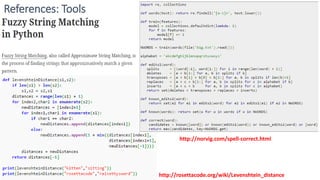
References: Tools
http://rosettacode.org/wiki/Levenshtein_distance
http://norvig.com/spell-correct.html
Edit Distance
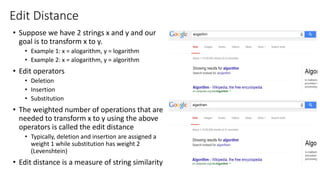
• Suppose we have 2 strings x and y and our
goal is to transform x to y.
• Example 1: x = alogarithm, y = logarithm
• Example 2: x = alogarithm, y = algorithm
• Edit operators
• Deletion
• Insertion
• Substitution
• The weighted number of operations that are
needed to transform x to y using the above
operators is called the edit distance
• Typically, deletion and insertion are assigned a
weight 1 while substitution has weight 2
(Levenshtein)
• Edit distance is a measure of string similarity
Example
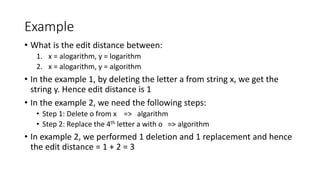
• What is the edit distance between:
1. x = alogarithm, y = logarithm
2. x = alogarithm, y = algorithm
• In the example 1, by deleting the letter a from string x, we get the
string y. Hence edit distance is 1
• In the example 2, we need the following steps:
• Step 1: Delete o from x => algarithm
• Step 2: Replace the 4th letter a with o => algorithm
• In example 2, we performed 1 deletion and 1 replacement and hence
the edit distance = 1 + 2 = 3
Why is this needed?
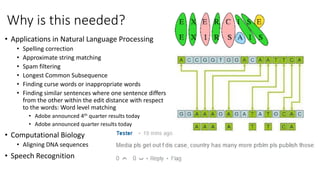
• Applications in Natural Language Processing
• Spelling correction
• Approximate string matching
• Spam filtering
• Longest Common Subsequence
• Finding curse words or inappropriate words
• Finding similar sentences where one sentence differs
from the other within the edit distance with respect
to the words: Word level matching
• Adobe announced 4th quarter results today
• Adobe announced quarter results today
• Computational Biology
• Aligning DNA sequences
• Speech Recognition
How to find min edit distance?
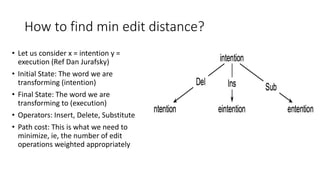
• Let us consider x = intention y =
execution (Ref Dan Jurafsky)
• Initial State: The word we are
transforming (intention)
• Final State: The word we are
transforming to (execution)
• Operators: Insert, Delete, Substitute
• Path cost: This is what we need to
minimize, ie, the number of edit
operations weighted appropriately
Minimum Edit Distance
• The space of all edit sequence is huge and so it is not viable to
compute the edit distance using this approach
• Many paths to reach the end state from the start state.
• We only need to consider the shortest path: Minimum Edit Distance
• Let us consider 2 strings X, Y with lengths n and m respectively
• Define D(i, j) as the distance between X[1..i], Y[1..j]. This the distance
between X and Y is D(n, m)
Dynamic Programming algorithm To compute
minimum edit distance
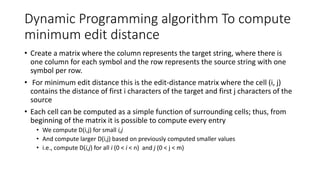
• Create a matrix where the column represents the target string, where there is
one column for each symbol and the row represents the source string with one
symbol per row.
• For minimum edit distance this is the edit-distance matrix where the cell (i, j)
contains the distance of first i characters of the target and first j characters of the
source
• Each cell can be computed as a simple function of surrounding cells; thus, from
beginning of the matrix it is possible to compute every entry
• We compute D(i,j) for small i,j
• And compute larger D(i,j) based on previously computed smaller values
• i.e., compute D(i,j) for all i (0 < i < n) and j (0 < j < m)
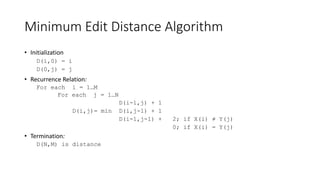
Minimum Edit Distance Algorithm
• Initialization
D(i,0) = i
D(0,j) = j
• Recurrence Relation:
For each i = 1…M
For each j = 1…N
D(i-1,j) + 1
D(i,j)= min D(i,j-1) + 1
D(i-1,j-1) + 2; if X(i) ≠ Y(j)
0; if X(i) = Y(j)
• Termination:
D(N,M) is distance
Example
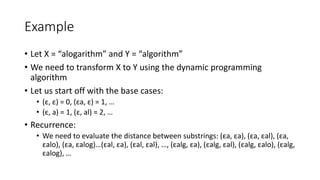
• Let X = “alogarithm” and Y = “algorithm”
• We need to transform X to Y using the dynamic programming
algorithm
• Let us start off with the base cases:
• (ε, ε) = 0, (εa, ε) = 1, …
• (ε, a) = 1, (ε, al) = 2, …
• Recurrence:
• We need to evaluate the distance between substrings: (εa, εa), (εa, εal), (εa,
εalo), (εa, εalog)…(εal, εa), (εal, εal), …, (εalg, εa), (εalg, εal), (εalg, εalo), (εalg,
εalog), …
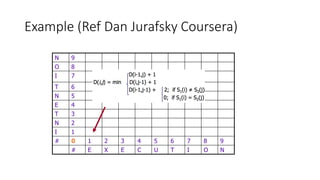
Example (Ref Dan Jurafsky Coursera)
N 9
O 8
I 7
T 6
N 5
E 4
T 3
N 2
I 1
# 0 1 2 3 4 5 6 7 8 9
# E X E C U T I O N
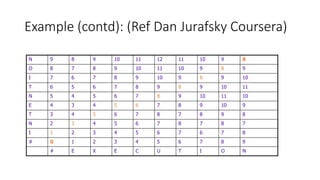
Example (contd): (Ref Dan Jurafsky Coursera)
N 9 8 9 10 11 12 11 10 9 8
O 8 7 8 9 10 11 10 9 8 9
I 7 6 7 8 9 10 9 8 9 10
T 6 5 6 7 8 9 8 9 10 11
N 5 4 5 6 7 8 9 10 11 10
E 4 3 4 5 6 7 8 9 10 9
T 3 4 5 6 7 8 7 8 9 8
N 2 3 4 5 6 7 8 7 8 7
I 1 2 3 4 5 6 7 6 7 8
# 0 1 2 3 4 5 6 7 8 9
# E X E C U T I O N
Backtrace
• Often it is not adequate to just compute minimum edit distance alone. It may also
be necessary to find the path to the minimum edit distance. This for example, is
needed for finding the alignment between 2 sequences
• Example:
• Intention and Execution
• We can implement backtracing by keeping pointers for each cell to record the
possible preceding cells that contributed to the minimum distance for this cell (i,
j). It is possible that this cell might have been reached just from one previous cell,
or two cells or all the three.
• When we reach the termination condition, start from the pointer from the final
cell (i = M, j = N) and trace back to find the alignment
Example – Backtracing (Adopted from Dan
Jurafsky)
Backup slides

L06 stemmer and edit distance

  • 1.
    Edit distance and applications AnantharamanNarayana Iyer Narayana dot Anantharaman at gmail dot com 3 Sep 2015
  • 2.
    Objective • Porter stemmer:we will mention it briefly and let you go through this at home • Discuss in depth the concept of edit distance computation using dynamic programming • Look at a few applications
  • 3.
    References • Speech AndLanguage Processing, 2nd Edition by Dan Jurafsky and James Martin • Natural Language Processing, Coursera online learning course by Dan Jurafsky and Christopher Manning • Home page of Dr Martin Porter: http://tartarus.org/~martin/Porter Stemmer/ • Wikipedia (for certain definitions of linguistic terminology)
  • 4.
  • 5.
    Edit Distance • Supposewe have 2 strings x and y and our goal is to transform x to y. • Example 1: x = alogarithm, y = logarithm • Example 2: x = alogarithm, y = algorithm • Edit operators • Deletion • Insertion • Substitution • The weighted number of operations that are needed to transform x to y using the above operators is called the edit distance • Typically, deletion and insertion are assigned a weight 1 while substitution has weight 2 (Levenshtein) • Edit distance is a measure of string similarity
  • 6.
    Example • What isthe edit distance between: 1. x = alogarithm, y = logarithm 2. x = alogarithm, y = algorithm • In the example 1, by deleting the letter a from string x, we get the string y. Hence edit distance is 1 • In the example 2, we need the following steps: • Step 1: Delete o from x => algarithm • Step 2: Replace the 4th letter a with o => algorithm • In example 2, we performed 1 deletion and 1 replacement and hence the edit distance = 1 + 2 = 3
  • 7.
    Why is thisneeded? • Applications in Natural Language Processing • Spelling correction • Approximate string matching • Spam filtering • Longest Common Subsequence • Finding curse words or inappropriate words • Finding similar sentences where one sentence differs from the other within the edit distance with respect to the words: Word level matching • Adobe announced 4th quarter results today • Adobe announced quarter results today • Computational Biology • Aligning DNA sequences • Speech Recognition
  • 8.
    How to findmin edit distance? • Let us consider x = intention y = execution (Ref Dan Jurafsky) • Initial State: The word we are transforming (intention) • Final State: The word we are transforming to (execution) • Operators: Insert, Delete, Substitute • Path cost: This is what we need to minimize, ie, the number of edit operations weighted appropriately
  • 9.
    Minimum Edit Distance •The space of all edit sequence is huge and so it is not viable to compute the edit distance using this approach • Many paths to reach the end state from the start state. • We only need to consider the shortest path: Minimum Edit Distance • Let us consider 2 strings X, Y with lengths n and m respectively • Define D(i, j) as the distance between X[1..i], Y[1..j]. This the distance between X and Y is D(n, m)
  • 10.
    Dynamic Programming algorithmTo compute minimum edit distance • Create a matrix where the column represents the target string, where there is one column for each symbol and the row represents the source string with one symbol per row. • For minimum edit distance this is the edit-distance matrix where the cell (i, j) contains the distance of first i characters of the target and first j characters of the source • Each cell can be computed as a simple function of surrounding cells; thus, from beginning of the matrix it is possible to compute every entry • We compute D(i,j) for small i,j • And compute larger D(i,j) based on previously computed smaller values • i.e., compute D(i,j) for all i (0 < i < n) and j (0 < j < m)
  • 11.
    Minimum Edit DistanceAlgorithm • Initialization D(i,0) = i D(0,j) = j • Recurrence Relation: For each i = 1…M For each j = 1…N D(i-1,j) + 1 D(i,j)= min D(i,j-1) + 1 D(i-1,j-1) + 2; if X(i) ≠ Y(j) 0; if X(i) = Y(j) • Termination: D(N,M) is distance
  • 12.
    Example • Let X= “alogarithm” and Y = “algorithm” • We need to transform X to Y using the dynamic programming algorithm • Let us start off with the base cases: • (ε, ε) = 0, (εa, ε) = 1, … • (ε, a) = 1, (ε, al) = 2, … • Recurrence: • We need to evaluate the distance between substrings: (εa, εa), (εa, εal), (εa, εalo), (εa, εalog)…(εal, εa), (εal, εal), …, (εalg, εa), (εalg, εal), (εalg, εalo), (εalg, εalog), …
  • 13.
    Example (Ref DanJurafsky Coursera) N 9 O 8 I 7 T 6 N 5 E 4 T 3 N 2 I 1 # 0 1 2 3 4 5 6 7 8 9 # E X E C U T I O N
  • 14.
    Example (contd): (RefDan Jurafsky Coursera) N 9 8 9 10 11 12 11 10 9 8 O 8 7 8 9 10 11 10 9 8 9 I 7 6 7 8 9 10 9 8 9 10 T 6 5 6 7 8 9 8 9 10 11 N 5 4 5 6 7 8 9 10 11 10 E 4 3 4 5 6 7 8 9 10 9 T 3 4 5 6 7 8 7 8 9 8 N 2 3 4 5 6 7 8 7 8 7 I 1 2 3 4 5 6 7 6 7 8 # 0 1 2 3 4 5 6 7 8 9 # E X E C U T I O N
  • 15.
    Backtrace • Often itis not adequate to just compute minimum edit distance alone. It may also be necessary to find the path to the minimum edit distance. This for example, is needed for finding the alignment between 2 sequences • Example: • Intention and Execution • We can implement backtracing by keeping pointers for each cell to record the possible preceding cells that contributed to the minimum distance for this cell (i, j). It is possible that this cell might have been reached just from one previous cell, or two cells or all the three. • When we reach the termination condition, start from the pointer from the final cell (i = M, j = N) and trace back to find the alignment
  • 16.
    Example – Backtracing(Adopted from Dan Jurafsky)
  • 17.