Introduction to Biology: What is Life?
What is Biology?
● Biology is the study of life
● Covers everything from microscopic cells
to entire ecosystems
● Helps us understand medicine, ecology,
genetics, and more
● Why do you think biology is important to
study?
Defining Life: A Centuries-Old Challenge
● Aristotle: Life involves growth, reproduction, and reaction to
forces
● Modern view: Life is a self-sustaining, evolving chemical system
● NASA definition for potential extraterrestrial life
● How would you define life?
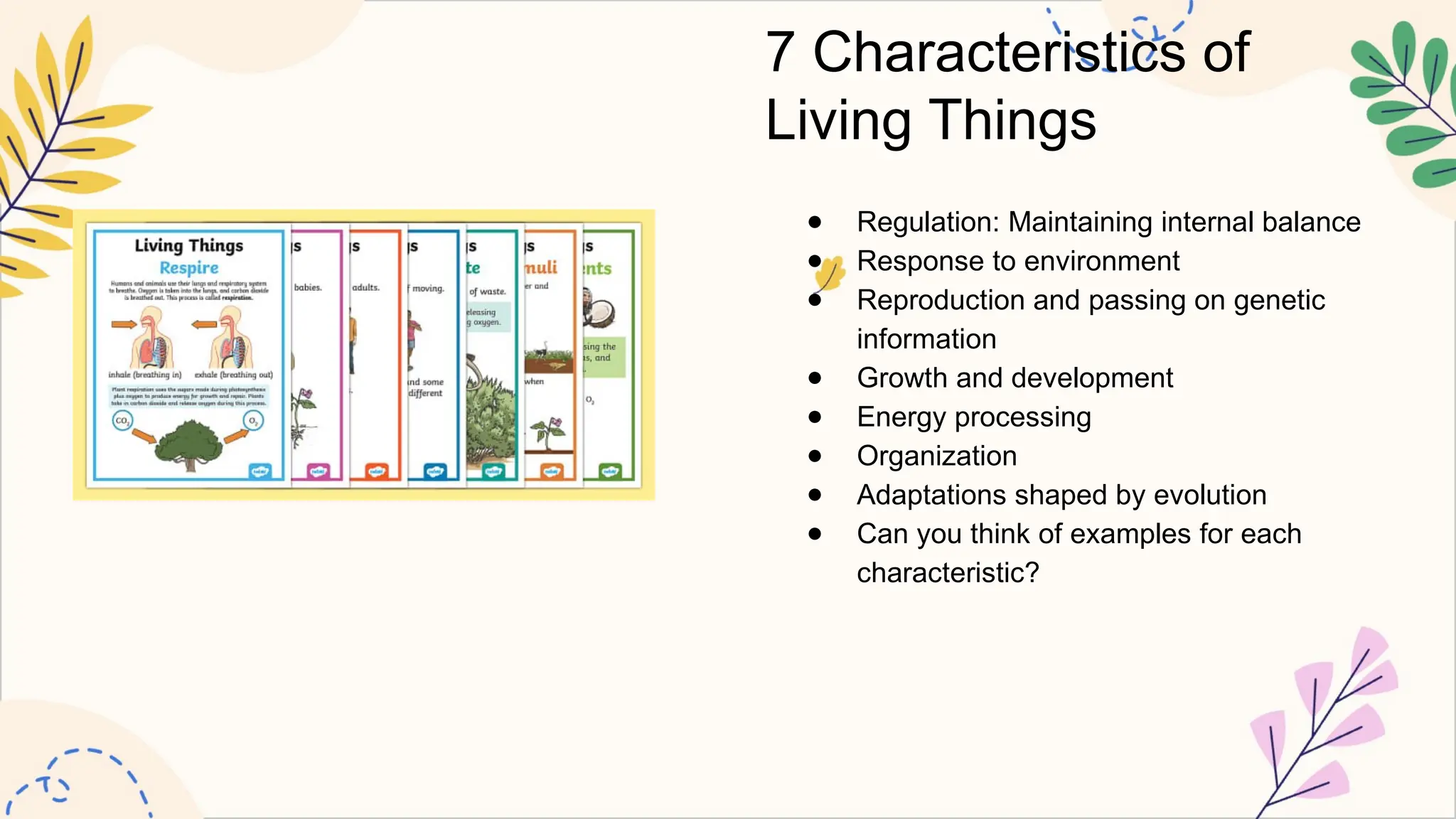
7 Characteristics of
Living Things
● Regulation: Maintaining internal balance
● Response to environment
● Reproduction and passing on genetic
information
● Growth and development
● Energy processing
● Organization
● Adaptations shaped by evolution
● Can you think of examples for each
characteristic?
Regulation and Response
● Regulation: Keeping internal conditions stable
● Examples: Sweating, panting to control temperature
● Response: Reacting to environmental stimuli
● Examples: Cheetah chasing prey, plants turning toward light
● How does your body regulate temperature?
Reproduction, Growth,
and Energy
● Reproduction: Passing on genetic
information
● Growth: Following genetic instructions for
development
● Energy processing: Using nutrients to
power life processes
● Which of these processes do you find
most fascinating?
Organization and Adaptation
● Organization: Structured from cells to organ systems
● Adaptations: Traits shaped by evolution to aid survival
● Example: Platypus with webbed feet and venomous spurs
● What unique adaptations do humans have?
The Gray Area:
Viruses
● Viruses challenge our definition of life
● They can't reproduce or process energy
on their own
● But they evolve and replicate using host
cells
● Are viruses alive? Why or why not?
Life Beyond Earth?
● Astrobiology studies potential extraterrestrial life
● Examines extreme life forms on Earth for clues
● Our definition of life may change with new discoveries
● How might life on other planets differ from Earth?
The Interconnectedness of
Life
● All living things share a common ancestor
● We're made of "stardust" - elements
forged in stars
● Understanding connections helps solve
global challenges
● How does knowing we're connected to all
life change your perspective?
Biology's Impact on Our World
● Helps develop medicines and vaccines
● Informs climate change research and solutions
● Advances agriculture and food production
● Deepens our understanding of ourselves and nature
● What area of biology interests you most?

Presentation-university.pptx all about science

  • 1.
  • 2.
    What is Biology? ●Biology is the study of life ● Covers everything from microscopic cells to entire ecosystems ● Helps us understand medicine, ecology, genetics, and more ● Why do you think biology is important to study?
  • 3.
    Defining Life: ACenturies-Old Challenge ● Aristotle: Life involves growth, reproduction, and reaction to forces ● Modern view: Life is a self-sustaining, evolving chemical system ● NASA definition for potential extraterrestrial life ● How would you define life?
  • 4.
    7 Characteristics of LivingThings ● Regulation: Maintaining internal balance ● Response to environment ● Reproduction and passing on genetic information ● Growth and development ● Energy processing ● Organization ● Adaptations shaped by evolution ● Can you think of examples for each characteristic?
  • 5.
    Regulation and Response ●Regulation: Keeping internal conditions stable ● Examples: Sweating, panting to control temperature ● Response: Reacting to environmental stimuli ● Examples: Cheetah chasing prey, plants turning toward light ● How does your body regulate temperature?
  • 6.
    Reproduction, Growth, and Energy ●Reproduction: Passing on genetic information ● Growth: Following genetic instructions for development ● Energy processing: Using nutrients to power life processes ● Which of these processes do you find most fascinating?
  • 7.
    Organization and Adaptation ●Organization: Structured from cells to organ systems ● Adaptations: Traits shaped by evolution to aid survival ● Example: Platypus with webbed feet and venomous spurs ● What unique adaptations do humans have?
  • 8.
    The Gray Area: Viruses ●Viruses challenge our definition of life ● They can't reproduce or process energy on their own ● But they evolve and replicate using host cells ● Are viruses alive? Why or why not?
  • 9.
    Life Beyond Earth? ●Astrobiology studies potential extraterrestrial life ● Examines extreme life forms on Earth for clues ● Our definition of life may change with new discoveries ● How might life on other planets differ from Earth?
  • 10.
    The Interconnectedness of Life ●All living things share a common ancestor ● We're made of "stardust" - elements forged in stars ● Understanding connections helps solve global challenges ● How does knowing we're connected to all life change your perspective?
  • 11.
    Biology's Impact onOur World ● Helps develop medicines and vaccines ● Informs climate change research and solutions ● Advances agriculture and food production ● Deepens our understanding of ourselves and nature ● What area of biology interests you most?

Editor's Notes

  • #1 Created from: https://app.briskteaching.com/onboarding_try_video