GENERALANESTHETICS
MISS.R.S.DHOLE
ASST.PROFESSOR
ANNASAHEBDANGECOLLEGEOFD.PHARMACY,ASHTA
GENERAL ANESTHESIA
2
General anesthesia (GA) is the state produced
when a patient receives medications for amnesia,
analgesia, muscle relaxation, and sedation. An
anesthetized patient can be thought of as being
in a controlled, reversible state of
unconsciousness.
General anaesthetics
These pharmacological agent which are used to
produce reversible loss of consciousness is called
as general anaesthetics
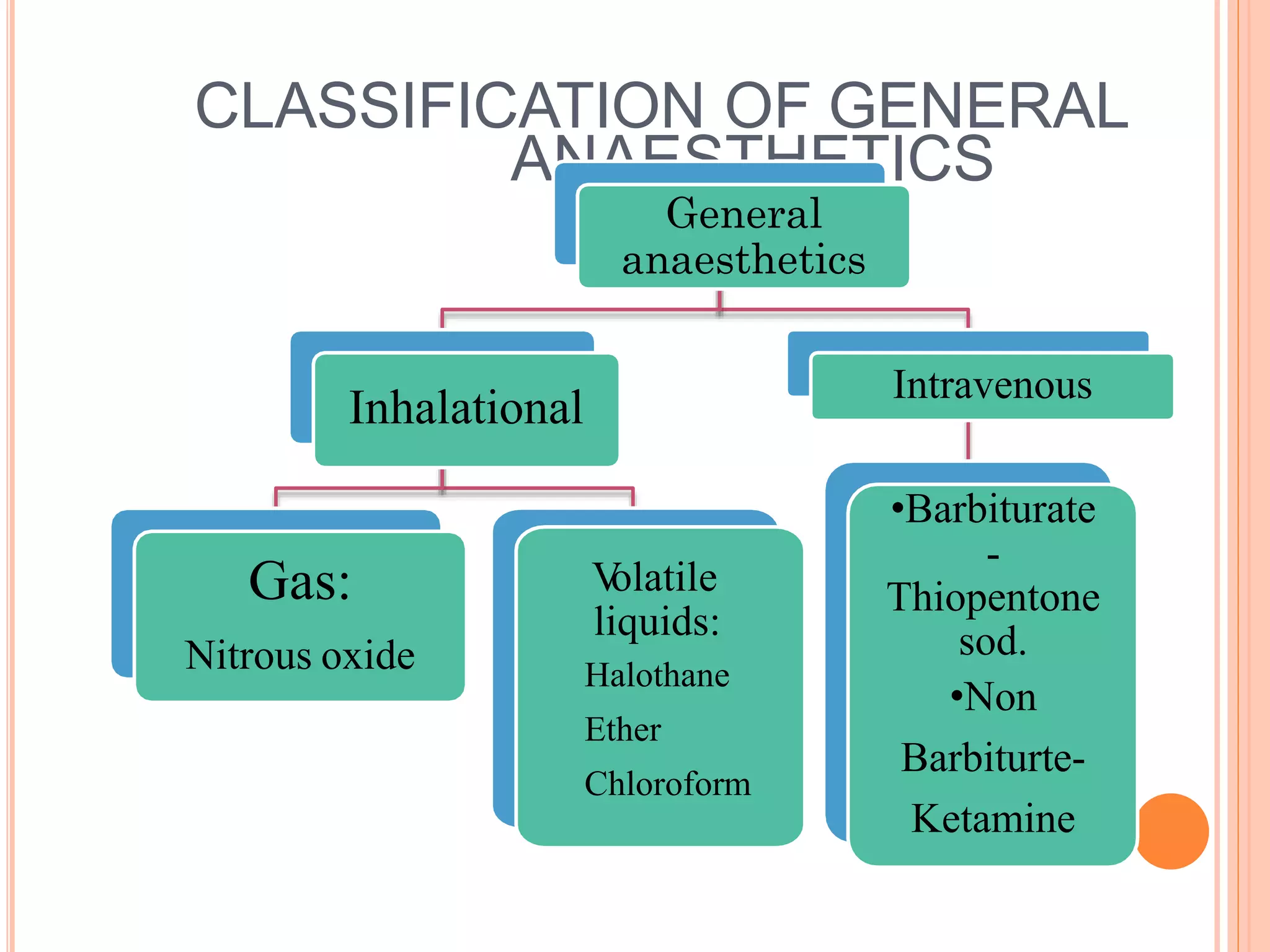
CLASSIFICATION OF GENERAL
ANAESTHETICS
General
anaesthetics
Inhalational
Gas:
Nitrous oxide
Volatile
liquids:
Halothane
Ether
Chloroform
Intravenous
•Barbiturate
-
Thiopentone
sod.
•Non
Barbiturte-
Ketamine
PROPERTIES OF GENERAL
ANAESTHETICS
4
It should be non toxic
It should be non irritaant
It should be non inflammable
It should be stable
It should be easy to administer
It should have proper muscle relaxant property
Should have adequate analgesic property
PREANESTHETIC MEDICATIONS
5
Preanesthetic medications are defined as the use of
drugs or medications before or concurrent to the
administration of anesthetics to make anaesthesia safe
& pleasant
They are used to achieve following objectives like:
 To reduce anxiety in patient occuring before & during surgery
 To produce sedation, calm the patient & relieve pain
 Counteract certain adverse effects of anaesthetics such as
salivation, vomitting etc.to reduce secretions
 To reduce pre & post operative pain
 To produce synergistic effect along with anaesthetics
 facilitate smooth induction of anesthesia,
 lowered the required dose ofanesthetic
There is no single drug which can achieve the above objective & hence
usually combination of drugs are useful
PREANESTHETIC MEDICATIONS:
6
Analgesics eg. Paracetamol
Anxiolytics/ Tranquilizer eg. Diazepam, phenobarbitone
Anticholinergics: eg. Atropine, scopolamine
(Reduces bronchial and salivary secretion)
Skeletal muscle relaxants: eg. D- tubocurarine
Antiemetics: eg. Promethazine
Prevents aspiration of stomach contents and post surgical vomiting
DEPTH OF ANESTHESIA (GUEDEL’SSIGNS)
7
Guedel (1920) described four sequential stages with anaesthesia, dividing the
stage into 4 planes.
Stage of
Analgesia
• analgesia and amnesia, the patient is conscious and
conversational. Starts from beginning of anaesthetic inhalation
and lasts upto the loss of consciousness
• Pain is progressively abolished
• Reflexes and respiration remain normal
• Use is limited to short procedures
Stage of
Delirium
• From loss of consciousness to beginning of regular respiration
• Patient may shout, struggle and hold his breath; muscle tone
increases, jaws are tightly closed, breathing is jerky; vomiting,
involuntary micturition or defecation may occur
• Heart rate and BP may rise and pupils dilate due to
sympathetic stimulation
• No operative procedure carried out
• Can be cut short by rapid induction, premedication
DEPTH OF ANESTHESIA (GUEDEL’SSIGNS)
8
Surgical
anaesthesia
• Extends from onset of regular respiration to cessation of
spontaneous breathing. This has been divided into 4 planes
which may be distinguished as:
• Plane 1 moving eye balls. This plane ends when eyes become
fixed.
• Plane 2 loss of corneal and laryngeal reflexes.
• Plane 3 pupil starts dilating and light reflex is lost.
• Plane 4 Intercostal paralysis, shallow abdominal respiration,
dilated pupil.
Medullary
paralysis • Cessation of breathing to failure of circulation and death.
MECHANISMOFACTIONOFANAESTHESIA
10
No specific receptor has been identified. The fact that
chemically unrelated compounds produce anesthesia argues
against the existence of a single receptor.
The focus is NOW on proteins comprising ion channels:
GABAAreceptors, Glycine receptors,
NMDAglutamate receptors (nitrous oxide and ketamine ):
Nicotinic receptors: Blocks the excitatory postsynaptic current
of the nicotinic receptors.
MECHANISM OF ACTION OF
GENERAL ANAESTHETICS
 GABA –A receptor : Potentiated by
Halothane,
 Propofol, Etomidate ,Enflurane,
 isoflurane, Desflurane,
sevoflurane
 NMDA receptors:
 Glycine receptors :
Inhibited by Ketamine,
nitrous oxide and xenon
Potentiated by Halothane,
Propofol, ,Enflurane,
isoflurane, Desflurane,
sevoflurane
Also has effect on neuronal nicotinic receptorsand
5-HT3 receptors
INHALATIONAL
ANAESTHETICS
Inhalational anaesthesia refers to the delivery of gases or
vapours to the respiratory system to produce anaesthesia
Ether
 It is explosive
 Irritant to respiratory tract
 High incidence of nausea and vomiting during
 induction and post-surgical emergence
Colourless, odourless gas at room temperature.
Very insoluble in blood and other tissues (quick recovery)
Rapid induction of anaesthesia and rapid emergence
following discontinuation of administration.
Completely eliminated by the lungs.
It is weak anaesthetic and powerful analgesic.
The mac value is 105%.
Causes megaloblastic anaemia.
Used as adjunct to supplement other inhalationals.
NITROUS OXIDE
Volatile liquid at room temperature.
Light sensitive
High fat solubility => slow induction & recovery
Eliminated unchange via lungs
Commonly used in children, where preoperative
placement of an iv catheter can be difficult
It is marketed in amber bottles with thymol added as a
preservative
Metabolised in liver by Cyt-P450
HALOTHANE
 Side effects of halothane :
CVS : Cardiac arrhythmia, depression of myocardial contraction.
Respiratory system : Depression of respiration
Muscles : Malignant hyperthermia
Kidney : Decrease renal blood flow and g.f.r
Liver and GIT: Cause halothane induced hepatitis & nausia and
vomitting
 DRUG INTERACTION : Halothane + adrenaline, theophylline => arrhythmia
may be precipitated.
 CONTRAINDICATION : Hepatic dysfunction and/or jaundice.
INTRAVENOUS ANAESTHETICS
THIOPENTAL
 Ultrashort acting barbiturate
 High lipid solubility rapid entry into the brain
 Rapid onset (20 sec) , short duration
 Effect terminated not by metabolism but by redistribution
 Risk of sever vasospasm if accidently injected intoartery
 Depress cerebral blood flow
 Decrease intracranial pressure
 Tissue necrosis—gangrene, Tissue stores, hypotension, apnea
 Build-up in adipose tissue = very long emergence fromanaesthesia
 Rapid onset and have a short duration of action
 Highly protein bound in vivo and is metabolised by conjugation
in the liver
 Very good anesthetic for induction and maintaince of anesthesia
with no accumulation effect
 Side-effects are pain on injection, hypotension and transient
apnea following induction
 Used for the induction, maintenance of GA andsedation
 Useful for day-case surgery
PROPOFOL
 Dissociative anaesthetic
 NMDA ReceptorAntagonist
 Cardiovascular stimulant
 Catatonia, analgesia, and amnesia without loss of consciousness
 Useful for anesthetizing patients at risk for hypotension and
bronchospasm and for certain paediatric procedures
KETAMINE
 Rapid induction
 Minimal change in cardiac function and respiratory rate
 Not analgesic
 Cause pain on injection and nausea postoperatively
 Prolonged administration may cause adrenal suppression
ETOMIDATE

General anaesthetics

  • 1.
  • 2.
    GENERAL ANESTHESIA 2 General anesthesia(GA) is the state produced when a patient receives medications for amnesia, analgesia, muscle relaxation, and sedation. An anesthetized patient can be thought of as being in a controlled, reversible state of unconsciousness. General anaesthetics These pharmacological agent which are used to produce reversible loss of consciousness is called as general anaesthetics
  • 3.
    CLASSIFICATION OF GENERAL ANAESTHETICS General anaesthetics Inhalational Gas: Nitrousoxide Volatile liquids: Halothane Ether Chloroform Intravenous •Barbiturate - Thiopentone sod. •Non Barbiturte- Ketamine
  • 4.
    PROPERTIES OF GENERAL ANAESTHETICS 4 Itshould be non toxic It should be non irritaant It should be non inflammable It should be stable It should be easy to administer It should have proper muscle relaxant property Should have adequate analgesic property
  • 5.
    PREANESTHETIC MEDICATIONS 5 Preanesthetic medicationsare defined as the use of drugs or medications before or concurrent to the administration of anesthetics to make anaesthesia safe & pleasant They are used to achieve following objectives like:  To reduce anxiety in patient occuring before & during surgery  To produce sedation, calm the patient & relieve pain  Counteract certain adverse effects of anaesthetics such as salivation, vomitting etc.to reduce secretions  To reduce pre & post operative pain  To produce synergistic effect along with anaesthetics  facilitate smooth induction of anesthesia,  lowered the required dose ofanesthetic There is no single drug which can achieve the above objective & hence usually combination of drugs are useful
  • 6.
    PREANESTHETIC MEDICATIONS: 6 Analgesics eg.Paracetamol Anxiolytics/ Tranquilizer eg. Diazepam, phenobarbitone Anticholinergics: eg. Atropine, scopolamine (Reduces bronchial and salivary secretion) Skeletal muscle relaxants: eg. D- tubocurarine Antiemetics: eg. Promethazine Prevents aspiration of stomach contents and post surgical vomiting
  • 7.
    DEPTH OF ANESTHESIA(GUEDEL’SSIGNS) 7 Guedel (1920) described four sequential stages with anaesthesia, dividing the stage into 4 planes. Stage of Analgesia • analgesia and amnesia, the patient is conscious and conversational. Starts from beginning of anaesthetic inhalation and lasts upto the loss of consciousness • Pain is progressively abolished • Reflexes and respiration remain normal • Use is limited to short procedures Stage of Delirium • From loss of consciousness to beginning of regular respiration • Patient may shout, struggle and hold his breath; muscle tone increases, jaws are tightly closed, breathing is jerky; vomiting, involuntary micturition or defecation may occur • Heart rate and BP may rise and pupils dilate due to sympathetic stimulation • No operative procedure carried out • Can be cut short by rapid induction, premedication
  • 8.
    DEPTH OF ANESTHESIA(GUEDEL’SSIGNS) 8 Surgical anaesthesia • Extends from onset of regular respiration to cessation of spontaneous breathing. This has been divided into 4 planes which may be distinguished as: • Plane 1 moving eye balls. This plane ends when eyes become fixed. • Plane 2 loss of corneal and laryngeal reflexes. • Plane 3 pupil starts dilating and light reflex is lost. • Plane 4 Intercostal paralysis, shallow abdominal respiration, dilated pupil. Medullary paralysis • Cessation of breathing to failure of circulation and death.
  • 10.
    MECHANISMOFACTIONOFANAESTHESIA 10 No specific receptorhas been identified. The fact that chemically unrelated compounds produce anesthesia argues against the existence of a single receptor. The focus is NOW on proteins comprising ion channels: GABAAreceptors, Glycine receptors, NMDAglutamate receptors (nitrous oxide and ketamine ): Nicotinic receptors: Blocks the excitatory postsynaptic current of the nicotinic receptors.
  • 11.
    MECHANISM OF ACTIONOF GENERAL ANAESTHETICS  GABA –A receptor : Potentiated by Halothane,  Propofol, Etomidate ,Enflurane,  isoflurane, Desflurane, sevoflurane  NMDA receptors:  Glycine receptors : Inhibited by Ketamine, nitrous oxide and xenon Potentiated by Halothane, Propofol, ,Enflurane, isoflurane, Desflurane, sevoflurane Also has effect on neuronal nicotinic receptorsand 5-HT3 receptors
  • 12.
    INHALATIONAL ANAESTHETICS Inhalational anaesthesia refersto the delivery of gases or vapours to the respiratory system to produce anaesthesia Ether  It is explosive  Irritant to respiratory tract  High incidence of nausea and vomiting during  induction and post-surgical emergence
  • 13.
    Colourless, odourless gasat room temperature. Very insoluble in blood and other tissues (quick recovery) Rapid induction of anaesthesia and rapid emergence following discontinuation of administration. Completely eliminated by the lungs. It is weak anaesthetic and powerful analgesic. The mac value is 105%. Causes megaloblastic anaemia. Used as adjunct to supplement other inhalationals. NITROUS OXIDE
  • 14.
    Volatile liquid atroom temperature. Light sensitive High fat solubility => slow induction & recovery Eliminated unchange via lungs Commonly used in children, where preoperative placement of an iv catheter can be difficult It is marketed in amber bottles with thymol added as a preservative Metabolised in liver by Cyt-P450 HALOTHANE
  • 15.
     Side effectsof halothane : CVS : Cardiac arrhythmia, depression of myocardial contraction. Respiratory system : Depression of respiration Muscles : Malignant hyperthermia Kidney : Decrease renal blood flow and g.f.r Liver and GIT: Cause halothane induced hepatitis & nausia and vomitting  DRUG INTERACTION : Halothane + adrenaline, theophylline => arrhythmia may be precipitated.  CONTRAINDICATION : Hepatic dysfunction and/or jaundice.
  • 16.
    INTRAVENOUS ANAESTHETICS THIOPENTAL  Ultrashortacting barbiturate  High lipid solubility rapid entry into the brain  Rapid onset (20 sec) , short duration  Effect terminated not by metabolism but by redistribution  Risk of sever vasospasm if accidently injected intoartery  Depress cerebral blood flow  Decrease intracranial pressure  Tissue necrosis—gangrene, Tissue stores, hypotension, apnea  Build-up in adipose tissue = very long emergence fromanaesthesia
  • 17.
     Rapid onsetand have a short duration of action  Highly protein bound in vivo and is metabolised by conjugation in the liver  Very good anesthetic for induction and maintaince of anesthesia with no accumulation effect  Side-effects are pain on injection, hypotension and transient apnea following induction  Used for the induction, maintenance of GA andsedation  Useful for day-case surgery PROPOFOL
  • 18.
     Dissociative anaesthetic NMDA ReceptorAntagonist  Cardiovascular stimulant  Catatonia, analgesia, and amnesia without loss of consciousness  Useful for anesthetizing patients at risk for hypotension and bronchospasm and for certain paediatric procedures KETAMINE
  • 19.
     Rapid induction Minimal change in cardiac function and respiratory rate  Not analgesic  Cause pain on injection and nausea postoperatively  Prolonged administration may cause adrenal suppression ETOMIDATE