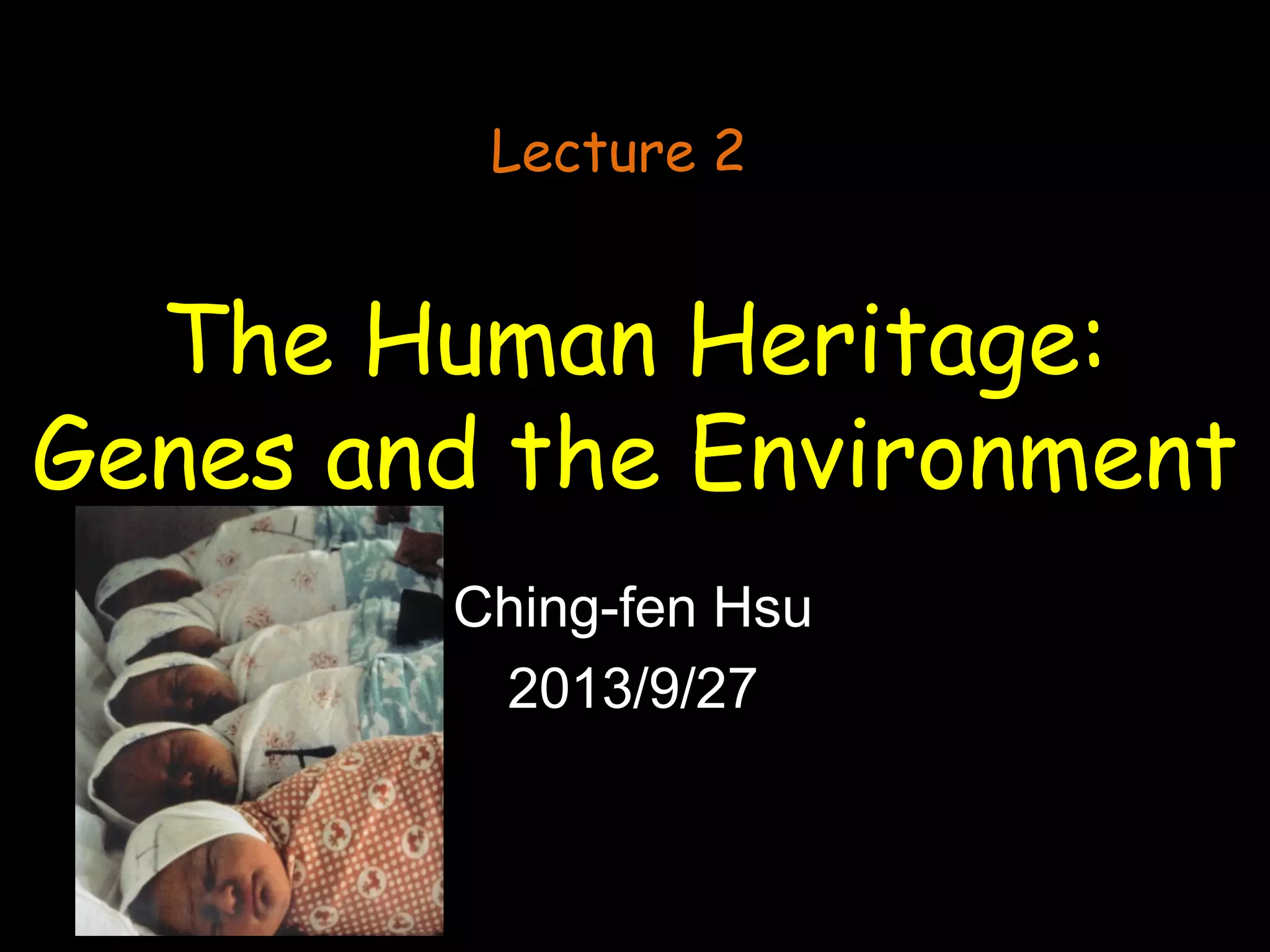
The Human Heritage:
Genes and the Environment
Ching-fen Hsu
2013/9/27
Lecture 2
Sexual Reproduction and
Genetic Transmission
• Sperm & egg: 23
chromosome
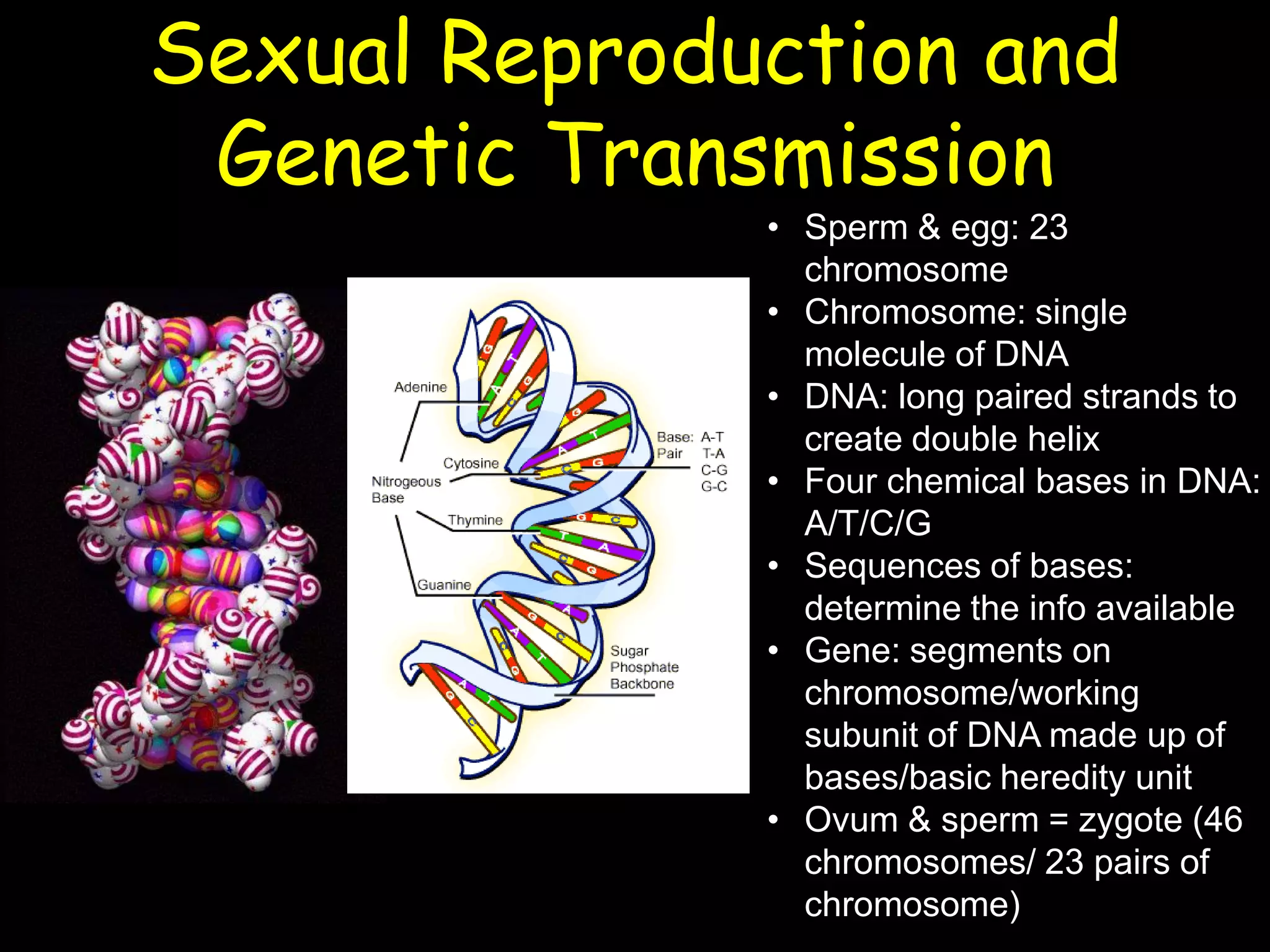
• Chromosome: single
molecule of DNA
• DNA: long paired strands to
create double helix
• Four chemical bases in DNA:
A/T/C/G
• Sequences of bases:
determine the info available
• Gene: segments on
chromosome/working
subunit of DNA made up of
bases/basic heredity unit
• Ovum & sperm = zygote (46
chromosomes/ 23 pairs of
chromosome)
Process of Cell Replication
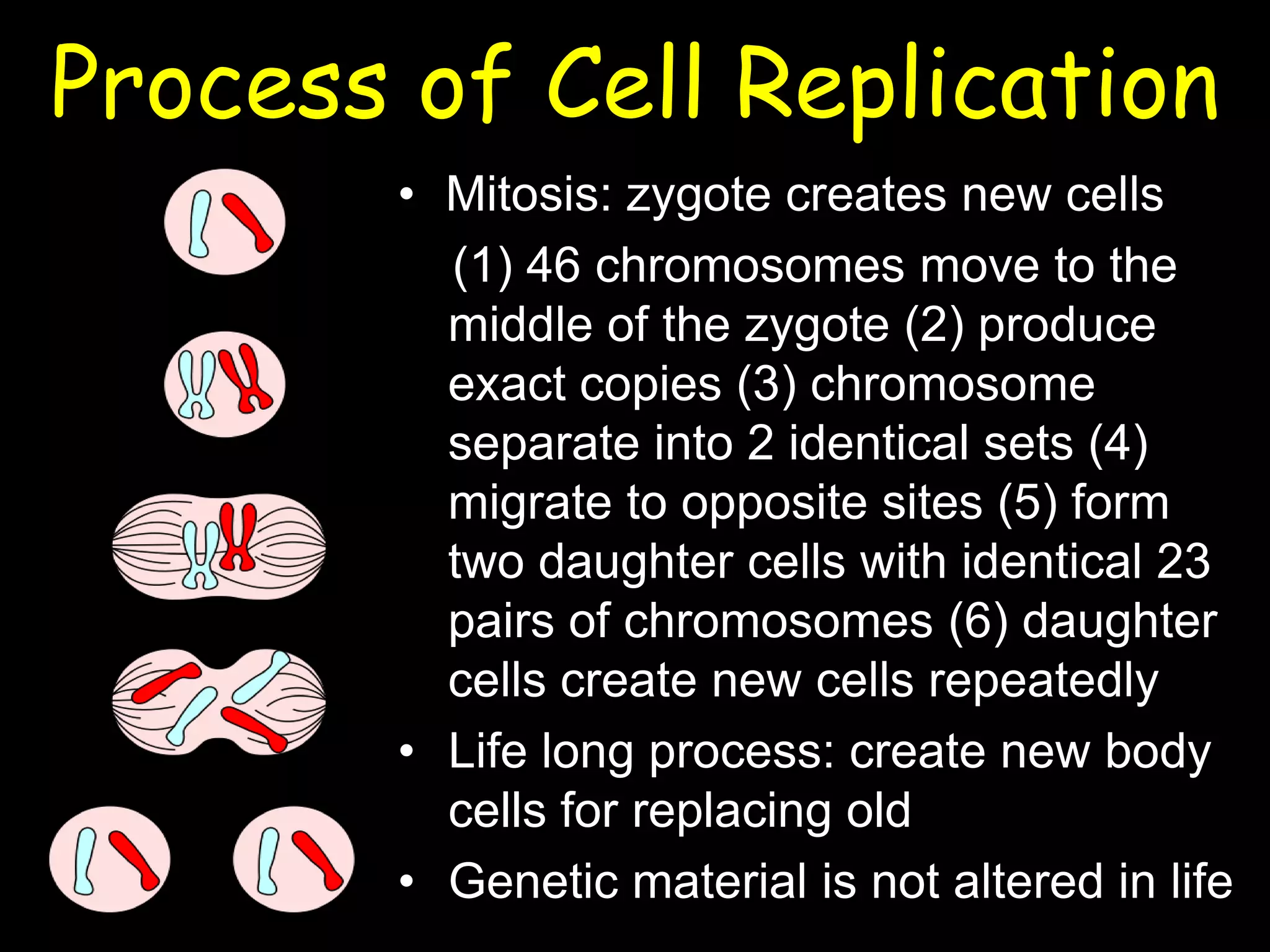
• Mitosis: zygote creates new cells
(1) 46 chromosomes move to the
middle of the zygote (2) produce
exact copies (3) chromosome
separate into 2 identical sets (4)
migrate to opposite sites (5) form
two daughter cells with identical 23
pairs of chromosomes (6) daughter
cells create new cells repeatedly
• Life long process: create new body
cells for replacing old
• Genetic material is not altered in life
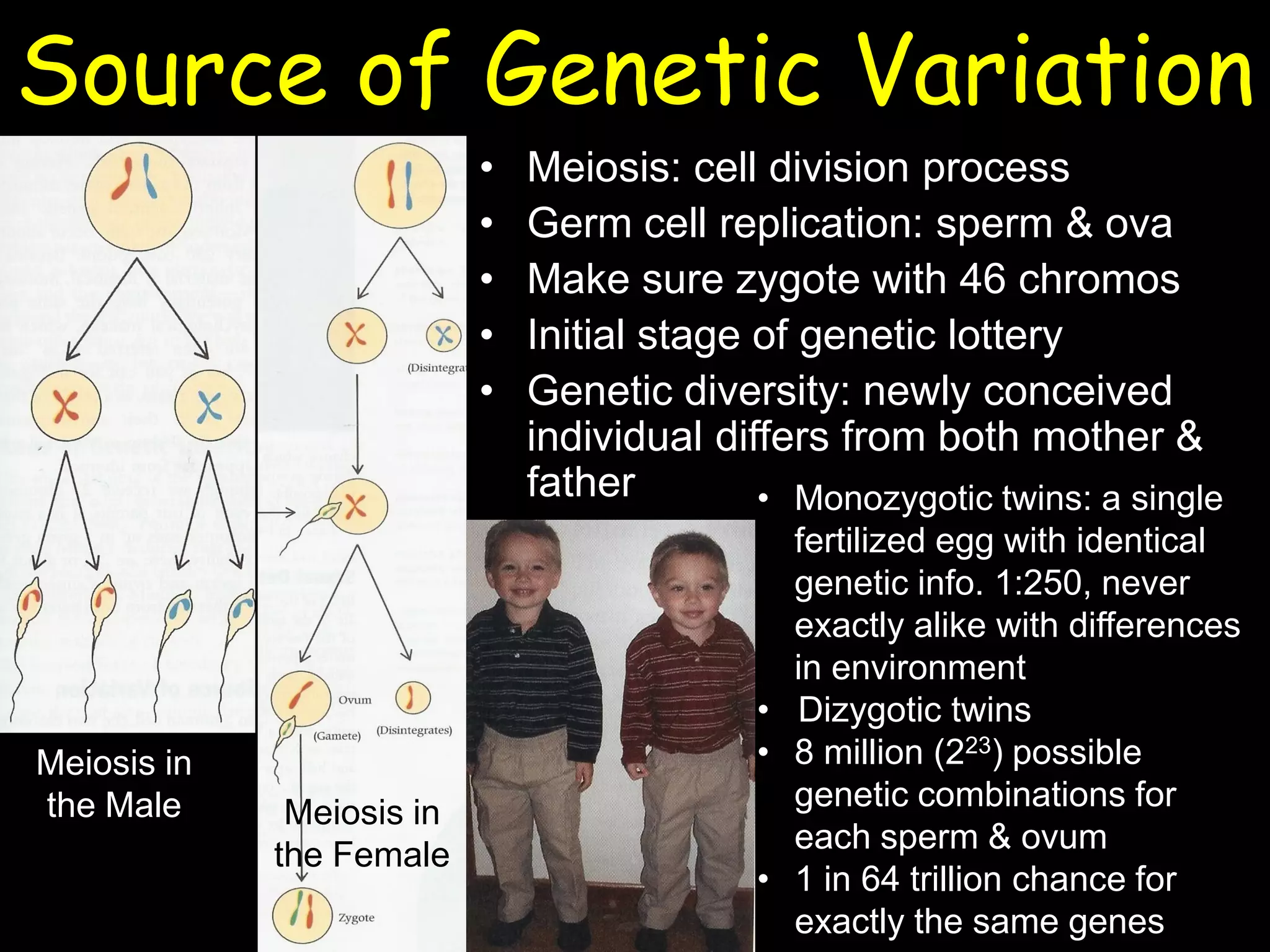
Source of Genetic Variation
• Meiosis: cell division process
• Germ cell replication: sperm & ova
• Make sure zygote with 46 chromos
• Initial stage of genetic lottery
• Genetic diversity: newly conceived
individual differs from both mother &
father
Meiosis in
the Male Meiosis in
the Female
• Monozygotic twins: a single
fertilized egg with identical
genetic info. 1:250, never
exactly alike with differences
in environment
• Dizygotic twins
• 8 million (223) possible
genetic combinations for
each sperm & ovum
• 1 in 64 trillion chance for
exactly the same genes
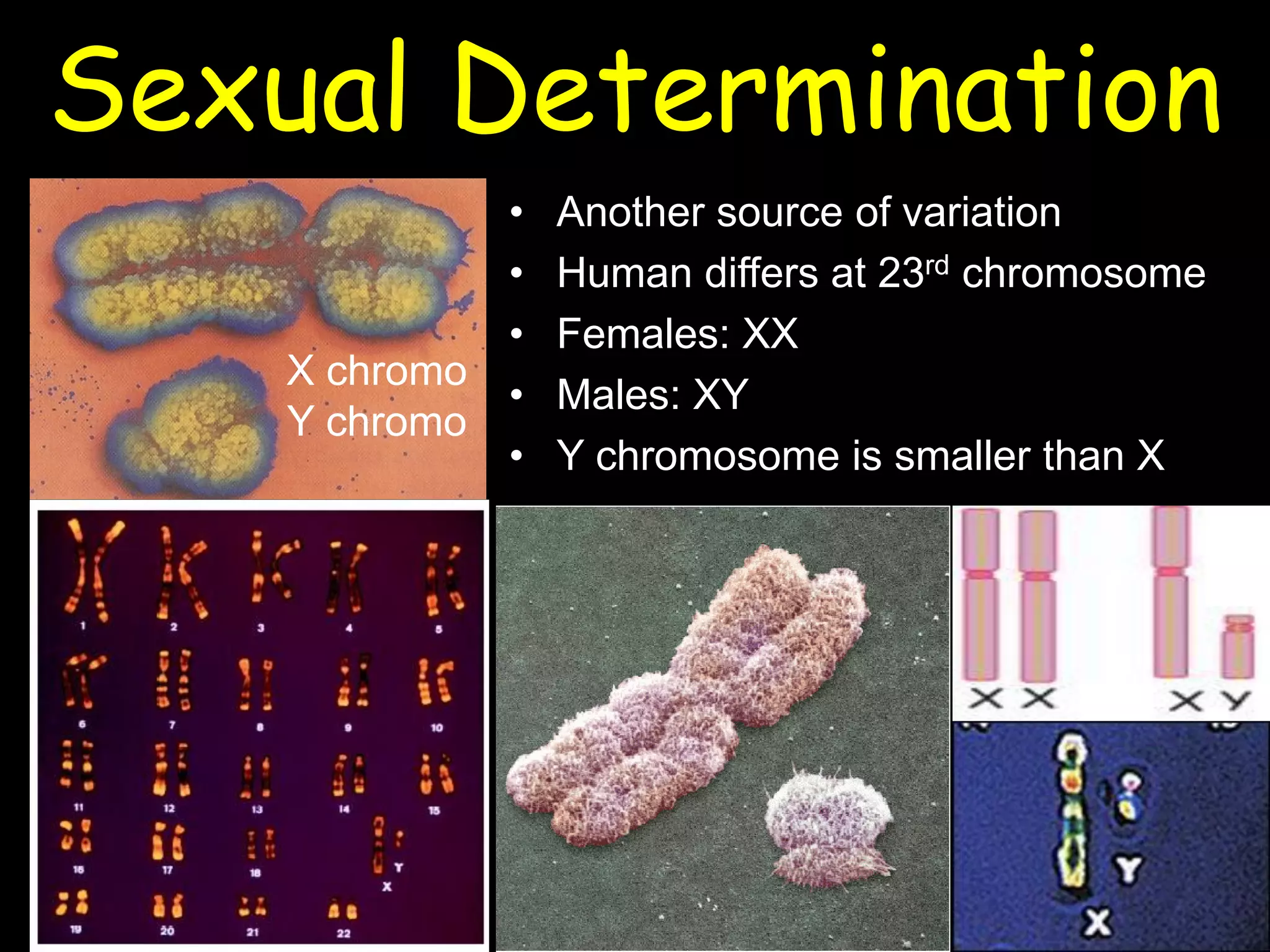
Sexual Determination
• Another source of variation
• Human differs at 23rd chromosome
• Females: XX
• Males: XY
• Y chromosome is smaller than X
X chromo
Y chromo
Genotype & Phenotype
• How genes influence development
• Genotype: individual’s genetic endowment;
particular gene forms that individual inherits;
constant over lifetime
• Phenotype: observable characteristics/ traits
on physical, psychological, healthy,
behavioral levels; interaction with E
• Genetic inheritance expresses itself through
interaction with E to create phenotype
Genotype
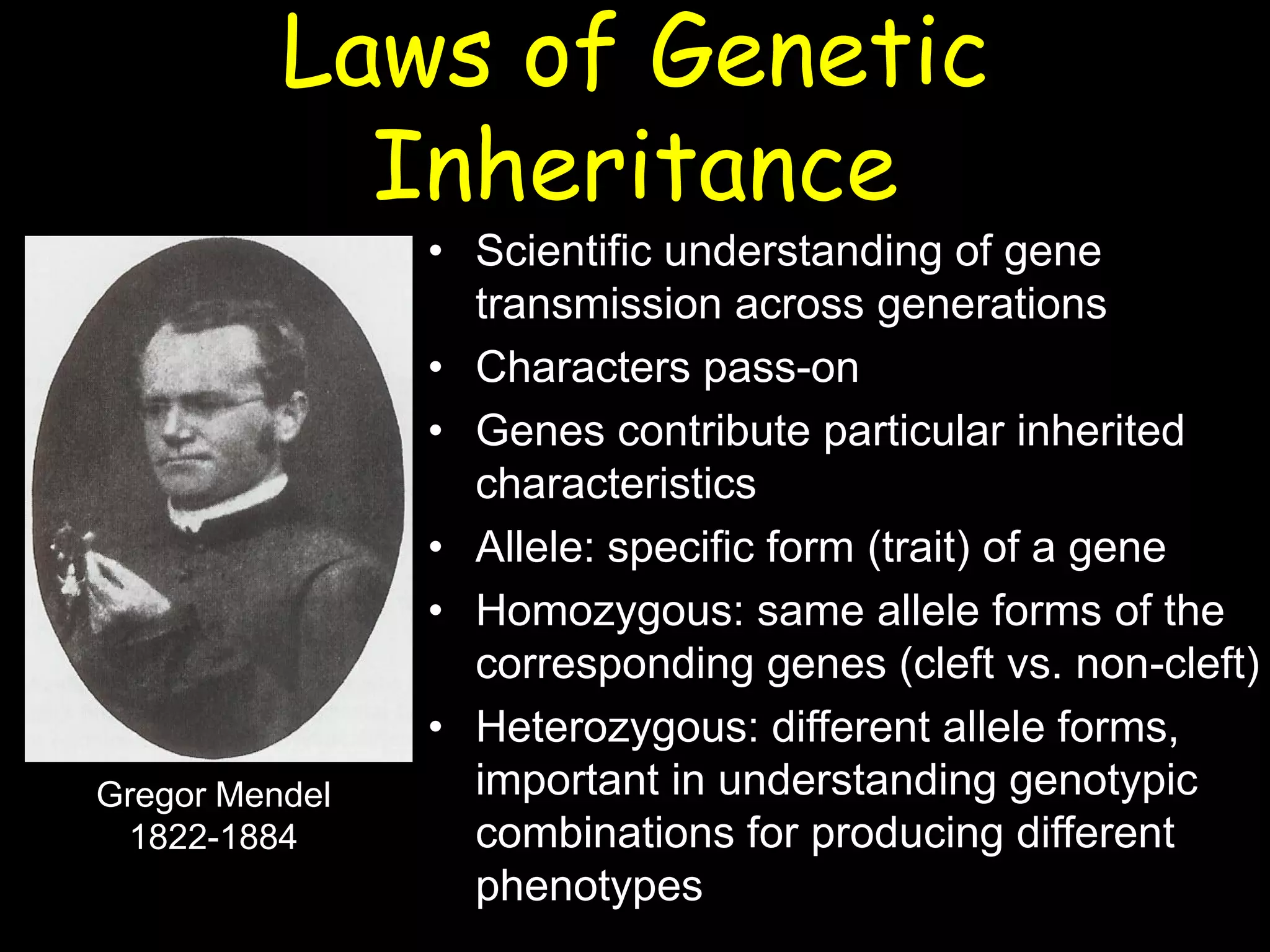
Laws of Genetic
Inheritance
• Scientific understanding of gene
transmission across generations
• Characters pass-on
• Genes contribute particular inherited
characteristics
• Allele: specific form (trait) of a gene
• Homozygous: same allele forms of the
corresponding genes (cleft vs. non-cleft)
• Heterozygous: different allele forms,
important in understanding genotypic
combinations for producing different
phenotypes
Gregor Mendel
1822-1884
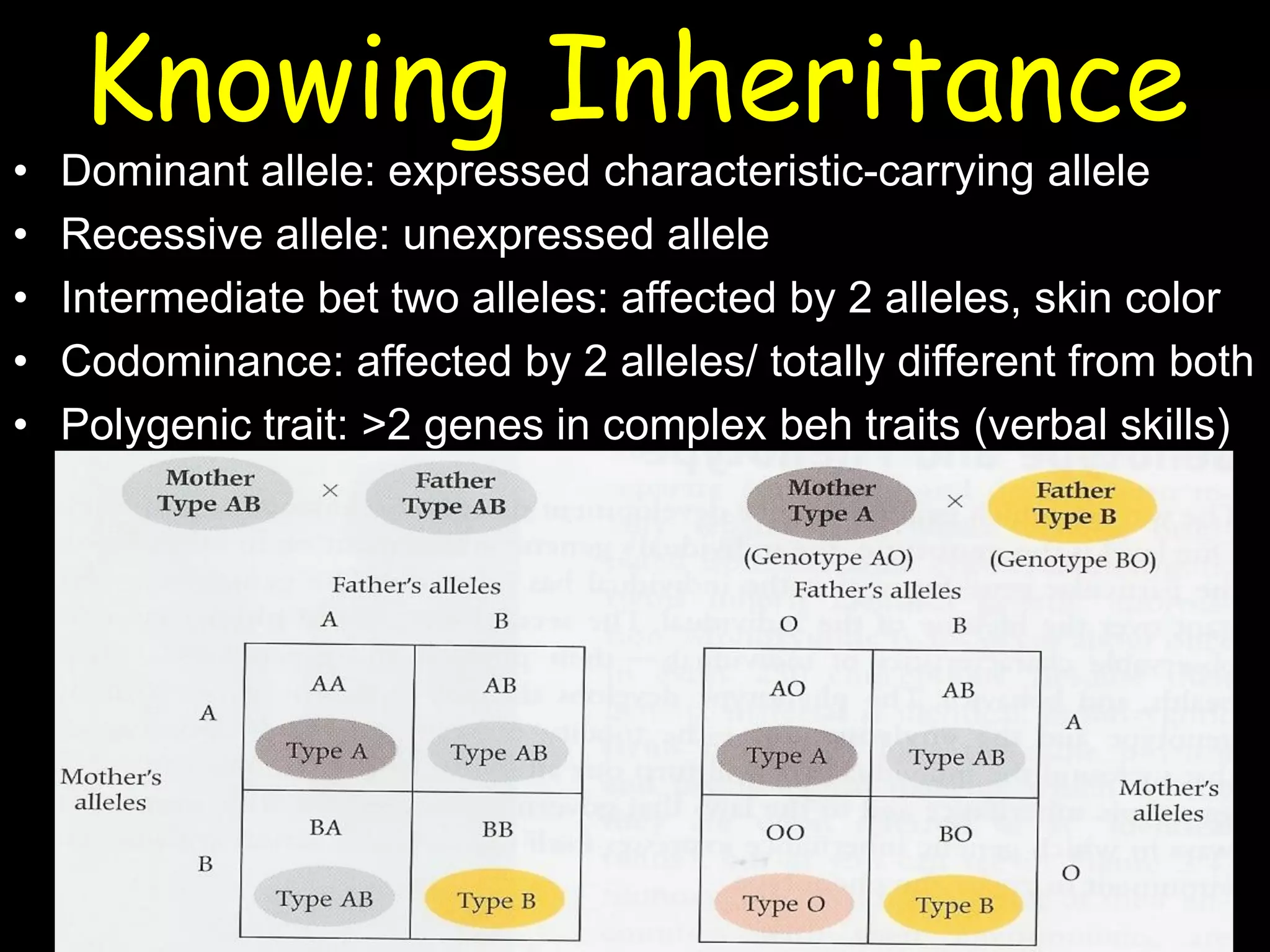
Knowing Inheritance
• Dominant allele: expressed characteristic-carrying allele
• Recessive allele: unexpressed allele
• Intermediate bet two alleles: affected by 2 alleles, skin color
• Codominance: affected by 2 alleles/ totally different from both
• Polygenic trait: >2 genes in complex beh traits (verbal skills)
Sex-Linked Genetic
Effects
• Sex-linked characteristics: specific inherited deficit with X/Y
chromosome
• Mostly X-chromo related (girls from each parent; boy from
mother)
• Females: complementary function from the other X-chromo
• Males: fragile function on X-chromo/getting deficits
e.g., red-green color blindness (lack of color-absorbing
pigments in the retina of the eye)
girls: homozygous alleles from both parents
boys: inherited from mothers
hemophilia/muscular dystrophy
Phenotype
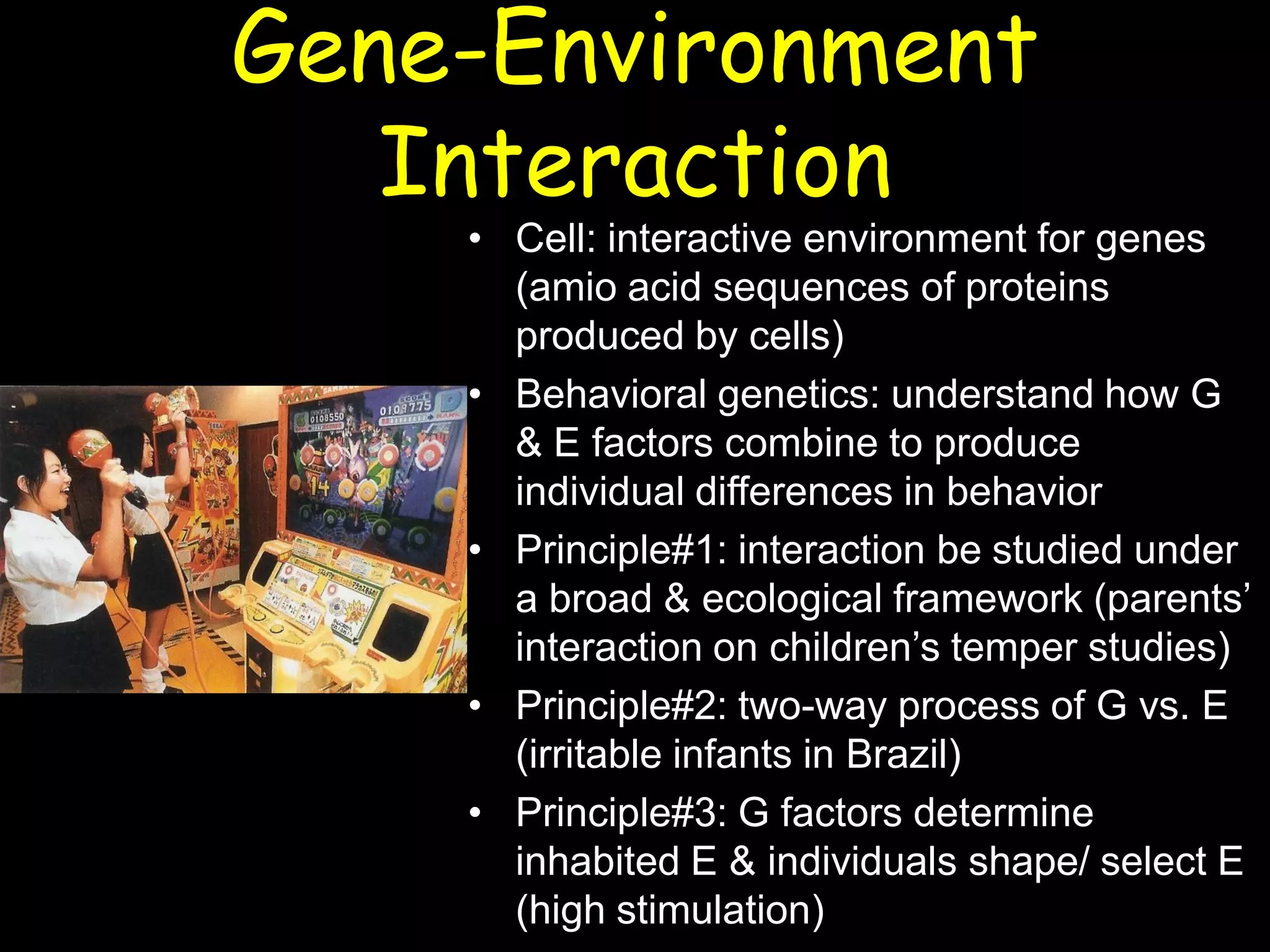
Gene-Environment
Interaction
• Cell: interactive environment for genes
(amio acid sequences of proteins
produced by cells)
• Behavioral genetics: understand how G
& E factors combine to produce
individual differences in behavior
• Principle#1: interaction be studied under
a broad & ecological framework (parents’
interaction on children’s temper studies)
• Principle#2: two-way process of G vs. E
(irritable infants in Brazil)
• Principle#3: G factors determine
inhabited E & individuals shape/ select E
(high stimulation)
Range of Reaction
• Two approaches in study GE
interaction
(1) Keep E constant: G influences
(2) Keep G constant: E influences
• Range of reaction: changes of E of a
particular G = phenotype
e.g., Himalayan rabbits fur color vs.
temperature
bet 2 extremes: dark --- white fur
• Ethnical problem on human studies
• Should be cautious on explanations of
animal studies
Genetic Influences on
Human Behavior
Heritability• Individual differences = Gs + Es interaction
• G/ Gs ≠ a certain behavior
• Heritability == statistical correlation
proportion of phenotypic variation in a population that is
attributable to genetic variation among individuals
estimate relative contributions of differences in genetic and
non-genetic factors to the total phenotypic variance in a
population
Heritability coefficient h2 == genetic variation == population
statistics
e.g., 90% height variation from genes in the US
• Explanation of heritability including E factor
e.g., IQ score increases in the US 16-20y (the young leave
home then)
• Discrete gene = responsible for particular phenotype in E
e.g., WS
KE Family
• Since 1990 in London
• 30 family members suffer specific language
impairment
• Have problem controlling lower half of face in
speech
• Have difficulty writing down as many words as
possible with the beginning of a certain letter
• Chromosome 7 gene FOXP2
• Nucleotide 7q31 mutation
• Uncertainty about E (education, developmental
course, disease history)
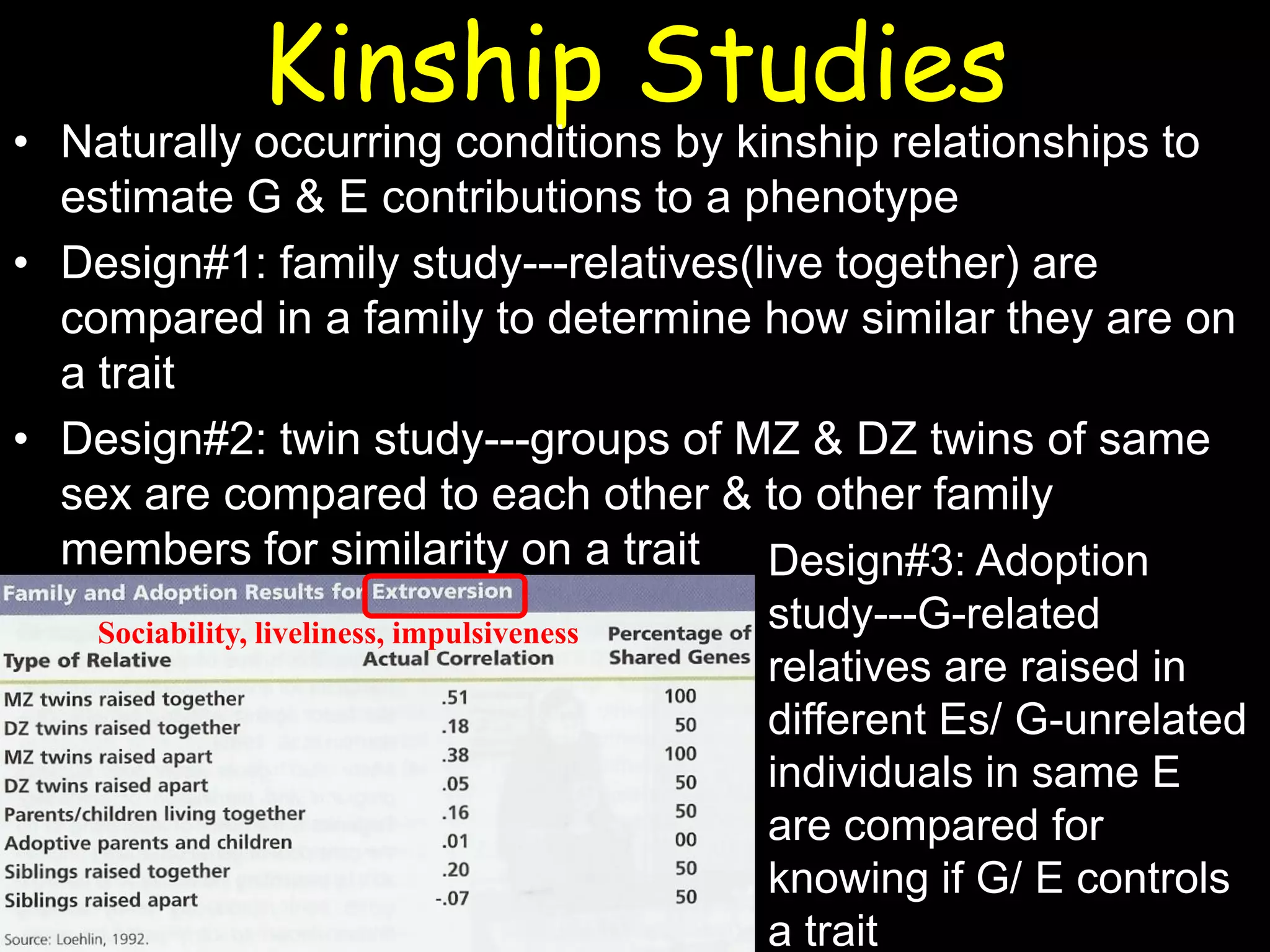
Kinship Studies
• Naturally occurring conditions by kinship relationships to
estimate G & E contributions to a phenotype
• Design#1: family study---relatives(live together) are
compared in a family to determine how similar they are on
a trait
• Design#2: twin study---groups of MZ & DZ twins of same
sex are compared to each other & to other family
members for similarity on a trait Design#3: Adoption
study---G-related
relatives are raised in
different Es/ G-unrelated
individuals in same E
are compared for
knowing if G/ E controls
a trait
Sociability, liveliness, impulsiveness
Mutations & Genetic
Abnormalities• Gene pool: the total variety of genetic info possessed by
a sexually reproducing population
• Mutation: error in the process of gene replication that
results in a change in molecular structure of the DNA
• Causes: only part of chromosome is replicated
a part is lost
on a particular gene / sequence of genes
• Somatic (body) cell affects the carrying person only
• Genetic defect affects generations
• Mutation creates new genes in the gene pool
• A small change in human genes leads to serious
problems
Interests in Genetic
Abnormality Studies
• ½ human conceptions have chromosomal
abnormality
• Majority of abnormalities results in miscarriage
• 3.5% babies born with genotypic aberration
(recessive)
• Reason#1: understand mutation reveal interaction
of heredity & E
• Reason#2: find ways to prevent/ameliorate birth
defeats
• Reason#3: try to reduce impact of abnormalities on
children & families
Down Syndrome
• First human disease linked with specific
chromosomal disorder
• >95% DS are trisomy chromosome 21
• Mental & physical retardation: slanting eyes, fold
on eyelids, flat facial profile, ears lower than
normal, short neck, protruding tongue, dental
irregularity, short broad hands, small curved
fingers
• Heart, ear, eye problems, likely to die young
• 1:1000 etiology; >30y pregnancy, 1:800; >40y,
1:100; >45y, 1:32; >49y, 1:12
• Women’s potential eggs are affected by E
chemicals, radiation, viruses
Phenylketonuria• Inherited metabolic disorder leads to severe
mental retardation
• Caused by a defective recessive gene that
reduces body’s ability to covert one amino acid
(phenylalanine) into another (tyrosine)
• PKU children produce too much phenylalanine in
bloodstreams which retards development of brain
cells in prefrontal cortex
• US 1:10,000 PKU; Europe 1:100
• PKU incidence is lower among blacks than whites
• Feeding PKU infants diet low in phenylalanine
(milk, egg, bread, fish) reduces severity of mental
retardation compared to untreated infants
• PKU infants will suffer brain irreversible damage in
1-3 months
Sickle-Cell Anemia
• People who inherit the recessive gene for
sickle-cell trait from both of their parents &
homozygous suffer from serious abnormality
of red blood cells
• Sickle-cell anemia take on curved sickle
shape when oxygen supply to blood is
reduced
• Abnormal blood cells clump together & clog
body’s blood vessels for people to have pain
• This disease enlarges the heart & deprives
the brain of blood
• Deformed blood cells rupture easily & may
lead to death
• Africans (20%): Americans (8-9%)
Before Marriage Health Check
婚前健康檢查
• Going-to-marry couple/ going-to-have-baby couple
• 傳染性疾病(病毒性肝炎/ 愛滋病/ 梅毒)
• 遺傳疾病篩檢(地中海型貧血/ 蠶豆症)
• 生育健康諮詢
產前遺傳診斷
• 超音波掃瞄羊膜穿刺術/ 絨毛取樣/ 胎兒臍帶抽血術
羊膜穿刺術
• 16-18週發現胎兒染色體異常基因疾病
• 抽取約20cc羊水檢驗室做細胞培養/ 胎兒染色體檢查
• 3-week process
• 胎兒染色體分析: 可檢查染色數目或構造是否正常
胎兒蛋白定量檢查: 檢查胎兒是否有開放性神經管缺損
單基因疾病檢查: 例如海洋性貧血
Cultural Evolution
• Phenotypes acquired in lifetimes can
be transmitted to next generations
parents pass on criminality to children
marking  writing/ numerical
calculation
• Successful innovations of earlier
generations pass on knowledge
through language + instruction
• Meme: basic unit of cultural inheritance
carry knowledge (how to study
an exam)
evolve & transmit through
social processes over time
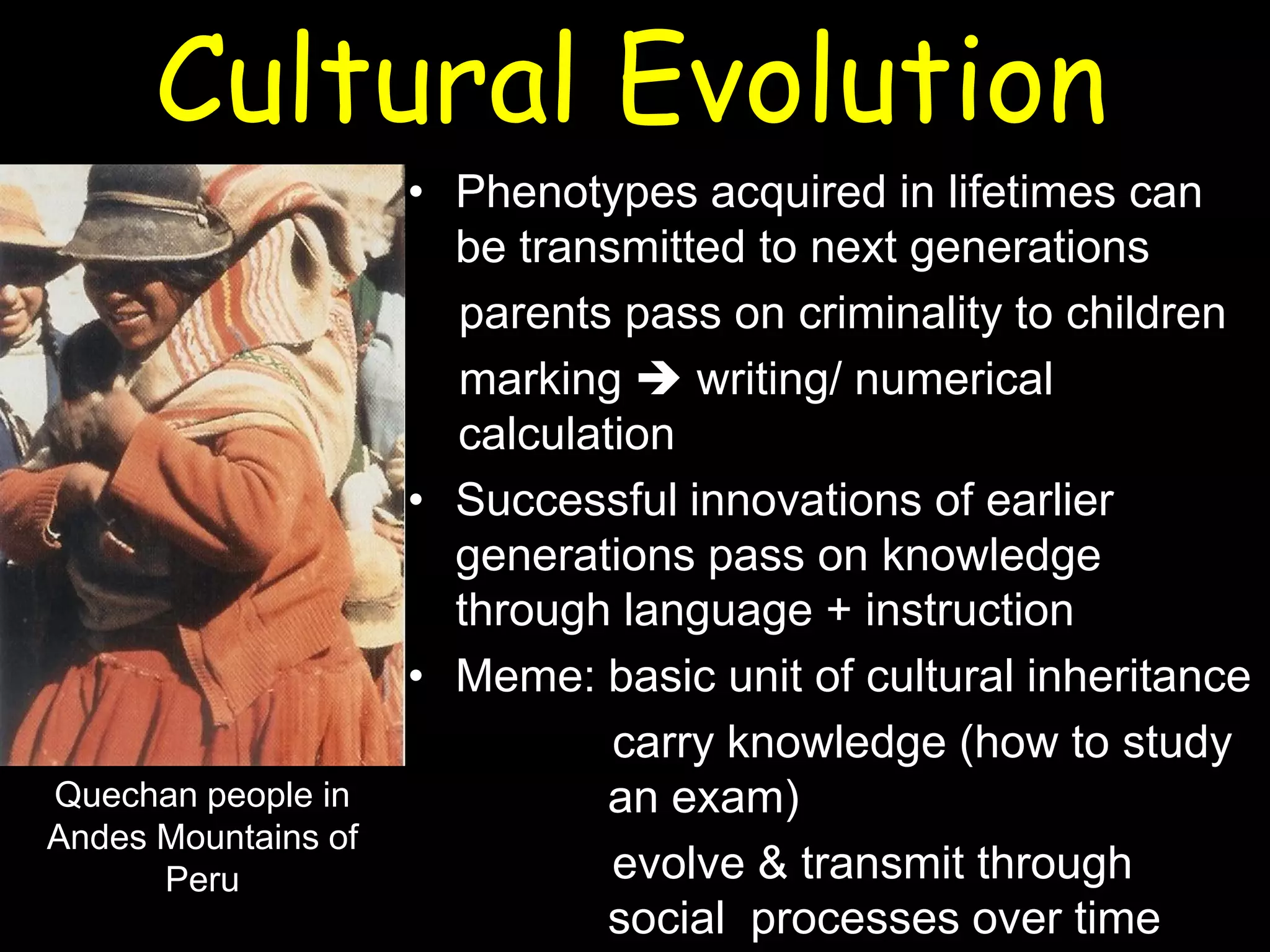
Quechan people in
Andes Mountains of
Peru
Coevolution & Survival Strategy
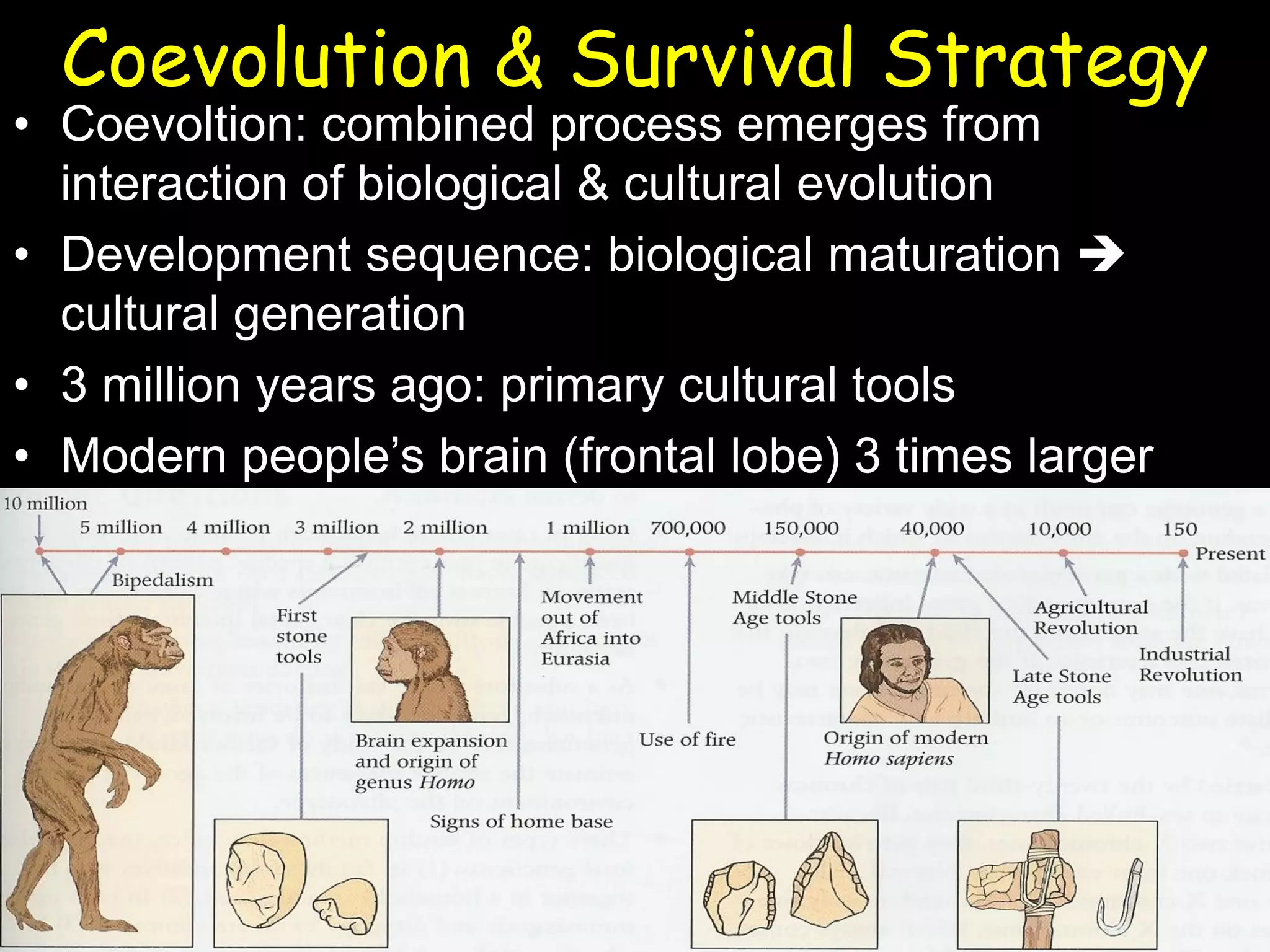
• Coevoltion: combined process emerges from
interaction of biological & cultural evolution
• Development sequence: biological maturation 
cultural generation
• 3 million years ago: primary cultural tools
• Modern people’s brain (frontal lobe) 3 times larger
Teaching
Implications
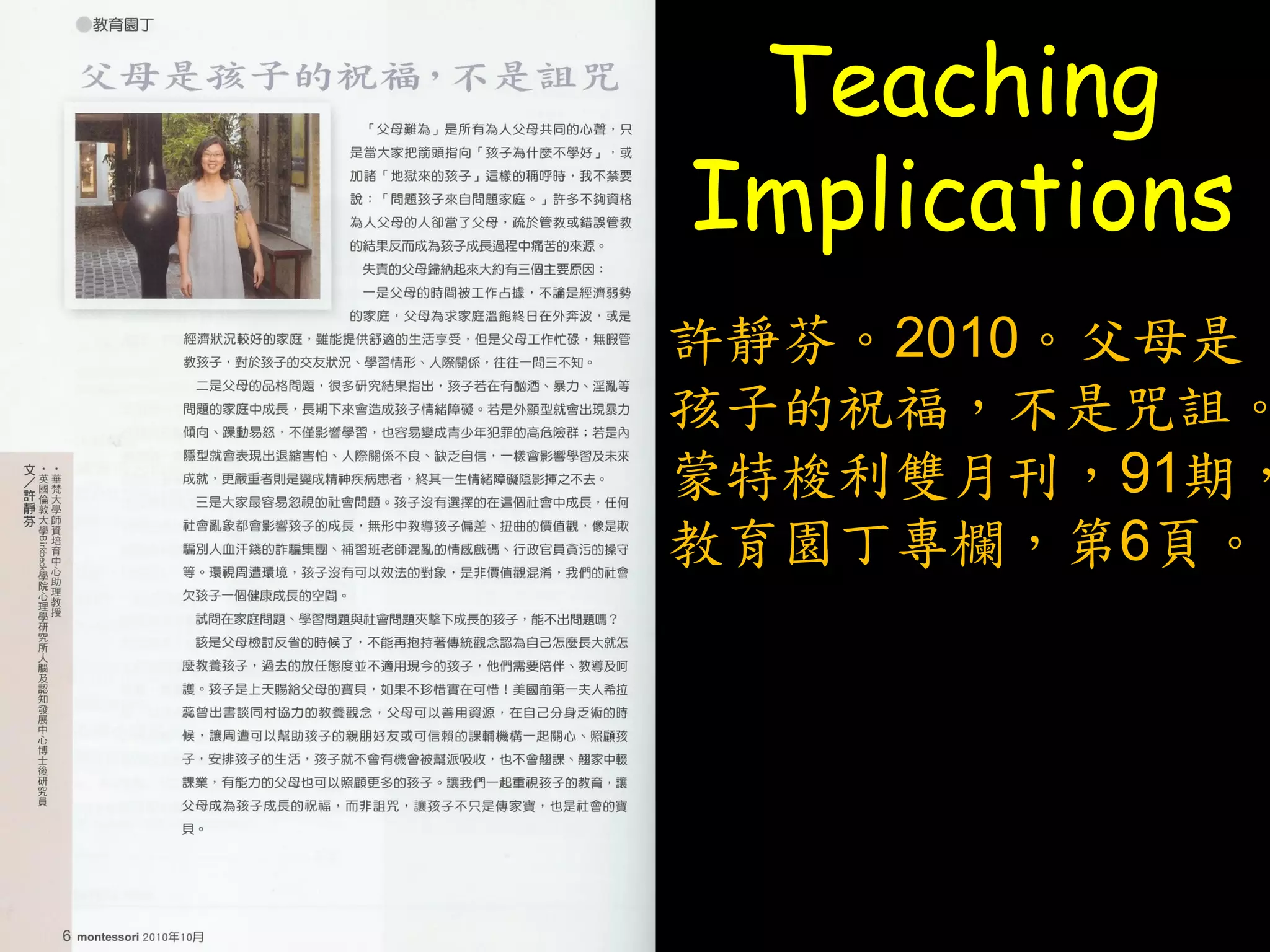
許靜芬。2010。父母是
孩子的祝福,不是咒詛。
蒙特梭利雙月刊,91期,
教育園丁專欄,第6頁。
Questions?

Gene environment 2

  • 1.
    The Human Heritage: Genesand the Environment Ching-fen Hsu 2013/9/27 Lecture 2
  • 3.
    Sexual Reproduction and GeneticTransmission • Sperm & egg: 23 chromosome • Chromosome: single molecule of DNA • DNA: long paired strands to create double helix • Four chemical bases in DNA: A/T/C/G • Sequences of bases: determine the info available • Gene: segments on chromosome/working subunit of DNA made up of bases/basic heredity unit • Ovum & sperm = zygote (46 chromosomes/ 23 pairs of chromosome)
  • 4.
    Process of CellReplication • Mitosis: zygote creates new cells (1) 46 chromosomes move to the middle of the zygote (2) produce exact copies (3) chromosome separate into 2 identical sets (4) migrate to opposite sites (5) form two daughter cells with identical 23 pairs of chromosomes (6) daughter cells create new cells repeatedly • Life long process: create new body cells for replacing old • Genetic material is not altered in life
  • 5.
    Source of GeneticVariation • Meiosis: cell division process • Germ cell replication: sperm & ova • Make sure zygote with 46 chromos • Initial stage of genetic lottery • Genetic diversity: newly conceived individual differs from both mother & father Meiosis in the Male Meiosis in the Female • Monozygotic twins: a single fertilized egg with identical genetic info. 1:250, never exactly alike with differences in environment • Dizygotic twins • 8 million (223) possible genetic combinations for each sperm & ovum • 1 in 64 trillion chance for exactly the same genes
  • 6.
    Sexual Determination • Anothersource of variation • Human differs at 23rd chromosome • Females: XX • Males: XY • Y chromosome is smaller than X X chromo Y chromo
  • 7.
    Genotype & Phenotype •How genes influence development • Genotype: individual’s genetic endowment; particular gene forms that individual inherits; constant over lifetime • Phenotype: observable characteristics/ traits on physical, psychological, healthy, behavioral levels; interaction with E • Genetic inheritance expresses itself through interaction with E to create phenotype
  • 8.
  • 9.
    Laws of Genetic Inheritance •Scientific understanding of gene transmission across generations • Characters pass-on • Genes contribute particular inherited characteristics • Allele: specific form (trait) of a gene • Homozygous: same allele forms of the corresponding genes (cleft vs. non-cleft) • Heterozygous: different allele forms, important in understanding genotypic combinations for producing different phenotypes Gregor Mendel 1822-1884
  • 10.
    Knowing Inheritance • Dominantallele: expressed characteristic-carrying allele • Recessive allele: unexpressed allele • Intermediate bet two alleles: affected by 2 alleles, skin color • Codominance: affected by 2 alleles/ totally different from both • Polygenic trait: >2 genes in complex beh traits (verbal skills)
  • 11.
    Sex-Linked Genetic Effects • Sex-linkedcharacteristics: specific inherited deficit with X/Y chromosome • Mostly X-chromo related (girls from each parent; boy from mother) • Females: complementary function from the other X-chromo • Males: fragile function on X-chromo/getting deficits e.g., red-green color blindness (lack of color-absorbing pigments in the retina of the eye) girls: homozygous alleles from both parents boys: inherited from mothers hemophilia/muscular dystrophy
  • 12.
  • 13.
    Gene-Environment Interaction • Cell: interactiveenvironment for genes (amio acid sequences of proteins produced by cells) • Behavioral genetics: understand how G & E factors combine to produce individual differences in behavior • Principle#1: interaction be studied under a broad & ecological framework (parents’ interaction on children’s temper studies) • Principle#2: two-way process of G vs. E (irritable infants in Brazil) • Principle#3: G factors determine inhabited E & individuals shape/ select E (high stimulation)
  • 14.
    Range of Reaction •Two approaches in study GE interaction (1) Keep E constant: G influences (2) Keep G constant: E influences • Range of reaction: changes of E of a particular G = phenotype e.g., Himalayan rabbits fur color vs. temperature bet 2 extremes: dark --- white fur • Ethnical problem on human studies • Should be cautious on explanations of animal studies
  • 15.
  • 16.
    Heritability• Individual differences= Gs + Es interaction • G/ Gs ≠ a certain behavior • Heritability == statistical correlation proportion of phenotypic variation in a population that is attributable to genetic variation among individuals estimate relative contributions of differences in genetic and non-genetic factors to the total phenotypic variance in a population Heritability coefficient h2 == genetic variation == population statistics e.g., 90% height variation from genes in the US • Explanation of heritability including E factor e.g., IQ score increases in the US 16-20y (the young leave home then) • Discrete gene = responsible for particular phenotype in E e.g., WS
  • 17.
    KE Family • Since1990 in London • 30 family members suffer specific language impairment • Have problem controlling lower half of face in speech • Have difficulty writing down as many words as possible with the beginning of a certain letter • Chromosome 7 gene FOXP2 • Nucleotide 7q31 mutation • Uncertainty about E (education, developmental course, disease history)
  • 18.
    Kinship Studies • Naturallyoccurring conditions by kinship relationships to estimate G & E contributions to a phenotype • Design#1: family study---relatives(live together) are compared in a family to determine how similar they are on a trait • Design#2: twin study---groups of MZ & DZ twins of same sex are compared to each other & to other family members for similarity on a trait Design#3: Adoption study---G-related relatives are raised in different Es/ G-unrelated individuals in same E are compared for knowing if G/ E controls a trait Sociability, liveliness, impulsiveness
  • 19.
    Mutations & Genetic Abnormalities•Gene pool: the total variety of genetic info possessed by a sexually reproducing population • Mutation: error in the process of gene replication that results in a change in molecular structure of the DNA • Causes: only part of chromosome is replicated a part is lost on a particular gene / sequence of genes • Somatic (body) cell affects the carrying person only • Genetic defect affects generations • Mutation creates new genes in the gene pool • A small change in human genes leads to serious problems
  • 20.
    Interests in Genetic AbnormalityStudies • ½ human conceptions have chromosomal abnormality • Majority of abnormalities results in miscarriage • 3.5% babies born with genotypic aberration (recessive) • Reason#1: understand mutation reveal interaction of heredity & E • Reason#2: find ways to prevent/ameliorate birth defeats • Reason#3: try to reduce impact of abnormalities on children & families
  • 21.
    Down Syndrome • Firsthuman disease linked with specific chromosomal disorder • >95% DS are trisomy chromosome 21 • Mental & physical retardation: slanting eyes, fold on eyelids, flat facial profile, ears lower than normal, short neck, protruding tongue, dental irregularity, short broad hands, small curved fingers • Heart, ear, eye problems, likely to die young • 1:1000 etiology; >30y pregnancy, 1:800; >40y, 1:100; >45y, 1:32; >49y, 1:12 • Women’s potential eggs are affected by E chemicals, radiation, viruses
  • 22.
    Phenylketonuria• Inherited metabolicdisorder leads to severe mental retardation • Caused by a defective recessive gene that reduces body’s ability to covert one amino acid (phenylalanine) into another (tyrosine) • PKU children produce too much phenylalanine in bloodstreams which retards development of brain cells in prefrontal cortex • US 1:10,000 PKU; Europe 1:100 • PKU incidence is lower among blacks than whites • Feeding PKU infants diet low in phenylalanine (milk, egg, bread, fish) reduces severity of mental retardation compared to untreated infants • PKU infants will suffer brain irreversible damage in 1-3 months
  • 23.
    Sickle-Cell Anemia • Peoplewho inherit the recessive gene for sickle-cell trait from both of their parents & homozygous suffer from serious abnormality of red blood cells • Sickle-cell anemia take on curved sickle shape when oxygen supply to blood is reduced • Abnormal blood cells clump together & clog body’s blood vessels for people to have pain • This disease enlarges the heart & deprives the brain of blood • Deformed blood cells rupture easily & may lead to death • Africans (20%): Americans (8-9%)
  • 24.
    Before Marriage HealthCheck 婚前健康檢查 • Going-to-marry couple/ going-to-have-baby couple • 傳染性疾病(病毒性肝炎/ 愛滋病/ 梅毒) • 遺傳疾病篩檢(地中海型貧血/ 蠶豆症) • 生育健康諮詢 產前遺傳診斷 • 超音波掃瞄羊膜穿刺術/ 絨毛取樣/ 胎兒臍帶抽血術 羊膜穿刺術 • 16-18週發現胎兒染色體異常基因疾病 • 抽取約20cc羊水檢驗室做細胞培養/ 胎兒染色體檢查 • 3-week process • 胎兒染色體分析: 可檢查染色數目或構造是否正常 胎兒蛋白定量檢查: 檢查胎兒是否有開放性神經管缺損 單基因疾病檢查: 例如海洋性貧血
  • 25.
    Cultural Evolution • Phenotypesacquired in lifetimes can be transmitted to next generations parents pass on criminality to children marking  writing/ numerical calculation • Successful innovations of earlier generations pass on knowledge through language + instruction • Meme: basic unit of cultural inheritance carry knowledge (how to study an exam) evolve & transmit through social processes over time Quechan people in Andes Mountains of Peru
  • 26.
    Coevolution & SurvivalStrategy • Coevoltion: combined process emerges from interaction of biological & cultural evolution • Development sequence: biological maturation  cultural generation • 3 million years ago: primary cultural tools • Modern people’s brain (frontal lobe) 3 times larger
  • 27.
  • 28.