Copyright © 2018, 2015, 2012 Pearson Education, Inc. All Rights Reserved
Discovering the Life Span
Fourth Edition
Chapter 2
The Start of Life
Module 2.1
Prenatal Development
Copyright © 2018, 2015, 2012 Pearson Education, Inc. All Rights Reserved
Genes and Chromosomes: The
Code of Life
Copyright © 2018, 2015, 2012 Pearson Education, Inc. All Rights Reserved
Genes and Chromosomes: The Code of Life
•GAMETES
–ovum & sperm
•ZYGOTE
• Meiosis – formation of ovum + sperm = 1 human cell
•GENES composed of DNA sequences
–deoxy-ribo-nucleic acid
Copyright © 2018, 2015, 2012 Pearson Education, Inc. All Rights Reserved
Figure 2-1: The Contents of
a Single Human Cell
At the moment of conception, humans receive about 25,000 genes, contained on
46 chromosomes in 23 pairs.
Copyright © 2018, 2015, 2012 Pearson Education, Inc. All Rights Reserved
Chromosomes
At the moment of conception, humans receive 23 pairs of chromosomes, half from the mother
and half from the father. These chromosomes contain thousands of genes.
Copyright © 2018, 2015, 2012 Pearson Education, Inc. All Rights Reserved
Multiple Births: Two or More for the Genetic
Price of One
•Monozygotic twins
•Dizygotic twins
•Influential Factors
–Fertility Drugs
–Age of the mother
–Race
Copyright © 2018, 2015, 2012 Pearson Education, Inc. All Rights Reserved
Figure 2-3: Determining Sex
When an ovum and sperm meet at the
moment of fertilization, the ovum is certain to
provide an X chromosome, whereas the
sperm will provide either an X or a Y
chromosome. If the sperm contributes its X
chromosome, the child will have an XX
pairing on the 23rd chromosome and will be
a girl. If the sperm contributes a Y
chromosome, the result will be an XY
pairing—a boy. Does this mean that girls are
more likely to be conceived than boys?
Copyright © 2018, 2015, 2012 Pearson Education, Inc. All Rights Reserved
The Basics of Genetics: The Mixing
and Matching of Traits
LO 2.2 Explain the mechanisms by which genes transmit information.
•Basic genetics (Gregor Mendel, mid-1800’s)
–Dominant trait
–Recessive trait
–Genotype
–Phenotype
▪Homozygous
▪Heterozygous
–Polygenic trait
▪Diathesis stress
Copyright © 2018, 2015, 2012 Pearson Education, Inc. All Rights Reserved
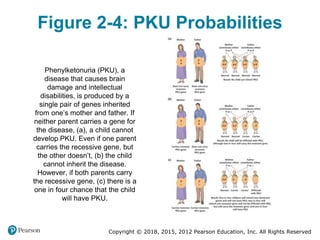
Figure 2-4: PKU Probabilities
Phenylketonuria (PKU), a
disease that causes brain
damage and intellectual
disabilities, is produced by a
single pair of genes inherited
from one’s mother and father. If
neither parent carries a gene for
the disease, (a), a child cannot
develop PKU. Even if one parent
carries the recessive gene, but
the other doesn’t, (b) the child
cannot inherit the disease.
However, if both parents carry
the recessive gene, (c) there is a
one in four chance that the child
will have PKU.
Copyright © 2018, 2015, 2012 Pearson Education, Inc. All Rights Reserved
The Human Genome: Behavioral
Genetics
Humans have about 25,000 genes, making
them not much more genetically complex
than some primitive species.
Copyright © 2018, 2015, 2012 Pearson Education, Inc. All Rights Reserved
Inherited and Genetic Disorders:
When Development Deviates from the
Norm
•Down syndrome
•Fragile X
•Sickle-Cell anemia
•Tay-Sachs disease
•Klinefelter’s syndrome
Copyright © 2018, 2015, 2012 Pearson Education, Inc. All Rights Reserved
Genetic Counseling and Prenatal Testing
•Karotype
•Ultrasound sonography
•Chorionic villus
sampling (CVS)
•Amniocentesis
Copyright © 2018, 2015, 2012 Pearson Education, Inc. All Rights Reserved
Amniocentesis
In amniocentesis, a sample of fetal cells is withdrawn from the amniotic sac and used to
identify a number of genetic defects.
Copyright © 2018, 2015, 2012 Pearson Education, Inc. All Rights Reserved
Studying Development: How
much is nature and how much is
nurture?
• Temperament
• Multifactorial transmission
Copyright © 2018, 2015, 2012 Pearson Education, Inc. All Rights Reserved
Nonhuman Animal Studies: Controlling Both
Genetics and Environment
•Measureing environmental effects
• Genetically similar animals in
different environments
• Genetically different animals
in similar environments
Copyright © 2018, 2015, 2012 Pearson Education, Inc. All Rights Reserved
Contrasting Relatedness and Behavior:
Adoption, Twin and Family Studies
•Monozygotic and Dizygotic twins separated at birth
•Adoptive parents vs Biological parents and children
•Both play a role in traits, characteristics, and
behaviors
•And the verdict is…
–Physical Traits
–Intelligence
Copyright © 2018, 2015, 2012 Pearson Education, Inc. All Rights Reserved
Figure 2-6: Genetics and IQ
The closer the genetic link between two individuals, the greater the correspondence
between their IQ scores. Why do you think there is a sex difference in the fraternal twins’
figures? Might there be other sex differences in other sets of twins or siblings, not shown
on this chart?
Copyright © 2018, 2015, 2012 Pearson Education, Inc. All Rights Reserved
Genetic and Environmental Influences on
personality: Do we inherit our personality?
•Two of the “Big Five” have been linked to genetic
stability:
–Neuroticism
–Extroversion
•Certain traits reflect the contribution of genetics
more than others
•The environment also plays a role in personality
Copyright © 2018, 2015, 2012 Pearson Education, Inc. All Rights Reserved
Psychological Disorders: The Role of Genetics
and Environment
•Several disorders brought about by genetic
factors:
– Schizophrenia spectrum disorder
– Major depression
– Alcoholism
– Autism spectrum disorder
– Attention-deficit hyperactivity disorder
•Do genetics cause psychological disorders?
Copyright © 2018, 2015, 2012 Pearson Education, Inc. All Rights Reserved
Figure 2-8: The Genetics of
Schizophrenia
The psychological disorder of schizophrenia has clear genetic components. The closer
the genetic links between someone with schizophrenia and another family member, the
more likely it is that the other person will also develop schizophrenia.
Copyright © 2018, 2015, 2012 Pearson Education, Inc. All Rights Reserved
Review: The Interaction of Heredity
and Environment
• Behavioral characteristics are often determined by both
genetics and environment.
• The genotype is the genetic contribution while phenotype is
the expression of the genes in observable traits.
• Traits, characteristics, and behaviors are all due to nature and
nurture.
• Some personality traits have been linked to genetic factors.
• Children may influence their environment through genetic
traits.
• They can create an environment that matches their
disposition.
Copyright © 2018, 2015, 2012 Pearson Education, Inc. All Rights Reserved
Applying Lifespan Development
How might an environment different from the one you
experienced have affected the development of personality
characteristics that you believe you inherited from one or
both of your parents?

Feldman 4e 2.1 genetics

  • 1.
    Copyright © 2018,2015, 2012 Pearson Education, Inc. All Rights Reserved Discovering the Life Span Fourth Edition Chapter 2 The Start of Life Module 2.1 Prenatal Development
  • 2.
    Copyright © 2018,2015, 2012 Pearson Education, Inc. All Rights Reserved Genes and Chromosomes: The Code of Life
  • 3.
    Copyright © 2018,2015, 2012 Pearson Education, Inc. All Rights Reserved Genes and Chromosomes: The Code of Life •GAMETES –ovum & sperm •ZYGOTE • Meiosis – formation of ovum + sperm = 1 human cell •GENES composed of DNA sequences –deoxy-ribo-nucleic acid
  • 4.
    Copyright © 2018,2015, 2012 Pearson Education, Inc. All Rights Reserved Figure 2-1: The Contents of a Single Human Cell At the moment of conception, humans receive about 25,000 genes, contained on 46 chromosomes in 23 pairs.
  • 5.
    Copyright © 2018,2015, 2012 Pearson Education, Inc. All Rights Reserved Chromosomes At the moment of conception, humans receive 23 pairs of chromosomes, half from the mother and half from the father. These chromosomes contain thousands of genes.
  • 6.
    Copyright © 2018,2015, 2012 Pearson Education, Inc. All Rights Reserved Multiple Births: Two or More for the Genetic Price of One •Monozygotic twins •Dizygotic twins •Influential Factors –Fertility Drugs –Age of the mother –Race
  • 7.
    Copyright © 2018,2015, 2012 Pearson Education, Inc. All Rights Reserved Figure 2-3: Determining Sex When an ovum and sperm meet at the moment of fertilization, the ovum is certain to provide an X chromosome, whereas the sperm will provide either an X or a Y chromosome. If the sperm contributes its X chromosome, the child will have an XX pairing on the 23rd chromosome and will be a girl. If the sperm contributes a Y chromosome, the result will be an XY pairing—a boy. Does this mean that girls are more likely to be conceived than boys?
  • 8.
    Copyright © 2018,2015, 2012 Pearson Education, Inc. All Rights Reserved The Basics of Genetics: The Mixing and Matching of Traits LO 2.2 Explain the mechanisms by which genes transmit information. •Basic genetics (Gregor Mendel, mid-1800’s) –Dominant trait –Recessive trait –Genotype –Phenotype ▪Homozygous ▪Heterozygous –Polygenic trait ▪Diathesis stress
  • 9.
    Copyright © 2018,2015, 2012 Pearson Education, Inc. All Rights Reserved Figure 2-4: PKU Probabilities Phenylketonuria (PKU), a disease that causes brain damage and intellectual disabilities, is produced by a single pair of genes inherited from one’s mother and father. If neither parent carries a gene for the disease, (a), a child cannot develop PKU. Even if one parent carries the recessive gene, but the other doesn’t, (b) the child cannot inherit the disease. However, if both parents carry the recessive gene, (c) there is a one in four chance that the child will have PKU.
  • 10.
    Copyright © 2018,2015, 2012 Pearson Education, Inc. All Rights Reserved The Human Genome: Behavioral Genetics Humans have about 25,000 genes, making them not much more genetically complex than some primitive species.
  • 11.
    Copyright © 2018,2015, 2012 Pearson Education, Inc. All Rights Reserved Inherited and Genetic Disorders: When Development Deviates from the Norm •Down syndrome •Fragile X •Sickle-Cell anemia •Tay-Sachs disease •Klinefelter’s syndrome
  • 12.
    Copyright © 2018,2015, 2012 Pearson Education, Inc. All Rights Reserved Genetic Counseling and Prenatal Testing •Karotype •Ultrasound sonography •Chorionic villus sampling (CVS) •Amniocentesis
  • 13.
    Copyright © 2018,2015, 2012 Pearson Education, Inc. All Rights Reserved Amniocentesis In amniocentesis, a sample of fetal cells is withdrawn from the amniotic sac and used to identify a number of genetic defects.
  • 14.
    Copyright © 2018,2015, 2012 Pearson Education, Inc. All Rights Reserved Studying Development: How much is nature and how much is nurture? • Temperament • Multifactorial transmission
  • 15.
    Copyright © 2018,2015, 2012 Pearson Education, Inc. All Rights Reserved Nonhuman Animal Studies: Controlling Both Genetics and Environment •Measureing environmental effects • Genetically similar animals in different environments • Genetically different animals in similar environments
  • 16.
    Copyright © 2018,2015, 2012 Pearson Education, Inc. All Rights Reserved Contrasting Relatedness and Behavior: Adoption, Twin and Family Studies •Monozygotic and Dizygotic twins separated at birth •Adoptive parents vs Biological parents and children •Both play a role in traits, characteristics, and behaviors •And the verdict is… –Physical Traits –Intelligence
  • 17.
    Copyright © 2018,2015, 2012 Pearson Education, Inc. All Rights Reserved Figure 2-6: Genetics and IQ The closer the genetic link between two individuals, the greater the correspondence between their IQ scores. Why do you think there is a sex difference in the fraternal twins’ figures? Might there be other sex differences in other sets of twins or siblings, not shown on this chart?
  • 18.
    Copyright © 2018,2015, 2012 Pearson Education, Inc. All Rights Reserved Genetic and Environmental Influences on personality: Do we inherit our personality? •Two of the “Big Five” have been linked to genetic stability: –Neuroticism –Extroversion •Certain traits reflect the contribution of genetics more than others •The environment also plays a role in personality
  • 19.
    Copyright © 2018,2015, 2012 Pearson Education, Inc. All Rights Reserved Psychological Disorders: The Role of Genetics and Environment •Several disorders brought about by genetic factors: – Schizophrenia spectrum disorder – Major depression – Alcoholism – Autism spectrum disorder – Attention-deficit hyperactivity disorder •Do genetics cause psychological disorders?
  • 20.
    Copyright © 2018,2015, 2012 Pearson Education, Inc. All Rights Reserved Figure 2-8: The Genetics of Schizophrenia The psychological disorder of schizophrenia has clear genetic components. The closer the genetic links between someone with schizophrenia and another family member, the more likely it is that the other person will also develop schizophrenia.
  • 21.
    Copyright © 2018,2015, 2012 Pearson Education, Inc. All Rights Reserved Review: The Interaction of Heredity and Environment • Behavioral characteristics are often determined by both genetics and environment. • The genotype is the genetic contribution while phenotype is the expression of the genes in observable traits. • Traits, characteristics, and behaviors are all due to nature and nurture. • Some personality traits have been linked to genetic factors. • Children may influence their environment through genetic traits. • They can create an environment that matches their disposition.
  • 22.
    Copyright © 2018,2015, 2012 Pearson Education, Inc. All Rights Reserved Applying Lifespan Development How might an environment different from the one you experienced have affected the development of personality characteristics that you believe you inherited from one or both of your parents?

Editor's Notes

  • #9 An Austrian monk, Gregor Mendel (mid-1800s), working with peas, discovered that when two competing traits were present only one could be expressed. The trait that is expressed when two competing traits are present is called the DOMINANT TRAIT. The trait that is present in the organism but not expressed is called the RECESSIVE TRAIT. GENOTYPE is the underlying combination of genetic material present (but not outwardly visible) in an organism. PHENOTYPE is an observable trait, the trait that is actually seen. Alleles are genes for traits that may take alternate forms. HOMOZYGOUS is inheriting from parents similar genes for a given trait. HETEROZYGOUS is inheriting from parents different forms of a gene for a given trait.
  • #11 Source: Celera Genomics: International Human Genome Sequencing Consortium, 2001.
  • #12 DOWN SYNDROME is a disorder produced by the presence of an extra chromosome on the 21st chromosome pair, once referred to as mongolism. FRAGILE X SYNDROME is a disorder produced by injury to a gene on the X chromosome, producing mild to moderate mental retardation. SICKLE-CELL ANEMIA is a blood disorder that gets its name from the shape of the red blood cells in those who have it. TAY-SACHS DISEASE is an untreatable disorder that produces blindness and muscle degeneration prior to death. One male out of every 400 is born with KLINEFELTER’S SYNDROME, a disorder resulting from the presence of an extra X chromosome that produces underdeveloped genitals, extreme height, and enlarged breasts.
  • #13 ULTRASOUND SONOGRAPHY is a process in which high-frequency sound waves scan the mother’s womb to produce an image of the unborn baby whose size and shape can then be assessed. CHORIONIC VILLUS SAMPLING (CVS) is a test used to find genetic defects that involves taking samples of hairlike material that surrounds the embryo. AMNIOCENTESIS is the process of identifying genetic defects by examining a small sample of fetal cells drawn by a needle inserted into the amniotic fluid surrounding the unborn fetus.
  • #18 Source: Based on Bouchard & McGue, 1981
  • #21 Source: Based on Gottesman, 1991.