Hakim Shah
RN, BSN, MSN, PhD (Scholar)
30-08-2022
1
Required Reading Book:
Carol, Porth M. (2014). Pathophysiology concept of altered health
states (9th Ed). Philadelphia: J. B. Lippincott.
(Book is available in ICoNM Library)
Chapter-7, Page No. 138-158
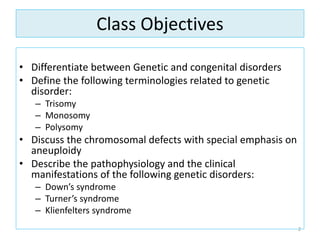
Class Objectives
• Differentiate between Genetic and congenital disorders
• Define the following terminologies related to genetic
disorder:
– Trisomy
– Monosomy
– Polysomy
• Discuss the chromosomal defects with special emphasis on
aneuploidy
• Describe the pathophysiology and the clinical
manifestations of the following genetic disorders:
– Down’s syndrome
– Turner’s syndrome
– Klienfelters syndrome
2
Introduction to Genetics
• “Genetics is the study of heredity, the process
in which a parent passes certain genes onto
their children.”
• Children inherit their biological parents’ genes
that express specific traits, such as some
physical characteristics, natural talents, and
genetic disorders.
3
Congenital Diseases
• Those diseases present at birth
• Note that not all genetic diseases present at birth
• Congenital diseases include:
1. Developmental diseases
• Those that arise spontaneously during gestation
• Example: failure of testis to descend
2. Those that are secondary to environmental problems
• From trauma
• From poisons (teratogenic agents)
• From poor nutrition of mother during gestation
4
Types of Genetic Disorders
• There are Three types of Genetic Disorders:
1. Single gene disorders
2. Chromosomal diseases
1. Multifactorial diseases
5
1. Single Gene Disorders
This type of genetic disorders occur due to
Nucleotide mutation. Classified by inheritance
pattern
6
2.Chromosomal Diseases
Usually occurs during mitosis
There are 2 types of chromosomal diseases
a. Structural change of the chromosome
• Deletion: cause most serious problems and/or
death
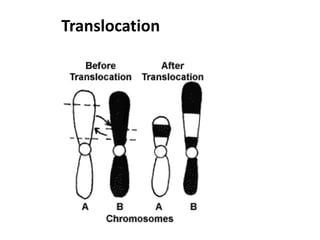
• Translocation: broken part of chromosome
becomes attached to non-homologous
chromosome
7
Cont…
b. Change in chromosome number
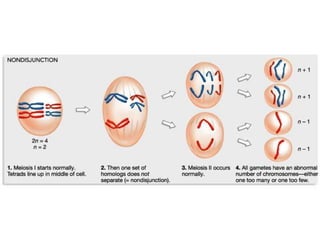
• Caused during meiosis by nondisjunction
• Euploidy: normal number of
chromosomes
• Aneuploidy: abnormal number of
chromosomes. Example:
– Turner’s syndrome: monosomy X
– Down’s syndrome: Trisomy 21
8
3. Multifactorial diseases
• May be a combination of environmental factors &
genetic tendency.
– Example: Lung cancer, colon cancer
• These may be polygenic.
– Example: deafness, diabetes
9
Basic Unit of Genetics: DNA
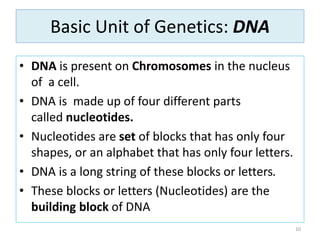
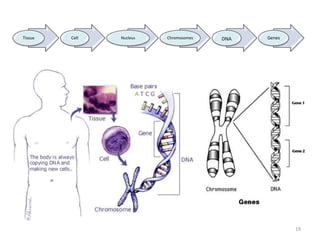
• DNA is present on Chromosomes in the nucleus
of a cell.
• DNA is made up of four different parts
called nucleotides.
• Nucleotides are set of blocks that has only four
shapes, or an alphabet that has only four letters.
• DNA is a long string of these blocks or letters.
• These blocks or letters (Nucleotides) are the
building block of DNA
10
Structure of DNA
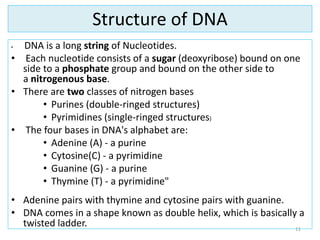
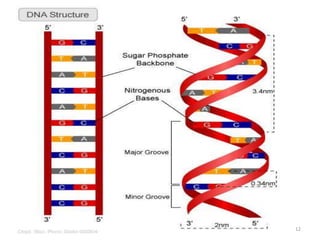
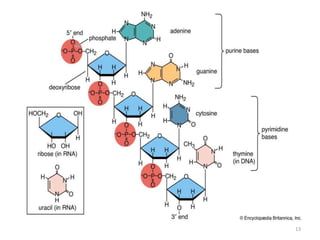
• DNA is a long string of Nucleotides.
• Each nucleotide consists of a sugar (deoxyribose) bound on one
side to a phosphate group and bound on the other side to
a nitrogenous base.
• There are two classes of nitrogen bases
• Purines (double-ringed structures)
• Pyrimidines (single-ringed structures)
• The four bases in DNA's alphabet are:
• Adenine (A) - a purine
• Cytosine(C) - a pyrimidine
• Guanine (G) - a purine
• Thymine (T) - a pyrimidine"
• Adenine pairs with thymine and cytosine pairs with guanine.
• DNA comes in a shape known as double helix, which is basically a
twisted ladder. 11
12
13
Basic Concepts of Genetics
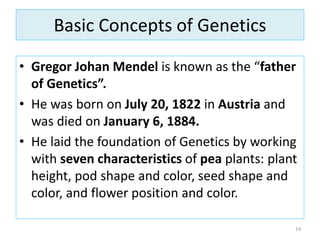
• Gregor Johan Mendel is known as the “father
of Genetics”.
• He was born on July 20, 1822 in Austria and
was died on January 6, 1884.
• He laid the foundation of Genetics by working
with seven characteristics of pea plants: plant
height, pod shape and color, seed shape and
color, and flower position and color.
14
Principle of Independent Assortment
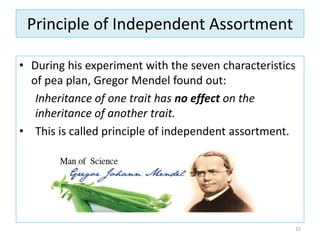
• During his experiment with the seven characteristics
of pea plan, Gregor Mendel found out:
Inheritance of one trait has no effect on the
inheritance of another trait.
• This is called principle of independent assortment.
15
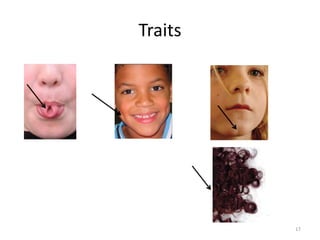
Traits
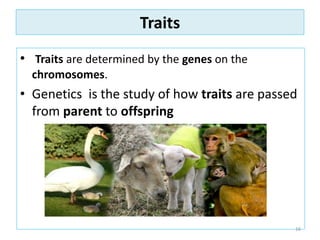
• Traits are determined by the genes on the
chromosomes.
• Genetics is the study of how traits are passed
from parent to offspring
16
Traits
17
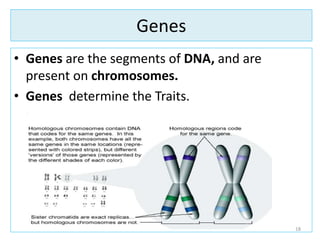
Genes
• Genes are the segments of DNA, and are
present on chromosomes.
• Genes determine the Traits.
18
19
Tissue Cell Nucleus Chromosomes DNA Genes
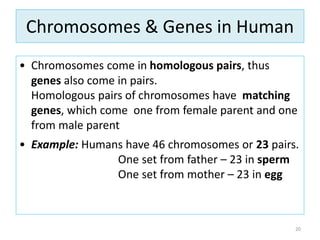
Chromosomes & Genes in Human
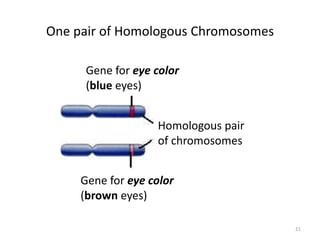
• Chromosomes come in homologous pairs, thus
genes also come in pairs.
Homologous pairs of chromosomes have matching
genes, which come one from female parent and one
from male parent
• Example: Humans have 46 chromosomes or 23 pairs.
One set from father – 23 in sperm
One set from mother – 23 in egg
20
One pair of Homologous Chromosomes
21
Homologous pair
of chromosomes
Gene for eye color
(blue eyes)
Gene for eye color
(brown eyes)
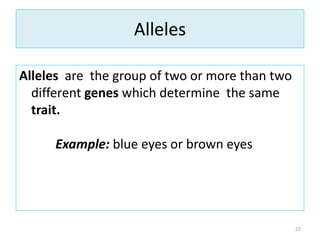
Alleles
Alleles are the group of two or more than two
different genes which determine the same
trait.
Example: blue eyes or brown eyes
22
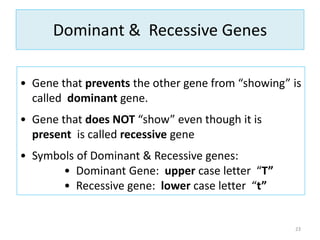
Dominant & Recessive Genes
23
• Gene that prevents the other gene from “showing” is
called dominant gene.
• Gene that does NOT “show” even though it is
present is called recessive gene
• Symbols of Dominant & Recessive genes:
• Dominant Gene: upper case letter “T”
• Recessive gene: lower case letter “t”
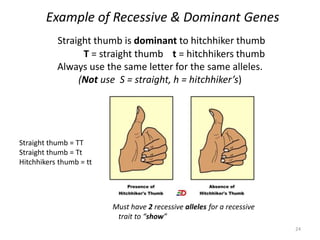
Example of Recessive & Dominant Genes
24
Straight thumb is dominant to hitchhiker thumb
T = straight thumb t = hitchhikers thumb
Always use the same letter for the same alleles.
(Not use S = straight, h = hitchhiker’s)
Straight thumb = TT
Straight thumb = Tt
Hitchhikers thumb = tt
Must have 2 recessive alleles for a recessive
trait to “show”
Homozygous & Heterozygous
25
• When both genes of a pair are the same it is
called homozygous or purebred
TT – homozygous dominant
tt – homozygous recessive
• When both genes are Not same, one dominant
and one recessive gene, it is called
heterozygous or hybrid
Tt – heterozygous
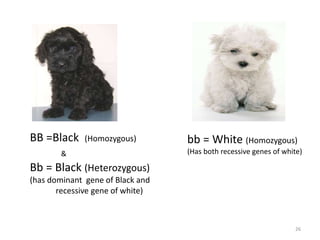
BB =Black (Homozygous)
&
Bb = Black (Heterozygous)
(has dominant gene of Black and
recessive gene of white)
bb = White (Homozygous)
(Has both recessive genes of white)
26
Genotype & Phenotype
27
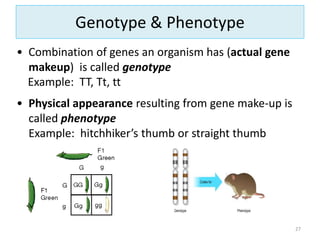
• Combination of genes an organism has (actual gene
makeup) is called genotype
Example: TT, Tt, tt
• Physical appearance resulting from gene make-up is
called phenotype
Example: hitchhiker’s thumb or straight thumb
Punnett Square and Probability
28
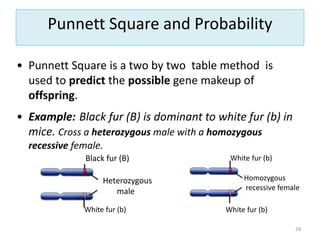
• Punnett Square is a two by two table method is
used to predict the possible gene makeup of
offspring.
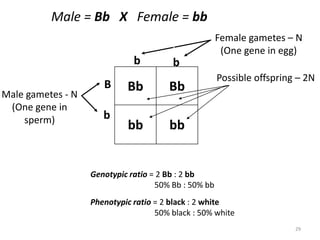
• Example: Black fur (B) is dominant to white fur (b) in
mice. Cross a heterozygous male with a homozygous
recessive female.
Black fur (B)
White fur (b)
Heterozygous
male
White fur (b)
White fur (b)
Homozygous
recessive female
Bb Bb
bb bb
Possible offspring – 2N
Male gametes - N
(One gene in
sperm)
Female gametes – N
(One gene in egg)
Male = Bb X Female = bb
Genotypic ratio = 2 Bb : 2 bb
50% Bb : 50% bb
Phenotypic ratio = 2 black : 2 white
50% black : 50% white
b
b
29
B
b
b
Sex Determination
30
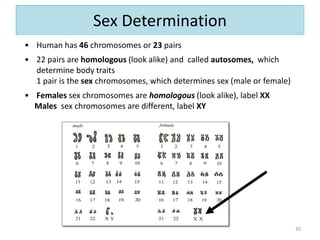
• Human has 46 chromosomes or 23 pairs
• 22 pairs are homologous (look alike) and called autosomes, which
determine body traits
1 pair is the sex chromosomes, which determines sex (male or female)
• Females sex chromosomes are homologous (look alike), label XX
Males sex chromosomes are different, label XY
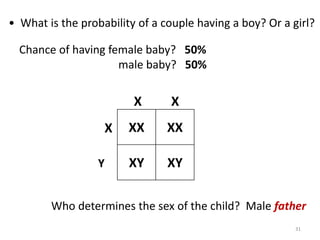
XX XX
XY XY
X
• What is the probability of a couple having a boy? Or a girl?
Chance of having female baby? 50%
male baby? 50%
Who determines the sex of the child? Male father
X
X
Y
31
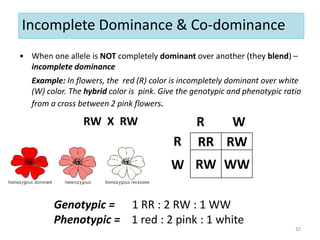
• When one allele is NOT completely dominant over another (they blend) –
incomplete dominance
Example: In flowers, the red (R) color is incompletely dominant over white
(W) color. The hybrid color is pink. Give the genotypic and phenotypic ratio
from a cross between 2 pink flowers.
RW X RW
RR RW
RW WW
W
R
W
Genotypic = 1 RR : 2 RW : 1 WW
Phenotypic = 1 red : 2 pink : 1 white
R
32
Incomplete Dominance & Co-dominance
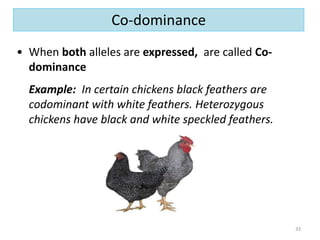
• When both alleles are expressed, are called Co-
dominance
Example: In certain chickens black feathers are
codominant with white feathers. Heterozygous
chickens have black and white speckled feathers.
33
Co-dominance
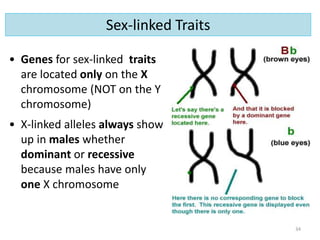
• Genes for sex-linked traits
are located only on the X
chromosome (NOT on the Y
chromosome)
• X-linked alleles always show
up in males whether
dominant or recessive
because males have only
one X chromosome
34
Sex-linked Traits
Examples of Recessive Sex-linked Disorders
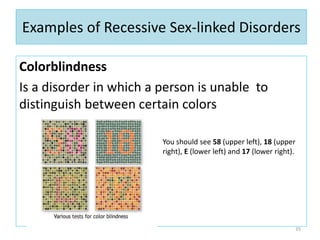
Colorblindness
Is a disorder in which a person is unable to
distinguish between certain colors
35
You should see 58 (upper left), 18 (upper
right), E (lower left) and 17 (lower right).
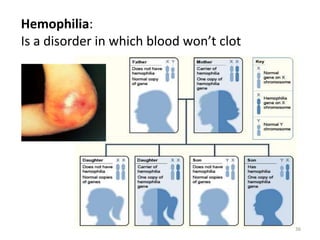
Hemophilia:
Is a disorder in which blood won’t clot
36
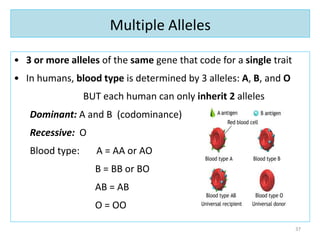
Multiple Alleles
• 3 or more alleles of the same gene that code for a single trait
• In humans, blood type is determined by 3 alleles: A, B, and O
BUT each human can only inherit 2 alleles
Dominant: A and B (codominance)
Recessive: O
Blood type: A = AA or AO
B = BB or BO
AB = AB
O = OO
37
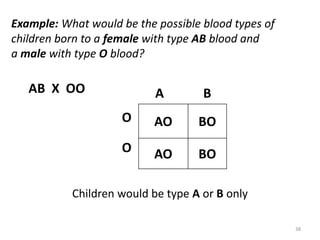
A B
Example: What would be the possible blood types of
children born to a female with type AB blood and
a male with type O blood?
AB X OO
AO BO
AO BO
O
O
Children would be type A or B only
38
Euploidy & Aneuploidy
• Euploidy
– Normal variations of the number of complete sets
of chromosomes
– Haploid, Diploid, Triploid, Tetraploid, etc…
• Aneuploidy
– Variation in the number of particular
chromosomes within a set
– Monosomy, trisomy, polysomy
39
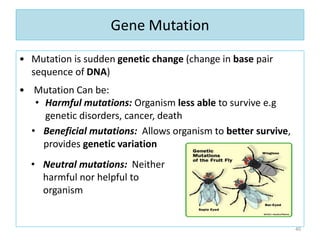
Gene Mutation
• Mutation is sudden genetic change (change in base pair
sequence of DNA)
• Mutation Can be:
• Harmful mutations: Organism less able to survive e.g
genetic disorders, cancer, death
• Beneficial mutations: Allows organism to better survive,
provides genetic variation
40
• Neutral mutations: Neither
harmful nor helpful to
organism
Types of Mutation
Mutations can occur in 2 ways:
1. Chromosomal mutation
1. Gene/point mutation
41
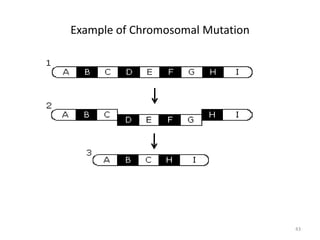
Chromosomal mutation:
• less common than a gene mutation
• Has more drastic affects on entire chromosome,
so affects many genes rather than just one
• caused by failure of the homologous
chromosomes to separate normally during
meiosis
• chromosome pairs no longer look the same, too
few or too many genes, having different shape
42
Example of Chromosomal Mutation
43
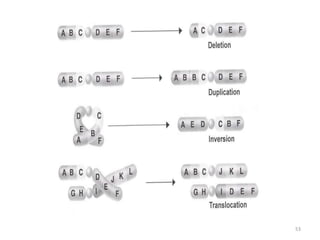
Types of Chromosome Mutations
• May be Point/Gene Mutation or Chromosomal
mutation.
• Five types exist:
–Deletion
–Inversion
–Translocation
–Nondisjunction (Chromosomal)
–Duplication
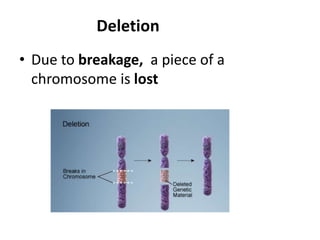
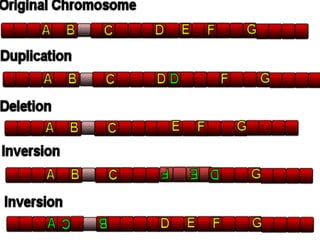
Deletion
• Due to breakage, a piece of a
chromosome is lost
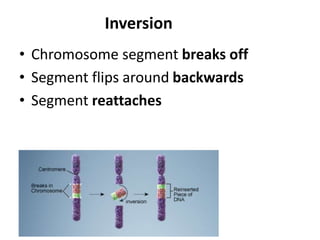
Inversion
• Chromosome segment breaks off
• Segment flips around backwards
• Segment reattaches
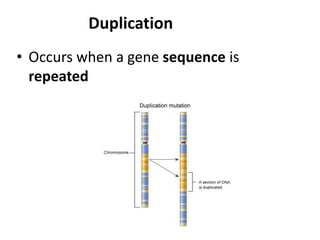
Duplication
• Occurs when a gene sequence is
repeated
Translocation
• Involves two chromosomes that aren’t
homologous
• Part of one chromosome is transferred
to another chromosomes
Translocation
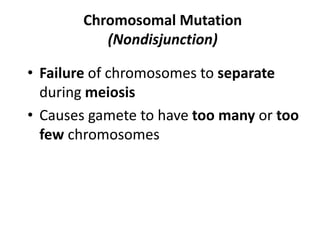
Chromosomal Mutation
(Nondisjunction)
• Failure of chromosomes to separate
during meiosis
• Causes gamete to have too many or too
few chromosomes
53
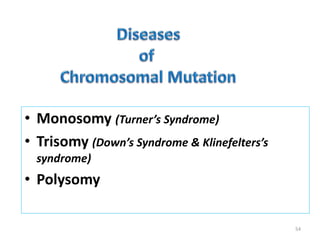
• Monosomy (Turner’s Syndrome)
• Trisomy (Down’s Syndrome & Klinefelters’s
syndrome)
• Polysomy
54
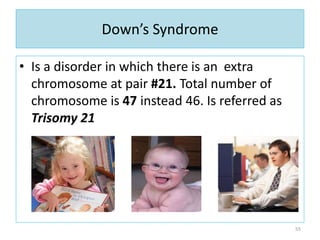
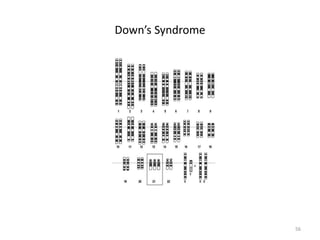
Down’s Syndrome
• Is a disorder in which there is an extra
chromosome at pair #21. Total number of
chromosome is 47 instead 46. Is referred as
Trisomy 21
55
Down’s Syndrome
56
Clinical Manifestations of Down’s Syndrome
• Upward slant to eyes (Mongolian Eyes).
• Small ears that fold over at the top.
• Small, flattened nose.
• Small mouth, making tongue appear large.
• Short neck.
• Small hands with short fingers.
57
Down’s syndrome
58
Cont…
• Low muscle tone.
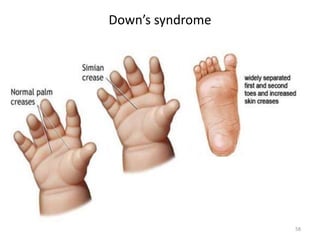
• Single deep crease across center of palm.
• Looseness of joints.
• Small skin folds at the inner corners of the eyes.
• Excessive space between first and second toe.
• In addition, down syndrome always involves
some degree of mental retardation, from mild to
severe. In most cases, the mental retardation is
mild to moderate.
59
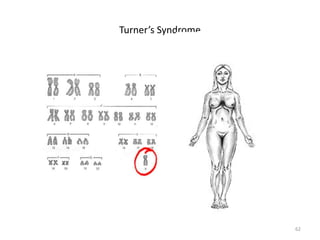
Turner’s Syndrome
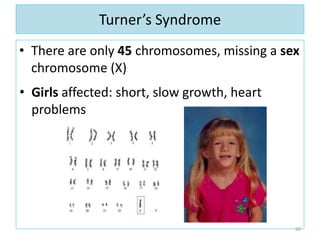
• There are only 45 chromosomes, missing a sex
chromosome (X)
• Girls affected: short, slow growth, heart
problems
60
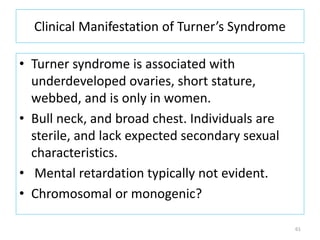
Clinical Manifestation of Turner’s Syndrome
• Turner syndrome is associated with
underdeveloped ovaries, short stature,
webbed, and is only in women.
• Bull neck, and broad chest. Individuals are
sterile, and lack expected secondary sexual
characteristics.
• Mental retardation typically not evident.
• Chromosomal or monogenic?
61
Turner’s Syndrome
62
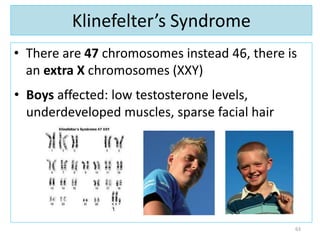
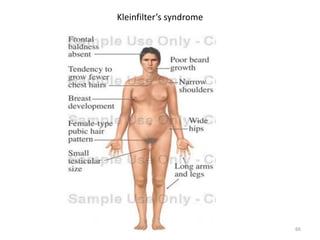
Klinefelter’s Syndrome
• There are 47 chromosomes instead 46, there is
an extra X chromosomes (XXY)
• Boys affected: low testosterone levels,
underdeveloped muscles, sparse facial hair
63
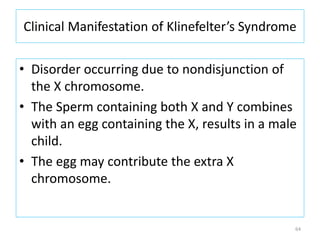
Clinical Manifestation of Klinefelter’s Syndrome
• Disorder occurring due to nondisjunction of
the X chromosome.
• The Sperm containing both X and Y combines
with an egg containing the X, results in a male
child.
• The egg may contribute the extra X
chromosome.
64
Cont…
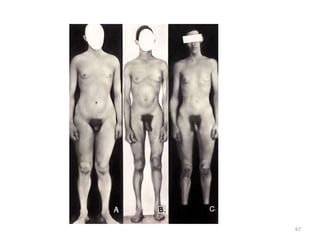
• Males with some development of breast
tissue normally seen in females.
• Little body hair is present, and such person are
typically tall, have small testes.
• Infertility results from absent sperm.
• Evidence of mental retardation may or may
not be present.
65
Kleinfilter’s syndrome
66
67
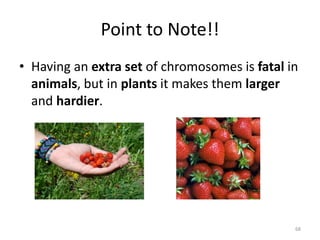
Point to Note!!
• Having an extra set of chromosomes is fatal in
animals, but in plants it makes them larger
and hardier.
68
69
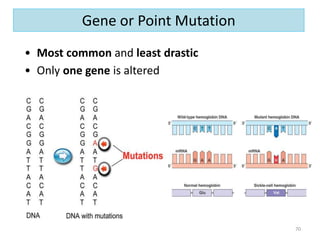
• Most common and least drastic
• Only one gene is altered
70
Gene or Point Mutation
Recessive Gene Mutation
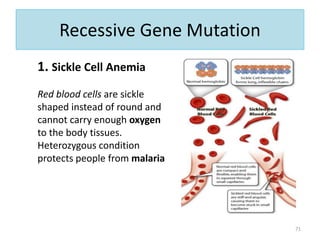
1. Sickle Cell Anemia
Red blood cells are sickle
shaped instead of round and
cannot carry enough oxygen
to the body tissues.
Heterozygous condition
protects people from malaria
71
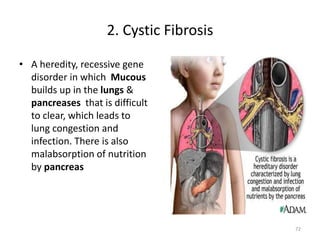
2. Cystic Fibrosis
• A heredity, recessive gene
disorder in which Mucous
builds up in the lungs &
pancreases that is difficult
to clear, which leads to
lung congestion and
infection. There is also
malabsorption of nutrition
by pancreas
72
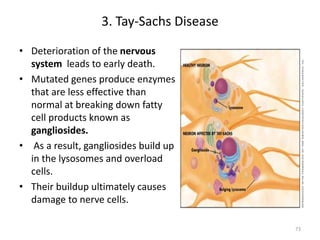
3. Tay-Sachs Disease
• Deterioration of the nervous
system leads to early death.
• Mutated genes produce enzymes
that are less effective than
normal at breaking down fatty
cell products known as
gangliosides.
• As a result, gangliosides build up
in the lysosomes and overload
cells.
• Their buildup ultimately causes
damage to nerve cells.
73
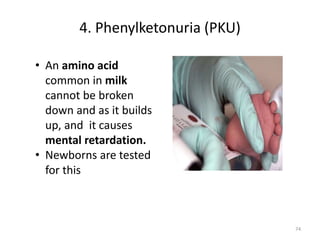
4. Phenylketonuria (PKU)
• An amino acid
common in milk
cannot be broken
down and as it builds
up, and it causes
mental retardation.
• Newborns are tested
for this
74
Dominant Gene Mutations
• There are two types of disorders in which Dominant
gene is involved:
1. Huntington’s disease
– Gradual deterioration of brain tissue, shows up in middle
age, and is fatal
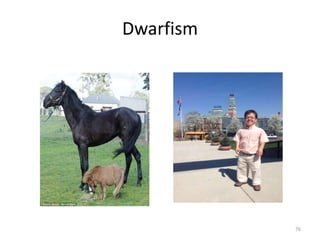
2. Dwarfism
– Short height with variety of skeletal abnormalities
75
Dwarfism
76
Detecting Genetic Disorders
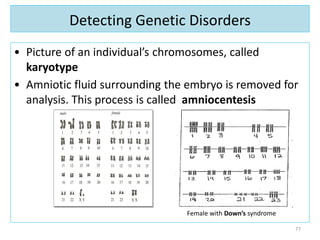
• Picture of an individual’s chromosomes, called
karyotype
• Amniotic fluid surrounding the embryo is removed for
analysis. This process is called amniocentesis
77
Female with Down’s syndrome
Thank You
The Great Class!
Any Question?
78

Genetic disorders.pptx

  • 1.
    Hakim Shah RN, BSN,MSN, PhD (Scholar) 30-08-2022 1 Required Reading Book: Carol, Porth M. (2014). Pathophysiology concept of altered health states (9th Ed). Philadelphia: J. B. Lippincott. (Book is available in ICoNM Library) Chapter-7, Page No. 138-158
  • 2.
    Class Objectives • Differentiatebetween Genetic and congenital disorders • Define the following terminologies related to genetic disorder: – Trisomy – Monosomy – Polysomy • Discuss the chromosomal defects with special emphasis on aneuploidy • Describe the pathophysiology and the clinical manifestations of the following genetic disorders: – Down’s syndrome – Turner’s syndrome – Klienfelters syndrome 2
  • 3.
    Introduction to Genetics •“Genetics is the study of heredity, the process in which a parent passes certain genes onto their children.” • Children inherit their biological parents’ genes that express specific traits, such as some physical characteristics, natural talents, and genetic disorders. 3
  • 4.
    Congenital Diseases • Thosediseases present at birth • Note that not all genetic diseases present at birth • Congenital diseases include: 1. Developmental diseases • Those that arise spontaneously during gestation • Example: failure of testis to descend 2. Those that are secondary to environmental problems • From trauma • From poisons (teratogenic agents) • From poor nutrition of mother during gestation 4
  • 5.
    Types of GeneticDisorders • There are Three types of Genetic Disorders: 1. Single gene disorders 2. Chromosomal diseases 1. Multifactorial diseases 5
  • 6.
    1. Single GeneDisorders This type of genetic disorders occur due to Nucleotide mutation. Classified by inheritance pattern 6
  • 7.
    2.Chromosomal Diseases Usually occursduring mitosis There are 2 types of chromosomal diseases a. Structural change of the chromosome • Deletion: cause most serious problems and/or death • Translocation: broken part of chromosome becomes attached to non-homologous chromosome 7
  • 8.
    Cont… b. Change inchromosome number • Caused during meiosis by nondisjunction • Euploidy: normal number of chromosomes • Aneuploidy: abnormal number of chromosomes. Example: – Turner’s syndrome: monosomy X – Down’s syndrome: Trisomy 21 8
  • 9.
    3. Multifactorial diseases •May be a combination of environmental factors & genetic tendency. – Example: Lung cancer, colon cancer • These may be polygenic. – Example: deafness, diabetes 9
  • 10.
    Basic Unit ofGenetics: DNA • DNA is present on Chromosomes in the nucleus of a cell. • DNA is made up of four different parts called nucleotides. • Nucleotides are set of blocks that has only four shapes, or an alphabet that has only four letters. • DNA is a long string of these blocks or letters. • These blocks or letters (Nucleotides) are the building block of DNA 10
  • 11.
    Structure of DNA •DNA is a long string of Nucleotides. • Each nucleotide consists of a sugar (deoxyribose) bound on one side to a phosphate group and bound on the other side to a nitrogenous base. • There are two classes of nitrogen bases • Purines (double-ringed structures) • Pyrimidines (single-ringed structures) • The four bases in DNA's alphabet are: • Adenine (A) - a purine • Cytosine(C) - a pyrimidine • Guanine (G) - a purine • Thymine (T) - a pyrimidine" • Adenine pairs with thymine and cytosine pairs with guanine. • DNA comes in a shape known as double helix, which is basically a twisted ladder. 11
  • 12.
  • 13.
  • 14.
    Basic Concepts ofGenetics • Gregor Johan Mendel is known as the “father of Genetics”. • He was born on July 20, 1822 in Austria and was died on January 6, 1884. • He laid the foundation of Genetics by working with seven characteristics of pea plants: plant height, pod shape and color, seed shape and color, and flower position and color. 14
  • 15.
    Principle of IndependentAssortment • During his experiment with the seven characteristics of pea plan, Gregor Mendel found out: Inheritance of one trait has no effect on the inheritance of another trait. • This is called principle of independent assortment. 15
  • 16.
    Traits • Traits aredetermined by the genes on the chromosomes. • Genetics is the study of how traits are passed from parent to offspring 16
  • 17.
  • 18.
    Genes • Genes arethe segments of DNA, and are present on chromosomes. • Genes determine the Traits. 18
  • 19.
    19 Tissue Cell NucleusChromosomes DNA Genes
  • 20.
    Chromosomes & Genesin Human • Chromosomes come in homologous pairs, thus genes also come in pairs. Homologous pairs of chromosomes have matching genes, which come one from female parent and one from male parent • Example: Humans have 46 chromosomes or 23 pairs. One set from father – 23 in sperm One set from mother – 23 in egg 20
  • 21.
    One pair ofHomologous Chromosomes 21 Homologous pair of chromosomes Gene for eye color (blue eyes) Gene for eye color (brown eyes)
  • 22.
    Alleles Alleles are thegroup of two or more than two different genes which determine the same trait. Example: blue eyes or brown eyes 22
  • 23.
    Dominant & RecessiveGenes 23 • Gene that prevents the other gene from “showing” is called dominant gene. • Gene that does NOT “show” even though it is present is called recessive gene • Symbols of Dominant & Recessive genes: • Dominant Gene: upper case letter “T” • Recessive gene: lower case letter “t”
  • 24.
    Example of Recessive& Dominant Genes 24 Straight thumb is dominant to hitchhiker thumb T = straight thumb t = hitchhikers thumb Always use the same letter for the same alleles. (Not use S = straight, h = hitchhiker’s) Straight thumb = TT Straight thumb = Tt Hitchhikers thumb = tt Must have 2 recessive alleles for a recessive trait to “show”
  • 25.
    Homozygous & Heterozygous 25 •When both genes of a pair are the same it is called homozygous or purebred TT – homozygous dominant tt – homozygous recessive • When both genes are Not same, one dominant and one recessive gene, it is called heterozygous or hybrid Tt – heterozygous
  • 26.
    BB =Black (Homozygous) & Bb= Black (Heterozygous) (has dominant gene of Black and recessive gene of white) bb = White (Homozygous) (Has both recessive genes of white) 26
  • 27.
    Genotype & Phenotype 27 •Combination of genes an organism has (actual gene makeup) is called genotype Example: TT, Tt, tt • Physical appearance resulting from gene make-up is called phenotype Example: hitchhiker’s thumb or straight thumb
  • 28.
    Punnett Square andProbability 28 • Punnett Square is a two by two table method is used to predict the possible gene makeup of offspring. • Example: Black fur (B) is dominant to white fur (b) in mice. Cross a heterozygous male with a homozygous recessive female. Black fur (B) White fur (b) Heterozygous male White fur (b) White fur (b) Homozygous recessive female
  • 29.
    Bb Bb bb bb Possibleoffspring – 2N Male gametes - N (One gene in sperm) Female gametes – N (One gene in egg) Male = Bb X Female = bb Genotypic ratio = 2 Bb : 2 bb 50% Bb : 50% bb Phenotypic ratio = 2 black : 2 white 50% black : 50% white b b 29 B b b
  • 30.
    Sex Determination 30 • Humanhas 46 chromosomes or 23 pairs • 22 pairs are homologous (look alike) and called autosomes, which determine body traits 1 pair is the sex chromosomes, which determines sex (male or female) • Females sex chromosomes are homologous (look alike), label XX Males sex chromosomes are different, label XY
  • 31.
    XX XX XY XY X •What is the probability of a couple having a boy? Or a girl? Chance of having female baby? 50% male baby? 50% Who determines the sex of the child? Male father X X Y 31
  • 32.
    • When oneallele is NOT completely dominant over another (they blend) – incomplete dominance Example: In flowers, the red (R) color is incompletely dominant over white (W) color. The hybrid color is pink. Give the genotypic and phenotypic ratio from a cross between 2 pink flowers. RW X RW RR RW RW WW W R W Genotypic = 1 RR : 2 RW : 1 WW Phenotypic = 1 red : 2 pink : 1 white R 32 Incomplete Dominance & Co-dominance
  • 33.
    • When bothalleles are expressed, are called Co- dominance Example: In certain chickens black feathers are codominant with white feathers. Heterozygous chickens have black and white speckled feathers. 33 Co-dominance
  • 34.
    • Genes forsex-linked traits are located only on the X chromosome (NOT on the Y chromosome) • X-linked alleles always show up in males whether dominant or recessive because males have only one X chromosome 34 Sex-linked Traits
  • 35.
    Examples of RecessiveSex-linked Disorders Colorblindness Is a disorder in which a person is unable to distinguish between certain colors 35 You should see 58 (upper left), 18 (upper right), E (lower left) and 17 (lower right).
  • 36.
    Hemophilia: Is a disorderin which blood won’t clot 36
  • 37.
    Multiple Alleles • 3or more alleles of the same gene that code for a single trait • In humans, blood type is determined by 3 alleles: A, B, and O BUT each human can only inherit 2 alleles Dominant: A and B (codominance) Recessive: O Blood type: A = AA or AO B = BB or BO AB = AB O = OO 37
  • 38.
    A B Example: Whatwould be the possible blood types of children born to a female with type AB blood and a male with type O blood? AB X OO AO BO AO BO O O Children would be type A or B only 38
  • 39.
    Euploidy & Aneuploidy •Euploidy – Normal variations of the number of complete sets of chromosomes – Haploid, Diploid, Triploid, Tetraploid, etc… • Aneuploidy – Variation in the number of particular chromosomes within a set – Monosomy, trisomy, polysomy 39
  • 40.
    Gene Mutation • Mutationis sudden genetic change (change in base pair sequence of DNA) • Mutation Can be: • Harmful mutations: Organism less able to survive e.g genetic disorders, cancer, death • Beneficial mutations: Allows organism to better survive, provides genetic variation 40 • Neutral mutations: Neither harmful nor helpful to organism
  • 41.
    Types of Mutation Mutationscan occur in 2 ways: 1. Chromosomal mutation 1. Gene/point mutation 41
  • 42.
    Chromosomal mutation: • lesscommon than a gene mutation • Has more drastic affects on entire chromosome, so affects many genes rather than just one • caused by failure of the homologous chromosomes to separate normally during meiosis • chromosome pairs no longer look the same, too few or too many genes, having different shape 42
  • 43.
  • 44.
    Types of ChromosomeMutations • May be Point/Gene Mutation or Chromosomal mutation. • Five types exist: –Deletion –Inversion –Translocation –Nondisjunction (Chromosomal) –Duplication
  • 45.
    Deletion • Due tobreakage, a piece of a chromosome is lost
  • 46.
    Inversion • Chromosome segmentbreaks off • Segment flips around backwards • Segment reattaches
  • 47.
    Duplication • Occurs whena gene sequence is repeated
  • 48.
    Translocation • Involves twochromosomes that aren’t homologous • Part of one chromosome is transferred to another chromosomes
  • 49.
  • 50.
    Chromosomal Mutation (Nondisjunction) • Failureof chromosomes to separate during meiosis • Causes gamete to have too many or too few chromosomes
  • 53.
  • 54.
    • Monosomy (Turner’sSyndrome) • Trisomy (Down’s Syndrome & Klinefelters’s syndrome) • Polysomy 54
  • 55.
    Down’s Syndrome • Isa disorder in which there is an extra chromosome at pair #21. Total number of chromosome is 47 instead 46. Is referred as Trisomy 21 55
  • 56.
  • 57.
    Clinical Manifestations ofDown’s Syndrome • Upward slant to eyes (Mongolian Eyes). • Small ears that fold over at the top. • Small, flattened nose. • Small mouth, making tongue appear large. • Short neck. • Small hands with short fingers. 57
  • 58.
  • 59.
    Cont… • Low muscletone. • Single deep crease across center of palm. • Looseness of joints. • Small skin folds at the inner corners of the eyes. • Excessive space between first and second toe. • In addition, down syndrome always involves some degree of mental retardation, from mild to severe. In most cases, the mental retardation is mild to moderate. 59
  • 60.
    Turner’s Syndrome • Thereare only 45 chromosomes, missing a sex chromosome (X) • Girls affected: short, slow growth, heart problems 60
  • 61.
    Clinical Manifestation ofTurner’s Syndrome • Turner syndrome is associated with underdeveloped ovaries, short stature, webbed, and is only in women. • Bull neck, and broad chest. Individuals are sterile, and lack expected secondary sexual characteristics. • Mental retardation typically not evident. • Chromosomal or monogenic? 61
  • 62.
  • 63.
    Klinefelter’s Syndrome • Thereare 47 chromosomes instead 46, there is an extra X chromosomes (XXY) • Boys affected: low testosterone levels, underdeveloped muscles, sparse facial hair 63
  • 64.
    Clinical Manifestation ofKlinefelter’s Syndrome • Disorder occurring due to nondisjunction of the X chromosome. • The Sperm containing both X and Y combines with an egg containing the X, results in a male child. • The egg may contribute the extra X chromosome. 64
  • 65.
    Cont… • Males withsome development of breast tissue normally seen in females. • Little body hair is present, and such person are typically tall, have small testes. • Infertility results from absent sperm. • Evidence of mental retardation may or may not be present. 65
  • 66.
  • 67.
  • 68.
    Point to Note!! •Having an extra set of chromosomes is fatal in animals, but in plants it makes them larger and hardier. 68
  • 69.
  • 70.
    • Most commonand least drastic • Only one gene is altered 70 Gene or Point Mutation
  • 71.
    Recessive Gene Mutation 1.Sickle Cell Anemia Red blood cells are sickle shaped instead of round and cannot carry enough oxygen to the body tissues. Heterozygous condition protects people from malaria 71
  • 72.
    2. Cystic Fibrosis •A heredity, recessive gene disorder in which Mucous builds up in the lungs & pancreases that is difficult to clear, which leads to lung congestion and infection. There is also malabsorption of nutrition by pancreas 72
  • 73.
    3. Tay-Sachs Disease •Deterioration of the nervous system leads to early death. • Mutated genes produce enzymes that are less effective than normal at breaking down fatty cell products known as gangliosides. • As a result, gangliosides build up in the lysosomes and overload cells. • Their buildup ultimately causes damage to nerve cells. 73
  • 74.
    4. Phenylketonuria (PKU) •An amino acid common in milk cannot be broken down and as it builds up, and it causes mental retardation. • Newborns are tested for this 74
  • 75.
    Dominant Gene Mutations •There are two types of disorders in which Dominant gene is involved: 1. Huntington’s disease – Gradual deterioration of brain tissue, shows up in middle age, and is fatal 2. Dwarfism – Short height with variety of skeletal abnormalities 75
  • 76.
  • 77.
    Detecting Genetic Disorders •Picture of an individual’s chromosomes, called karyotype • Amniotic fluid surrounding the embryo is removed for analysis. This process is called amniocentesis 77 Female with Down’s syndrome
  • 78.
    Thank You The GreatClass! Any Question? 78