Author(s): Antoinette A. Bradshaw, PhD, MS, BSN, RN, 2011
License: Unless otherwise noted, this material is made available under the
terms of the Creative Commons Attribution Share Alike 3.0 License:
http://creativecommons.org/licenses/by-sa/3.0/
We have reviewed this material in accordance with U.S. Copyright Law and have tried to maximize your
ability to use, share, and adapt it.
Copyright holders of content included in this material should contact open.michigan@umich.edu with any
questions, corrections, or clarification regarding the use of content.
For more information about how to cite these materials visit http://open.umich.edu/privacy-and-terms-use.
Any medical information in this material is intended to inform and educate and is not a tool for self-diagnosis
or a replacement for medical evaluation, advice, diagnosis or treatment by a healthcare professional. Please
speak to your physician if you have questions about your medical condition.
Viewer discretion is advised: Some medical content is graphic and may not be suitable for all viewers.
Citation Key
for more information see: http://open.umich.edu/wiki/CitationPolicy

Use + Share + Adapt
{ Content the copyright holder, author, or law permits you to use, share and adapt. }
Public Domain – Government: Works that are produced by the U.S. Government. (17 USC § 105)
Public Domain – Expired: Works that are no longer protected due to an expired copyright term.
Public Domain – Self Dedicated: Works that a copyright holder has dedicated to the public domain.
Creative Commons – Zero Waiver
Creative Commons – Attribution License
Creative Commons – Attribution Share Alike License
Creative Commons – Attribution Noncommercial License
Creative Commons – Attribution Noncommercial Share Alike License
GNU – Free Documentation License

Make Your Own Assessment
{ Content Open.Michigan believes can be used, shared, and adapted because it is ineligible for copyright. }
Public Domain – Ineligible: Works that are ineligible for copyright protection in the U.S. (17 USC § 102(b)) *laws in
your jurisdiction may differ

{ Content Open.Michigan has used under a Fair Use determination. }
Fair Use: Use of works that is determined to be Fair consistent with the U.S. Copyright Act. (17 USC § 107) *laws in your
jurisdiction may differ
Our determination DOES NOT mean that all uses of this 3rd-party content are Fair Uses and we DO NOT guarantee that
your use of the content is Fair.
To use this content you should do your own independent analysis to determine whether or not your use will be Fair.
UNIVERSITY OF MICHIGAN
EMERGENCY MEDICINE AND
PROJECT HOPE
KATH
EMERGENCY NURSING
TRAINING PROGRAM
MODULE ~ 3
Antoinette A. Bradshaw, PhD,
MS, BSN, RN
EMERGENCY NURSING TRIAGE
MODULE
COURSE OBJECTIVES

*TO DEFINE THE MAJOR OBJECTIVES OF TRIAGE AND THE
ROLE OF TRIAGE WITHIN THE EMERGENCY MEDICAL SYSTEM
*TO DEFINE THE MAJOR TYPES OF TRIAGE PRACTICES
*TO DESCRIBE AND APPLY THE CAPE TRIAGE SCORING
SYSTEM
*TO APPLY THE NURSING PROCESS WHEN ANALYZING THE
TRIAGE CASE SCENARIO
*TO DELINEATE THE NURSING PROCESS DURING TRIAGE
*TO PREDICT CAPE TRIAGE SCORE WHEN PRESENTED WITH
SPECIFIC INFORMATION REGARDING THE PATIENT S
HISTORY AND CONSIDER AGE SPECIFIC FACTORS
* TO EMPOWER THE NURSES WITH KNOWLEDGE TO BECOME
SKILLED AT TRIAGE
WHAT IS TRIAGE?
Triage is the process of determining
the priority of patients' treatments
based on the severity of their condition.
This rations patient treatment
efficiently when resources are
insufficient for all to be treated
immediately. The term comes from the
French verb trier, meaning to separate,
sort, sift or select.
The Purpose & Benefits of
Triage
~ To expedite the delivery of time-critical treatment
for patients with life-threatening conditions
~To ensure that ALL people requiring emergency
care are appropriately categorized according to
their clinical condition
~ To improve patient flow
~ To improve patient satisfaction
~ To decrease the patient s overall length of stay
~ To facilitate streaming of less urgent patients
~ To be user-friendly for all levels of health care
professionals
ROLE OF TRIAGE NURSE
To competently assess all
incoming patients to properly
place them in categories
according to the Triage Early
Warning Score (TEWS)
NURSING QUALIFICATIONS
FOR TRIAGE
1. Ideally the nurse should have worked in
the Emergency Department for a minimum
of 6 months
2. A nurse must go through the Emergency
Department orientation program
3. The nurse must complete at least four
month rotation through the various hospital
units including the ED
The Significance of Nurses in
The Triage Process
Compared to other countries whose doctor
to nurse ratios range from 1:4 to 1:1.6, in
South Africa the Ratio of doctors to nurses is
1:8. Thus, the nurses have a critical role in
assisting the physicians in assessing patients
for initial treatment as well as in the
ongoing delivery of care.
~ Assessment ~
A Critical Tool
Across the Room Assessment
What are some of the symptoms or physical
signs that you can assess from across the
room?
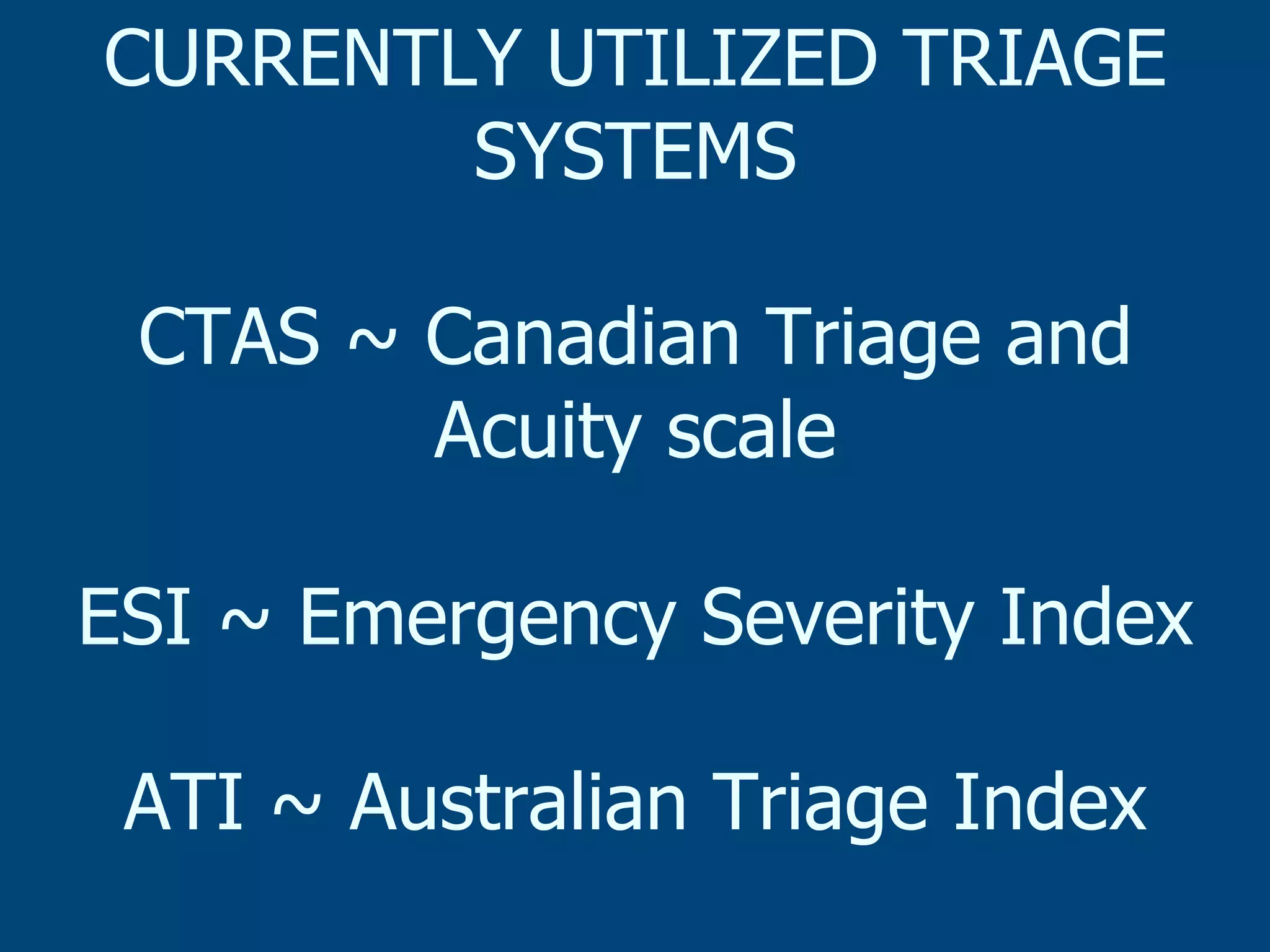
CURRENTLY UTILIZED TRIAGE
SYSTEMS
CTAS ~ Canadian Triage and
Acuity scale
ESI ~ Emergency Severity Index
ATI ~ Australian Triage Index
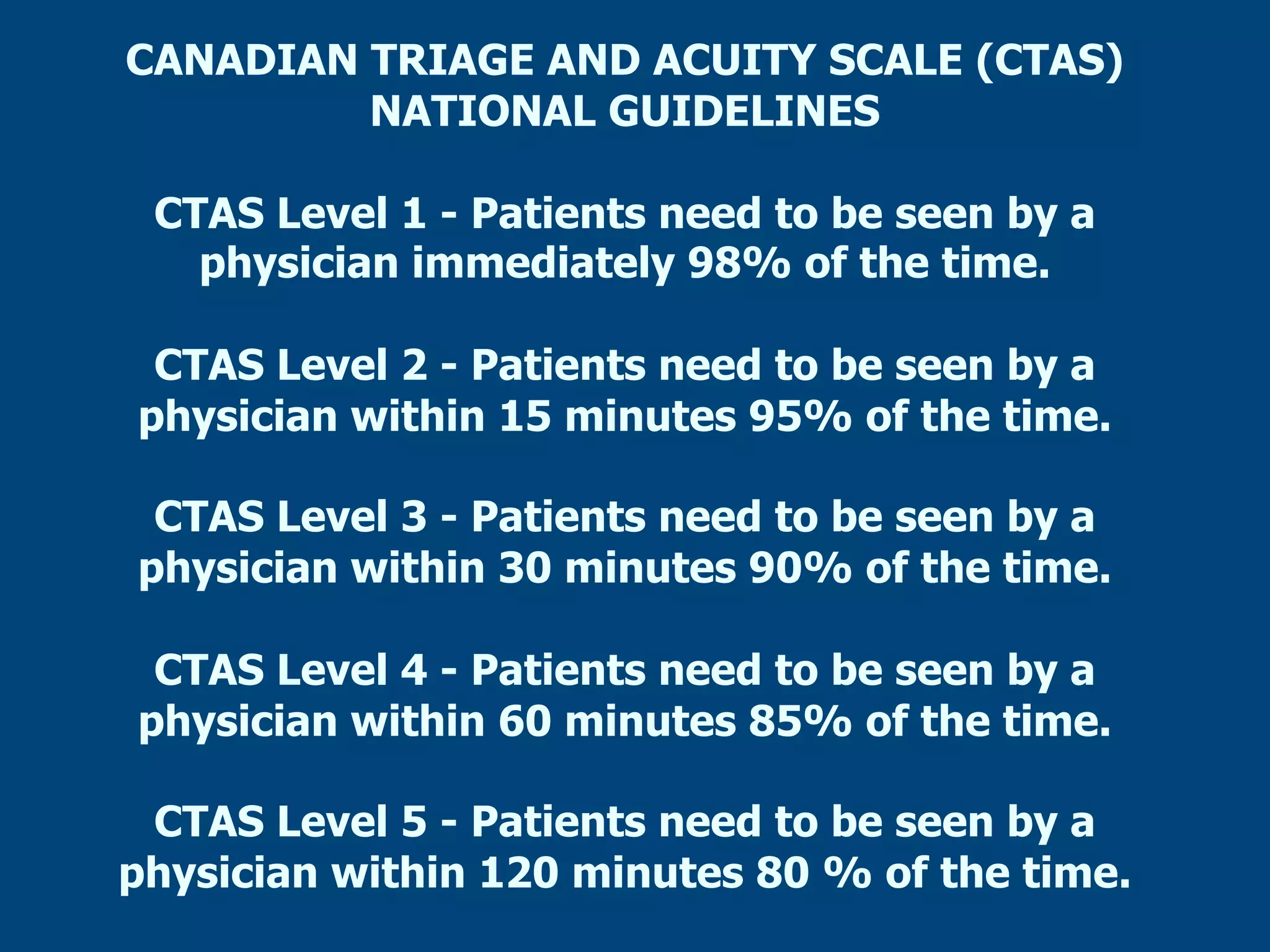
CANADIAN TRIAGE AND ACUITY SCALE (CTAS)
NATIONAL GUIDELINES
CTAS Level 1 - Patients need to be seen by a
physician immediately 98% of the time.
CTAS Level 2 - Patients need to be seen by a
physician within 15 minutes 95% of the time.
CTAS Level 3 - Patients need to be seen by a
physician within 30 minutes 90% of the time.
CTAS Level 4 - Patients need to be seen by a
physician within 60 minutes 85% of the time.
CTAS Level 5 - Patients need to be seen by a
physician within 120 minutes 80 % of the time.
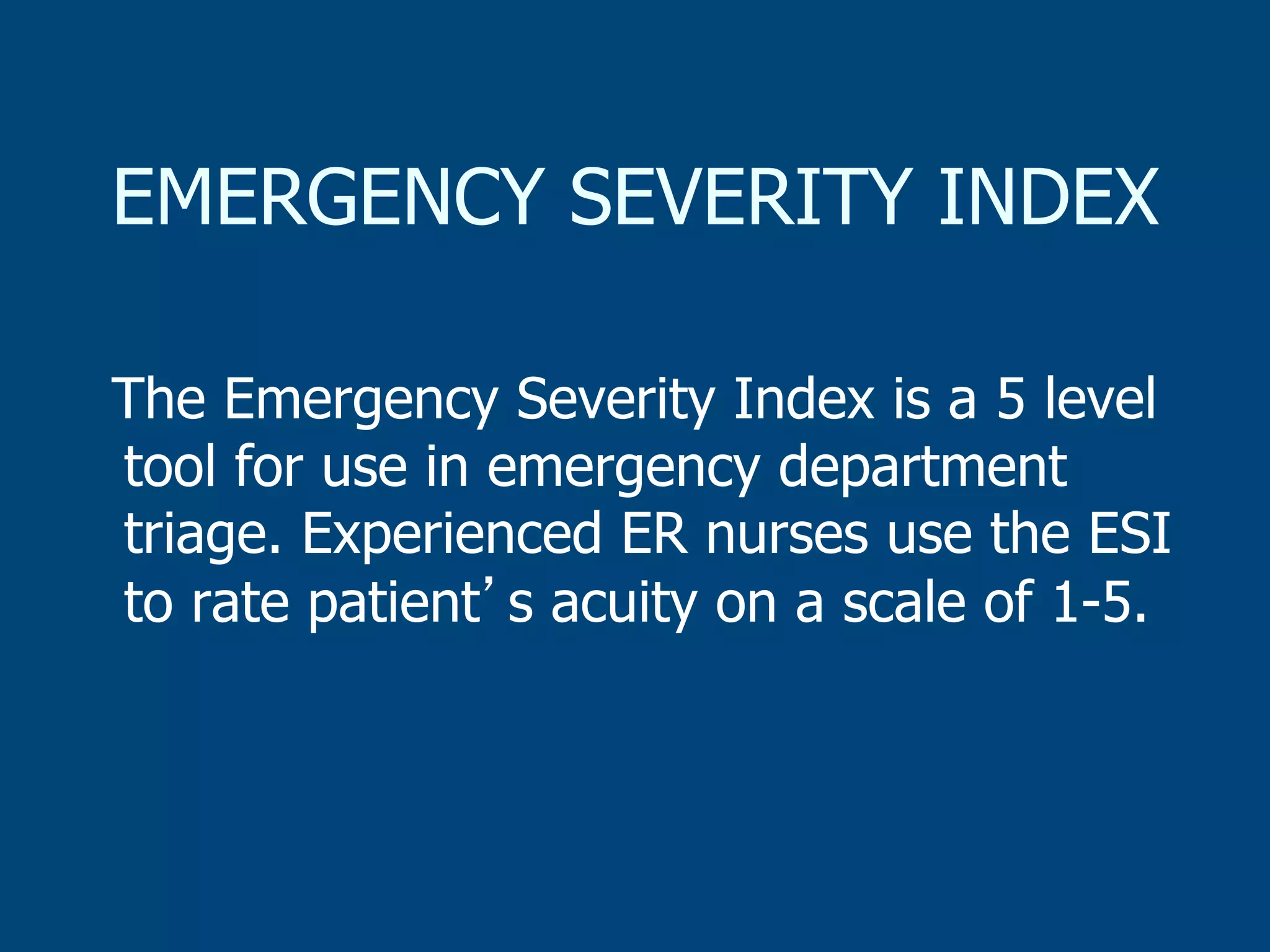
EMERGENCY SEVERITY INDEX
The Emergency Severity Index is a 5 level
tool for use in emergency department
triage. Experienced ER nurses use the ESI
to rate patient s acuity on a scale of 1-5.
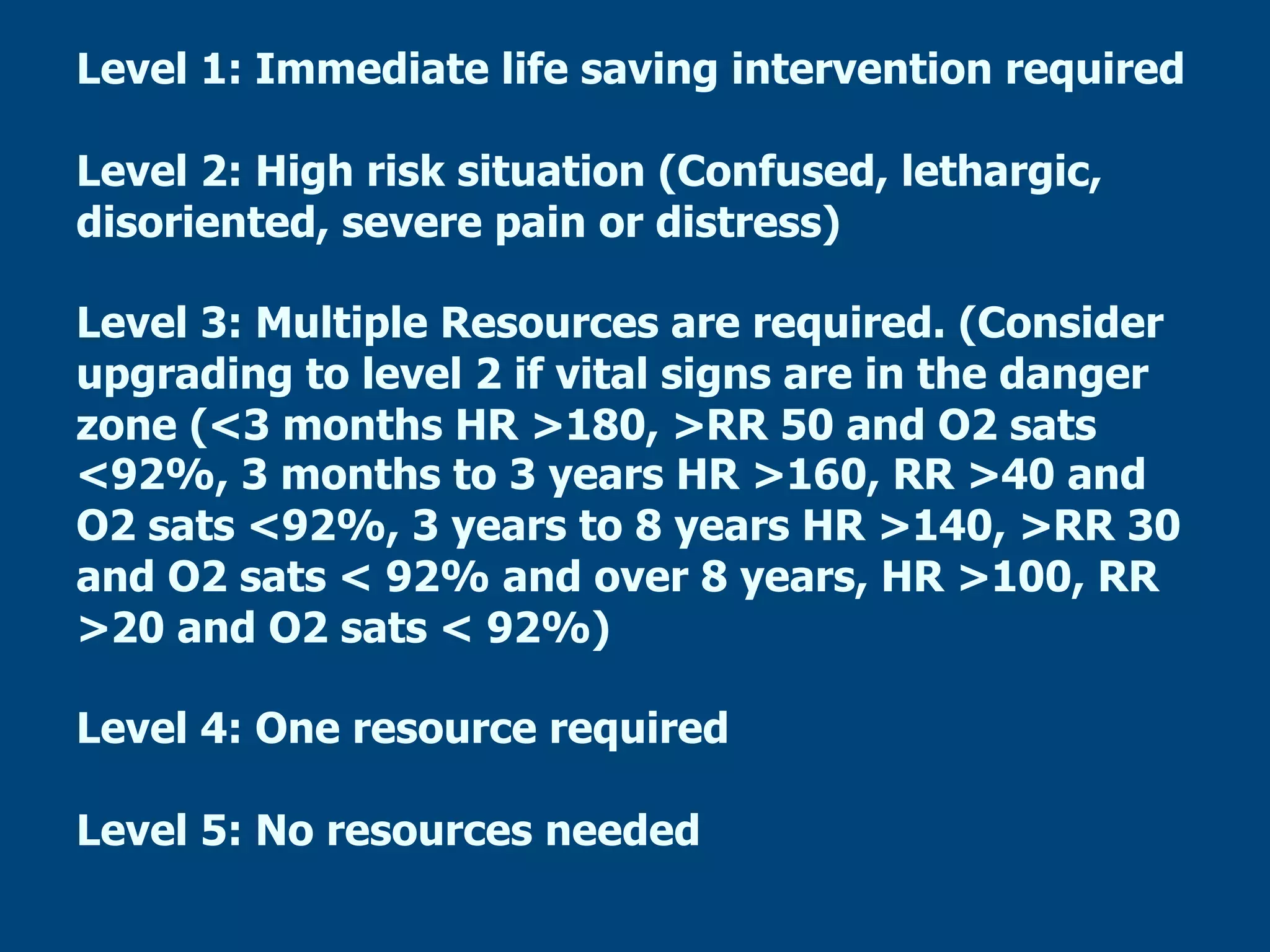
Level 1: Immediate life saving intervention required
Level 2: High risk situation (Confused, lethargic,
disoriented, severe pain or distress)
Level 3: Multiple Resources are required. (Consider
upgrading to level 2 if vital signs are in the danger
zone (<3 months HR >180, >RR 50 and O2 sats
<92%, 3 months to 3 years HR >160, RR >40 and
O2 sats <92%, 3 years to 8 years HR >140, >RR 30
and O2 sats < 92% and over 8 years, HR >100, RR
>20 and O2 sats < 92%)
Level 4: One resource required
Level 5: No resources needed
SOUTH AFRICA TRIAGE SCORE
In 2004 the South African Triage Group
(SATG) formerly known as the Cape
Triage Group) was convened under the
auspices of the Joint Division of
Emergency Medicine and the University of
Cape Town and Stellenbosch. The aim of
the STAG was to produce a triage score
for use throughout South Africa.
KEY TRIAGE CONCEPTS
~RED VS RESUSCITATION
~ACUTE VS CHRONIC
~CHILDREN AND INFANTS
~TEWS CALCULATOR
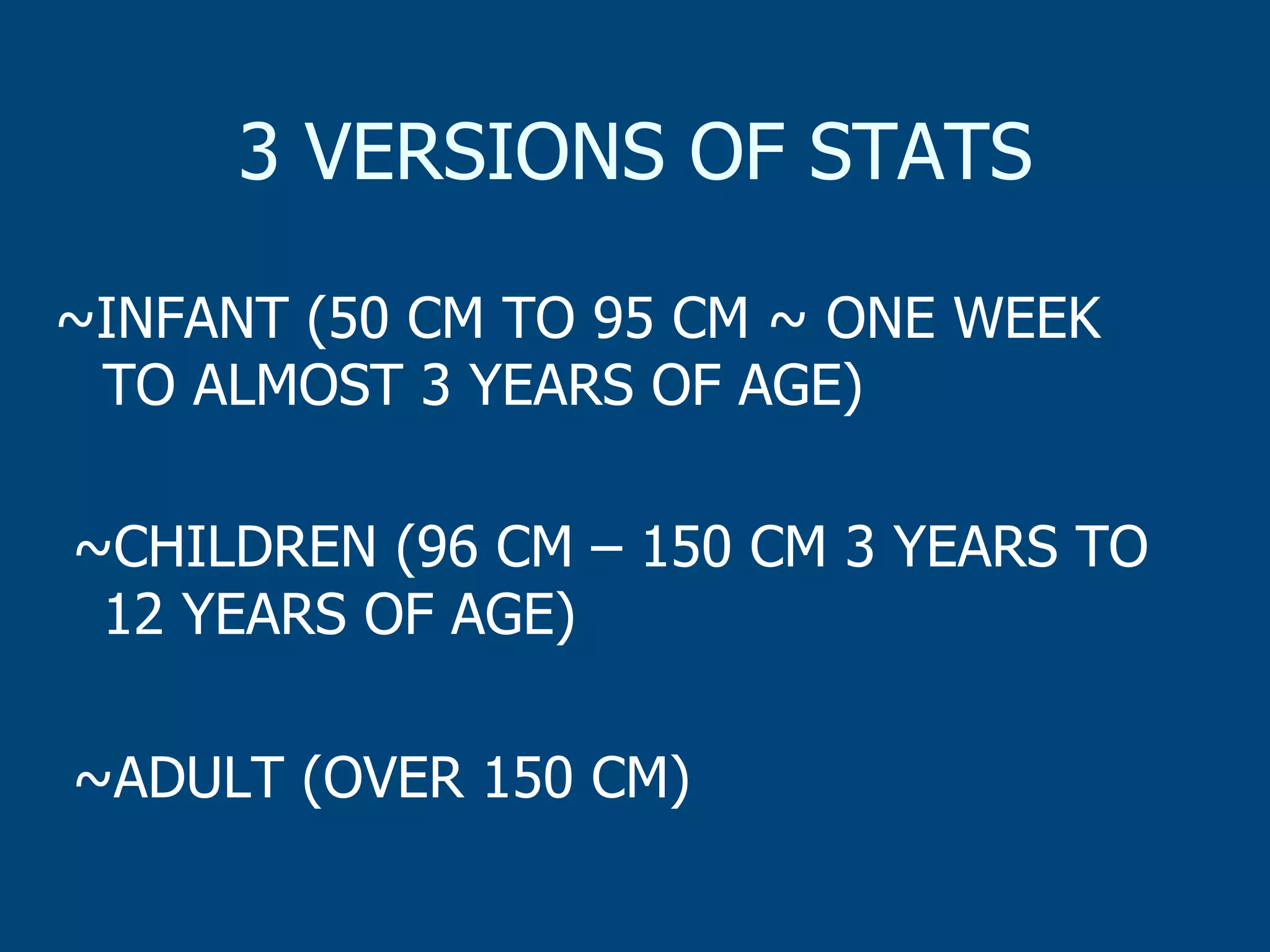
3 VERSIONS OF STATS
~INFANT (50 CM TO 95 CM ~ ONE WEEK
TO ALMOST 3 YEARS OF AGE)
~CHILDREN (96 CM – 150 CM 3 YEARS TO
12 YEARS OF AGE)
~ADULT (OVER 150 CM)
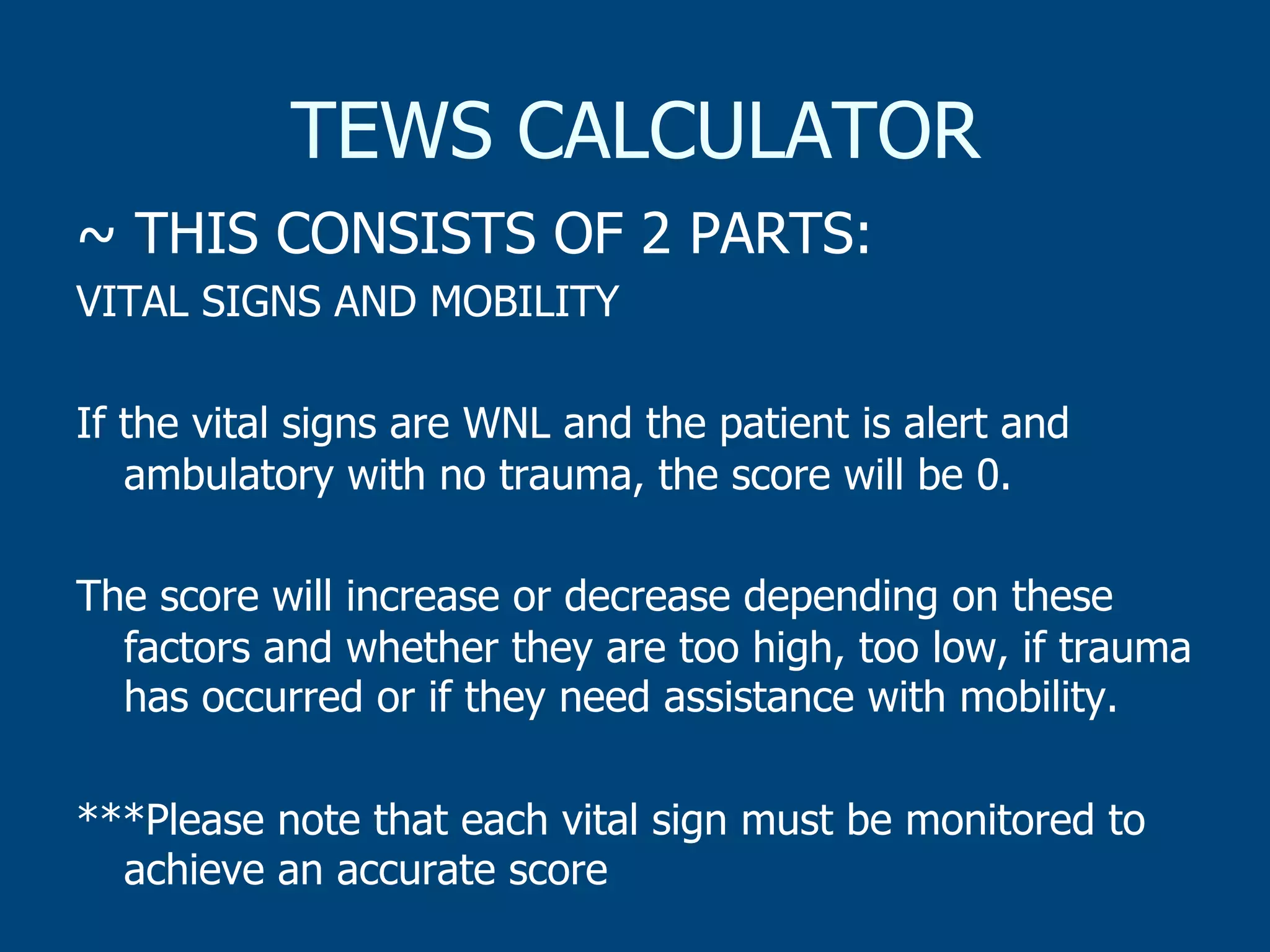
TEWS CALCULATOR
~ THIS CONSISTS OF 2 PARTS:
VITAL SIGNS AND MOBILITY
If the vital signs are WNL and the patient is alert and
ambulatory with no trauma, the score will be 0.
The score will increase or decrease depending on these
factors and whether they are too high, too low, if trauma
has occurred or if they need assistance with mobility.
***Please note that each vital sign must be monitored to
achieve an accurate score
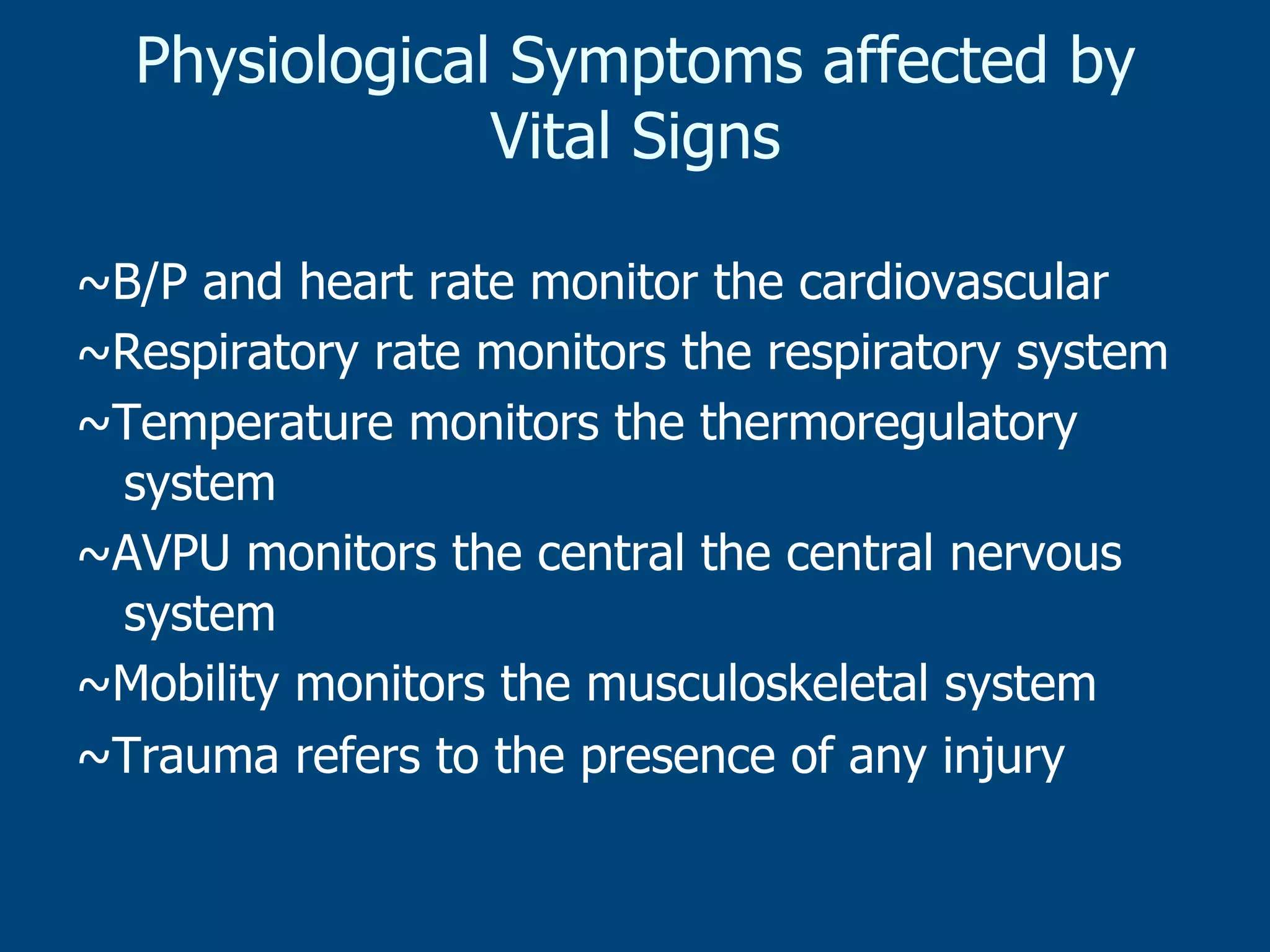
Physiological Symptoms affected by
Vital Signs
~B/P and heart rate monitor the cardiovascular
~Respiratory rate monitors the respiratory system
~Temperature monitors the thermoregulatory
system
~AVPU monitors the central the central nervous
system
~Mobility monitors the musculoskeletal system
~Trauma refers to the presence of any injury
The second discriminator is the
part that generates the actual
triage color (red, orange,
yellow, green or blue)
which will determine the
severity level and essentially
when the patient will be
attended to.
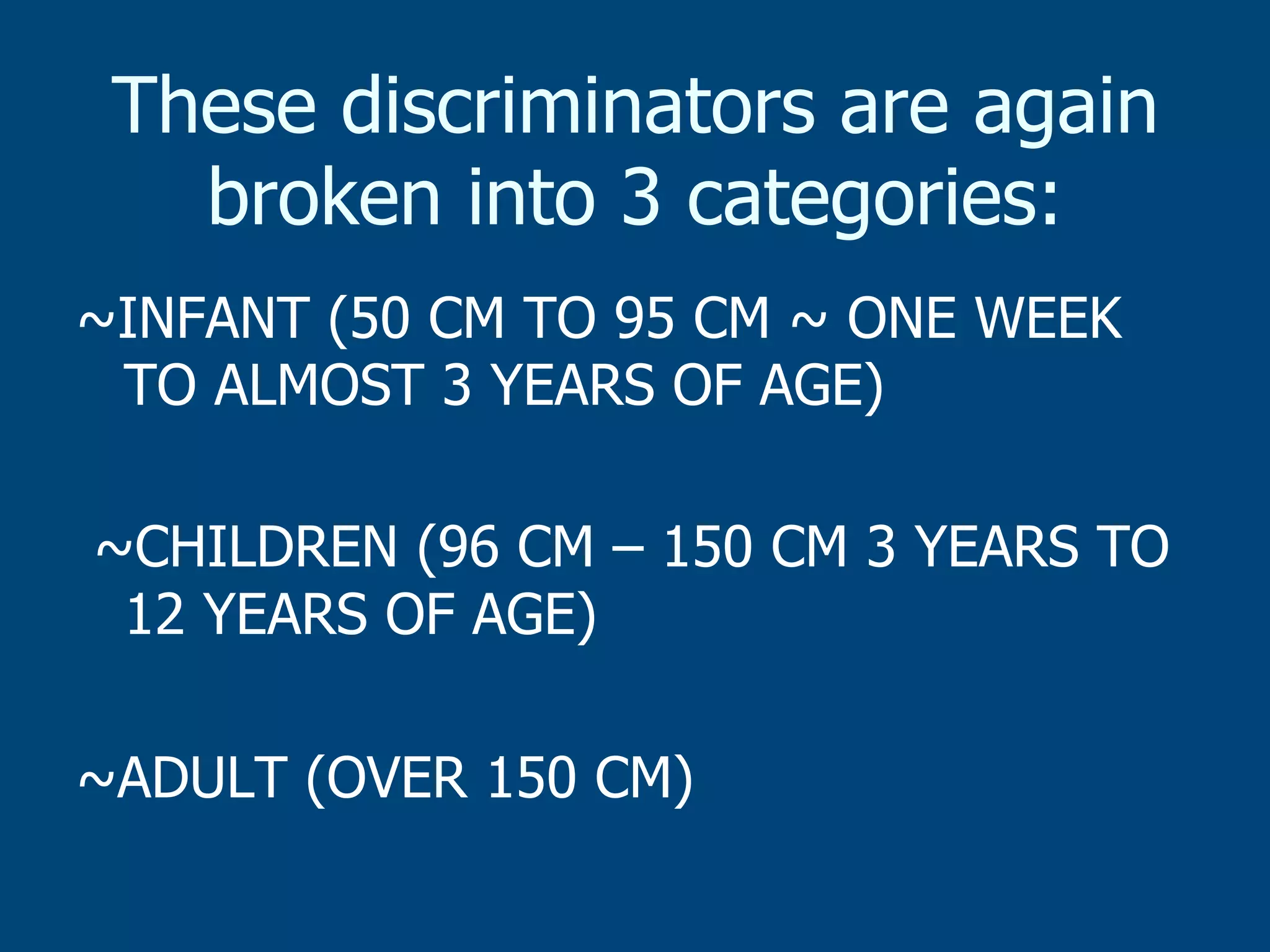
These discriminators are again
broken into 3 categories:
~INFANT (50 CM TO 95 CM ~ ONE WEEK
TO ALMOST 3 YEARS OF AGE)
~CHILDREN (96 CM – 150 CM 3 YEARS TO
12 YEARS OF AGE)
~ADULT (OVER 150 CM)
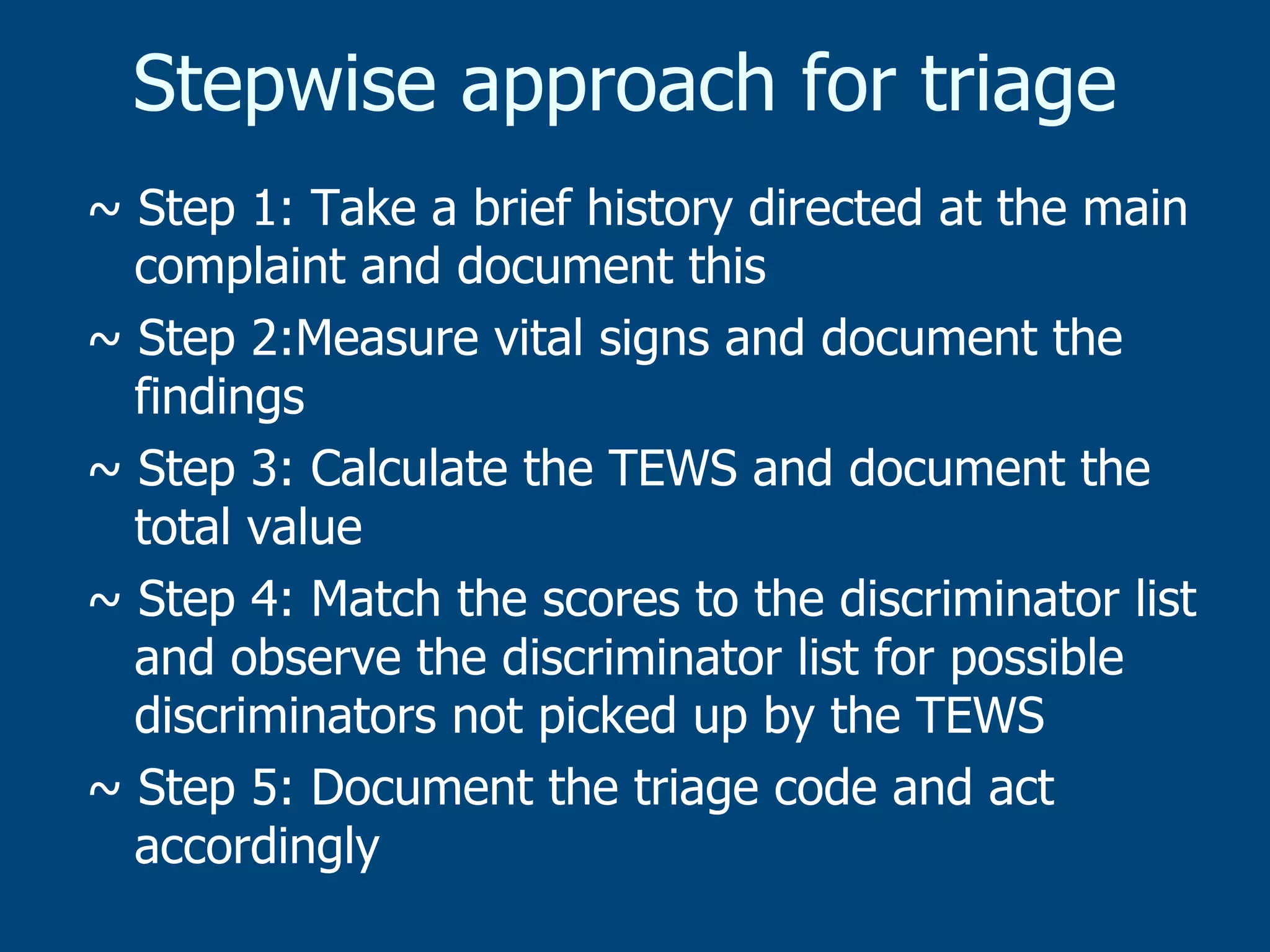
Stepwise approach for triage
~ Step 1: Take a brief history directed at the main
complaint and document this
~ Step 2:Measure vital signs and document the
findings
~ Step 3: Calculate the TEWS and document the
total value
~ Step 4: Match the scores to the discriminator list
and observe the discriminator list for possible
discriminators not picked up by the TEWS
~ Step 5: Document the triage code and act
accordingly
A decision regarding the acuity
of the patient s condition
should not me made until the
whole stepwise approach has
been completed.
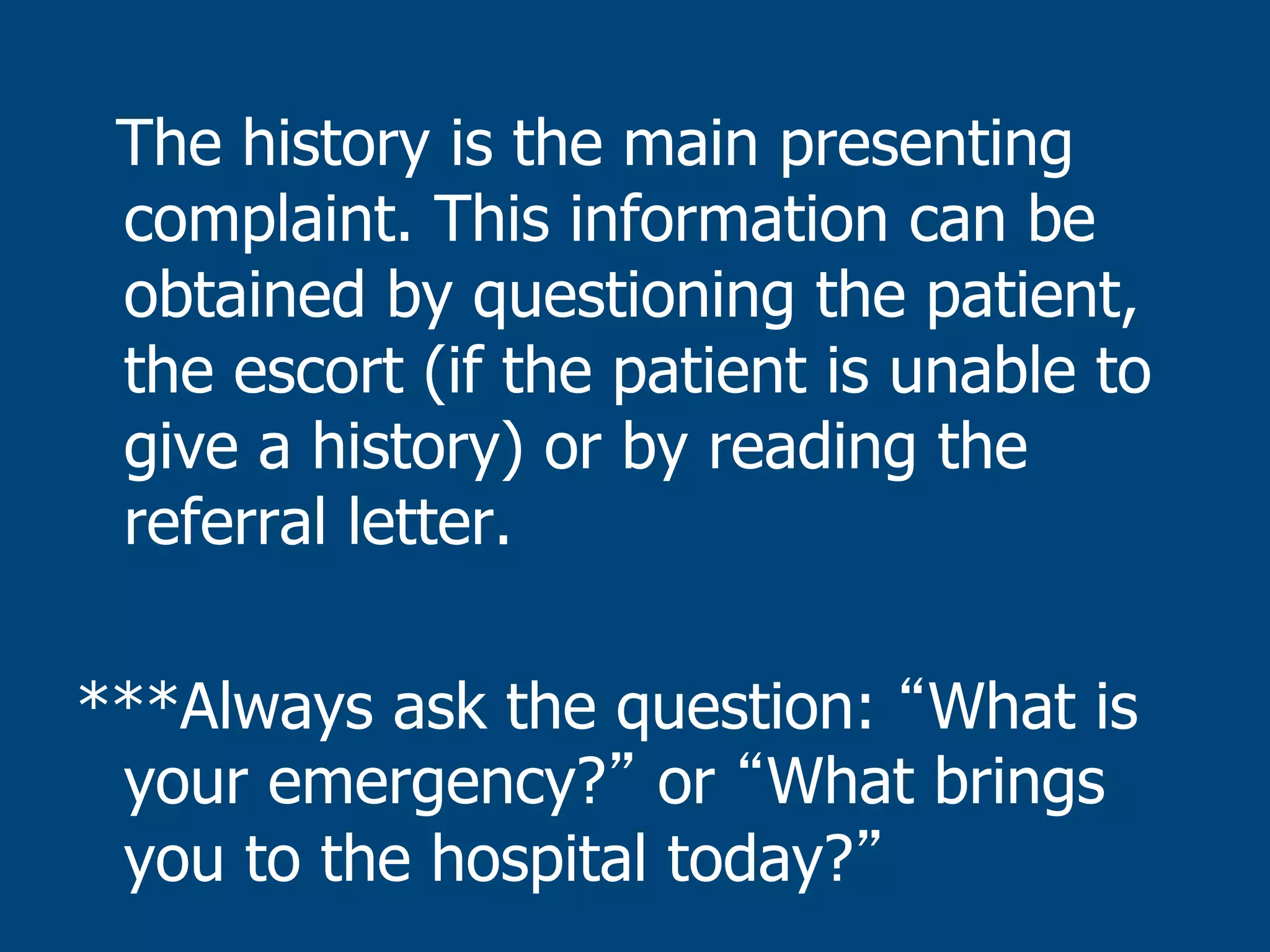
The history is the main presenting
complaint. This information can be
obtained by questioning the patient,
the escort (if the patient is unable to
give a history) or by reading the
referral letter.
***Always ask the question: What is
your emergency? or What brings
you to the hospital today?
THE IMPORTANCE OF
OBSERVATION
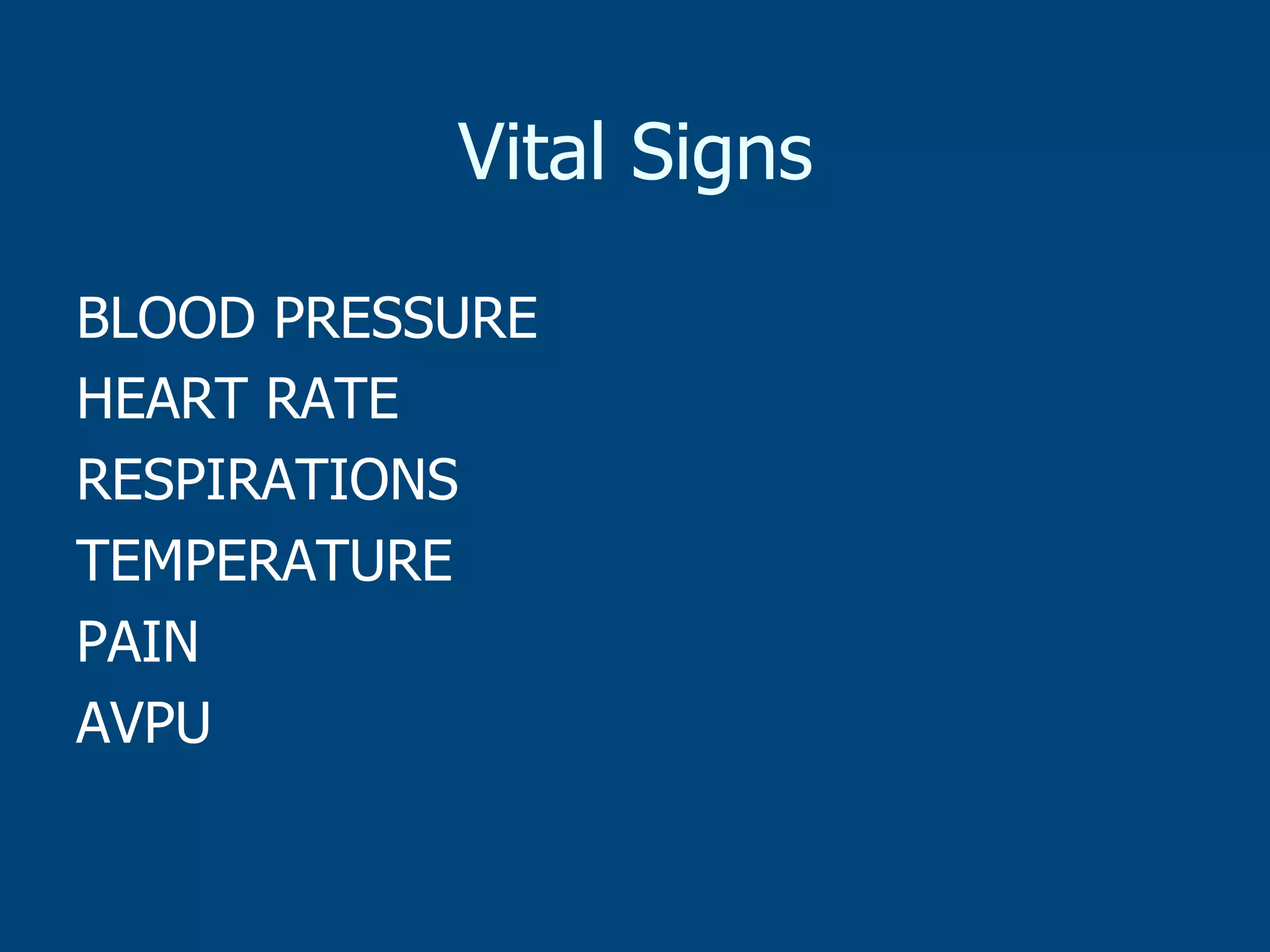
Vital Signs
BLOOD PRESSURE
HEART RATE
RESPIRATIONS
TEMPERATURE
PAIN
AVPU
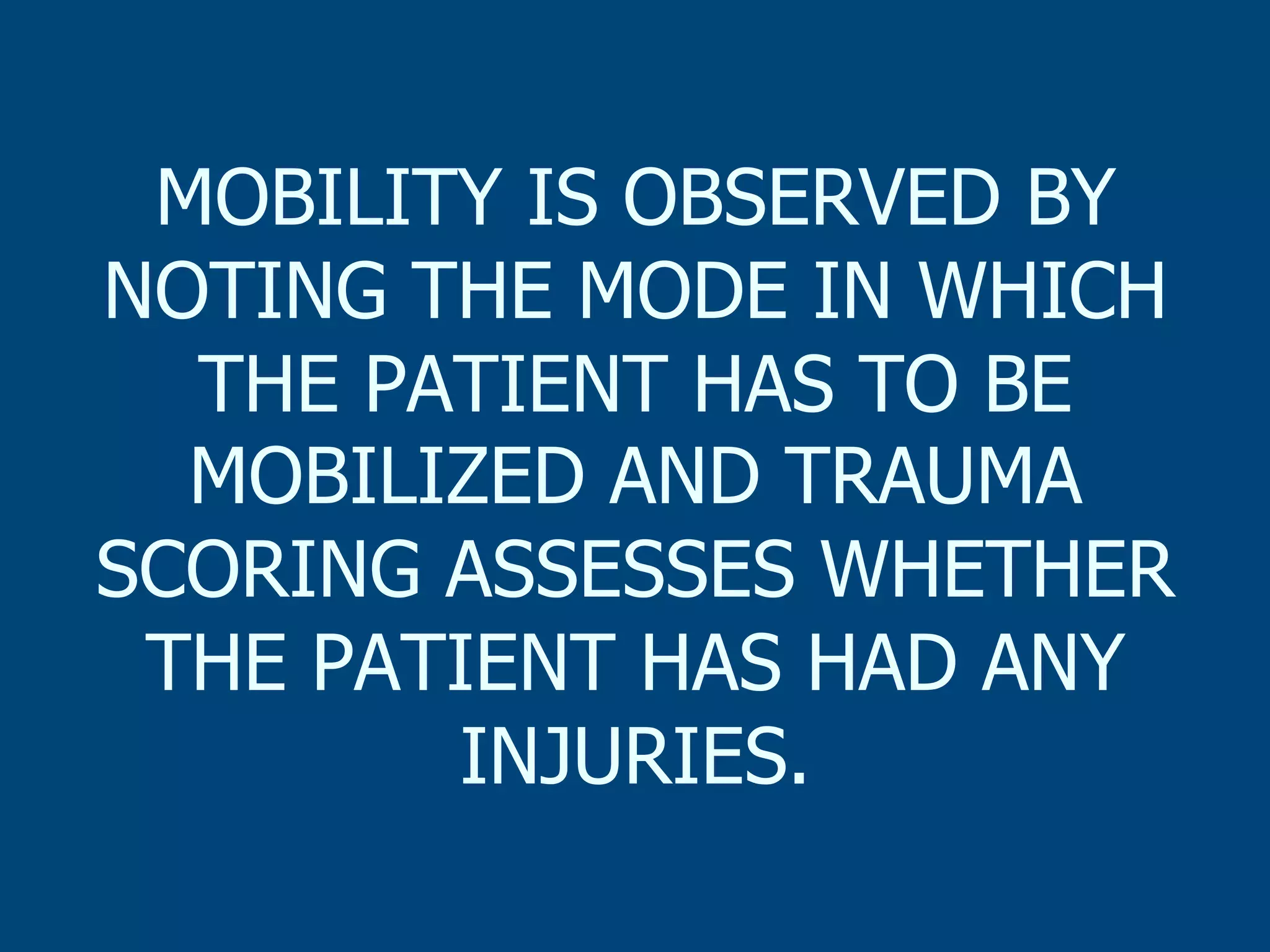
MOBILITY IS OBSERVED BY
NOTING THE MODE IN WHICH
THE PATIENT HAS TO BE
MOBILIZED AND TRAUMA
SCORING ASSESSES WHETHER
THE PATIENT HAS HAD ANY
INJURIES.
The history along with vital
signs must be documented!
~Practice Scenarios~
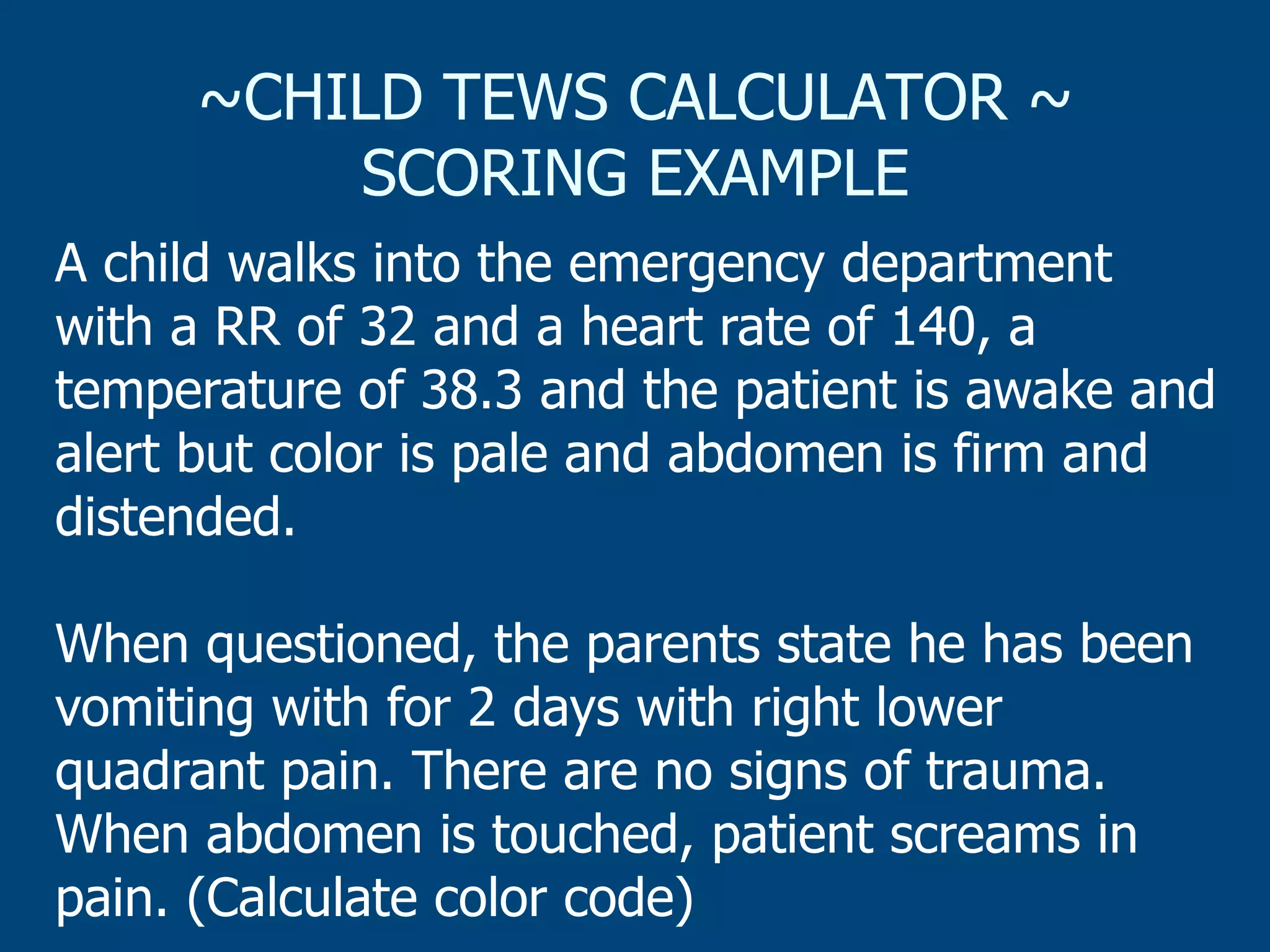
~CHILD TEWS CALCULATOR ~
SCORING EXAMPLE
A child walks into the emergency department
with a RR of 32 and a heart rate of 140, a
temperature of 38.3 and the patient is awake and
alert but color is pale and abdomen is firm and
distended.
When questioned, the parents state he has been
vomiting with for 2 days with right lower
quadrant pain. There are no signs of trauma.
When abdomen is touched, patient screams in
pain. (Calculate color code)
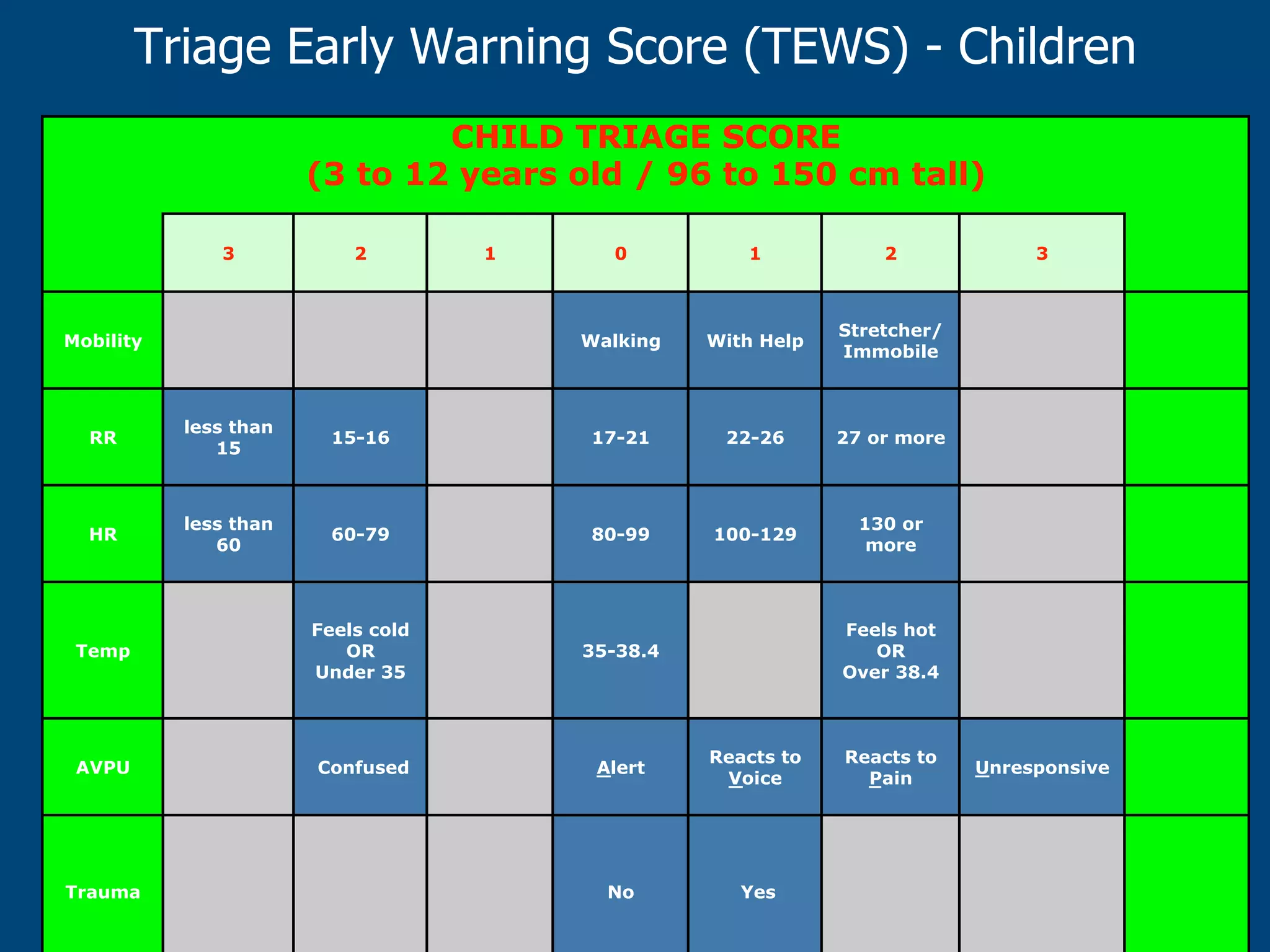
Triage Early Warning Score (TEWS) - Children
CHILD TRIAGE SCORE
(3 to 12 years old / 96 to 150 cm tall)
3

2

0

1

2

Walking

Mobility

1

With Help

Stretcher/
Immobile

RR

less than
15

15-16

17-21

22-26

27 or more

HR

less than
60

60-79

80-99

100-129

130 or
more

Temp

Feels cold
OR
Under 35

35-38.4

AVPU

Confused

Alert

Reacts to
Voice

No

Yes

3

Trauma

Feels hot
OR
Over 38.4

Reacts to
Pain

Unresponsive
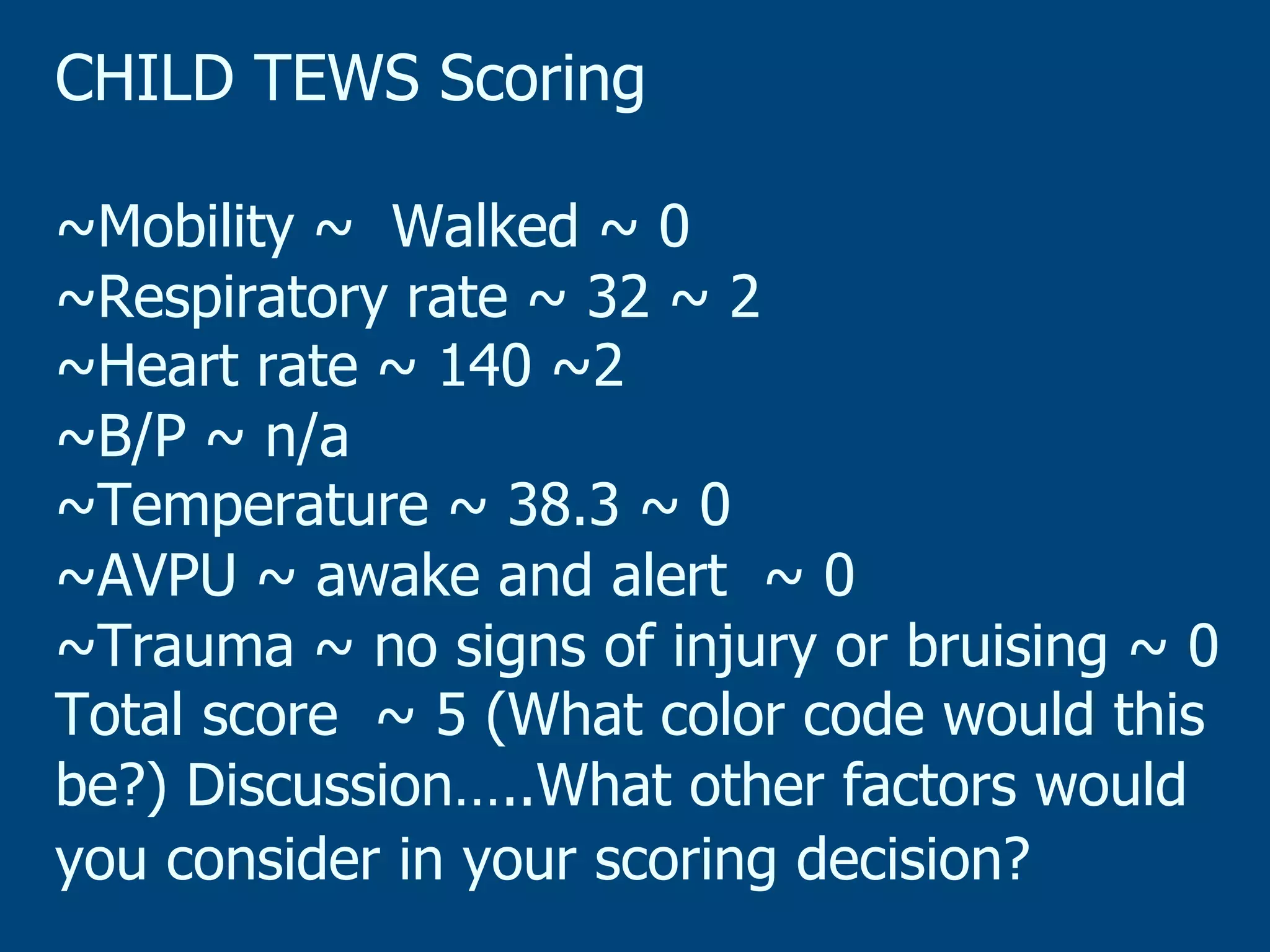
CHILD TEWS Scoring
~Mobility ~ Walked ~ 0
~Respiratory rate ~ 32 ~ 2
~Heart rate ~ 140 ~2
~B/P ~ n/a
~Temperature ~ 38.3 ~ 0
~AVPU ~ awake and alert ~ 0
~Trauma ~ no signs of injury or bruising ~ 0
Total score ~ 5 (What color code would this
be?) Discussion…..What other factors would
you consider in your scoring decision?
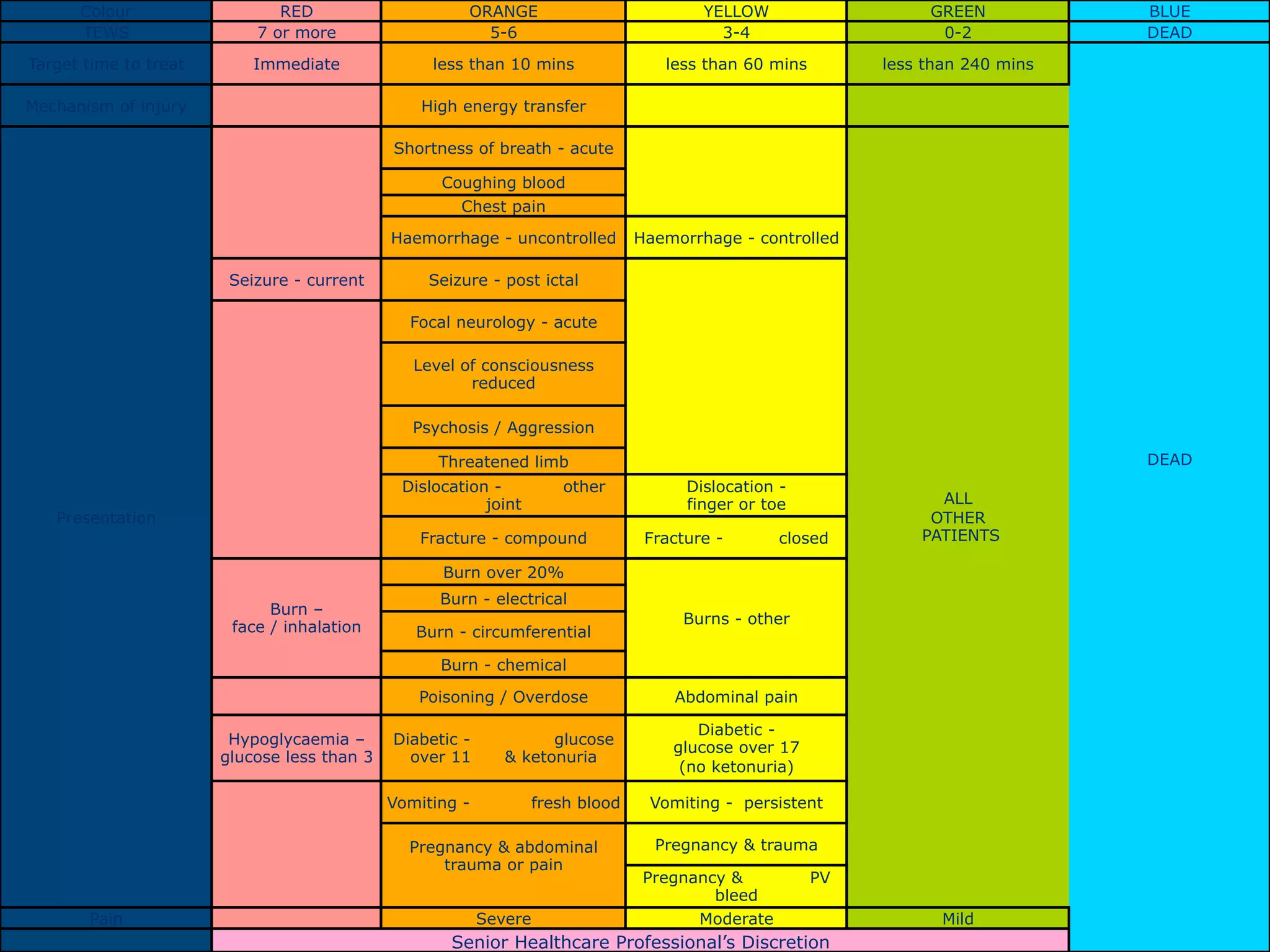
Colour
TEWS

RED
7 or more

ORANGE
5-6

YELLOW
3-4

GREEN
0-2

Target time to treat

Immediate

less than 10 mins

less than 60 mins

less than 240 mins

Mechanism of injury

BLUE
DEAD

High energy transfer
Shortness of breath - acute
Coughing blood
Chest pain
Haemorrhage - uncontrolled
Seizure - current

Haemorrhage - controlled

Seizure - post ictal
Focal neurology - acute
Level of consciousness
reduced
Psychosis / Aggression
DEAD

Threatened limb
Dislocation joint

Presentation

other

Fracture - compound

Dislocation finger or toe
Fracture -

closed

ALL
OTHER
PATIENTS

Burn over 20%
Burn –
face / inhalation

Burn - electrical
Burn - circumferential

Burns - other

Burn - chemical
Poisoning / Overdose
Hypoglycaemia –
glucose less than 3

Diabetic over 11
Vomiting -

glucose
& ketonuria
fresh blood

Pregnancy & abdominal
trauma or pain
Pain

Severe

Abdominal pain
Diabetic glucose over 17
(no ketonuria)
Vomiting - persistent
Pregnancy & trauma
Pregnancy &
bleed
Moderate

PV

Senior Healthcare Professional’s Discretion

Mild
~ ADULT TEWS CALCULATOR ~
SCORING EXAMPLE
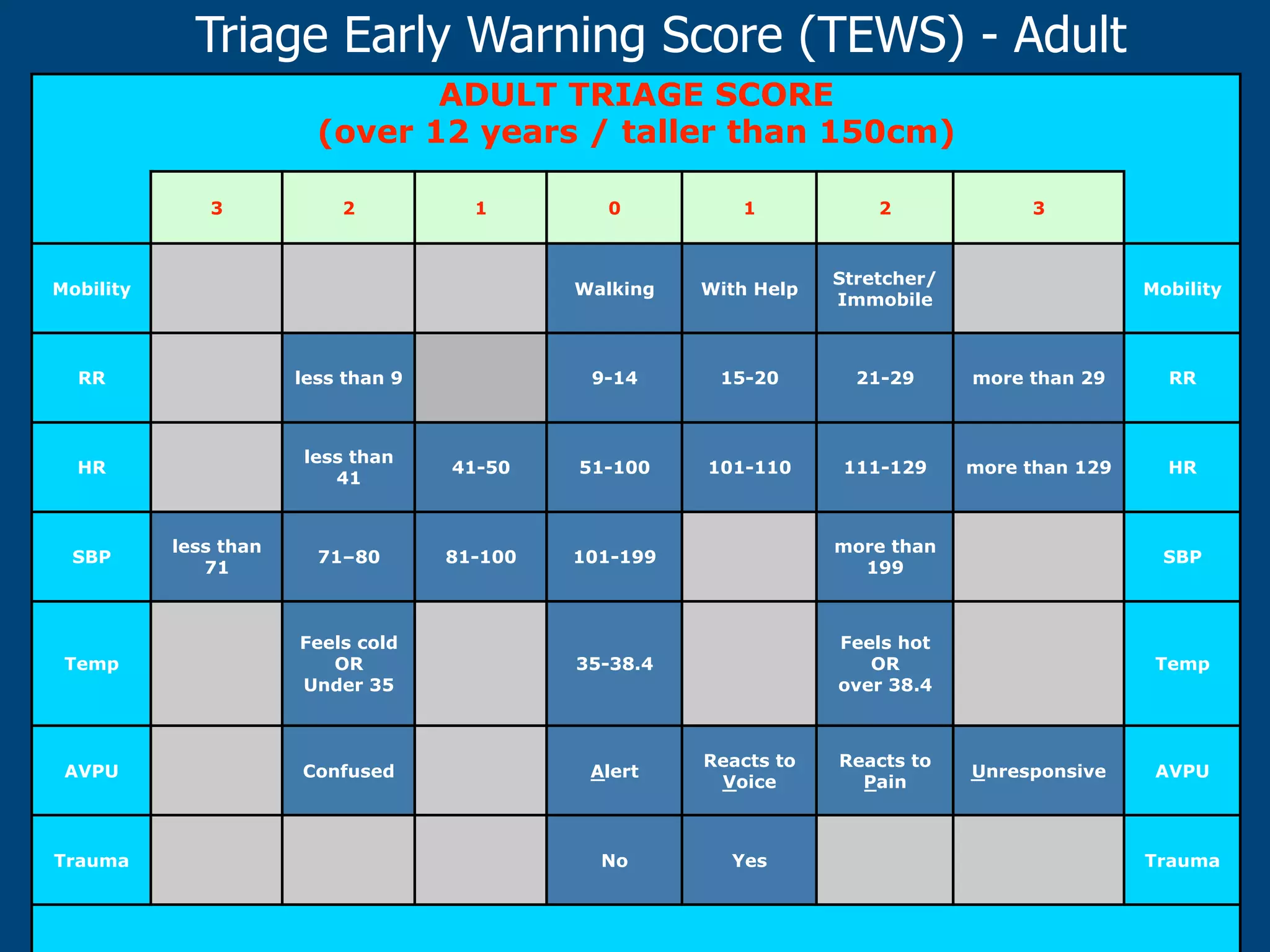
An adult patient arrives in a wheelchair with
a RR of 28 and a pulse of 129. The B/P is
200/98, temperature is 37.0 and the patient
is alert and oriented.
When questioned, the patient noted that
there had been no trauma and no physical
wounds, lacerations or bruising were noted.
Triage Early Warning Score (TEWS) - Adult
ADULT TRIAGE SCORE
(over 12 years / taller than 150cm)
3

2

1

1

2

Walking

With Help

Stretcher/
Immobile

9-14

Mobility

0

3

15-20

21-29

more than 29

RR

101-110

111-129

more than 129

HR

Mobility

RR

less than 9

HR

less than
41

41-50

51-100

71–80

81-100

101-199

more than
199

SBP

Feels hot
OR
over 38.4

Temp

SBP

less than
71

Temp

Feels cold
OR
Under 35

35-38.4

AVPU

Confused

Alert

Reacts to
Voice

No

Yes

Trauma

Reacts to
Pain

Unresponsive

AVPU

Trauma
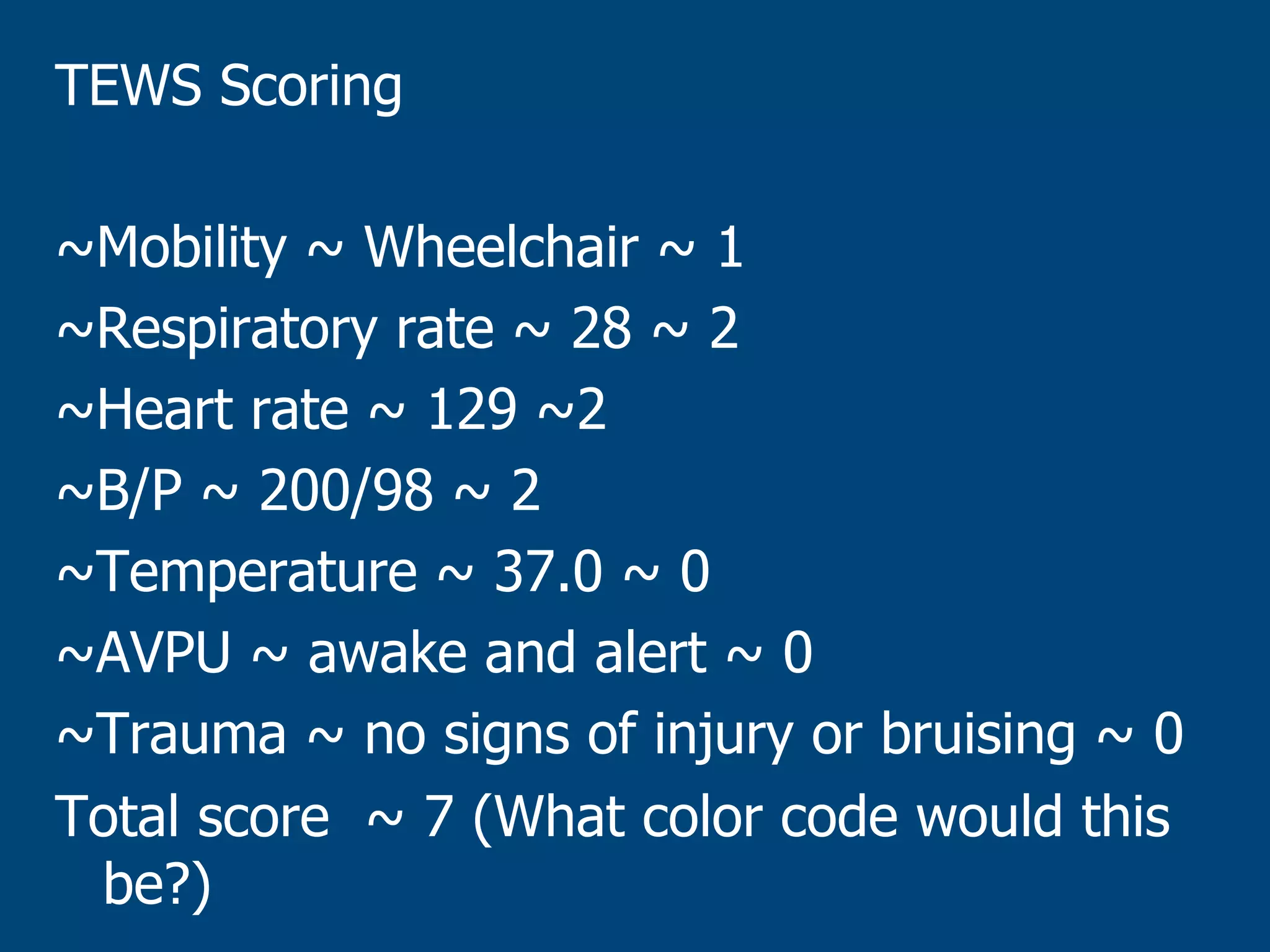
TEWS Scoring
~Mobility ~ Wheelchair ~ 1
~Respiratory rate ~ 28 ~ 2
~Heart rate ~ 129 ~2
~B/P ~ 200/98 ~ 2
~Temperature ~ 37.0 ~ 0
~AVPU ~ awake and alert ~ 0
~Trauma ~ no signs of injury or bruising ~ 0
Total score ~ 7 (What color code would this
be?)
DISCRIMINATORS
After the triage code according to the TEWS
discriminators are addressed by placing the
right hand over the selected color code.
Based on the history taken the triage code
may be changed to the corresponding
column in which the discriminator was
found.
Utilize the TEWS Scores and
also use your assessment skills,
knowledge & expertise to
determine whether to upgrade a
patient or ask for colleague/
physician input regarding your
triage placement decision.
TRIAGING UP IS ESSENTIAL TO
THE PROCESS AND MUST BE DONE
WHERE DISCRIMINATORS OUTTRIAGE THE TEWS.
TRIAGE DOWN IS NOT A PART OF
THE TRIAGE PROVIDERS DUTY
BUT CAN BE DONE BY THE SENIOR
HEALTHCARE PROVIDER.
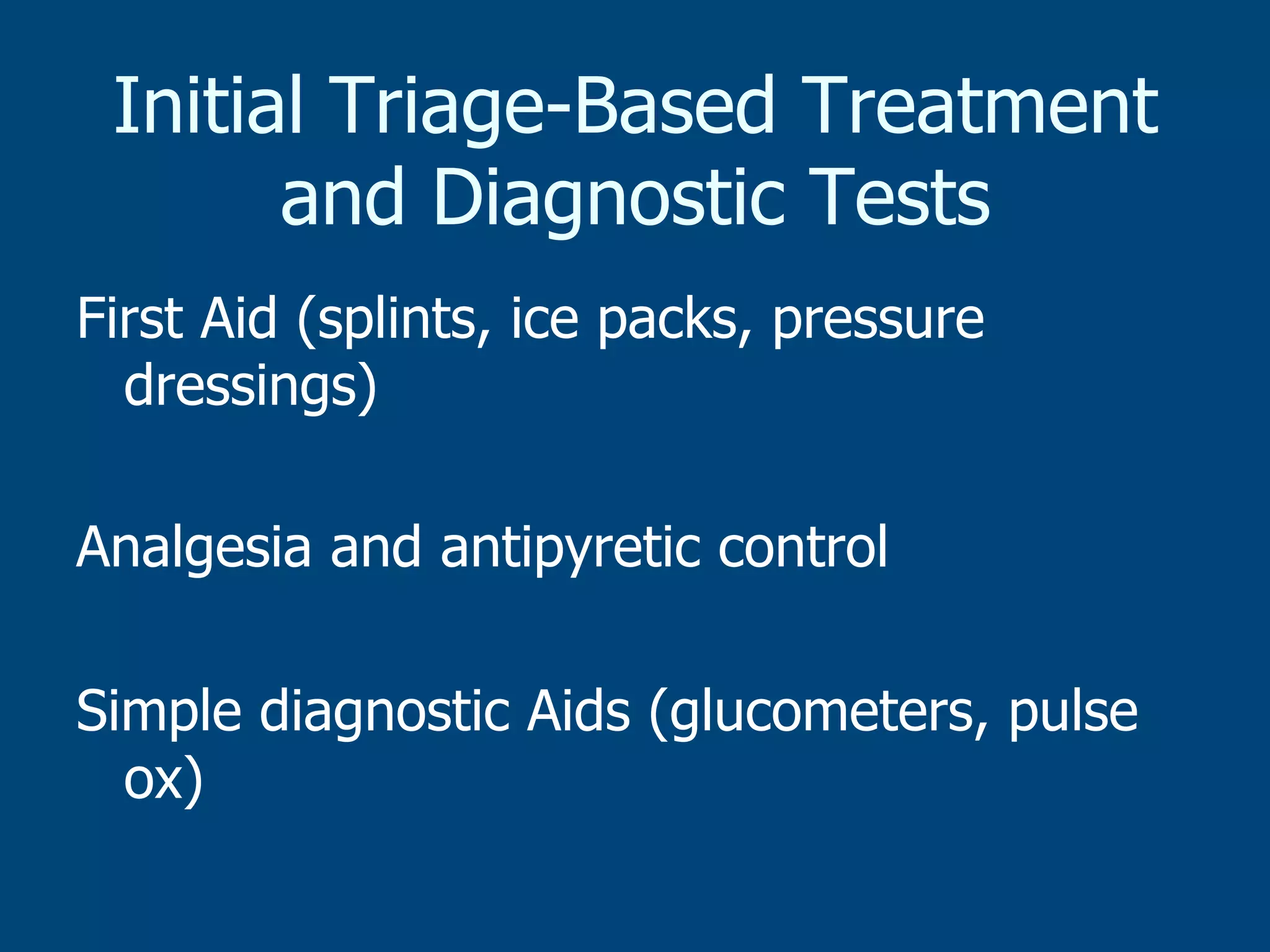
Initial Triage-Based Treatment
and Diagnostic Tests
First Aid (splints, ice packs, pressure
dressings)
Analgesia and antipyretic control
Simple diagnostic Aids (glucometers, pulse
ox)
Decision Making Process
Prioritization
Time Management
Organization
Resource Utilization
Follow-up
Additional Triage
Responsibilities
Waiting Room Management
~Safety of Waiting Room Patients
~Reassessment of Patients
~Privacy
Communication
~Customer Service
~Management of Visitors
Administrative Responsibilities
Safety
Infection Control
Triage Legalities
Triage Performance
Improvement
Triage Data Utilizations
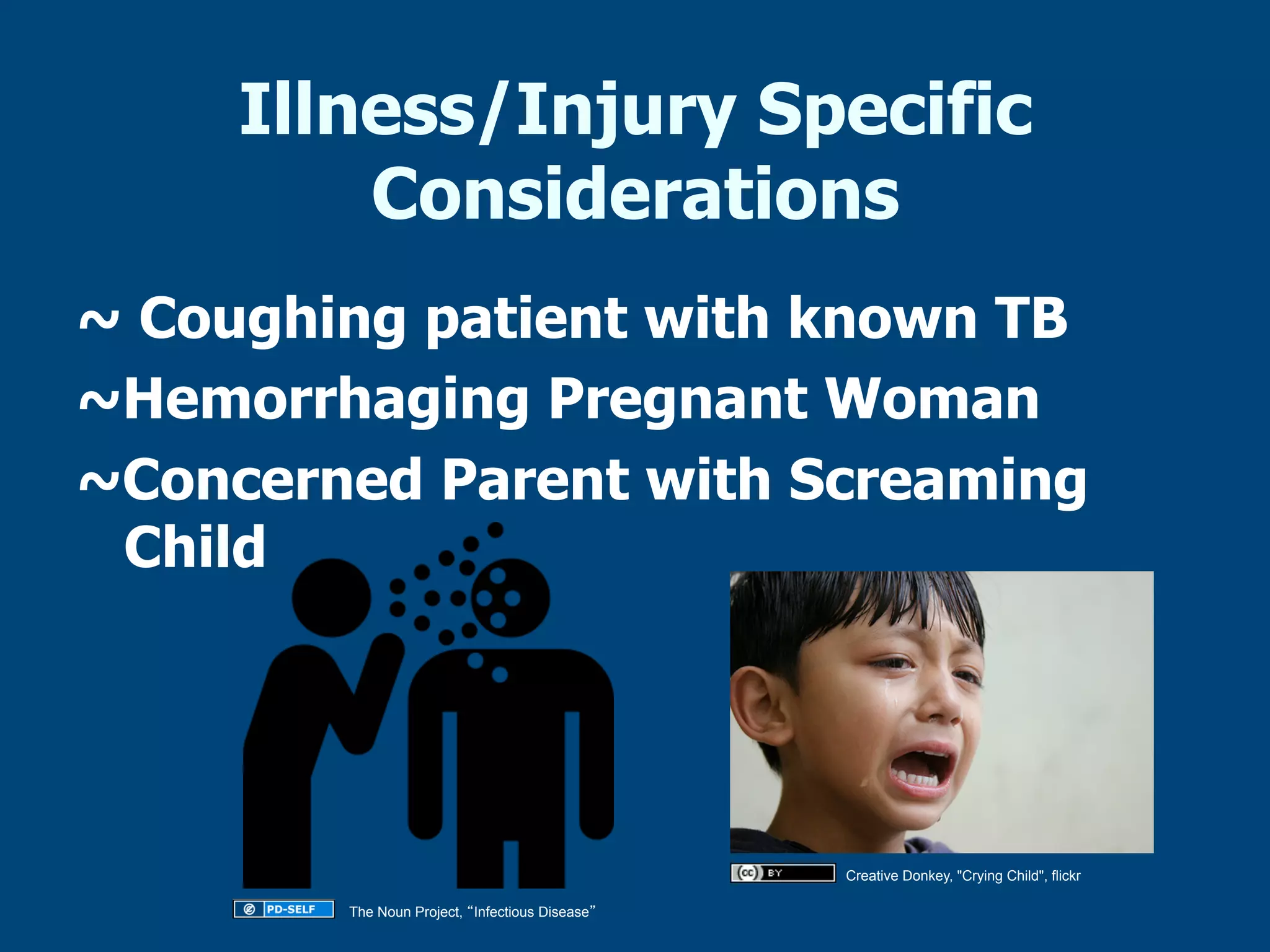
Illness/Injury Specific
Considerations
~ Coughing patient with known TB
~Hemorrhaging Pregnant Woman
~Concerned Parent with Screaming
Child

Creative Donkey, "Crying Child", flickr
The Noun Project, Infectious Disease
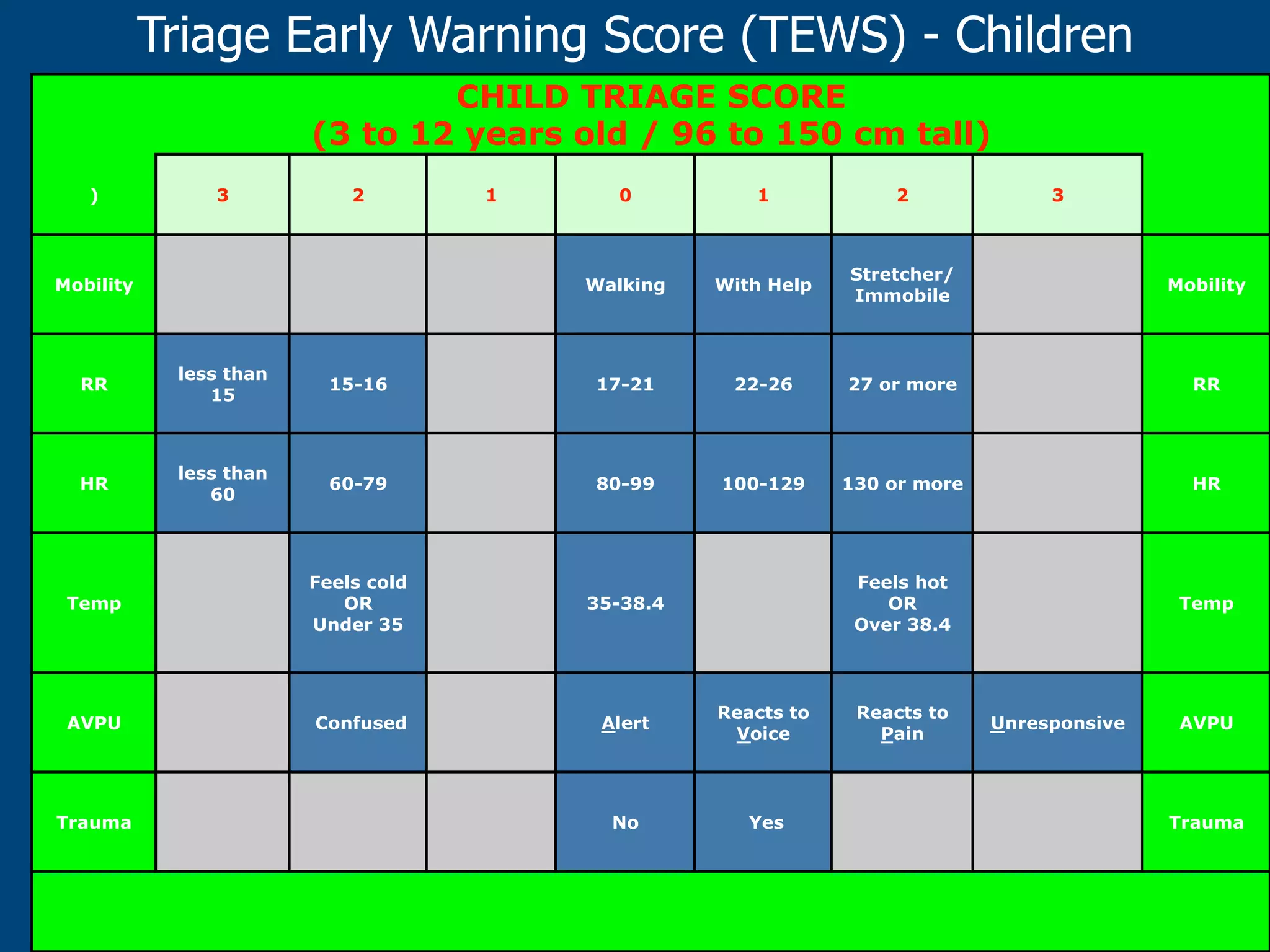
Triage Early Warning Score (TEWS) - Children
CHILD TRIAGE SCORE
(3 to 12 years old / 96 to 150 cm tall)
)

3

2

0

1

2

Walking

Mobility

1

3

With Help

Stretcher/
Immobile

Mobility

RR

less than
15

15-16

17-21

22-26

27 or more

RR

HR

less than
60

60-79

80-99

100-129

130 or more

HR

Temp

Feels cold
OR
Under 35

35-38.4

Feels hot
OR
Over 38.4

Temp

AVPU

Confused

Alert

Reacts to
Voice

No

Yes

Trauma

Reacts to
Pain

Unresponsive

AVPU

Trauma
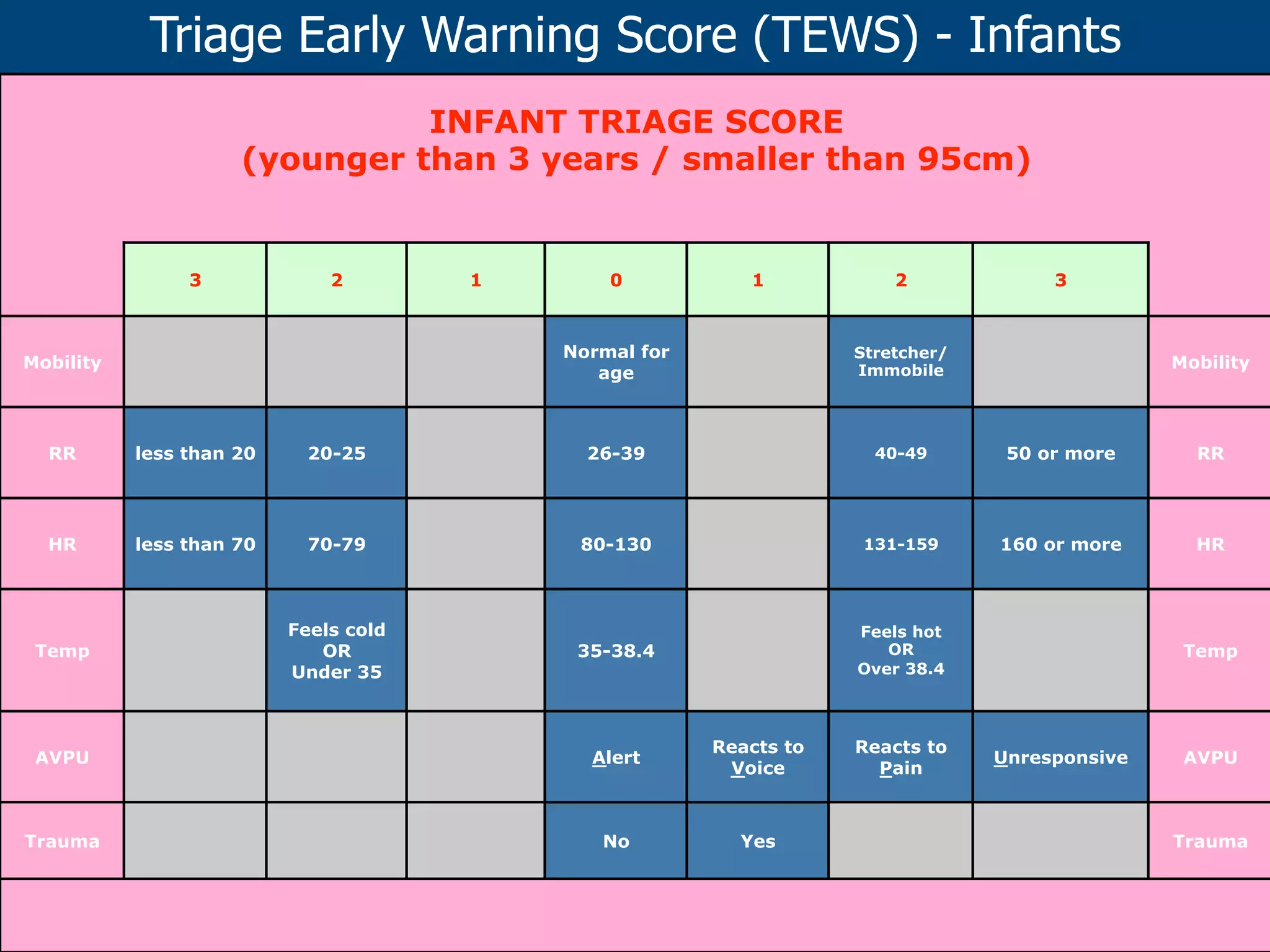
Triage Early Warning Score (TEWS) - Infants
INFANT TRIAGE SCORE
(younger than 3 years / smaller than 95cm)

3

2

1

0

1

2

Normal for
age

Mobility

3

Stretcher/
Immobile

Mobility

RR

less than 20

20-25

26-39

40-49

50 or more

RR

HR

less than 70

70-79

80-130

131-159

160 or more

HR

Feels cold
OR
Under 35

35-38.4

Feels hot
OR
Over 38.4

Temp

AVPU

Alert

Reacts to
Voice

Trauma

No

Yes

Reacts to
Pain

Temp

Unresponsive

AVPU

Trauma
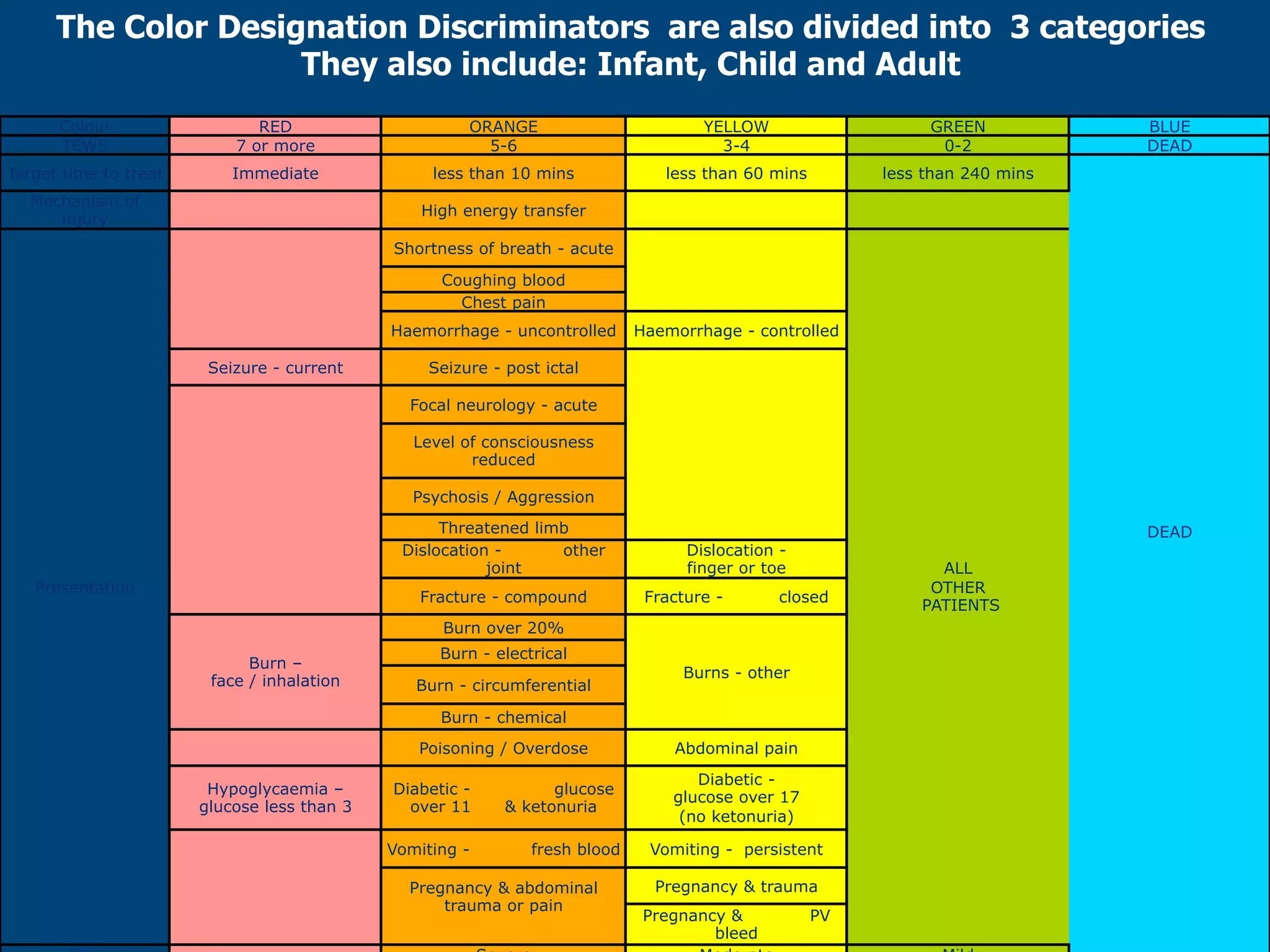
The Color Designation Discriminators are also divided into 3 categories
They also include: Infant, Child and Adult
Colour
TEWS

RED
7 or more

ORANGE
5-6

YELLOW
3-4

GREEN
0-2

Target time to treat

Immediate

less than 10 mins

less than 60 mins

less than 240 mins

Mechanism of
injury

BLUE
DEAD

High energy transfer
Shortness of breath - acute
Coughing blood
Chest pain
Haemorrhage - uncontrolled
Seizure - current

Haemorrhage - controlled

Seizure - post ictal
Focal neurology - acute
Level of consciousness
reduced
Psychosis / Aggression
Threatened limb
Dislocation other
joint

Presentation

Fracture - compound

DEAD

Dislocation finger or toe
Fracture -

closed

Burn over 20%
Burn –
face / inhalation

Burn - electrical
Burn - circumferential

Burns - other

Burn - chemical
Poisoning / Overdose
Hypoglycaemia –
glucose less than 3

Diabetic over 11
Vomiting -

glucose
& ketonuria
fresh blood

Pregnancy & abdominal
trauma or pain

Abdominal pain
Diabetic glucose over 17
(no ketonuria)
Vomiting - persistent
Pregnancy & trauma
Pregnancy &
bleed

PV

ALL
OTHER
PATIENTS
IT IS ONLY THROUGH PRACTICE
AND REPETITION THAT A NURSE
WILL BECOME SKILLED WITH
TRIAGE. THEREFORE, IT IS
ENCOURAGED THAT YOU
PARICIPATE IN THE TRIAGE
PROCESS AS FREQUENTLY AS
POSSIBLE IN ORDER TO STAY IN
PRACTICE AND UP TO DATE
Summary
Triage is an essentially 1st step
in the efficient and effective
running of any Emergency
Center. Utilized together with
common sense, education and
assessment skills, the SATS is an
excellent tool to that can save
lives and reduce morbidity.
Additional Source Information
for more information see: http://open.umich.edu/wiki/CitationPolicy
Slide 47, Image 1: Jack Biesek, Gladys Brenner, Margaret Faye, Healther Merrifield, Kate Keating, Wendy Olmstead, Todd Pierce, Jamie Cowgill,
Jim Bolek, "Infectious Disease" The Noun Project, http://thenounproject.com/noun/infectious-disease/#icon-No613, Public Domain.
Slide 47, Image 2: Creative Donkey, "Crying Child", flickr, http://www.flickr.com/photos/binusarina/3889528397/, CC: BY 2.0, http://
creativecommons.org/licenses/by/2.0/

GEMC - Trauma - Triage - for Nurses

  • 1.
    Author(s): Antoinette A.Bradshaw, PhD, MS, BSN, RN, 2011 License: Unless otherwise noted, this material is made available under the terms of the Creative Commons Attribution Share Alike 3.0 License: http://creativecommons.org/licenses/by-sa/3.0/ We have reviewed this material in accordance with U.S. Copyright Law and have tried to maximize your ability to use, share, and adapt it. Copyright holders of content included in this material should contact open.michigan@umich.edu with any questions, corrections, or clarification regarding the use of content. For more information about how to cite these materials visit http://open.umich.edu/privacy-and-terms-use. Any medical information in this material is intended to inform and educate and is not a tool for self-diagnosis or a replacement for medical evaluation, advice, diagnosis or treatment by a healthcare professional. Please speak to your physician if you have questions about your medical condition. Viewer discretion is advised: Some medical content is graphic and may not be suitable for all viewers.
  • 2.
    Citation Key for moreinformation see: http://open.umich.edu/wiki/CitationPolicy Use + Share + Adapt { Content the copyright holder, author, or law permits you to use, share and adapt. } Public Domain – Government: Works that are produced by the U.S. Government. (17 USC § 105) Public Domain – Expired: Works that are no longer protected due to an expired copyright term. Public Domain – Self Dedicated: Works that a copyright holder has dedicated to the public domain. Creative Commons – Zero Waiver Creative Commons – Attribution License Creative Commons – Attribution Share Alike License Creative Commons – Attribution Noncommercial License Creative Commons – Attribution Noncommercial Share Alike License GNU – Free Documentation License Make Your Own Assessment { Content Open.Michigan believes can be used, shared, and adapted because it is ineligible for copyright. } Public Domain – Ineligible: Works that are ineligible for copyright protection in the U.S. (17 USC § 102(b)) *laws in your jurisdiction may differ { Content Open.Michigan has used under a Fair Use determination. } Fair Use: Use of works that is determined to be Fair consistent with the U.S. Copyright Act. (17 USC § 107) *laws in your jurisdiction may differ Our determination DOES NOT mean that all uses of this 3rd-party content are Fair Uses and we DO NOT guarantee that your use of the content is Fair. To use this content you should do your own independent analysis to determine whether or not your use will be Fair.
  • 3.
    UNIVERSITY OF MICHIGAN EMERGENCYMEDICINE AND PROJECT HOPE KATH EMERGENCY NURSING TRAINING PROGRAM MODULE ~ 3
  • 4.
    Antoinette A. Bradshaw,PhD, MS, BSN, RN
  • 5.
  • 6.
    COURSE OBJECTIVES *TO DEFINETHE MAJOR OBJECTIVES OF TRIAGE AND THE ROLE OF TRIAGE WITHIN THE EMERGENCY MEDICAL SYSTEM *TO DEFINE THE MAJOR TYPES OF TRIAGE PRACTICES *TO DESCRIBE AND APPLY THE CAPE TRIAGE SCORING SYSTEM *TO APPLY THE NURSING PROCESS WHEN ANALYZING THE TRIAGE CASE SCENARIO *TO DELINEATE THE NURSING PROCESS DURING TRIAGE *TO PREDICT CAPE TRIAGE SCORE WHEN PRESENTED WITH SPECIFIC INFORMATION REGARDING THE PATIENT S HISTORY AND CONSIDER AGE SPECIFIC FACTORS * TO EMPOWER THE NURSES WITH KNOWLEDGE TO BECOME SKILLED AT TRIAGE
  • 7.
    WHAT IS TRIAGE? Triageis the process of determining the priority of patients' treatments based on the severity of their condition. This rations patient treatment efficiently when resources are insufficient for all to be treated immediately. The term comes from the French verb trier, meaning to separate, sort, sift or select.
  • 8.
    The Purpose &Benefits of Triage ~ To expedite the delivery of time-critical treatment for patients with life-threatening conditions ~To ensure that ALL people requiring emergency care are appropriately categorized according to their clinical condition ~ To improve patient flow ~ To improve patient satisfaction ~ To decrease the patient s overall length of stay ~ To facilitate streaming of less urgent patients ~ To be user-friendly for all levels of health care professionals
  • 9.
    ROLE OF TRIAGENURSE To competently assess all incoming patients to properly place them in categories according to the Triage Early Warning Score (TEWS)
  • 10.
    NURSING QUALIFICATIONS FOR TRIAGE 1.Ideally the nurse should have worked in the Emergency Department for a minimum of 6 months 2. A nurse must go through the Emergency Department orientation program 3. The nurse must complete at least four month rotation through the various hospital units including the ED
  • 11.
    The Significance ofNurses in The Triage Process Compared to other countries whose doctor to nurse ratios range from 1:4 to 1:1.6, in South Africa the Ratio of doctors to nurses is 1:8. Thus, the nurses have a critical role in assisting the physicians in assessing patients for initial treatment as well as in the ongoing delivery of care.
  • 12.
    ~ Assessment ~ ACritical Tool
  • 13.
    Across the RoomAssessment What are some of the symptoms or physical signs that you can assess from across the room?
  • 14.
    CURRENTLY UTILIZED TRIAGE SYSTEMS CTAS~ Canadian Triage and Acuity scale ESI ~ Emergency Severity Index ATI ~ Australian Triage Index
  • 15.
    CANADIAN TRIAGE ANDACUITY SCALE (CTAS) NATIONAL GUIDELINES CTAS Level 1 - Patients need to be seen by a physician immediately 98% of the time. CTAS Level 2 - Patients need to be seen by a physician within 15 minutes 95% of the time. CTAS Level 3 - Patients need to be seen by a physician within 30 minutes 90% of the time. CTAS Level 4 - Patients need to be seen by a physician within 60 minutes 85% of the time. CTAS Level 5 - Patients need to be seen by a physician within 120 minutes 80 % of the time.
  • 16.
    EMERGENCY SEVERITY INDEX TheEmergency Severity Index is a 5 level tool for use in emergency department triage. Experienced ER nurses use the ESI to rate patient s acuity on a scale of 1-5.
  • 17.
    Level 1: Immediatelife saving intervention required Level 2: High risk situation (Confused, lethargic, disoriented, severe pain or distress) Level 3: Multiple Resources are required. (Consider upgrading to level 2 if vital signs are in the danger zone (<3 months HR >180, >RR 50 and O2 sats <92%, 3 months to 3 years HR >160, RR >40 and O2 sats <92%, 3 years to 8 years HR >140, >RR 30 and O2 sats < 92% and over 8 years, HR >100, RR >20 and O2 sats < 92%) Level 4: One resource required Level 5: No resources needed
  • 18.
    SOUTH AFRICA TRIAGESCORE In 2004 the South African Triage Group (SATG) formerly known as the Cape Triage Group) was convened under the auspices of the Joint Division of Emergency Medicine and the University of Cape Town and Stellenbosch. The aim of the STAG was to produce a triage score for use throughout South Africa.
  • 19.
    KEY TRIAGE CONCEPTS ~REDVS RESUSCITATION ~ACUTE VS CHRONIC ~CHILDREN AND INFANTS ~TEWS CALCULATOR
  • 20.
    3 VERSIONS OFSTATS ~INFANT (50 CM TO 95 CM ~ ONE WEEK TO ALMOST 3 YEARS OF AGE) ~CHILDREN (96 CM – 150 CM 3 YEARS TO 12 YEARS OF AGE) ~ADULT (OVER 150 CM)
  • 21.
    TEWS CALCULATOR ~ THISCONSISTS OF 2 PARTS: VITAL SIGNS AND MOBILITY If the vital signs are WNL and the patient is alert and ambulatory with no trauma, the score will be 0. The score will increase or decrease depending on these factors and whether they are too high, too low, if trauma has occurred or if they need assistance with mobility. ***Please note that each vital sign must be monitored to achieve an accurate score
  • 22.
    Physiological Symptoms affectedby Vital Signs ~B/P and heart rate monitor the cardiovascular ~Respiratory rate monitors the respiratory system ~Temperature monitors the thermoregulatory system ~AVPU monitors the central the central nervous system ~Mobility monitors the musculoskeletal system ~Trauma refers to the presence of any injury
  • 23.
    The second discriminatoris the part that generates the actual triage color (red, orange, yellow, green or blue) which will determine the severity level and essentially when the patient will be attended to.
  • 24.
    These discriminators areagain broken into 3 categories: ~INFANT (50 CM TO 95 CM ~ ONE WEEK TO ALMOST 3 YEARS OF AGE) ~CHILDREN (96 CM – 150 CM 3 YEARS TO 12 YEARS OF AGE) ~ADULT (OVER 150 CM)
  • 25.
    Stepwise approach fortriage ~ Step 1: Take a brief history directed at the main complaint and document this ~ Step 2:Measure vital signs and document the findings ~ Step 3: Calculate the TEWS and document the total value ~ Step 4: Match the scores to the discriminator list and observe the discriminator list for possible discriminators not picked up by the TEWS ~ Step 5: Document the triage code and act accordingly
  • 26.
    A decision regardingthe acuity of the patient s condition should not me made until the whole stepwise approach has been completed.
  • 27.
    The history isthe main presenting complaint. This information can be obtained by questioning the patient, the escort (if the patient is unable to give a history) or by reading the referral letter. ***Always ask the question: What is your emergency? or What brings you to the hospital today?
  • 28.
  • 29.
    Vital Signs BLOOD PRESSURE HEARTRATE RESPIRATIONS TEMPERATURE PAIN AVPU
  • 30.
    MOBILITY IS OBSERVEDBY NOTING THE MODE IN WHICH THE PATIENT HAS TO BE MOBILIZED AND TRAUMA SCORING ASSESSES WHETHER THE PATIENT HAS HAD ANY INJURIES.
  • 31.
    The history alongwith vital signs must be documented!
  • 32.
  • 33.
    ~CHILD TEWS CALCULATOR~ SCORING EXAMPLE A child walks into the emergency department with a RR of 32 and a heart rate of 140, a temperature of 38.3 and the patient is awake and alert but color is pale and abdomen is firm and distended. When questioned, the parents state he has been vomiting with for 2 days with right lower quadrant pain. There are no signs of trauma. When abdomen is touched, patient screams in pain. (Calculate color code)
  • 34.
    Triage Early WarningScore (TEWS) - Children CHILD TRIAGE SCORE (3 to 12 years old / 96 to 150 cm tall) 3 2 0 1 2 Walking Mobility 1 With Help Stretcher/ Immobile RR less than 15 15-16 17-21 22-26 27 or more HR less than 60 60-79 80-99 100-129 130 or more Temp Feels cold OR Under 35 35-38.4 AVPU Confused Alert Reacts to Voice No Yes 3 Trauma Feels hot OR Over 38.4 Reacts to Pain Unresponsive
  • 35.
    CHILD TEWS Scoring ~Mobility~ Walked ~ 0 ~Respiratory rate ~ 32 ~ 2 ~Heart rate ~ 140 ~2 ~B/P ~ n/a ~Temperature ~ 38.3 ~ 0 ~AVPU ~ awake and alert ~ 0 ~Trauma ~ no signs of injury or bruising ~ 0 Total score ~ 5 (What color code would this be?) Discussion…..What other factors would you consider in your scoring decision?
  • 36.
    Colour TEWS RED 7 or more ORANGE 5-6 YELLOW 3-4 GREEN 0-2 Targettime to treat Immediate less than 10 mins less than 60 mins less than 240 mins Mechanism of injury BLUE DEAD High energy transfer Shortness of breath - acute Coughing blood Chest pain Haemorrhage - uncontrolled Seizure - current Haemorrhage - controlled Seizure - post ictal Focal neurology - acute Level of consciousness reduced Psychosis / Aggression DEAD Threatened limb Dislocation joint Presentation other Fracture - compound Dislocation finger or toe Fracture - closed ALL OTHER PATIENTS Burn over 20% Burn – face / inhalation Burn - electrical Burn - circumferential Burns - other Burn - chemical Poisoning / Overdose Hypoglycaemia – glucose less than 3 Diabetic over 11 Vomiting - glucose & ketonuria fresh blood Pregnancy & abdominal trauma or pain Pain Severe Abdominal pain Diabetic glucose over 17 (no ketonuria) Vomiting - persistent Pregnancy & trauma Pregnancy & bleed Moderate PV Senior Healthcare Professional’s Discretion Mild
  • 37.
    ~ ADULT TEWSCALCULATOR ~ SCORING EXAMPLE An adult patient arrives in a wheelchair with a RR of 28 and a pulse of 129. The B/P is 200/98, temperature is 37.0 and the patient is alert and oriented. When questioned, the patient noted that there had been no trauma and no physical wounds, lacerations or bruising were noted.
  • 38.
    Triage Early WarningScore (TEWS) - Adult ADULT TRIAGE SCORE (over 12 years / taller than 150cm) 3 2 1 1 2 Walking With Help Stretcher/ Immobile 9-14 Mobility 0 3 15-20 21-29 more than 29 RR 101-110 111-129 more than 129 HR Mobility RR less than 9 HR less than 41 41-50 51-100 71–80 81-100 101-199 more than 199 SBP Feels hot OR over 38.4 Temp SBP less than 71 Temp Feels cold OR Under 35 35-38.4 AVPU Confused Alert Reacts to Voice No Yes Trauma Reacts to Pain Unresponsive AVPU Trauma
  • 39.
    TEWS Scoring ~Mobility ~Wheelchair ~ 1 ~Respiratory rate ~ 28 ~ 2 ~Heart rate ~ 129 ~2 ~B/P ~ 200/98 ~ 2 ~Temperature ~ 37.0 ~ 0 ~AVPU ~ awake and alert ~ 0 ~Trauma ~ no signs of injury or bruising ~ 0 Total score ~ 7 (What color code would this be?)
  • 40.
    DISCRIMINATORS After the triagecode according to the TEWS discriminators are addressed by placing the right hand over the selected color code. Based on the history taken the triage code may be changed to the corresponding column in which the discriminator was found.
  • 41.
    Utilize the TEWSScores and also use your assessment skills, knowledge & expertise to determine whether to upgrade a patient or ask for colleague/ physician input regarding your triage placement decision.
  • 42.
    TRIAGING UP ISESSENTIAL TO THE PROCESS AND MUST BE DONE WHERE DISCRIMINATORS OUTTRIAGE THE TEWS. TRIAGE DOWN IS NOT A PART OF THE TRIAGE PROVIDERS DUTY BUT CAN BE DONE BY THE SENIOR HEALTHCARE PROVIDER.
  • 43.
    Initial Triage-Based Treatment andDiagnostic Tests First Aid (splints, ice packs, pressure dressings) Analgesia and antipyretic control Simple diagnostic Aids (glucometers, pulse ox)
  • 44.
    Decision Making Process Prioritization TimeManagement Organization Resource Utilization Follow-up
  • 45.
    Additional Triage Responsibilities Waiting RoomManagement ~Safety of Waiting Room Patients ~Reassessment of Patients ~Privacy Communication ~Customer Service ~Management of Visitors
  • 46.
    Administrative Responsibilities Safety Infection Control TriageLegalities Triage Performance Improvement Triage Data Utilizations
  • 47.
    Illness/Injury Specific Considerations ~ Coughingpatient with known TB ~Hemorrhaging Pregnant Woman ~Concerned Parent with Screaming Child Creative Donkey, "Crying Child", flickr The Noun Project, Infectious Disease
  • 48.
    Triage Early WarningScore (TEWS) - Children CHILD TRIAGE SCORE (3 to 12 years old / 96 to 150 cm tall) ) 3 2 0 1 2 Walking Mobility 1 3 With Help Stretcher/ Immobile Mobility RR less than 15 15-16 17-21 22-26 27 or more RR HR less than 60 60-79 80-99 100-129 130 or more HR Temp Feels cold OR Under 35 35-38.4 Feels hot OR Over 38.4 Temp AVPU Confused Alert Reacts to Voice No Yes Trauma Reacts to Pain Unresponsive AVPU Trauma
  • 49.
    Triage Early WarningScore (TEWS) - Infants INFANT TRIAGE SCORE (younger than 3 years / smaller than 95cm) 3 2 1 0 1 2 Normal for age Mobility 3 Stretcher/ Immobile Mobility RR less than 20 20-25 26-39 40-49 50 or more RR HR less than 70 70-79 80-130 131-159 160 or more HR Feels cold OR Under 35 35-38.4 Feels hot OR Over 38.4 Temp AVPU Alert Reacts to Voice Trauma No Yes Reacts to Pain Temp Unresponsive AVPU Trauma
  • 50.
    The Color DesignationDiscriminators are also divided into 3 categories They also include: Infant, Child and Adult Colour TEWS RED 7 or more ORANGE 5-6 YELLOW 3-4 GREEN 0-2 Target time to treat Immediate less than 10 mins less than 60 mins less than 240 mins Mechanism of injury BLUE DEAD High energy transfer Shortness of breath - acute Coughing blood Chest pain Haemorrhage - uncontrolled Seizure - current Haemorrhage - controlled Seizure - post ictal Focal neurology - acute Level of consciousness reduced Psychosis / Aggression Threatened limb Dislocation other joint Presentation Fracture - compound DEAD Dislocation finger or toe Fracture - closed Burn over 20% Burn – face / inhalation Burn - electrical Burn - circumferential Burns - other Burn - chemical Poisoning / Overdose Hypoglycaemia – glucose less than 3 Diabetic over 11 Vomiting - glucose & ketonuria fresh blood Pregnancy & abdominal trauma or pain Abdominal pain Diabetic glucose over 17 (no ketonuria) Vomiting - persistent Pregnancy & trauma Pregnancy & bleed PV ALL OTHER PATIENTS
  • 51.
    IT IS ONLYTHROUGH PRACTICE AND REPETITION THAT A NURSE WILL BECOME SKILLED WITH TRIAGE. THEREFORE, IT IS ENCOURAGED THAT YOU PARICIPATE IN THE TRIAGE PROCESS AS FREQUENTLY AS POSSIBLE IN ORDER TO STAY IN PRACTICE AND UP TO DATE
  • 52.
    Summary Triage is anessentially 1st step in the efficient and effective running of any Emergency Center. Utilized together with common sense, education and assessment skills, the SATS is an excellent tool to that can save lives and reduce morbidity.
  • 53.
    Additional Source Information formore information see: http://open.umich.edu/wiki/CitationPolicy Slide 47, Image 1: Jack Biesek, Gladys Brenner, Margaret Faye, Healther Merrifield, Kate Keating, Wendy Olmstead, Todd Pierce, Jamie Cowgill, Jim Bolek, "Infectious Disease" The Noun Project, http://thenounproject.com/noun/infectious-disease/#icon-No613, Public Domain. Slide 47, Image 2: Creative Donkey, "Crying Child", flickr, http://www.flickr.com/photos/binusarina/3889528397/, CC: BY 2.0, http:// creativecommons.org/licenses/by/2.0/