Falls Prevention Program
IPSG
Ahmad Thanin
Objectives
 To maintain patient safety.
 To reduce the risk of injury.
 To determine the way of the falls occurrence.
 To implement fall prevention program
Definitions
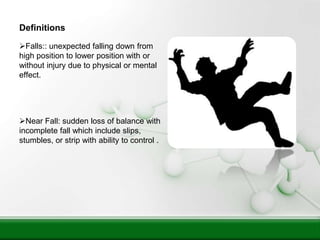
Falls:: unexpected falling down from
high position to lower position with or
without injury due to physical or mental
effect.
Near Fall: sudden loss of balance with
incomplete fall which include slips,
stumbles, or strip with ability to control .
Most Causing to Falls
Individual
• Loss of consciousness.
• Orthopedic disorders.
• Hypoglycemia.
• Anemia, Vision
• Hypotension.
• Drugs action.
• Post operative (sedation).
• Aging and sleeping habits
• Paralysis, TIA, CVA
Environmental
• Unsafe higher position.
• Beds side rails.
• unlocked wheel chair.
• Water in the floor.
• Wire connections.
• Steps or stairs.
• Walker.
• Interfering Clothes
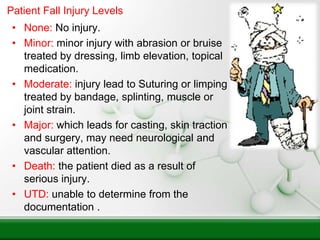
Patient Fall Injury Levels
• None: No injury.
• Minor: minor injury with abrasion or bruise
treated by dressing, limb elevation, topical
medication.
• Moderate: injury lead to Suturing or limping
treated by bandage, splinting, muscle or
joint strain.
• Major: which leads for casting, skin traction
and surgery, may need neurological and
vascular attention.
• Death: the patient died as a result of
serious injury.
• UTD: unable to determine from the
documentation .
• All in-patients will be assessed for the risk of fall upon admission.
• Reassessment is indicated for all of the following conditions:
- post operative.
- following procedural sedation.
- after administer medication.
- after blood transfusion.
- transferring patients between 2 units.
- after recording incident of fall.
- any changing in ambulatory status or elimination status,
• Applying Risk Fall procedure for patients
- Hendrich 11 Fall risk for Adults.
- Humpty Dumpty Scale for Pediatrics.
• Standard fall precaution shall be implemented for all patients.
• Reporting and documenting any fall occurrence.
• All Falls patients should be classified according to level of Injury
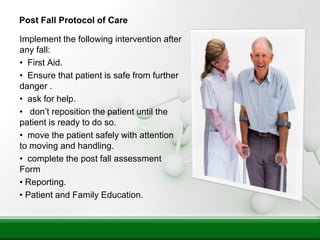
Post Fall Protocol of Care
Implement the following intervention after
any fall:
• First Aid.
• Ensure that patient is safe from further
danger .
• ask for help.
• don’t reposition the patient until the
patient is ready to do so.
• move the patient safely with attention
to moving and handling.
• complete the post fall assessment
Form
• Reporting.
• Patient and Family Education.
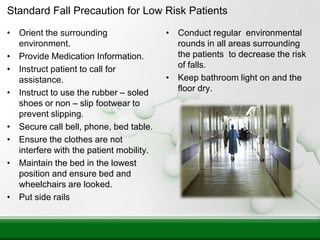
Standard Fall Precaution for Low Risk Patients
• Orient the surrounding
environment.
• Provide Medication Information.
• Instruct patient to call for
assistance.
• Instruct to use the rubber – soled
shoes or non – slip footwear to
prevent slipping.
• Secure call bell, phone, bed table.
• Ensure the clothes are not
interfere with the patient mobility.
• Maintain the bed in the lowest
position and ensure bed and
wheelchairs are looked.
• Put side rails
• Conduct regular environmental
rounds in all areas surrounding
the patients to decrease the risk
of falls.
• Keep bathroom light on and the
floor dry.
Standard Fall Precaution for Moderate Risk Patients
• Identify as falls risk on medical
record and include in shift
endorsement.
• Assist and supervise ambulation,
Reinforce to always call for
assistance.
• Conduct hourly safety checks.
• Perform regular pain assessment
• Offer assistance to the bathroom
or use bedpan hourly while
awake.
• Evaluate for reversible causes
- Orthostatic B.P
- Monitor Blood Sugar .
- Adequate Hydration
• Check the patients after the
visitors leave always.
• Don’t lower the bed side rails if
any nurse rise it up.
• Patient Education.
• Family Education.
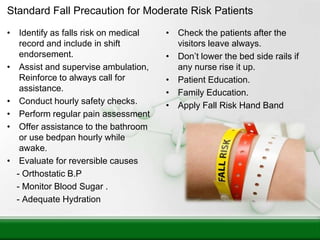
• Apply Fall Risk Hand Band
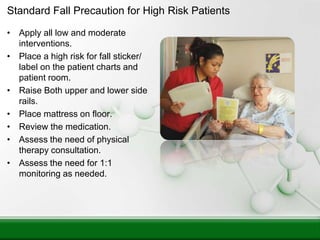
Standard Fall Precaution for High Risk Patients
• Apply all low and moderate
interventions.
• Place a high risk for fall sticker/
label on the patient charts and
patient room.
• Raise Both upper and lower side
rails.
• Place mattress on floor.
• Review the medication.
• Assess the need of physical
therapy consultation.
• Assess the need for 1:1
monitoring as needed.
Patient and Family Education
• Educate both about the risk of falling, Safety Issues, and their
Mobility Limitation.
• Teach patient to make position changes slowly.
• Emphasize how important the family to be involving tin the
patient safety.
• Emphasize on what patient can do to be healthy, active, and
independent
Questions & Answers
Thank you

Fall prevention

  • 1.
  • 2.
    Objectives  To maintainpatient safety.  To reduce the risk of injury.  To determine the way of the falls occurrence.  To implement fall prevention program
  • 3.
    Definitions Falls:: unexpected fallingdown from high position to lower position with or without injury due to physical or mental effect. Near Fall: sudden loss of balance with incomplete fall which include slips, stumbles, or strip with ability to control .
  • 4.
    Most Causing toFalls Individual • Loss of consciousness. • Orthopedic disorders. • Hypoglycemia. • Anemia, Vision • Hypotension. • Drugs action. • Post operative (sedation). • Aging and sleeping habits • Paralysis, TIA, CVA Environmental • Unsafe higher position. • Beds side rails. • unlocked wheel chair. • Water in the floor. • Wire connections. • Steps or stairs. • Walker. • Interfering Clothes
  • 5.
    Patient Fall InjuryLevels • None: No injury. • Minor: minor injury with abrasion or bruise treated by dressing, limb elevation, topical medication. • Moderate: injury lead to Suturing or limping treated by bandage, splinting, muscle or joint strain. • Major: which leads for casting, skin traction and surgery, may need neurological and vascular attention. • Death: the patient died as a result of serious injury. • UTD: unable to determine from the documentation .
  • 6.
    • All in-patientswill be assessed for the risk of fall upon admission. • Reassessment is indicated for all of the following conditions: - post operative. - following procedural sedation. - after administer medication. - after blood transfusion. - transferring patients between 2 units. - after recording incident of fall. - any changing in ambulatory status or elimination status, • Applying Risk Fall procedure for patients - Hendrich 11 Fall risk for Adults. - Humpty Dumpty Scale for Pediatrics. • Standard fall precaution shall be implemented for all patients. • Reporting and documenting any fall occurrence. • All Falls patients should be classified according to level of Injury
  • 7.
    Post Fall Protocolof Care Implement the following intervention after any fall: • First Aid. • Ensure that patient is safe from further danger . • ask for help. • don’t reposition the patient until the patient is ready to do so. • move the patient safely with attention to moving and handling. • complete the post fall assessment Form • Reporting. • Patient and Family Education.
  • 8.
    Standard Fall Precautionfor Low Risk Patients • Orient the surrounding environment. • Provide Medication Information. • Instruct patient to call for assistance. • Instruct to use the rubber – soled shoes or non – slip footwear to prevent slipping. • Secure call bell, phone, bed table. • Ensure the clothes are not interfere with the patient mobility. • Maintain the bed in the lowest position and ensure bed and wheelchairs are looked. • Put side rails • Conduct regular environmental rounds in all areas surrounding the patients to decrease the risk of falls. • Keep bathroom light on and the floor dry.
  • 9.
    Standard Fall Precautionfor Moderate Risk Patients • Identify as falls risk on medical record and include in shift endorsement. • Assist and supervise ambulation, Reinforce to always call for assistance. • Conduct hourly safety checks. • Perform regular pain assessment • Offer assistance to the bathroom or use bedpan hourly while awake. • Evaluate for reversible causes - Orthostatic B.P - Monitor Blood Sugar . - Adequate Hydration • Check the patients after the visitors leave always. • Don’t lower the bed side rails if any nurse rise it up. • Patient Education. • Family Education. • Apply Fall Risk Hand Band
  • 10.
    Standard Fall Precautionfor High Risk Patients • Apply all low and moderate interventions. • Place a high risk for fall sticker/ label on the patient charts and patient room. • Raise Both upper and lower side rails. • Place mattress on floor. • Review the medication. • Assess the need of physical therapy consultation. • Assess the need for 1:1 monitoring as needed.
  • 11.
    Patient and FamilyEducation • Educate both about the risk of falling, Safety Issues, and their Mobility Limitation. • Teach patient to make position changes slowly. • Emphasize how important the family to be involving tin the patient safety. • Emphasize on what patient can do to be healthy, active, and independent
  • 12.