EMS NC II
Triage is the prioritization of patient care (or victims
during a disaster) based on illness/injury, severity,
prognosis, and resource availability.
The term "triage" means sorting out. Medically, it's a
process used to prioritize who needs emergency medical
attention first, whether injured or sick people or disaster
survivors. Patients are triaged or prioritized according to
their need for emergency care.
What is the triage for emergency medicine?
Various criteria are taken into consideration,
including the patient's pulse, respiratory rate, capillary
refill time, presence of bleeding, and the patient's ability
to follow commands.
What is the triage system in EMS?
Triage is the sorting of patient's
treatment based on the severity of their
condition. This is an essential part of
responding to a mass casualty incident,
when limited resources need to be
allocated to maximize the number of
survivors.
Definition of MCI Triage
Triage means “to sort.” Triage in an MCI is the
assignment of resources based on the initial
patient assessment and consideration of
available resources.
What is an MCI?
• A mass casualty incident (MCI) is an incident
where the number of patients exceeds the
amount of healthcare resources available. •
This number varies widely across the country,
but is typically greater than 10 patients.
Types of MCI Notifications
•During a large scale incident such as a
mass casualty, it is important to have a
mass notification system. Successful mass
notification systems will
•Internally: alert staff to activate MCI
protocols and prepare for a potential surge
of patients
•Externally: increase community
awareness
Evidence-Based Triage and Assessment Tools
• START©: Simple Triage and Rapid Treatment
The START Triage System is intended for adults,
but may also be used for older children.
• JumpSTART© (Specific to pediatrics) Pediatric
Mass Casualty Incident (MCI) Triage Tool
• SALT Triage MCI Tool Sort, assess, life-saving
care, treatment/transport
• AVPU Assessment Tool Alert, Voice, Pain,
Unresponsive
SALT MCI Triage Tool Used primarily on scene
Sort - Sort based on whether victim can walk,
wave, or is still
Assess – Complete an individual assessment to
determine need for any lifesaving interventions
Lifesaving interventions – Control
hemorrhage, open airway, etc. and follow
algorithm
Treatment and/ or transport
SALT Triage
The sort, assess, life-saving interventions, and triage/treatment
approach is similar to the START system; however, it is more
comprehensive and adds simple life-saving techniques during
the triage phase.
• SORT: sort the walking, waving, and still. This can be achieved
by asking everyone at the scene to walk to a designated
casualty collection point similar to the START method; however,
this is followed by asking to wave an arm or leg if they need
help. Those who cannot move or follow commands should be
assessed first.
• ASSESSMENT: assessment and life-saving interventions go
hand in hand. When you assess a victim and find life-
threatening injuries, you should intervene.
SALT TRIAGE
• LIFE-SAVING INTERVENTIONS: simple
techniques such as controlling major hemorrhage,
opening airways, needle decompression, and auto-
injector antidotes should be performed as long as
it is not time intensive. Once performed, the
provider should assign a color-coded tag similar to
the START system and move onto the next patient
to ensure the forward flow of patients.
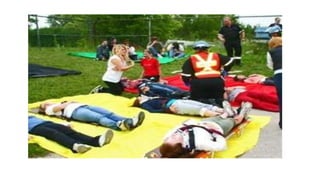
• TREATMENT AND TRANSPORT: Once tagged,
patients will be moved to the designated casualty
collection point for transport by emergency
management services to receiving facilities
Four main categories based on
injury severity:
• BLACK: (Deceased/expectant) injuries incompatible with
life or without spontaneous respiration; should not be
moved forward to the collection point
• RED: (Immediate) severe injuries but high potential for
survival with treatment; taken to collection point first
• YELLOW: (Delayed) serious injuries but not immediately
life-threatening
• GREEN: (Walking wounded) minor injuries
Classify victims according to these care and
transportation priorities:
1.Immediate care: the victim has life-threatening injuries but
can be saved. Airway or breathing difficulties (not breathing or
breathing rate faster than 30 per minute) Weak or no pulse
Uncontrolled or severe bleeding Unresponsive or unconscious
2.Urgent care: victims not fitting into the immediate or delayed
categories. Care and transportation can be delayed up to one
hour.
3.Delayed care: victims with minor injuries. Care and
transportation can be delayed up to three hours.
4.Dead: victims are obviously dead, mortally wounded, or unlikely
to survive because of the extent of their injuries, age, and
medical condition. Do not become involved in treating the
victims at this point, but ask knowledgeable bystanders to care
for immediate life-threatening problems (i.e., rescue breathing,
bleeding control).
START: Step 1
Triage officer announces that all patients that can walk
should get up and walk to a designated area for eventual
secondary triage.
All ambulatory patients are initially tagged as Green.
START: Step 2
1. Triage officer assesses patients in the order in which they
are encountered
2. Assess for presence or absence of spontaneous respirations
3. If breathing, move to Step 3
4. If apneic, open airway
5. If patient remains apneic, tag as Black
6. If patient starts breathing, tag as Red
START: Step 3
1. Assess respiratory rate
2. If ≤30, proceed to Step 4
3. If > 30, tag patient as Red
START: Step 4
1. Assess capillary refill
2. If ≤ 2 seconds, move to Step 5
3. If > 2 seconds, tag as Red
START: Step 5
1. Assess mental status
2. If able to obey commands, tag as Yellow
3. If unable to obey commands, tag as Red
Triage Considerations
There are three types of triage:
• Primary. Performed at the first encounter with the patient.
May be done by EMS, first responders, or hospital staff.
• Secondary. Reevaluation of primary triage after additional
assessment and/or interventions. Often used at the
hospital to prioritize patients for operative care or advanced
studies, but should be conducted on the scene, if transport
is delayed.
• Tertiary. Performed during ongoing definitive care.
• Patients may arrive on foot or via non-EMS transport
and require primary triage at the hospital.
What is ABCDE in triage?
“ABCDE” stands for Airway, Breathing, Circulation,
Disability, and Exposure. First, life-threatening airway
problems are assessed and treated; second, life-threatening
breathing problems are assessed and treated; and so on.
Using this structured approach, the aim is to quickly identify
life-threatening problems and institute treatment to correct
them.
Often, assistance will be required from emergency medical
services, a specialist, or a hospital response team (e.g.,
medical emergency team or cardiac arrest team). The
ABCDE approach helps to rapidly recognize the need for
assistance. Responders should call for help as soon as
possible and exploit the resources of all persons present to
increase the speed of both assessment and treatment.
Improved outcome is most often based on a team effort.
• The triage colors may be assigned by giving triage tags
to patients or simply by physically sorting patients into
different designated areas. (see the algorithm
below) "Green" patients are assigned by asking all
victims who can walk to a designated area. All non-
ambulatory patients are then assessed. Black tags
are assigned to victims who are not breathing even
after attempts to open the airway. Red tags are
assigned to any victim with the following:
• Respiratory rate greater than 30
• Absent radial pulse or cap refill greater than 2 sec
• Unable to follow simple commands

EMS NC II triage.pptxpppppppppppppppppppppppppp

  • 1.
  • 2.
    Triage is theprioritization of patient care (or victims during a disaster) based on illness/injury, severity, prognosis, and resource availability. The term "triage" means sorting out. Medically, it's a process used to prioritize who needs emergency medical attention first, whether injured or sick people or disaster survivors. Patients are triaged or prioritized according to their need for emergency care. What is the triage for emergency medicine? Various criteria are taken into consideration, including the patient's pulse, respiratory rate, capillary refill time, presence of bleeding, and the patient's ability to follow commands.
  • 3.
    What is thetriage system in EMS? Triage is the sorting of patient's treatment based on the severity of their condition. This is an essential part of responding to a mass casualty incident, when limited resources need to be allocated to maximize the number of survivors.
  • 4.
    Definition of MCITriage Triage means “to sort.” Triage in an MCI is the assignment of resources based on the initial patient assessment and consideration of available resources. What is an MCI? • A mass casualty incident (MCI) is an incident where the number of patients exceeds the amount of healthcare resources available. • This number varies widely across the country, but is typically greater than 10 patients.
  • 5.
    Types of MCINotifications •During a large scale incident such as a mass casualty, it is important to have a mass notification system. Successful mass notification systems will •Internally: alert staff to activate MCI protocols and prepare for a potential surge of patients •Externally: increase community awareness
  • 6.
    Evidence-Based Triage andAssessment Tools • START©: Simple Triage and Rapid Treatment The START Triage System is intended for adults, but may also be used for older children. • JumpSTART© (Specific to pediatrics) Pediatric Mass Casualty Incident (MCI) Triage Tool • SALT Triage MCI Tool Sort, assess, life-saving care, treatment/transport • AVPU Assessment Tool Alert, Voice, Pain, Unresponsive
  • 7.
    SALT MCI TriageTool Used primarily on scene Sort - Sort based on whether victim can walk, wave, or is still Assess – Complete an individual assessment to determine need for any lifesaving interventions Lifesaving interventions – Control hemorrhage, open airway, etc. and follow algorithm Treatment and/ or transport
  • 8.
    SALT Triage The sort,assess, life-saving interventions, and triage/treatment approach is similar to the START system; however, it is more comprehensive and adds simple life-saving techniques during the triage phase. • SORT: sort the walking, waving, and still. This can be achieved by asking everyone at the scene to walk to a designated casualty collection point similar to the START method; however, this is followed by asking to wave an arm or leg if they need help. Those who cannot move or follow commands should be assessed first. • ASSESSMENT: assessment and life-saving interventions go hand in hand. When you assess a victim and find life- threatening injuries, you should intervene.
  • 9.
    SALT TRIAGE • LIFE-SAVINGINTERVENTIONS: simple techniques such as controlling major hemorrhage, opening airways, needle decompression, and auto- injector antidotes should be performed as long as it is not time intensive. Once performed, the provider should assign a color-coded tag similar to the START system and move onto the next patient to ensure the forward flow of patients. • TREATMENT AND TRANSPORT: Once tagged, patients will be moved to the designated casualty collection point for transport by emergency management services to receiving facilities
  • 10.
    Four main categoriesbased on injury severity: • BLACK: (Deceased/expectant) injuries incompatible with life or without spontaneous respiration; should not be moved forward to the collection point • RED: (Immediate) severe injuries but high potential for survival with treatment; taken to collection point first • YELLOW: (Delayed) serious injuries but not immediately life-threatening • GREEN: (Walking wounded) minor injuries
  • 15.
    Classify victims accordingto these care and transportation priorities: 1.Immediate care: the victim has life-threatening injuries but can be saved. Airway or breathing difficulties (not breathing or breathing rate faster than 30 per minute) Weak or no pulse Uncontrolled or severe bleeding Unresponsive or unconscious 2.Urgent care: victims not fitting into the immediate or delayed categories. Care and transportation can be delayed up to one hour. 3.Delayed care: victims with minor injuries. Care and transportation can be delayed up to three hours. 4.Dead: victims are obviously dead, mortally wounded, or unlikely to survive because of the extent of their injuries, age, and medical condition. Do not become involved in treating the victims at this point, but ask knowledgeable bystanders to care for immediate life-threatening problems (i.e., rescue breathing, bleeding control).
  • 17.
    START: Step 1 Triageofficer announces that all patients that can walk should get up and walk to a designated area for eventual secondary triage. All ambulatory patients are initially tagged as Green. START: Step 2 1. Triage officer assesses patients in the order in which they are encountered 2. Assess for presence or absence of spontaneous respirations 3. If breathing, move to Step 3 4. If apneic, open airway 5. If patient remains apneic, tag as Black 6. If patient starts breathing, tag as Red
  • 18.
    START: Step 3 1.Assess respiratory rate 2. If ≤30, proceed to Step 4 3. If > 30, tag patient as Red START: Step 4 1. Assess capillary refill 2. If ≤ 2 seconds, move to Step 5 3. If > 2 seconds, tag as Red START: Step 5 1. Assess mental status 2. If able to obey commands, tag as Yellow 3. If unable to obey commands, tag as Red
  • 19.
    Triage Considerations There arethree types of triage: • Primary. Performed at the first encounter with the patient. May be done by EMS, first responders, or hospital staff. • Secondary. Reevaluation of primary triage after additional assessment and/or interventions. Often used at the hospital to prioritize patients for operative care or advanced studies, but should be conducted on the scene, if transport is delayed. • Tertiary. Performed during ongoing definitive care. • Patients may arrive on foot or via non-EMS transport and require primary triage at the hospital.
  • 20.
    What is ABCDEin triage? “ABCDE” stands for Airway, Breathing, Circulation, Disability, and Exposure. First, life-threatening airway problems are assessed and treated; second, life-threatening breathing problems are assessed and treated; and so on. Using this structured approach, the aim is to quickly identify life-threatening problems and institute treatment to correct them. Often, assistance will be required from emergency medical services, a specialist, or a hospital response team (e.g., medical emergency team or cardiac arrest team). The ABCDE approach helps to rapidly recognize the need for assistance. Responders should call for help as soon as possible and exploit the resources of all persons present to increase the speed of both assessment and treatment. Improved outcome is most often based on a team effort.
  • 23.
    • The triagecolors may be assigned by giving triage tags to patients or simply by physically sorting patients into different designated areas. (see the algorithm below) "Green" patients are assigned by asking all victims who can walk to a designated area. All non- ambulatory patients are then assessed. Black tags are assigned to victims who are not breathing even after attempts to open the airway. Red tags are assigned to any victim with the following: • Respiratory rate greater than 30 • Absent radial pulse or cap refill greater than 2 sec • Unable to follow simple commands