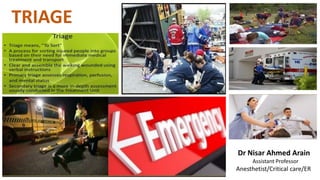
TRIAGE
Dr Nisar Ahmed Arain
Assistant Professor
Anesthetist/Critical care/ER
DEFINATION OF TRIAGE
-Triage is the term derived from French verb “Trier”
meaning to sort or to choose
-It is the process by which patients are
classified according to the
Type and Urgency
of their conditions to get the
Right patient to Right place
at the Right time with
Right care provider
TRIAGE
OBJECTIVES OF TRIAGE PROTOCOL
-1-Identifying the patient
-2-Identifying the priority of the patients
need for medical treatment and
transport from the emergency scene
-3-Track the patients progress through the
triage process
-4-Identify additional Hazards such as
contamination
TYPES OF TRIAGE
-1-Simple Triage
-2-Advanced Triage
-3-Continuous Integrated Triage
-4-Reverse Triage
-5-Under Triage or Over Triage
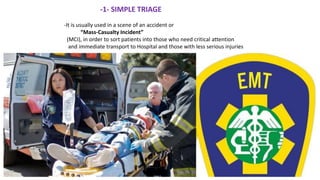
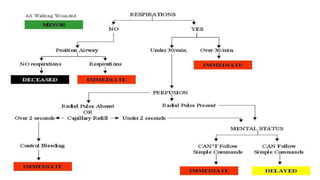
-1- SIMPLE TRIAGE
-It is usually used in a scene of an accident or
“Mass-Casualty Incident”
(MCI), in order to sort patients into those who need critical attention
and immediate transport to Hospital and those with less serious injuries
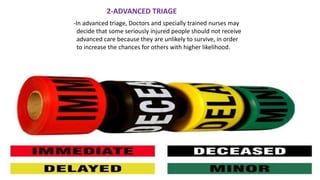
2-ADVANCED TRIAGE
-In advanced triage, Doctors and specially trained nurses may
decide that some seriously injured people should not receive
advanced care because they are unlikely to survive, in order
to increase the chances for others with higher likelihood.
-3-CONTINUOUS INTEGRATED TRIAGE
-It is an approach to triage in mass casualty. It combines
three forms of triage with progressive specificity and
to identify those patients who are in greatest need
of care while balancing the needs of the individual
Patients against the available resources. Continuous
integrated Triage employs
a-Group triage
b-Individual triage
c-Hospital Triage
-4-REVERSE TRIAGE
-This process of Triage can applied to discharging patients early
when the Medical system is stressed
-During a “surge” in demand, such as immediately after a natural
disaster, many Hospital beds will be occupied by regular
noncritical patients.
-In order to accommodate a greater number of the new critical
patients, the existing patients may be Triaged, and those who
will not need immediate care can be discharged.
5-UNDER TRIAGE
-It is the underestimating the severity of an illness or
an injury. An example of this would be categorizing as
a-Priority-1 (Immediate)
b-Priority-2 (Delayed)
c-Priority-3 (Minimal)
-It is overestimating of the severity of the illness or injury
An example this would be categorizing as.
-1-Priority-1 (Minimal)
-2-Priority-2 (Delayed)
-3-Priority-3 (Minimal)
6-OVER TRIAGE
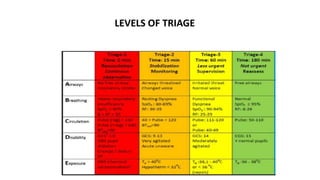
LEVELS OF TRIAGE
-1- RED (Resuscitation) Threat to LIFE
-1-Time of Assessment immediately
Characteristics
-Obstructed airway
-SpO2 < 80
-Respiratory Rate >35 OR < 3
-Heart Rate > 130
-BP sys < 80
-GCS < 8
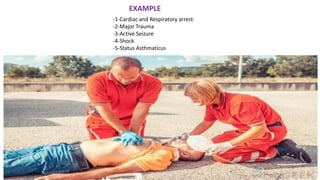
EXAMPLE
-1-Cardiac and Respiratory arrest
-2-Major Trauma
-3-Active Seizure
-4-Shock
-5-Status Asthmaticus
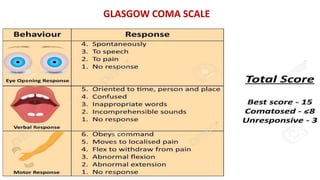
GLASGOW COMA SCALE
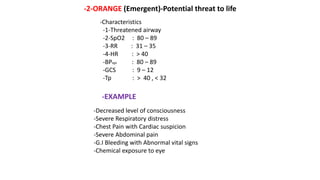
-2-ORANGE (Emergent)-Potential threat to life
-Characteristics
-1-Threatened airway
-2-SpO2 : 80 – 89
-3-RR : 31 – 35
-4-HR : > 40
-BPsys : 80 – 89
-GCS : 9 – 12
-Tp : > 40 , < 32
-EXAMPLE
-Decreased level of consciousness
-Severe Respiratory distress
-Chest Pain with Cardiac suspicion
-Severe Abdominal pain
-G.I Bleeding with Abnormal vital signs
-Chemical exposure to eye
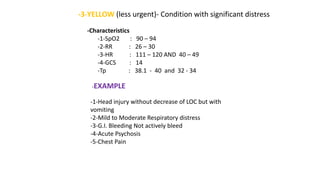
-3-YELLOW (less urgent)- Condition with significant distress
-Characteristics
-1-SpO2 : 90 – 94
-2-RR : 26 – 30
-3-HR : 111 – 120 AND 40 – 49
-4-GCS : 14
-Tp : 38.1 - 40 and 32 - 34
-EXAMPLE
-1-Head injury without decrease of LOC but with
vomiting
-2-Mild to Moderate Respiratory distress
-3-G.I. Bleeding Not actively bleed
-4-Acute Psychosis
-5-Chest Pain
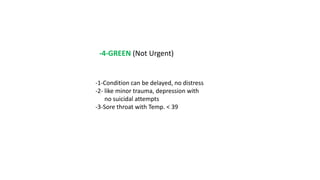
-4-GREEN (Not Urgent)
-1-Condition can be delayed, no distress
-2- like minor trauma, depression with
no suicidal attempts
-3-Sore throat with Temp. < 39
LEVELS OF TRIAGE
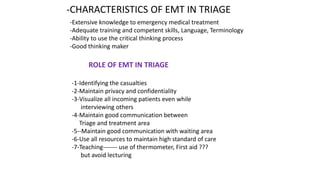
-CHARACTERISTICS OF EMT IN TRIAGE
-Extensive knowledge to emergency medical treatment
-Adequate training and competent skills, Language, Terminology
-Ability to use the critical thinking process
-Good thinking maker
ROLE OF EMT IN TRIAGE
-1-Identifying the casualties
-2-Maintain privacy and confidentiality
-3-Visualize all incoming patients even while
interviewing others
-4-Maintain good communication between
Triage and treatment area
-5--Maintain good communication with waiting area
-6-Use all resources to maintain high standard of care
-7-Teaching------- use of thermometer, First aid ???
but avoid lecturing
Triage

Triage

  • 1.
    TRIAGE Dr Nisar AhmedArain Assistant Professor Anesthetist/Critical care/ER
  • 2.
    DEFINATION OF TRIAGE -Triageis the term derived from French verb “Trier” meaning to sort or to choose
  • 3.
    -It is theprocess by which patients are classified according to the Type and Urgency of their conditions to get the Right patient to Right place at the Right time with Right care provider TRIAGE
  • 4.
    OBJECTIVES OF TRIAGEPROTOCOL -1-Identifying the patient -2-Identifying the priority of the patients need for medical treatment and transport from the emergency scene -3-Track the patients progress through the triage process -4-Identify additional Hazards such as contamination
  • 5.
    TYPES OF TRIAGE -1-SimpleTriage -2-Advanced Triage -3-Continuous Integrated Triage -4-Reverse Triage -5-Under Triage or Over Triage
  • 6.
    -1- SIMPLE TRIAGE -Itis usually used in a scene of an accident or “Mass-Casualty Incident” (MCI), in order to sort patients into those who need critical attention and immediate transport to Hospital and those with less serious injuries
  • 7.
    2-ADVANCED TRIAGE -In advancedtriage, Doctors and specially trained nurses may decide that some seriously injured people should not receive advanced care because they are unlikely to survive, in order to increase the chances for others with higher likelihood.
  • 8.
    -3-CONTINUOUS INTEGRATED TRIAGE -Itis an approach to triage in mass casualty. It combines three forms of triage with progressive specificity and to identify those patients who are in greatest need of care while balancing the needs of the individual Patients against the available resources. Continuous integrated Triage employs a-Group triage b-Individual triage c-Hospital Triage
  • 9.
    -4-REVERSE TRIAGE -This processof Triage can applied to discharging patients early when the Medical system is stressed -During a “surge” in demand, such as immediately after a natural disaster, many Hospital beds will be occupied by regular noncritical patients. -In order to accommodate a greater number of the new critical patients, the existing patients may be Triaged, and those who will not need immediate care can be discharged. 5-UNDER TRIAGE -It is the underestimating the severity of an illness or an injury. An example of this would be categorizing as a-Priority-1 (Immediate) b-Priority-2 (Delayed) c-Priority-3 (Minimal)
  • 10.
    -It is overestimatingof the severity of the illness or injury An example this would be categorizing as. -1-Priority-1 (Minimal) -2-Priority-2 (Delayed) -3-Priority-3 (Minimal) 6-OVER TRIAGE
  • 11.
    LEVELS OF TRIAGE -1-RED (Resuscitation) Threat to LIFE -1-Time of Assessment immediately Characteristics -Obstructed airway -SpO2 < 80 -Respiratory Rate >35 OR < 3 -Heart Rate > 130 -BP sys < 80 -GCS < 8
  • 12.
    EXAMPLE -1-Cardiac and Respiratoryarrest -2-Major Trauma -3-Active Seizure -4-Shock -5-Status Asthmaticus
  • 13.
  • 14.
    -2-ORANGE (Emergent)-Potential threatto life -Characteristics -1-Threatened airway -2-SpO2 : 80 – 89 -3-RR : 31 – 35 -4-HR : > 40 -BPsys : 80 – 89 -GCS : 9 – 12 -Tp : > 40 , < 32 -EXAMPLE -Decreased level of consciousness -Severe Respiratory distress -Chest Pain with Cardiac suspicion -Severe Abdominal pain -G.I Bleeding with Abnormal vital signs -Chemical exposure to eye
  • 15.
    -3-YELLOW (less urgent)-Condition with significant distress -Characteristics -1-SpO2 : 90 – 94 -2-RR : 26 – 30 -3-HR : 111 – 120 AND 40 – 49 -4-GCS : 14 -Tp : 38.1 - 40 and 32 - 34 -EXAMPLE -1-Head injury without decrease of LOC but with vomiting -2-Mild to Moderate Respiratory distress -3-G.I. Bleeding Not actively bleed -4-Acute Psychosis -5-Chest Pain
  • 16.
    -4-GREEN (Not Urgent) -1-Conditioncan be delayed, no distress -2- like minor trauma, depression with no suicidal attempts -3-Sore throat with Temp. < 39
  • 17.
  • 19.
    -CHARACTERISTICS OF EMTIN TRIAGE -Extensive knowledge to emergency medical treatment -Adequate training and competent skills, Language, Terminology -Ability to use the critical thinking process -Good thinking maker ROLE OF EMT IN TRIAGE -1-Identifying the casualties -2-Maintain privacy and confidentiality -3-Visualize all incoming patients even while interviewing others -4-Maintain good communication between Triage and treatment area -5--Maintain good communication with waiting area -6-Use all resources to maintain high standard of care -7-Teaching------- use of thermometer, First aid ??? but avoid lecturing