My
Quality Indicators in EM
Ahmed Kamal
Consultant in Emergency Medicine
South Wales -UK
Egyptian Critical Care Summit 12-15
January 2015 - Cairo
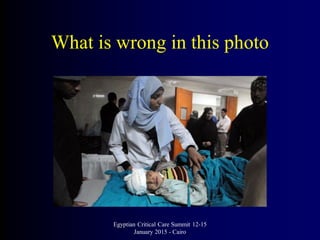
What is wrong in this photo
Egyptian Critical Care Summit 12-15
January 2015 - Cairo
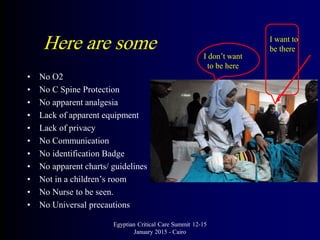
Here are some
• No O2
• No C Spine Protection
• No apparent analgesia
• Lack of apparent equipment
• Lack of privacy
• No Communication
• No identification Badge
• No apparent charts/ guidelines
• Not in a children’s room
• No Nurse to be seen.
• No Universal precautions
Egyptian Critical Care Summit 12-15
January 2015 - Cairo
I don’t want
to be here
I want to
be there
Why Quality Indicators
• 1. Unbiased objective analysis of performance.
• 2. Evidence of performance against difficulties.
• 3. An Indication of the performance of:
– Whole Hospital
– Organisation
– Health Care System
• 4. For Bench marking
Egyptian Critical Care Summit 12-15
January 2015 - Cairo
Influence
Change
Good Emergency care
• 1. Available 24 hours / 7 days a week in an
appropriate environment.
• 2. Easy to access & Convenient.
• 3. Is Patient – Focused.
• 4. Timely and consistent.
Egyptian Critical Care Summit 12-15
January 2015 - Cairo
Good Emergency care
• 5. Right first time.
• 6. Delivers Excellent clinical outcomes including:
– Recovery
– Survival
– Lack of adverse events
• 7. Delivers a good Pt Experience.
Egyptian Critical Care Summit 12-15
January 2015 - Cairo
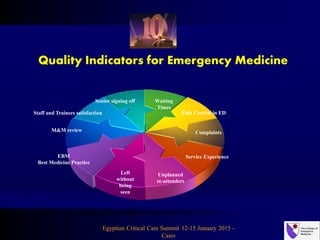
Quality Indicators for Emergency Medicine
Waiting
Times
Pain Control in ED
M&M review
Staff and Trainees satisfaction
Complaints
Left
without
being
seen
Service ExperienceEBM
Best Medicine Practice
Unplanned
re-attenders
Senior signing off
Egyptian Critical Care Summit 12-15 January 2015 -
Cairo
Waiting
Times
TEXT 2
TEXT 8
TEXT 9
TEXT 3
TEXT 6
TEXT 4TEXT 7
TEXT 5
TEXT 10
1. Waiting Times
Egyptian Critical Care Summit 12-15 January 2015 - Cairo
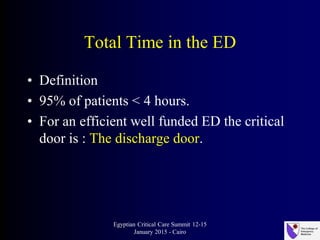
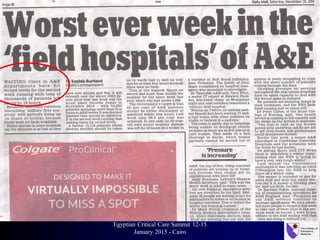
Total Time in the ED
• Definition
• 95% of patients < 4 hours.
• For an efficient well funded ED the critical
door is : The discharge door.
Egyptian Critical Care Summit 12-15
January 2015 - Cairo
Egyptian Critical Care Summit 12-15
January 2015 - Cairo
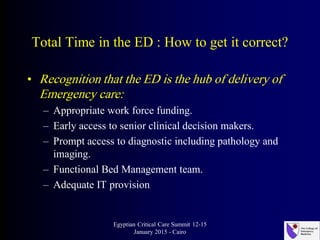
Total Time in the ED : How to get it correct?
• Recognition that the ED is the hub of delivery of
Emergency care:
– Appropriate work force funding.
– Early access to senior clinical decision makers.
– Prompt access to diagnostic including pathology and
imaging.
– Functional Bed Management team.
– Adequate IT provision
Egyptian Critical Care Summit 12-15
January 2015 - Cairo
Waiting Times
Egyptian Critical Care Summit 12-15
January 2015 - Cairo
60.00%
65.00%
70.00%
75.00%
80.00%
85.00%
90.00%
95.00%
100.00%
08/12/14
09/12/14
10/12/14
11/12/14
12/12/14
13/12/14
14/12/14
15/12/14
16/12/14
17/12/14
18/12/14
19/12/14
20/12/14
21/12/14
22/12/14
%PerformanceAchieved
Day
RGH 4 Hour Waits
4Hr % Achieved
4 Hour Target
Total Time in the ED
Failure to achieve the target should trigger an
intervention.
Egyptian Critical Care Summit 12-15
January 2015 - Cairo
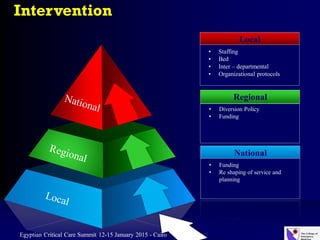
• Staffing
• Bed
• Inter – departmental
• Organizational protocols
Local
• Diversion Policy
• Funding
Regional
• Funding
• Re shaping of service and
planning
National
Intervention
Egyptian Critical Care Summit 12-15 January 2015 - Cairo
Total Time in the ED : Challenges
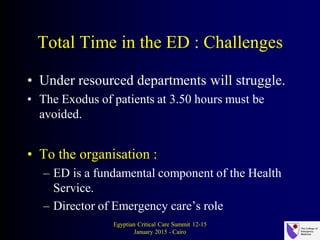
• Under resourced departments will struggle.
• The Exodus of patients at 3.50 hours must be
avoided.
• To the organisation :
– ED is a fundamental component of the Health
Service.
– Director of Emergency care’s role
Egyptian Critical Care Summit 12-15
January 2015 - Cairo
Other relevant Times
• Time to initial assessment
• Time to Treatment
Egyptian Critical Care Summit 12-15
January 2015 - Cairo
TEXT 1
Pain
Control
TEXT 8
TEXT 9
TEXT 3
TEXT 4TEXT 7
TEXT 5
TEXT 10
TEXT 6
2. Pain Control in ED
Egyptian Critical Care Summit 12-15 January
2015 - Cairo
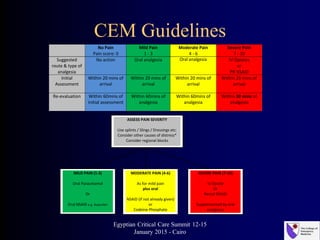
CEM Guidelines
Algorithm for treatment of undifferentiated acute pain in the Emergency
Department
MODERATE PAIN (4-6)
As for mild pain
plus oral
NSAID (if not already given)
or
SEVERE PAIN (7-10)
IV Opiate
Or
Rectal NSAID
Supplemented by oral
MILD PAIN (1-3)
Oral Paracetamol
Or
Oral NSAID e.g. ibuprofen
ASSESS PAIN SEVERITY
Use splints / Slings / Dressings etc.
Consider other causes of distress*
Consider regional blocks
No Pain
Pain score: 0
Mild Pain
1 - 3
Moderate Pain
4 - 6
Severe Pain
7 - 10
Suggested
route & type of
analgesia
No action Oral analgesia Oral analgesia IV Opiates
or
PR NSAID
Initial
Assessment
Within 20 mins of
arrival
Within 20 mins of
arrival
Within 20 mins of
arrival
Within 20 mins of
arrival
Re-evaluation Within 60mins of
initial assessment
Within 60mins of
analgesia
Within 60mins of
analgesia
Within 30 mins of
analgesia
Egyptian Critical Care Summit 12-15
January 2015 - Cairo
Algorithm for treatment of undifferentiated acute pain in the Emergency
Department
*Other causes of distress include: fear of the unfamiliar environment, needle phobia, fear of injury severity etc.
MODERATE PAIN (4-6)
As for mild pain
plus oral
NSAID (if not already given)
or
Codeine Phosphate
A
s
f
o
SEVERE PAIN (7-10)
IV Opiate
Or
Rectal NSAID
Supplemented by oral
analgesics
MILD PAIN (1-3)
Oral Paracetamol
Or
Oral NSAID e.g. ibuprofen
ASSESS PAIN SEVERITY
Use splints / Slings / Dressings etc.
Consider other causes of distress*
Consider regional blocks
No Pain
Pain score: 0
Mild Pain
1 - 3
Moderate Pain
4 - 6
Severe Pain
7 - 10
Suggested
route & type of
analgesia
No action Oral analgesia Oral analgesia IV Opiates
or
PR NSAID
Initial
Assessment
Within 20 mins of
arrival
Within 20 mins of
arrival
Within 20 mins of
arrival
Within 20 mins of
arrival
Re-evaluation Within 60mins of
initial assessment
Within 60mins of
analgesia
Within 60mins of
analgesia
Within 30 mins of
analgesia
2. Pain Control in ED
• Triage
• Audits
• Teaching
Egyptian Critical Care Summit 12-15
January 2015 - Cairo
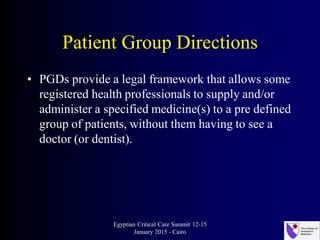
Patient Group Directions
• PGDs provide a legal framework that allows some
registered health professionals to supply and/or
administer a specified medicine(s) to a pre defined
group of patients, without them having to see a
doctor (or dentist).
Egyptian Critical Care Summit 12-15
January 2015 - Cairo
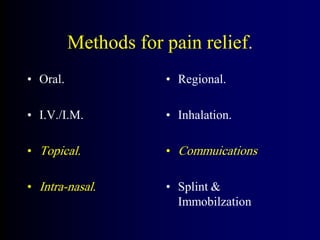
Methods for pain relief.
• Oral.
• I.V./I.M.
• Topical.
• Intra-nasal.
• Regional.
• Inhalation.
• Commuications
• Splint &
Immobilzation
TEXT 1
TEXT 2
TEXT 8
TEXT 9
Complaints
TEXT 4TEXT 7
TEXT 5
TEXT 10
TEXT 6
3. Complaints
Egyptian Critical Care Summit 12-15 January
2015 - Cairo
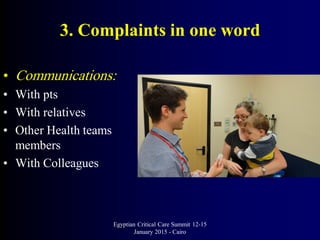
3. Complaints in one word
• Communications:
• With pts
• With relatives
• Other Health teams
members
• With Colleagues
Egyptian Critical Care Summit 12-15
January 2015 - Cairo
3.Complaints
• Number and Nature
• System for :
– Receive
– Address
– Respond to
• Act on findings.
Egyptian Critical Care Summit 12-15
January 2015 - Cairo
}Within a specific time frame
TEXT 1
TEXT 2
TEXT 8
TEXT 9
TEXT 3
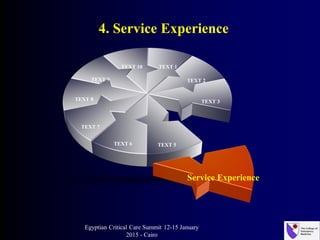
Service Experience
TEXT 7
TEXT 5
TEXT 10
TEXT 6
4. Service Experience
Egyptian Critical Care Summit 12-15 January
2015 - Cairo
Service Experience ( SE)
• Is not : A patient satisfactory indicator
• Asks specific questions:
– Cleanliness
– Communication
• Reflects the 24 hours of overall (SE).
• May also include carers and staff perception of
service
• Requires data collection and analysis regularly
Egyptian Critical Care Summit 12-15
January 2015 - Cairo
Service Experience
Egyptian Critical Care Summit 12-15
January 2015 - Cairo
TEXT 1
TEXT 2
TEXT 8
TEXT 9
TEXT 3
TEXT 4TEXT 7
Unplanned
re-attenders
TEXT 10
TEXT 6
5. Unplanned Re attenders
Egyptian Critical Care Summit 12-15 January 2015 - Cairo
5. Unplanned re-attender
• Definition
• Relevance?
• Range of 1-5%
• % should not be 0% - Reason?
• Above 5% is an indication of poor quality of care.
• Guideline or protocol
Egyptian Critical Care Summit 12-15
January 2015 - Cairo
5. Unplanned re-attender
• System to Collect Data
• 2 Cohort of patients
– Single re-attenders
– Multiple re-attenders ( complex issues such as
Mental health or primary care)
Egyptian Critical Care Summit 12-15
January 2015 - Cairo
5. Unplanned re- attender
• Reasons – Multi factorial
– Misdiagnosis
– Getting worse
– Unrelated second condition
• Strategies to Manage the above two groups
on different ways
Egyptian Critical Care Summit 12-15
January 2015 - Cairo
TEXT 1
TEXT 2
TEXT 8
TEXT 9
TEXT 3
TEXT 4TEXT 7
TEXT 5
TEXT 10
Left
without
being
seen
6. Left without being seen
Egyptian Critical Care Summit 12-15
January 2015 - Cairo
6. Left without being seen
• Registered patients
• IT coding
• Multifactorial
• Relevance : Safety issues
• Should be < 5% of total annual attendance
number.
Egyptian Critical Care Summit 12-15
January 2015 - Cairo
6. Left without being seen
• Achieve <5% with:
– Prompt process
– Good pt Flow
– Good Pt communication
– Adequate staffing
Egyptian Critical Care Summit 12-15
January 2015 - Cairo
Did not wait Pt Management strategy
Dublin
O’Keefe EMJ July 2012
• 1 year study 2008
• 2872 (6.3 %) of total attendance - DNW
• Senior review of triage notes:
• 107 Pts (3.7 %) recall of Pts who DNW.
• Of those : 9.4% required Acute admission
Egyptian Critical Care Summit 12-15
January 2015 - Cairo
TEXT 1
TEXT 2
TEXT 8
TEXT 9
TEXT 3
TEXT 4
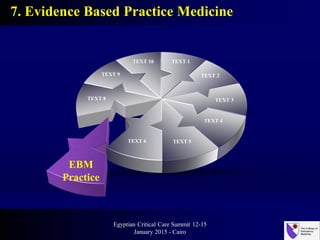
EBM
Practice
TEXT 5
TEXT 10
TEXT 6
7. Evidence Based Practice Medicine
Egyptian Critical Care Summit 12-15
January 2015 - Cairo
7. Evidence Base Medicine
practice
• Adherence to guidelines and protocols
– BTS Guidelines for Asthma
– ACS guidelines
– NICE guidelines for HI.
– NICE Guidelines to stroke
– Ottawa ankle and Knee rules.
• Audit
Egyptian Critical Care Summit 12-15
January 2015 - Cairo
TEXT 1
TEXT 2
M&M Review
TEXT 9
TEXT 3
TEXT 4
TEXT 7
TEXT 5
TEXT 10
TEXT 6
8. M&M review
Egyptian Critical Care Summit 12-
15 January 2015 - Cairo
M& M review
• Quarterly Clinical governance meeting.
• No blame culture.
• The Coroner’s power
• Measures to Minimise incidents:
– Audit presentations
– Teaching
– Bench marking
Egyptian Critical Care Summit 12-15
January 2015 - Cairo
TEXT 1
TEXT 2
TEXT 8
Staff & Trainees
Satisfaction
TEXT 3
TEXT 4TEXT 7
TEXT 5
TEXT 10
TEXT 6
9. Staff and Trainees satisfaction
Egyptian Critical Care Summit 12-15
January 2015 - Cairo
9 A. Trainees satisfaction
• Job Satisfaction Survey.
• Anonymous.
• Independently Assessed.
• Teaching ( Shop floor & protected teaching time).
• Clear and fair Career structure.
• Study leave.
• Salary.
Egyptian Critical Care Summit 12-15
January 2015 - Cairo
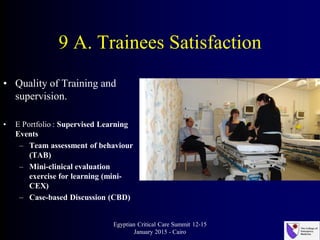
9 A. Trainees Satisfaction
• Quality of Training and
supervision.
• E Portfolio : Supervised Learning
Events
– Team assessment of behaviour
(TAB)
– Mini-clinical evaluation
exercise for learning (mini-
CEX)
– Case-based Discussion (CBD)
Egyptian Critical Care Summit 12-15
January 2015 - Cairo
9 B. Staff satisfaction
• Service experience
• Bullying at work
• Reasonable working conditions
Egyptian Critical Care Summit 12-15
January 2015 - Cairo
TEXT 1
TEXT 2
TEXT 8
TEXT 9
TEXT 3
TEXT 4TEXT 7
TEXT 5
Senior Sign
Off
TEXT 6
10. Senior Signing Off
Egyptian Critical Care Summit 12-15
January 2015 - Cairo
10. Senior ( ST4 or above)
sign -off
• Non Traumatic Chest pain.
• Febrile Illness < 1 year old
• Unscheduled return 9 with the same
complaint) with 72 hours.
• Head and spinal Injuries.
• Abdominal presentations.
Egyptian Critical Care Summit 12-15
January 2015 - Cairo
Horses for courses
• Juniors : Represent The Head of ED
• Head of ED: Answerable to CEO and to
Her Majesty's Coroner.
• CEO : Department of Health
Egyptian Critical Care Summit 12-15
January 2015 - Cairo
Requirement for success
• Realistic Funding
• Experienced EM
leadership
• Efficient and Dynamic
IT system
• Record Keeping system.
• Appropriate Coding &
Audit
• Guidelines and
Protocols endorsed by
the CEO
Egyptian Critical Care Summit 12-15
January 2015 - Cairo
& Finally
• QI should be used to support and not to
punish the ED
• Quality Indicators are useful tools only if
used to achieve a useful change.
Egyptian Critical Care Summit 12-15
January 2015 - Cairo
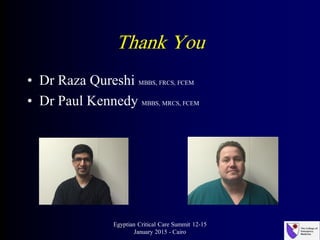
Thank You
• Dr Raza Qureshi MBBS, FRCS, FCEM
• Dr Paul Kennedy MBBS, MRCS, FCEM
Egyptian Critical Care Summit 12-15
January 2015 - Cairo

Quality Indicators in Emergency Medicine

  • 1.
    My Quality Indicators inEM Ahmed Kamal Consultant in Emergency Medicine South Wales -UK Egyptian Critical Care Summit 12-15 January 2015 - Cairo
  • 2.
    What is wrongin this photo Egyptian Critical Care Summit 12-15 January 2015 - Cairo
  • 3.
    Here are some •No O2 • No C Spine Protection • No apparent analgesia • Lack of apparent equipment • Lack of privacy • No Communication • No identification Badge • No apparent charts/ guidelines • Not in a children’s room • No Nurse to be seen. • No Universal precautions Egyptian Critical Care Summit 12-15 January 2015 - Cairo I don’t want to be here I want to be there
  • 4.
    Why Quality Indicators •1. Unbiased objective analysis of performance. • 2. Evidence of performance against difficulties. • 3. An Indication of the performance of: – Whole Hospital – Organisation – Health Care System • 4. For Bench marking Egyptian Critical Care Summit 12-15 January 2015 - Cairo Influence Change
  • 5.
    Good Emergency care •1. Available 24 hours / 7 days a week in an appropriate environment. • 2. Easy to access & Convenient. • 3. Is Patient – Focused. • 4. Timely and consistent. Egyptian Critical Care Summit 12-15 January 2015 - Cairo
  • 6.
    Good Emergency care •5. Right first time. • 6. Delivers Excellent clinical outcomes including: – Recovery – Survival – Lack of adverse events • 7. Delivers a good Pt Experience. Egyptian Critical Care Summit 12-15 January 2015 - Cairo
  • 7.
    Quality Indicators forEmergency Medicine Waiting Times Pain Control in ED M&M review Staff and Trainees satisfaction Complaints Left without being seen Service ExperienceEBM Best Medicine Practice Unplanned re-attenders Senior signing off Egyptian Critical Care Summit 12-15 January 2015 - Cairo
  • 8.
    Waiting Times TEXT 2 TEXT 8 TEXT9 TEXT 3 TEXT 6 TEXT 4TEXT 7 TEXT 5 TEXT 10 1. Waiting Times Egyptian Critical Care Summit 12-15 January 2015 - Cairo
  • 9.
    Total Time inthe ED • Definition • 95% of patients < 4 hours. • For an efficient well funded ED the critical door is : The discharge door. Egyptian Critical Care Summit 12-15 January 2015 - Cairo
  • 10.
    Egyptian Critical CareSummit 12-15 January 2015 - Cairo
  • 11.
    Total Time inthe ED : How to get it correct? • Recognition that the ED is the hub of delivery of Emergency care: – Appropriate work force funding. – Early access to senior clinical decision makers. – Prompt access to diagnostic including pathology and imaging. – Functional Bed Management team. – Adequate IT provision Egyptian Critical Care Summit 12-15 January 2015 - Cairo
  • 12.
    Waiting Times Egyptian CriticalCare Summit 12-15 January 2015 - Cairo 60.00% 65.00% 70.00% 75.00% 80.00% 85.00% 90.00% 95.00% 100.00% 08/12/14 09/12/14 10/12/14 11/12/14 12/12/14 13/12/14 14/12/14 15/12/14 16/12/14 17/12/14 18/12/14 19/12/14 20/12/14 21/12/14 22/12/14 %PerformanceAchieved Day RGH 4 Hour Waits 4Hr % Achieved 4 Hour Target
  • 13.
    Total Time inthe ED Failure to achieve the target should trigger an intervention. Egyptian Critical Care Summit 12-15 January 2015 - Cairo
  • 14.
    • Staffing • Bed •Inter – departmental • Organizational protocols Local • Diversion Policy • Funding Regional • Funding • Re shaping of service and planning National Intervention Egyptian Critical Care Summit 12-15 January 2015 - Cairo
  • 15.
    Total Time inthe ED : Challenges • Under resourced departments will struggle. • The Exodus of patients at 3.50 hours must be avoided. • To the organisation : – ED is a fundamental component of the Health Service. – Director of Emergency care’s role Egyptian Critical Care Summit 12-15 January 2015 - Cairo
  • 16.
    Other relevant Times •Time to initial assessment • Time to Treatment Egyptian Critical Care Summit 12-15 January 2015 - Cairo
  • 17.
    TEXT 1 Pain Control TEXT 8 TEXT9 TEXT 3 TEXT 4TEXT 7 TEXT 5 TEXT 10 TEXT 6 2. Pain Control in ED Egyptian Critical Care Summit 12-15 January 2015 - Cairo
  • 18.
    CEM Guidelines Algorithm fortreatment of undifferentiated acute pain in the Emergency Department MODERATE PAIN (4-6) As for mild pain plus oral NSAID (if not already given) or SEVERE PAIN (7-10) IV Opiate Or Rectal NSAID Supplemented by oral MILD PAIN (1-3) Oral Paracetamol Or Oral NSAID e.g. ibuprofen ASSESS PAIN SEVERITY Use splints / Slings / Dressings etc. Consider other causes of distress* Consider regional blocks No Pain Pain score: 0 Mild Pain 1 - 3 Moderate Pain 4 - 6 Severe Pain 7 - 10 Suggested route & type of analgesia No action Oral analgesia Oral analgesia IV Opiates or PR NSAID Initial Assessment Within 20 mins of arrival Within 20 mins of arrival Within 20 mins of arrival Within 20 mins of arrival Re-evaluation Within 60mins of initial assessment Within 60mins of analgesia Within 60mins of analgesia Within 30 mins of analgesia Egyptian Critical Care Summit 12-15 January 2015 - Cairo Algorithm for treatment of undifferentiated acute pain in the Emergency Department *Other causes of distress include: fear of the unfamiliar environment, needle phobia, fear of injury severity etc. MODERATE PAIN (4-6) As for mild pain plus oral NSAID (if not already given) or Codeine Phosphate A s f o SEVERE PAIN (7-10) IV Opiate Or Rectal NSAID Supplemented by oral analgesics MILD PAIN (1-3) Oral Paracetamol Or Oral NSAID e.g. ibuprofen ASSESS PAIN SEVERITY Use splints / Slings / Dressings etc. Consider other causes of distress* Consider regional blocks No Pain Pain score: 0 Mild Pain 1 - 3 Moderate Pain 4 - 6 Severe Pain 7 - 10 Suggested route & type of analgesia No action Oral analgesia Oral analgesia IV Opiates or PR NSAID Initial Assessment Within 20 mins of arrival Within 20 mins of arrival Within 20 mins of arrival Within 20 mins of arrival Re-evaluation Within 60mins of initial assessment Within 60mins of analgesia Within 60mins of analgesia Within 30 mins of analgesia
  • 19.
    2. Pain Controlin ED • Triage • Audits • Teaching Egyptian Critical Care Summit 12-15 January 2015 - Cairo
  • 20.
    Patient Group Directions •PGDs provide a legal framework that allows some registered health professionals to supply and/or administer a specified medicine(s) to a pre defined group of patients, without them having to see a doctor (or dentist). Egyptian Critical Care Summit 12-15 January 2015 - Cairo
  • 21.
    Methods for painrelief. • Oral. • I.V./I.M. • Topical. • Intra-nasal. • Regional. • Inhalation. • Commuications • Splint & Immobilzation
  • 22.
    TEXT 1 TEXT 2 TEXT8 TEXT 9 Complaints TEXT 4TEXT 7 TEXT 5 TEXT 10 TEXT 6 3. Complaints Egyptian Critical Care Summit 12-15 January 2015 - Cairo
  • 23.
    3. Complaints inone word • Communications: • With pts • With relatives • Other Health teams members • With Colleagues Egyptian Critical Care Summit 12-15 January 2015 - Cairo
  • 24.
    3.Complaints • Number andNature • System for : – Receive – Address – Respond to • Act on findings. Egyptian Critical Care Summit 12-15 January 2015 - Cairo }Within a specific time frame
  • 25.
    TEXT 1 TEXT 2 TEXT8 TEXT 9 TEXT 3 Service Experience TEXT 7 TEXT 5 TEXT 10 TEXT 6 4. Service Experience Egyptian Critical Care Summit 12-15 January 2015 - Cairo
  • 26.
    Service Experience (SE) • Is not : A patient satisfactory indicator • Asks specific questions: – Cleanliness – Communication • Reflects the 24 hours of overall (SE). • May also include carers and staff perception of service • Requires data collection and analysis regularly Egyptian Critical Care Summit 12-15 January 2015 - Cairo
  • 27.
    Service Experience Egyptian CriticalCare Summit 12-15 January 2015 - Cairo
  • 28.
    TEXT 1 TEXT 2 TEXT8 TEXT 9 TEXT 3 TEXT 4TEXT 7 Unplanned re-attenders TEXT 10 TEXT 6 5. Unplanned Re attenders Egyptian Critical Care Summit 12-15 January 2015 - Cairo
  • 29.
    5. Unplanned re-attender •Definition • Relevance? • Range of 1-5% • % should not be 0% - Reason? • Above 5% is an indication of poor quality of care. • Guideline or protocol Egyptian Critical Care Summit 12-15 January 2015 - Cairo
  • 30.
    5. Unplanned re-attender •System to Collect Data • 2 Cohort of patients – Single re-attenders – Multiple re-attenders ( complex issues such as Mental health or primary care) Egyptian Critical Care Summit 12-15 January 2015 - Cairo
  • 31.
    5. Unplanned re-attender • Reasons – Multi factorial – Misdiagnosis – Getting worse – Unrelated second condition • Strategies to Manage the above two groups on different ways Egyptian Critical Care Summit 12-15 January 2015 - Cairo
  • 32.
    TEXT 1 TEXT 2 TEXT8 TEXT 9 TEXT 3 TEXT 4TEXT 7 TEXT 5 TEXT 10 Left without being seen 6. Left without being seen Egyptian Critical Care Summit 12-15 January 2015 - Cairo
  • 33.
    6. Left withoutbeing seen • Registered patients • IT coding • Multifactorial • Relevance : Safety issues • Should be < 5% of total annual attendance number. Egyptian Critical Care Summit 12-15 January 2015 - Cairo
  • 34.
    6. Left withoutbeing seen • Achieve <5% with: – Prompt process – Good pt Flow – Good Pt communication – Adequate staffing Egyptian Critical Care Summit 12-15 January 2015 - Cairo
  • 35.
    Did not waitPt Management strategy Dublin O’Keefe EMJ July 2012 • 1 year study 2008 • 2872 (6.3 %) of total attendance - DNW • Senior review of triage notes: • 107 Pts (3.7 %) recall of Pts who DNW. • Of those : 9.4% required Acute admission Egyptian Critical Care Summit 12-15 January 2015 - Cairo
  • 36.
    TEXT 1 TEXT 2 TEXT8 TEXT 9 TEXT 3 TEXT 4 EBM Practice TEXT 5 TEXT 10 TEXT 6 7. Evidence Based Practice Medicine Egyptian Critical Care Summit 12-15 January 2015 - Cairo
  • 37.
    7. Evidence BaseMedicine practice • Adherence to guidelines and protocols – BTS Guidelines for Asthma – ACS guidelines – NICE guidelines for HI. – NICE Guidelines to stroke – Ottawa ankle and Knee rules. • Audit Egyptian Critical Care Summit 12-15 January 2015 - Cairo
  • 38.
    TEXT 1 TEXT 2 M&MReview TEXT 9 TEXT 3 TEXT 4 TEXT 7 TEXT 5 TEXT 10 TEXT 6 8. M&M review Egyptian Critical Care Summit 12- 15 January 2015 - Cairo
  • 39.
    M& M review •Quarterly Clinical governance meeting. • No blame culture. • The Coroner’s power • Measures to Minimise incidents: – Audit presentations – Teaching – Bench marking Egyptian Critical Care Summit 12-15 January 2015 - Cairo
  • 40.
    TEXT 1 TEXT 2 TEXT8 Staff & Trainees Satisfaction TEXT 3 TEXT 4TEXT 7 TEXT 5 TEXT 10 TEXT 6 9. Staff and Trainees satisfaction Egyptian Critical Care Summit 12-15 January 2015 - Cairo
  • 41.
    9 A. Traineessatisfaction • Job Satisfaction Survey. • Anonymous. • Independently Assessed. • Teaching ( Shop floor & protected teaching time). • Clear and fair Career structure. • Study leave. • Salary. Egyptian Critical Care Summit 12-15 January 2015 - Cairo
  • 42.
    9 A. TraineesSatisfaction • Quality of Training and supervision. • E Portfolio : Supervised Learning Events – Team assessment of behaviour (TAB) – Mini-clinical evaluation exercise for learning (mini- CEX) – Case-based Discussion (CBD) Egyptian Critical Care Summit 12-15 January 2015 - Cairo
  • 43.
    9 B. Staffsatisfaction • Service experience • Bullying at work • Reasonable working conditions Egyptian Critical Care Summit 12-15 January 2015 - Cairo
  • 44.
    TEXT 1 TEXT 2 TEXT8 TEXT 9 TEXT 3 TEXT 4TEXT 7 TEXT 5 Senior Sign Off TEXT 6 10. Senior Signing Off Egyptian Critical Care Summit 12-15 January 2015 - Cairo
  • 45.
    10. Senior (ST4 or above) sign -off • Non Traumatic Chest pain. • Febrile Illness < 1 year old • Unscheduled return 9 with the same complaint) with 72 hours. • Head and spinal Injuries. • Abdominal presentations. Egyptian Critical Care Summit 12-15 January 2015 - Cairo
  • 46.
    Horses for courses •Juniors : Represent The Head of ED • Head of ED: Answerable to CEO and to Her Majesty's Coroner. • CEO : Department of Health Egyptian Critical Care Summit 12-15 January 2015 - Cairo
  • 47.
    Requirement for success •Realistic Funding • Experienced EM leadership • Efficient and Dynamic IT system • Record Keeping system. • Appropriate Coding & Audit • Guidelines and Protocols endorsed by the CEO Egyptian Critical Care Summit 12-15 January 2015 - Cairo
  • 48.
    & Finally • QIshould be used to support and not to punish the ED • Quality Indicators are useful tools only if used to achieve a useful change. Egyptian Critical Care Summit 12-15 January 2015 - Cairo
  • 49.
    Thank You • DrRaza Qureshi MBBS, FRCS, FCEM • Dr Paul Kennedy MBBS, MRCS, FCEM Egyptian Critical Care Summit 12-15 January 2015 - Cairo