Gastroenteritis
Most common cause of significant adult gastroenteritis world-wide is bacterial infection. Organisms to be discussed: Salmonella Campylobacter jejuni Shigella EHEC Vibrio Yersinia Staph aureus Bacillus cereus Clostridium.
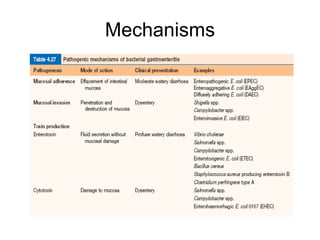
Mechanisms
 
Salmonella S. enteritidis and S. typhimurium .  Commensals in poultry and chicken. Transmitted via contaminated foodstuffs and water. Affects large and small bowel. Typical symptoms starts between  12–48 hours  after infection. Spontaneous resolution usually occurs in 3–6 days. Young children and elderly at risk of significant dehydration. Treat with ciprofloxacin 500mg po bd reduced duration and severity of symptoms.
Enteric Fever Occur world-wide mainly in  India and Africa. Typhoid by Salmonella typhi. Parathyphoid by  S. paratyphi A, B or C. Incubation period is 10–14 days.
Clinical features Invades small bowel (peyer’s patches) to regional LN to blood. In early stages include: Abdominal tenderness Hepatosplenomegaly Lymphadenopathy Scanty maculopapular rash (‘rose spots’).
Complications (Usually in 3 rd  week of illness) meningitis lobar pneumonia osteomyelitis intestinal perforation intestinal haemorrhage After clinical recovery they become  convalescent carriers. Usual site of carriage is the  gall bladder
Diagnosis Culture of S. typhi or S. paratyphi from the patient.  Blood culture is positive in most cases in the first 2 weeks. Bone marrow culture is more sensitive than blood culture, but is rarely required.
Management Ciprofloxacin 500 mg twice daily) are now the treatment of choice. Azithromycin if resistant.
Campylobacter jejuni A common cause of  childhood gastroenteritis  in developing countries. Affects small and large bowel. Incubation period  2-4 days. Self limiting in 3-5 days. If severe treat with  azithromycin 500mg po od.
Shigella Causes  classical bacillary dysentery . S. dysenteriae, S. flexneri and S. sonnei. Only small numbers needed  to be ingested to cause illness (<200). Symptoms start  24–48 hours  after ingestion  Frequent small-volume stools containing blood and mucus. Self-limiting in 7–10 days. Resistance to antibiotics is widespread.
Entero haemorrhagic   Escherichia coli  (EHEC) Also known as VTEC. Secretes a toxin ( Shiga-like toxin 1 ) which affects vascular endothelial cells in the gut and in the kidney. Incubation period of 12–48 hours. Patient may develop  TTP or HUS . Treatment Is supportive. Avoid antibiotics  as may precipitate HUS.
Vibrio Vibrio cholera-next slide. Vibrio  parahaemolyticus  causes acute watery diarrhoea after eating  raw fish or shellfish  that has been kept for several hours without refrigeration. Self limiting up to 10 days.
Cholera Pure enterotoxigenic diarrhoea . Gram-negative bacillus,  Vibrio cholerae . Common in  Bangladesh, India and South East Asia. Transmission is by the faeco-oral route Proliferates in the  small intestine . Releases exotoxin which produces massive secretion of isotonic fluid into the intestinal lumen. Releases serotonin (5-HT) from enterochromaffin cells in the gut, which activates a neural secretory reflex in the enteric nervous system.
Incubation period few hours to 6 days. Majority have mild illness. In severe cases:  profuse  painless  diarrhoea  ‘ rice water’ stool. vomiting hypovolemic shock. Children may present with convulsions owing to hypoglycaemia. Diagnosis is largely clinical. Demonstration of organism  in stool  not diagnostic . Stool and rectal swabs should be taken for culture to confirm the diagnosis.
Treatment Mainstay of treatment is rehydration. Tetracycline or erythromycin x 3/7. Help to eradicate infection, decrease stool output, and shorten the duration of the illness. However, a single dose of ciprofloxacin or azithromycin (each 1 g) is a better choice. Prevention by good hygiene and improved sanitation.
Yersinia Yersinia enterocolitica. Human disease arise either via contaminated food products,ie: pork, or  direct animal contact. Watery diarrhoea, dysentery and mesenteric adenitis. Self-limiting but ciprofloxacin may shorten the duration. Y. pseudotuberculosis  causes  mesenteric adenitis  and  terminal ileitis .
Staphylococcus aureus Produce a heat-stable toxin ( enterotoxin B ) which causes massive secretion of fluid into the intestinal lumen. Onset of symptoms is rapid , often within 2–4 hours of consumption. Causes violent vomiting, followed  within hours  by profuse watery diarrhoea. Symptoms have usually subsided within 24 hours.
Bacillus cereus Produces two toxins. One causes diarrhea the other causes severe vomiting. ‘ fried rice poisoning’
Clostridial infections Clostridium difficile  causes  antibiotic-associated  diarrhoea, colitis and pseudomembranous colitis.  Gram-positive,anaerobic, spore-forming bacillus. Normal flora in 3-5% general population. Up to 20% in hospitalized patients. Produces 2 toxins: Toxin A (enterotoxin) Toxin B (cytotoxic) Almost all antibiotics have been implicated but the present increase has been attributed to the  overuse  of quinolones (e.g.  ciprofloxacin ).
Clinical features Diarrhoea can begin anything from 2 days to a month after taking antibiotics. The colonic mucosa is inflamed and ulcerated and can be covered by an adherent membrane-like material (pseudomembranous colitis).
Diagnosis Detecting A or B toxins in the stools by ELISA techniques.
Treatment Discontinue causative antibiotic. Treat with  metronidazole  400 mg po tds or  Oral  vancomycin  125 mg po QID. Isolation of patients with C. difficile.
Clostridium perfringens  infection is due to  inadequately cooked food . Releases enterotoxin causing watery diarrhoea with severe abdominal pain, usually without vomiting.
Travellers Diarrhea
 
 
Possible questions By which mechanism does vibrio cholera cause gastroenteritis? Name 3 organisms causing watery diarrhea and profuse vomiting. Clinical features of thyphoid fever. In thyphoid, when does complications develop? Common site for carriage of s.thyphi?
What is the most common cause of childhood gastroenteritis in developing countries. A person had only eaten very small amount of food at a stall, becomes unwell with diarrhea. Passing frequent small-volume stools containing blood and mucus. Most likely organism? Consequence of infection from EHEC? Which toxin does EHEC secrete?
A person becomes very unwell with  profuse painless diarrhoea,  ‘ rice water’ stool ,  vomiting and ended up in ICU with hypovolemic shock. Most likely organism? Which organism has the potential to cause mesenteric adenitis? A person becomes unwell with vomiting and diarrhea only after several hours of eating dinner. Most likely organism? A person eats fried rice takeaway and becomes sick afterwards. Most likely organism?
A person took ciprofloxacin a month ago and now develops diarrhea. Most likely organism? Treatment choice? What is the most common organism in Traveller’s diarrhea?

Gastroenteritis

  • 1.
  • 2.
    Most common causeof significant adult gastroenteritis world-wide is bacterial infection. Organisms to be discussed: Salmonella Campylobacter jejuni Shigella EHEC Vibrio Yersinia Staph aureus Bacillus cereus Clostridium.
  • 3.
  • 4.
  • 5.
    Salmonella S. enteritidisand S. typhimurium . Commensals in poultry and chicken. Transmitted via contaminated foodstuffs and water. Affects large and small bowel. Typical symptoms starts between 12–48 hours after infection. Spontaneous resolution usually occurs in 3–6 days. Young children and elderly at risk of significant dehydration. Treat with ciprofloxacin 500mg po bd reduced duration and severity of symptoms.
  • 6.
    Enteric Fever Occurworld-wide mainly in India and Africa. Typhoid by Salmonella typhi. Parathyphoid by S. paratyphi A, B or C. Incubation period is 10–14 days.
  • 7.
    Clinical features Invadessmall bowel (peyer’s patches) to regional LN to blood. In early stages include: Abdominal tenderness Hepatosplenomegaly Lymphadenopathy Scanty maculopapular rash (‘rose spots’).
  • 8.
    Complications (Usually in3 rd week of illness) meningitis lobar pneumonia osteomyelitis intestinal perforation intestinal haemorrhage After clinical recovery they become convalescent carriers. Usual site of carriage is the gall bladder
  • 9.
    Diagnosis Culture ofS. typhi or S. paratyphi from the patient. Blood culture is positive in most cases in the first 2 weeks. Bone marrow culture is more sensitive than blood culture, but is rarely required.
  • 10.
    Management Ciprofloxacin 500mg twice daily) are now the treatment of choice. Azithromycin if resistant.
  • 11.
    Campylobacter jejuni Acommon cause of childhood gastroenteritis in developing countries. Affects small and large bowel. Incubation period 2-4 days. Self limiting in 3-5 days. If severe treat with azithromycin 500mg po od.
  • 12.
    Shigella Causes classical bacillary dysentery . S. dysenteriae, S. flexneri and S. sonnei. Only small numbers needed to be ingested to cause illness (<200). Symptoms start 24–48 hours after ingestion Frequent small-volume stools containing blood and mucus. Self-limiting in 7–10 days. Resistance to antibiotics is widespread.
  • 13.
    Entero haemorrhagic Escherichia coli (EHEC) Also known as VTEC. Secretes a toxin ( Shiga-like toxin 1 ) which affects vascular endothelial cells in the gut and in the kidney. Incubation period of 12–48 hours. Patient may develop TTP or HUS . Treatment Is supportive. Avoid antibiotics as may precipitate HUS.
  • 14.
    Vibrio Vibrio cholera-nextslide. Vibrio parahaemolyticus causes acute watery diarrhoea after eating raw fish or shellfish that has been kept for several hours without refrigeration. Self limiting up to 10 days.
  • 15.
    Cholera Pure enterotoxigenicdiarrhoea . Gram-negative bacillus, Vibrio cholerae . Common in Bangladesh, India and South East Asia. Transmission is by the faeco-oral route Proliferates in the small intestine . Releases exotoxin which produces massive secretion of isotonic fluid into the intestinal lumen. Releases serotonin (5-HT) from enterochromaffin cells in the gut, which activates a neural secretory reflex in the enteric nervous system.
  • 16.
    Incubation period fewhours to 6 days. Majority have mild illness. In severe cases: profuse painless diarrhoea ‘ rice water’ stool. vomiting hypovolemic shock. Children may present with convulsions owing to hypoglycaemia. Diagnosis is largely clinical. Demonstration of organism in stool not diagnostic . Stool and rectal swabs should be taken for culture to confirm the diagnosis.
  • 17.
    Treatment Mainstay oftreatment is rehydration. Tetracycline or erythromycin x 3/7. Help to eradicate infection, decrease stool output, and shorten the duration of the illness. However, a single dose of ciprofloxacin or azithromycin (each 1 g) is a better choice. Prevention by good hygiene and improved sanitation.
  • 18.
    Yersinia Yersinia enterocolitica.Human disease arise either via contaminated food products,ie: pork, or direct animal contact. Watery diarrhoea, dysentery and mesenteric adenitis. Self-limiting but ciprofloxacin may shorten the duration. Y. pseudotuberculosis causes mesenteric adenitis and terminal ileitis .
  • 19.
    Staphylococcus aureus Producea heat-stable toxin ( enterotoxin B ) which causes massive secretion of fluid into the intestinal lumen. Onset of symptoms is rapid , often within 2–4 hours of consumption. Causes violent vomiting, followed within hours by profuse watery diarrhoea. Symptoms have usually subsided within 24 hours.
  • 20.
    Bacillus cereus Producestwo toxins. One causes diarrhea the other causes severe vomiting. ‘ fried rice poisoning’
  • 21.
    Clostridial infections Clostridiumdifficile causes antibiotic-associated diarrhoea, colitis and pseudomembranous colitis. Gram-positive,anaerobic, spore-forming bacillus. Normal flora in 3-5% general population. Up to 20% in hospitalized patients. Produces 2 toxins: Toxin A (enterotoxin) Toxin B (cytotoxic) Almost all antibiotics have been implicated but the present increase has been attributed to the overuse of quinolones (e.g. ciprofloxacin ).
  • 22.
    Clinical features Diarrhoeacan begin anything from 2 days to a month after taking antibiotics. The colonic mucosa is inflamed and ulcerated and can be covered by an adherent membrane-like material (pseudomembranous colitis).
  • 23.
    Diagnosis Detecting Aor B toxins in the stools by ELISA techniques.
  • 24.
    Treatment Discontinue causativeantibiotic. Treat with metronidazole 400 mg po tds or Oral vancomycin 125 mg po QID. Isolation of patients with C. difficile.
  • 25.
    Clostridium perfringens infection is due to inadequately cooked food . Releases enterotoxin causing watery diarrhoea with severe abdominal pain, usually without vomiting.
  • 26.
  • 27.
  • 28.
  • 29.
    Possible questions Bywhich mechanism does vibrio cholera cause gastroenteritis? Name 3 organisms causing watery diarrhea and profuse vomiting. Clinical features of thyphoid fever. In thyphoid, when does complications develop? Common site for carriage of s.thyphi?
  • 30.
    What is themost common cause of childhood gastroenteritis in developing countries. A person had only eaten very small amount of food at a stall, becomes unwell with diarrhea. Passing frequent small-volume stools containing blood and mucus. Most likely organism? Consequence of infection from EHEC? Which toxin does EHEC secrete?
  • 31.
    A person becomesvery unwell with profuse painless diarrhoea, ‘ rice water’ stool , vomiting and ended up in ICU with hypovolemic shock. Most likely organism? Which organism has the potential to cause mesenteric adenitis? A person becomes unwell with vomiting and diarrhea only after several hours of eating dinner. Most likely organism? A person eats fried rice takeaway and becomes sick afterwards. Most likely organism?
  • 32.
    A person tookciprofloxacin a month ago and now develops diarrhea. Most likely organism? Treatment choice? What is the most common organism in Traveller’s diarrhea?