Career Point University
Submitted To:-
Mr. Kamal Arora
DEAN
Career Point University,Kota
Submitted By:-
Aman Gupta (K11534)
B.Tech , 5th sem , EE
Gas Power Plant
Basic Scheme Open Cycle Gas Turbine Plant
CONTENTS
 GAS POWER PLANT
 HISTORY OF GAS TURBINE
 GAS TURBINE POWER PLANT
 WORKING PRINCIPLE
 APPLICATION OF GAS TURBINE
 ADVANTAGES AND DISADVANTAGES OF GAS TURBINE
 TYPES OF GAS TURBINE POWER PLANTS
 OPEN CYCLE GAS POWER PLANT
 P-V AND T-S DIAGRAMS OF BRAYTON CYCLE
 ENTROPY
 METHODS OF IMPROVEMENT OF THERMAL EFFICIENCY
OF OPEN CYCLE GAS TURBINE PLANT
 REGENERATION
 REHEATING
 INTERCOOLING
GAS POWER PLANT
 A fossil-fuel power station is a power station which burns
fossil fuel such as coal, natural gas or petroleum to produce
electricity. Fossil-fuel power stations have machinery to
convert the heat energy of combustion into mechanical
energy, which then operates an electrical generator.
HISTORY OF GAS TURBINE
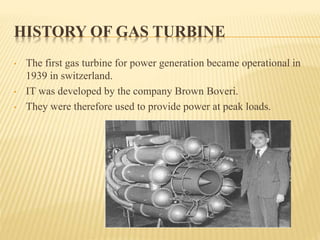
• The first gas turbine for power generation became operational in
1939 in switzerland.
• IT was developed by the company Brown Boveri.
• They were therefore used to provide power at peak loads.
GAS TURBINE POWER PLANT
 A gas turbine, also called a combustion turbine, is a type of
internal combustion engine. The basic operation of the gas
turbine is similar to that of the steam power plant except that air is
used instead of water. Fresh atmospheric air flows through a
compressor that brings it to higher pressure.
WORKING PRINCIPLE
• Instead of using the heat to produce steam, as in steam turbines,
gas turbines use the hot gases directly to turn the turbine blades.
• Gas turbines have three main parts:
i. Air compressor
ii. Combustion chamber
iii. turbine
APPLICATION OF GAS TURBINE
1. Aviation(self contained, light weight don’t require cooling)
2. Power Generation
3. Oil and Gas industry(cheaper supply of fuel and low installation
cost)
4. Marine propulsion
ADVANTAGES OF GAS TURBINE
 Compact design, high speed and high power.
 Storage of fuel requires less area and handling is easy.
 The cost of maintenance is less.
 Less pollution and less water is required.
 Simple lubrication system.
 The gas turbine can be driven at a very high speed i.e 40000 rpm.
DISADVANTAGES OF GAS TURBINE
 66% of the power developed is used to drive the compressor.
Therefore the gas turbine unit has a low thermal efficiency.
 High frequency noise from the compressor is objectionable.
 Starting of the plant is not as simple as diesel plants.
 Compare to other power plant, the overall efficiency of this plant
is quite low.
TYPES OF GAS TURBINE POWER PLANTS
 Open cycle gas power plant
In this type of power plant the atmospheric air is charged into the
combustor through a compressor and the exhaust of the turbine
also discharge to the atmosphere.
 Closed cycle gas power plant
In this type of power plant, the mass of air is constant or another
suitable gas used as working medium, circulates through the
cycle over and over again.
OPEN CYCLE GAS POWER PLANT
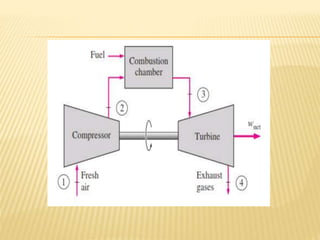
 Gas turbines usually operate on an open cycle. Air at ambient
conditions is drawn into the compressor, where its temperature and
pressure are raised.
 The high pressure air proceeds into the combustion chamber,
where the fuel is burned at constant pressure. The high-
temperature gases then enter the turbine where they expand to
atmospheric pressure while producing power output.
P-V AND T-S DIAGRAMS OF BRAYTON CYCLE
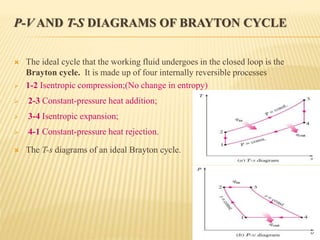
 The ideal cycle that the working fluid undergoes in the closed loop is the
Brayton cycle. It is made up of four internally reversible processes
 1-2 Isentropic compression;(No change in entropy)
 2-3 Constant-pressure heat addition;
 3-4 Isentropic expansion;
 4-1 Constant-pressure heat rejection.
 The T-s diagrams of an ideal Brayton cycle.
ENTROPY
 The term entropy was first used by Rudolf clausius to state the
second law of thermodynamics. Entropy is the extensive property
of the system and its unit of measurement is J/K.
 The various causes of the increase in entropy of the system are
@ Due to external interaction.
@ Internal changes in the system.
 dS = δq/T
Where dS is the change in entropy,
δq is the heat added to the system.
METHODS OF IMPROVEMENT OF THERMAL
EFFICIENCY OF OPEN CYCLE GAS TURBINE PLANT
1. Regeneration
2. Reheating
3. Intercooling
REGENERATION
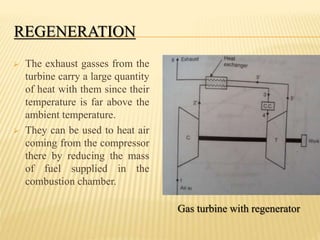
 The exhaust gasses from the
turbine carry a large quantity
of heat with them since their
temperature is far above the
ambient temperature.
 They can be used to heat air
coming from the compressor
there by reducing the mass
of fuel supplied in the
combustion chamber.
Gas turbine with regenerator
REHEATING
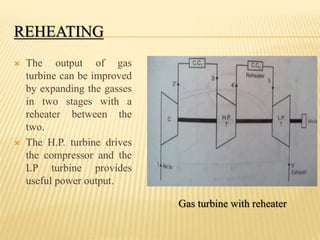
 The output of gas
turbine can be improved
by expanding the gasses
in two stages with a
reheater between the
two.
 The H.P. turbine drives
the compressor and the
LP turbine provides
useful power output.
Gas turbine with reheater
INTERCOOLING
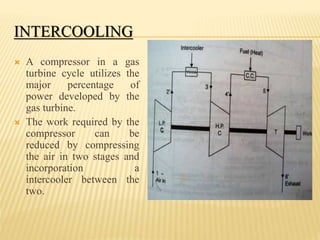
 A compressor in a gas
turbine cycle utilizes the
major percentage of
power developed by the
gas turbine.
 The work required by the
compressor can be
reduced by compressing
the air in two stages and
incorporation a
intercooler between the
two.
THANK YOU

Basic Scheme Open Cycle Gas Turbine Plant

  • 1.
    Career Point University SubmittedTo:- Mr. Kamal Arora DEAN Career Point University,Kota Submitted By:- Aman Gupta (K11534) B.Tech , 5th sem , EE Gas Power Plant Basic Scheme Open Cycle Gas Turbine Plant
  • 2.
    CONTENTS  GAS POWERPLANT  HISTORY OF GAS TURBINE  GAS TURBINE POWER PLANT  WORKING PRINCIPLE  APPLICATION OF GAS TURBINE  ADVANTAGES AND DISADVANTAGES OF GAS TURBINE  TYPES OF GAS TURBINE POWER PLANTS  OPEN CYCLE GAS POWER PLANT  P-V AND T-S DIAGRAMS OF BRAYTON CYCLE  ENTROPY
  • 3.
     METHODS OFIMPROVEMENT OF THERMAL EFFICIENCY OF OPEN CYCLE GAS TURBINE PLANT  REGENERATION  REHEATING  INTERCOOLING
  • 4.
    GAS POWER PLANT A fossil-fuel power station is a power station which burns fossil fuel such as coal, natural gas or petroleum to produce electricity. Fossil-fuel power stations have machinery to convert the heat energy of combustion into mechanical energy, which then operates an electrical generator.
  • 5.
    HISTORY OF GASTURBINE • The first gas turbine for power generation became operational in 1939 in switzerland. • IT was developed by the company Brown Boveri. • They were therefore used to provide power at peak loads.
  • 6.
    GAS TURBINE POWERPLANT  A gas turbine, also called a combustion turbine, is a type of internal combustion engine. The basic operation of the gas turbine is similar to that of the steam power plant except that air is used instead of water. Fresh atmospheric air flows through a compressor that brings it to higher pressure.
  • 7.
    WORKING PRINCIPLE • Insteadof using the heat to produce steam, as in steam turbines, gas turbines use the hot gases directly to turn the turbine blades. • Gas turbines have three main parts: i. Air compressor ii. Combustion chamber iii. turbine
  • 8.
    APPLICATION OF GASTURBINE 1. Aviation(self contained, light weight don’t require cooling) 2. Power Generation 3. Oil and Gas industry(cheaper supply of fuel and low installation cost) 4. Marine propulsion
  • 9.
    ADVANTAGES OF GASTURBINE  Compact design, high speed and high power.  Storage of fuel requires less area and handling is easy.  The cost of maintenance is less.  Less pollution and less water is required.  Simple lubrication system.  The gas turbine can be driven at a very high speed i.e 40000 rpm.
  • 10.
    DISADVANTAGES OF GASTURBINE  66% of the power developed is used to drive the compressor. Therefore the gas turbine unit has a low thermal efficiency.  High frequency noise from the compressor is objectionable.  Starting of the plant is not as simple as diesel plants.  Compare to other power plant, the overall efficiency of this plant is quite low.
  • 11.
    TYPES OF GASTURBINE POWER PLANTS  Open cycle gas power plant In this type of power plant the atmospheric air is charged into the combustor through a compressor and the exhaust of the turbine also discharge to the atmosphere.  Closed cycle gas power plant In this type of power plant, the mass of air is constant or another suitable gas used as working medium, circulates through the cycle over and over again.
  • 12.
    OPEN CYCLE GASPOWER PLANT  Gas turbines usually operate on an open cycle. Air at ambient conditions is drawn into the compressor, where its temperature and pressure are raised.  The high pressure air proceeds into the combustion chamber, where the fuel is burned at constant pressure. The high- temperature gases then enter the turbine where they expand to atmospheric pressure while producing power output.
  • 14.
    P-V AND T-SDIAGRAMS OF BRAYTON CYCLE  The ideal cycle that the working fluid undergoes in the closed loop is the Brayton cycle. It is made up of four internally reversible processes  1-2 Isentropic compression;(No change in entropy)  2-3 Constant-pressure heat addition;  3-4 Isentropic expansion;  4-1 Constant-pressure heat rejection.  The T-s diagrams of an ideal Brayton cycle.
  • 15.
    ENTROPY  The termentropy was first used by Rudolf clausius to state the second law of thermodynamics. Entropy is the extensive property of the system and its unit of measurement is J/K.  The various causes of the increase in entropy of the system are @ Due to external interaction. @ Internal changes in the system.  dS = δq/T Where dS is the change in entropy, δq is the heat added to the system.
  • 16.
    METHODS OF IMPROVEMENTOF THERMAL EFFICIENCY OF OPEN CYCLE GAS TURBINE PLANT 1. Regeneration 2. Reheating 3. Intercooling
  • 17.
    REGENERATION  The exhaustgasses from the turbine carry a large quantity of heat with them since their temperature is far above the ambient temperature.  They can be used to heat air coming from the compressor there by reducing the mass of fuel supplied in the combustion chamber. Gas turbine with regenerator
  • 18.
    REHEATING  The outputof gas turbine can be improved by expanding the gasses in two stages with a reheater between the two.  The H.P. turbine drives the compressor and the LP turbine provides useful power output. Gas turbine with reheater
  • 19.
    INTERCOOLING  A compressorin a gas turbine cycle utilizes the major percentage of power developed by the gas turbine.  The work required by the compressor can be reduced by compressing the air in two stages and incorporation a intercooler between the two.
  • 20.