By: Sukhdeep Singh
Ruby laser:
construction of ruby laser
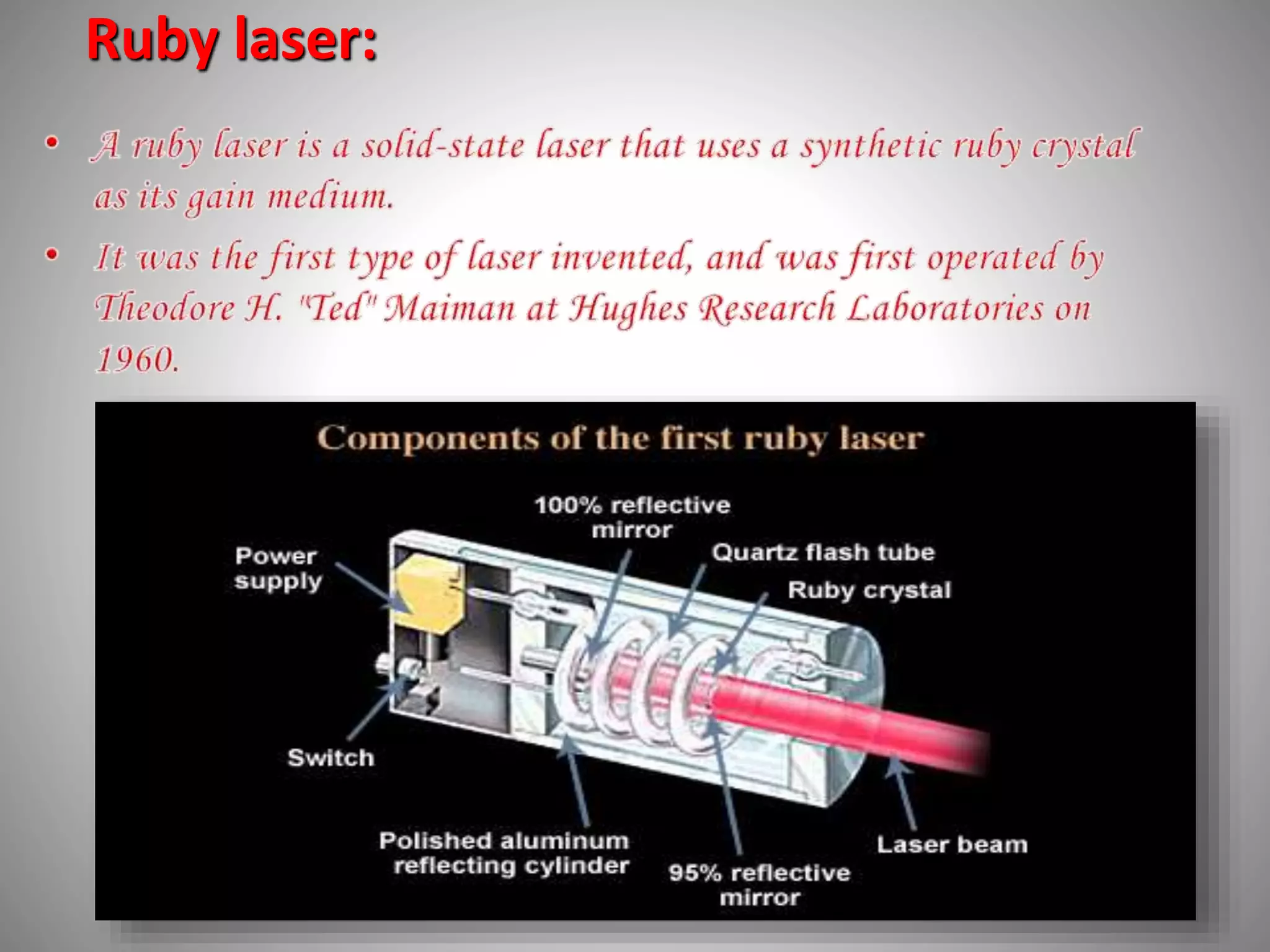
 The active laser medium (laser gain/amplification medium) is a synthetic ruby rod. Ruby is an
aluminum oxide crystal in which some of the aluminum atoms have been replaced with chromium
atoms(0.05% by weight). Chromium gives ruby its characteristic red color and is responsible for
the lasing behavior of the crystal. Chromium atoms absorb green and blue light and emit or reflect
only red light. For a ruby laser, a crystal of ruby is formed into a cylinder.
 The rod's ends had to be polished with great precision, such that the ends of the rod were flat to
within a quarter of a wavelength of the output light, and parallel to each other within a few
seconds of arc. The finely polished ends of the rod were silvered: one end completely, the other
only partially. The rod with its reflective ends then acts as a Fabry-Pérot etalon (or a Gires-
Tournois etalon).
 A xenon lamp is rolled over ruby rod and is used for pumping ions to excited state.
Working of ruby laser
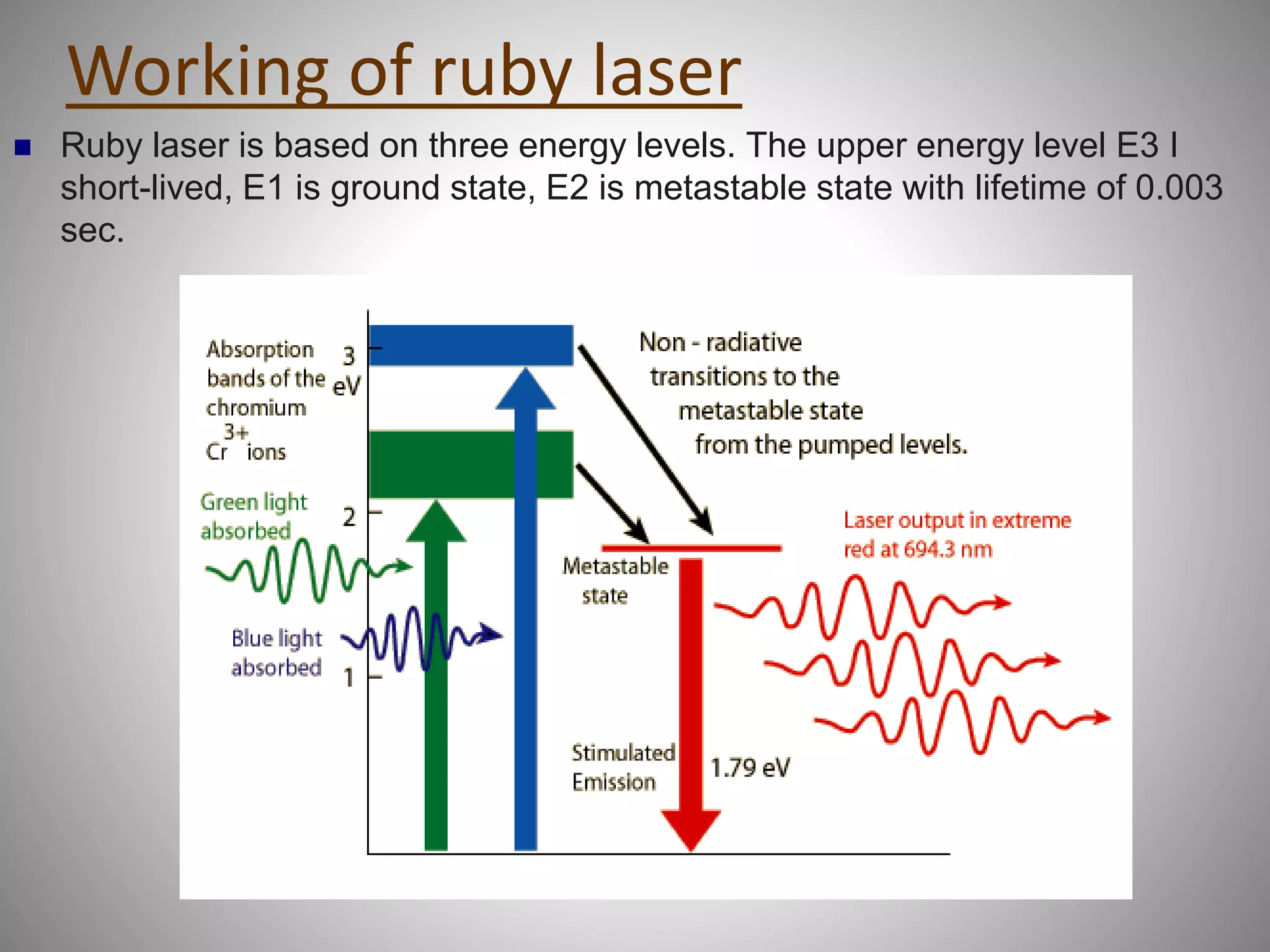
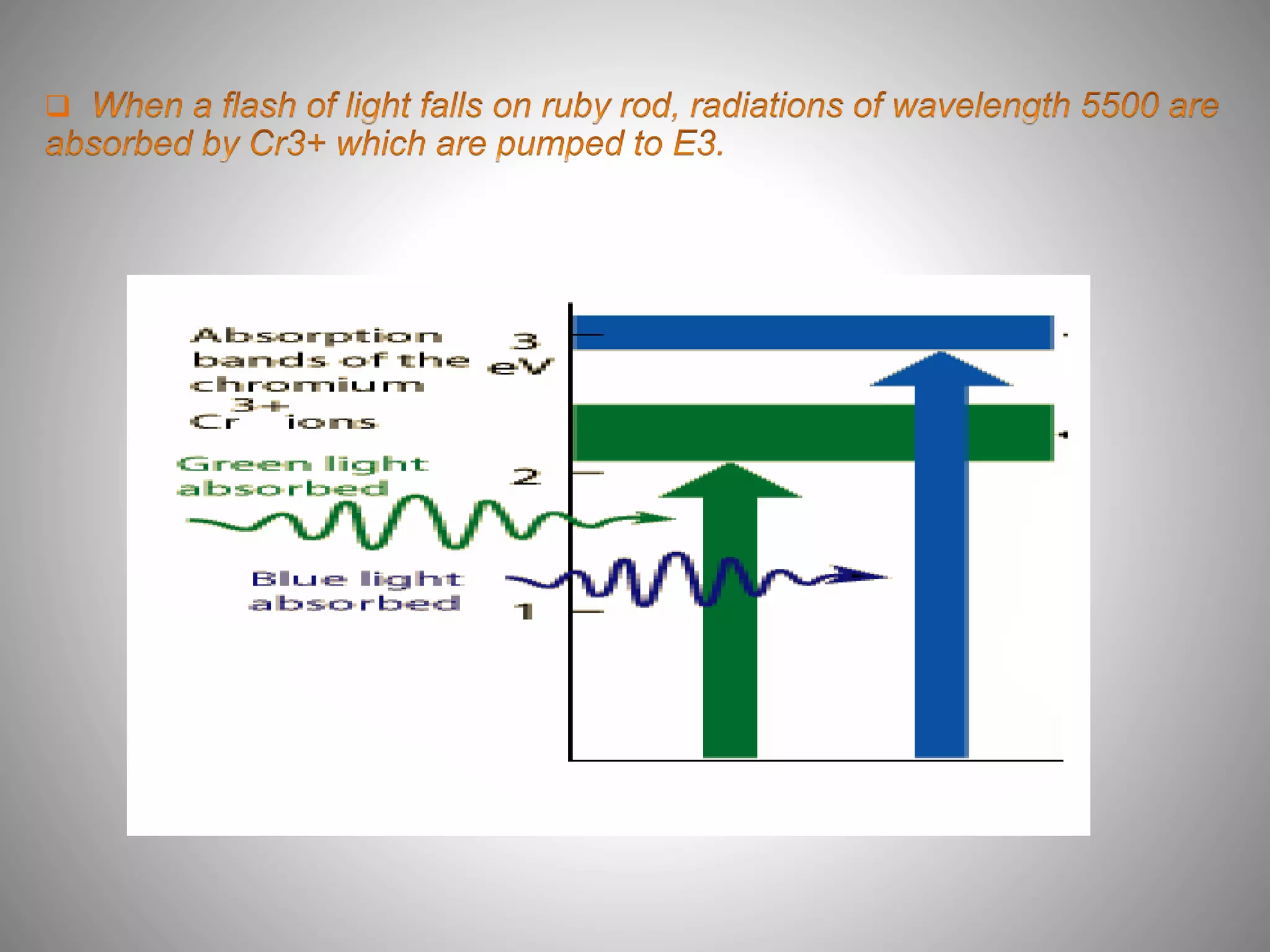
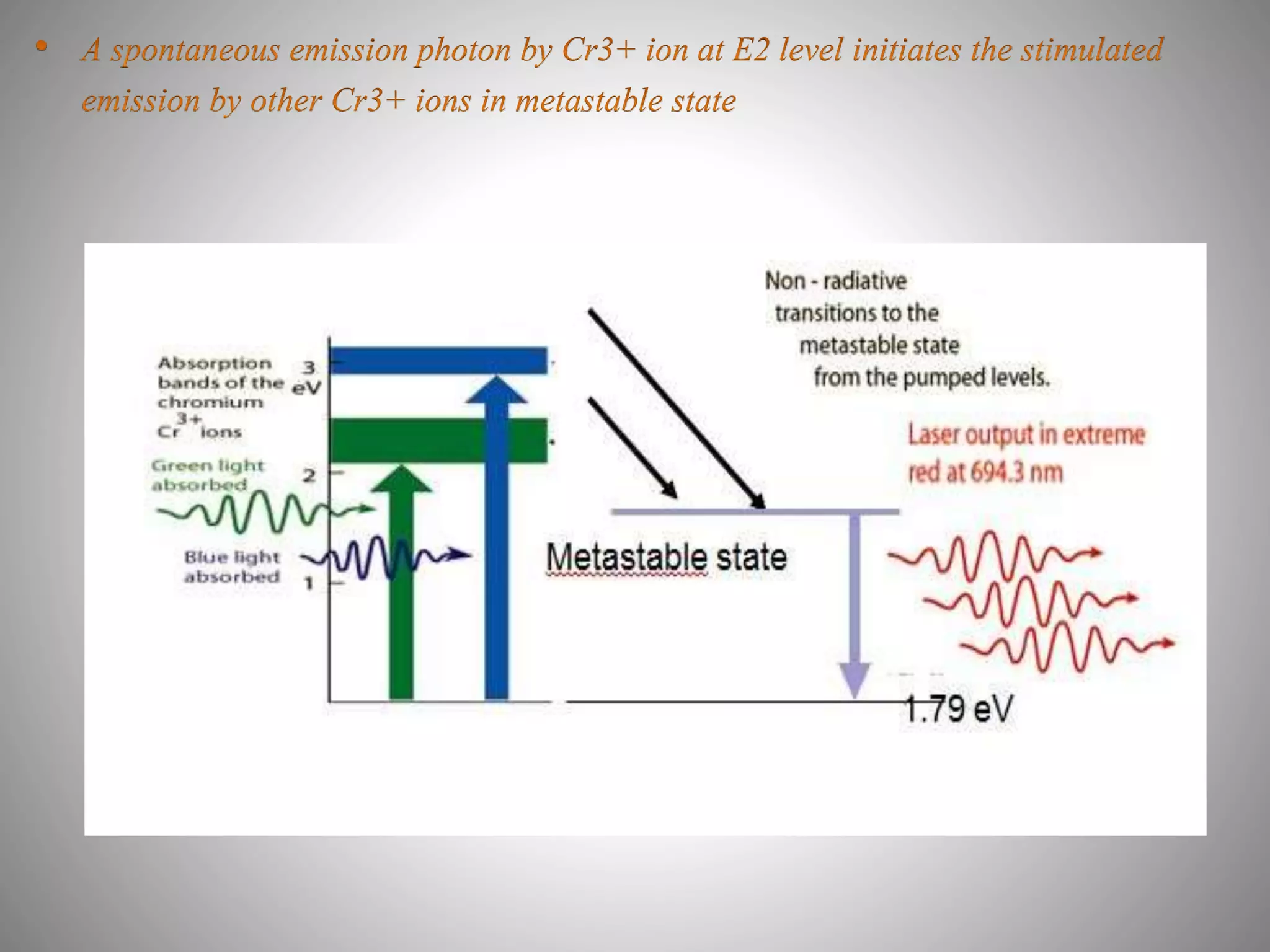
 Ruby laser is based on three energy levels. The upper energy level E3 I
short-lived, E1 is ground state, E2 is metastable state with lifetime of 0.003
sec.

Ruby lasers have declined in use with the discovery of better lasing
media. They are still used in a number of applications where short pulses
of red light are required. Heliographers around the world produce
holographic portraits with ruby lasers, in sizes up to a meter squared.
Many non-destructive testing labs use ruby lasers to create holograms of
large objects such as aircraft tires to look for weaknesses in the lining.
Ruby lasers were used extensively in tattoo and hair removal
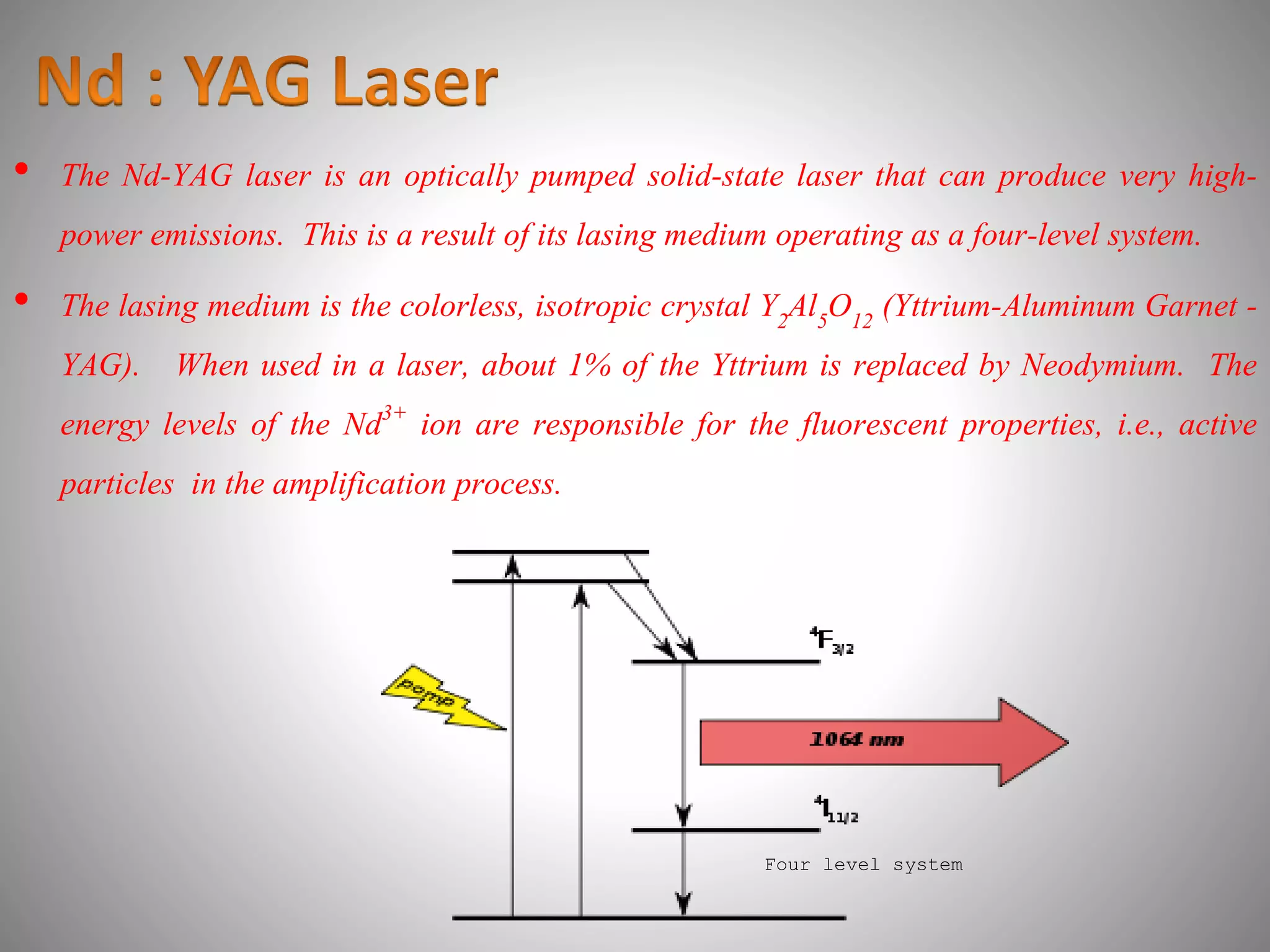
• The Nd-YAG laser is an optically pumped solid-state laser that can produce very high-
power emissions. This is a result of its lasing medium operating as a four-level system.
• The lasing medium is the colorless, isotropic crystal Y2Al5O12 (Yttrium-Aluminum Garnet -
YAG). When used in a laser, about 1% of the Yttrium is replaced by Neodymium. The
energy levels of the Nd3+ ion are responsible for the fluorescent properties, i.e., active
particles in the amplification process.
Four level system
• Population inversion results from shining light on this crystal. If the light is
intense enough, atoms within the crystal that absorb this light transition from
ground state into the absorption bands This is often done with a flash lamp - often
a quartz tube filled with a noble gas through which high energy stored in a
capacitor is discharged, emitting in the blue and ultra-violet (see diagram below).
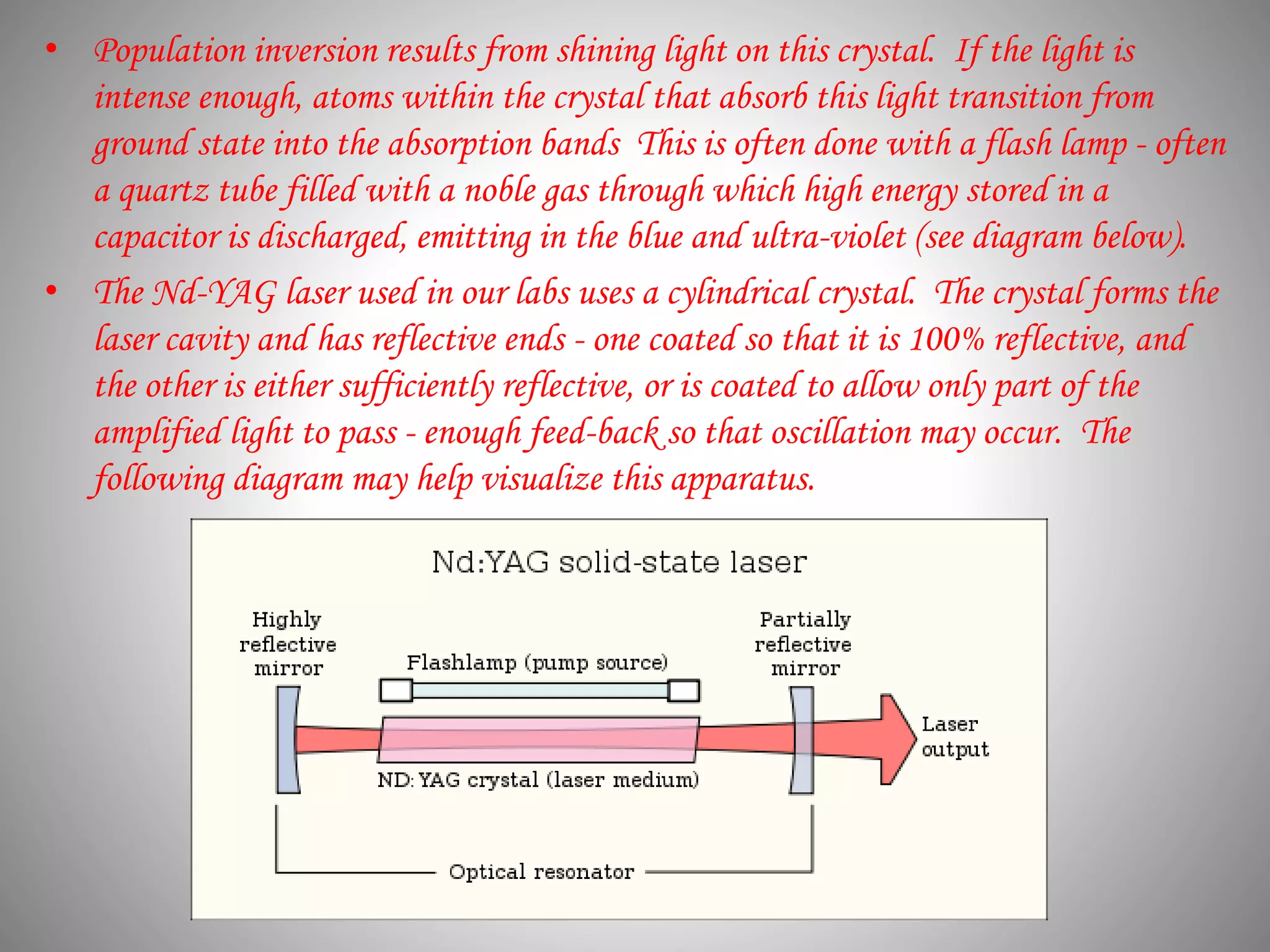
• The Nd-YAG laser used in our labs uses a cylindrical crystal. The crystal forms the
laser cavity and has reflective ends - one coated so that it is 100% reflective, and
the other is either sufficiently reflective, or is coated to allow only part of the
amplified light to pass - enough feed-back so that oscillation may occur. The
following diagram may help visualize this apparatus.
 They produce continuous laser at room temperature.
 They can be used as portable systems since the rods are small.
 they have surgical applications.
 they are used material processing such as drilling, spot welding
and marking.
 They are used as pumping tunable visible light lasers.
 They have applications in military such as including range
finders and target designators.
 Research applications such as Raman spectroscopy, remote
sensing, mass spectrometry.
Ruby & Nd YAG laser By Sukdeep Singh

Ruby & Nd YAG laser By Sukdeep Singh

  • 1.
  • 2.
  • 3.
    construction of rubylaser  The active laser medium (laser gain/amplification medium) is a synthetic ruby rod. Ruby is an aluminum oxide crystal in which some of the aluminum atoms have been replaced with chromium atoms(0.05% by weight). Chromium gives ruby its characteristic red color and is responsible for the lasing behavior of the crystal. Chromium atoms absorb green and blue light and emit or reflect only red light. For a ruby laser, a crystal of ruby is formed into a cylinder.  The rod's ends had to be polished with great precision, such that the ends of the rod were flat to within a quarter of a wavelength of the output light, and parallel to each other within a few seconds of arc. The finely polished ends of the rod were silvered: one end completely, the other only partially. The rod with its reflective ends then acts as a Fabry-Pérot etalon (or a Gires- Tournois etalon).  A xenon lamp is rolled over ruby rod and is used for pumping ions to excited state.
  • 4.
    Working of rubylaser  Ruby laser is based on three energy levels. The upper energy level E3 I short-lived, E1 is ground state, E2 is metastable state with lifetime of 0.003 sec.
  • 5.
  • 7.
    Ruby lasers havedeclined in use with the discovery of better lasing media. They are still used in a number of applications where short pulses of red light are required. Heliographers around the world produce holographic portraits with ruby lasers, in sizes up to a meter squared. Many non-destructive testing labs use ruby lasers to create holograms of large objects such as aircraft tires to look for weaknesses in the lining. Ruby lasers were used extensively in tattoo and hair removal
  • 8.
    • The Nd-YAGlaser is an optically pumped solid-state laser that can produce very high- power emissions. This is a result of its lasing medium operating as a four-level system. • The lasing medium is the colorless, isotropic crystal Y2Al5O12 (Yttrium-Aluminum Garnet - YAG). When used in a laser, about 1% of the Yttrium is replaced by Neodymium. The energy levels of the Nd3+ ion are responsible for the fluorescent properties, i.e., active particles in the amplification process. Four level system
  • 9.
    • Population inversionresults from shining light on this crystal. If the light is intense enough, atoms within the crystal that absorb this light transition from ground state into the absorption bands This is often done with a flash lamp - often a quartz tube filled with a noble gas through which high energy stored in a capacitor is discharged, emitting in the blue and ultra-violet (see diagram below). • The Nd-YAG laser used in our labs uses a cylindrical crystal. The crystal forms the laser cavity and has reflective ends - one coated so that it is 100% reflective, and the other is either sufficiently reflective, or is coated to allow only part of the amplified light to pass - enough feed-back so that oscillation may occur. The following diagram may help visualize this apparatus.
  • 10.
     They producecontinuous laser at room temperature.  They can be used as portable systems since the rods are small.  they have surgical applications.  they are used material processing such as drilling, spot welding and marking.  They are used as pumping tunable visible light lasers.  They have applications in military such as including range finders and target designators.  Research applications such as Raman spectroscopy, remote sensing, mass spectrometry.