CONTENT
• Introduction
• Objective
•Classification
• Principle
• Components
• Interpretation and Importance
• Advantages
• Conclusion
• Research work
3.
HISTORY
• The chromatographicprinciple was discovered 1st
by a Russian botanist – Michael Tswett in
1906
• Amongst the newest and most effective chromatographic technique for analysising complex
mixture is Gas Chromatography. It was introduced by Martin and James in 1952.
• This method is very advantageous in speed , accuracy , sensitivity and versatility as
compared to other methods.
INTRODUCTION
• The termChromatography comes from Greek words :
Kromatos – Colour and Graphos – written meaning colour writing
• Definition
• Tswett defines Chromatography as the method in which the components of a mixture are
separated on an adsorbent column in a flowing system.
• Recently IUPAC (international union of pure and applied chemistry) defines as: “A method
used primarily for the separation of the components of a sample , in which the components
are distributed between two phases, one of which is stationary while the other moves. The
stationary phase may be a solid or a liquid supported on a solid or a gel and may be packed
in a column, spread as a layer or distributed as a film. The mobile phase may be gas or
liquid.”
6.
CLASSIFICATION
• Chromatography
Absortion competitionPartition competition Ion exchange Molecular
between solid and between liquid and sieve
Gas(GSC) liquid Gas (GLC) liquid
Column Chromatography TLC column paper TLC
HPTLC HPTLC
7.
GAS CHROMATOGRAPHY
• Gaschromatography is a widely used technique for separation of gaseous and volatile
substance which are difficult to separate and analyse.
• It is a special form of chromatography in which moving phase is a gas and the stationary
phase may be either liquid or solid.
• Two major types:
Gas-solid chromatography (stationary phase : solid)
Gas-liquid chromatography (stationary phase : immobilized liquid)
8.
GAS – SOLIDCHROMATOGRAPHY
• The stationary phase, in this case, is a solid like silica or alumina. It is the affinity of
solutes towards adsorption onto the stationary phase which determines, in part, the
retention time. The mobile phase is, of course, a suitable carrier gas. This gas
chromatographic technique is most useful for the separation and analysis of gases
like CH4, CO2, CO, ... etc.
9.
GAS- - LIQUIDCHROMATOGRAPHY
• The stationary phase is a liquid with very low volatility while the mobile phase is a
suitable carrier gas. GLC is the most widely used technique for separation of
volatile species. The presence of a wide variety of stationary phases with
contrasting selectivity's and easy column preparation add to the assets of GLC or
simply GC.
10.
PRINCIPLES
• The principleof separation in GC is partition.
• The mixture of component to be separated is converted to vapour and mixed with gaseous
mobile phase.
• The component which is more soluble in stationary phase travel slower and eluted later. The
component which is less soluble in stationary phase travels faster and eluted out later.
• No two component has a same partition coefficient conditions. So the components are
separated according to their partition coefficient.
• Partition coefficient is “the ratio of solubility of a substance distributed between two
immiscible liquids at a constant temperature.
11.
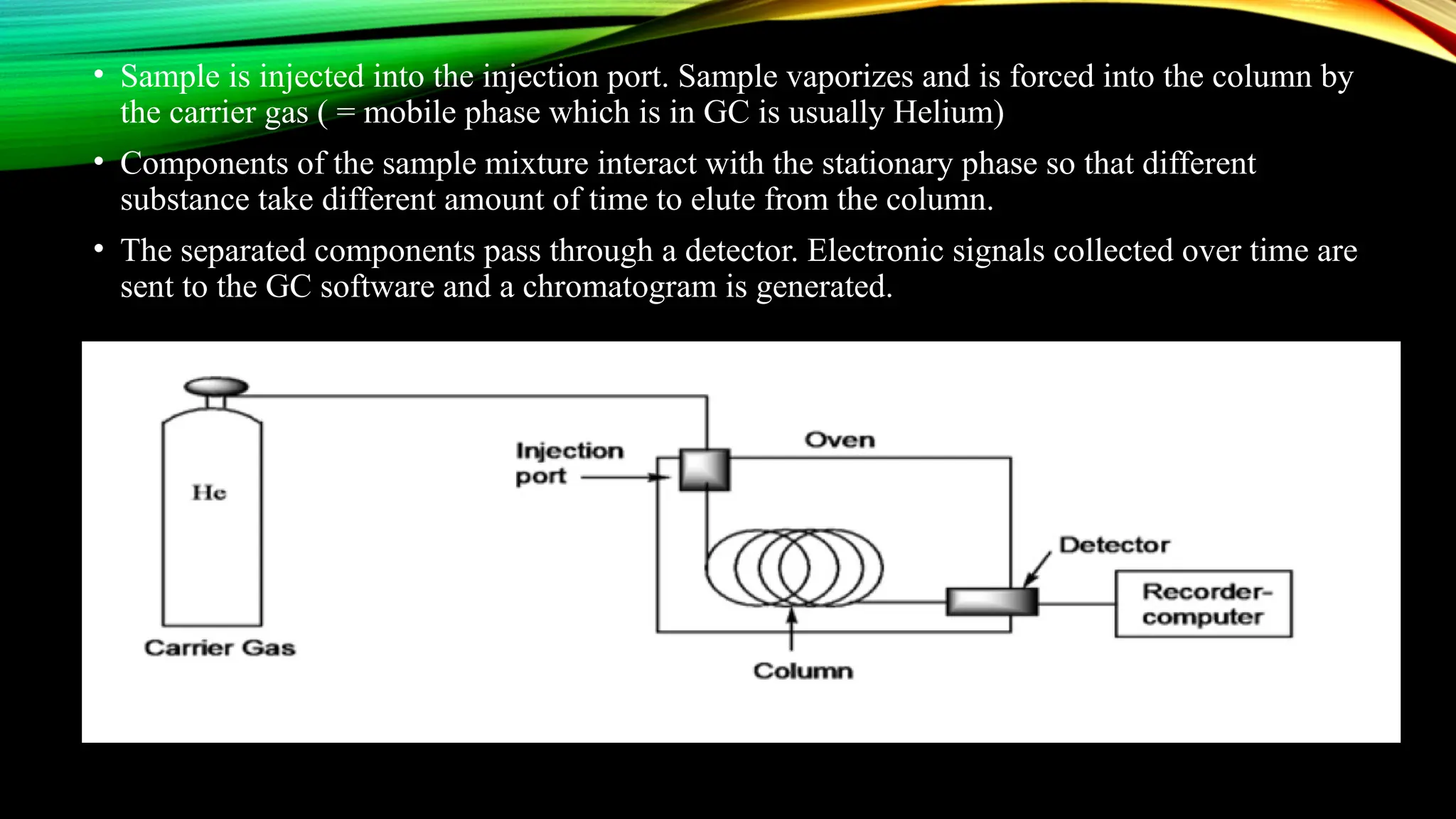
COMPONENTS
*It consists of
agas supply
an injection port
a separation column (the stationary phase)
an oven
a detector.
12.
• Sample isinjected into the injection port. Sample vaporizes and is forced into the column by
the carrier gas ( = mobile phase which is in GC is usually Helium)
• Components of the sample mixture interact with the stationary phase so that different
substance take different amount of time to elute from the column.
• The separated components pass through a detector. Electronic signals collected over time are
sent to the GC software and a chromatogram is generated.
13.
• Compounds A& B interact with the stationary phase through intermolecular forces.
• A interact more strongly with the stationary phase and is retained relative to B , which
interact weakly with the stationary phase. Thus B spends more time in the gas phase and
advance more rapidly through the column and has a shorter retention time than A.
• Typically , components with the similar polarity elute in order of volatility . Thus alkanes
elute in order of increasing boiling points; lower boiling alkanes will have shorter retention
times than higher boiling alkanes.
15.
• Gas supply: e.g. N2 or He
• Sample injector : syringe or septum
• Column : tubing packed with small uniform size, inert support coated with thin film
og non-volatile liquid.
• Detector : -Thermal conductivity TC
- Flame ionization detector FID
- Electron capture ECD
- - ray ionisation
𝛽
16.
CARRIER GAS
• Carriergases, which should be chemically inert and non reactive Helium, Nitrogen,
and Hydrogen. Along with the gas supply there are pressure regulators, gauges, and
flow meters. In addition, the gas carrier system often contains a molecular sieve to
remove water and other impurities.
17.
SAMPLE INJECTION SYSTEM
•Column efficiency depends upon that Sample should be of suitable size and
introduced as a "plug" of vapor. Slow injection of oversized samples causes poor
resolution and band spreading .The most common method of sample injection
involves the use of micro syringe to inject a liquid or gaseous sample through a self-
sealing, silicone-rubber diaphragm or septum into a flash vaporizer port located at
the head of the column.
19.
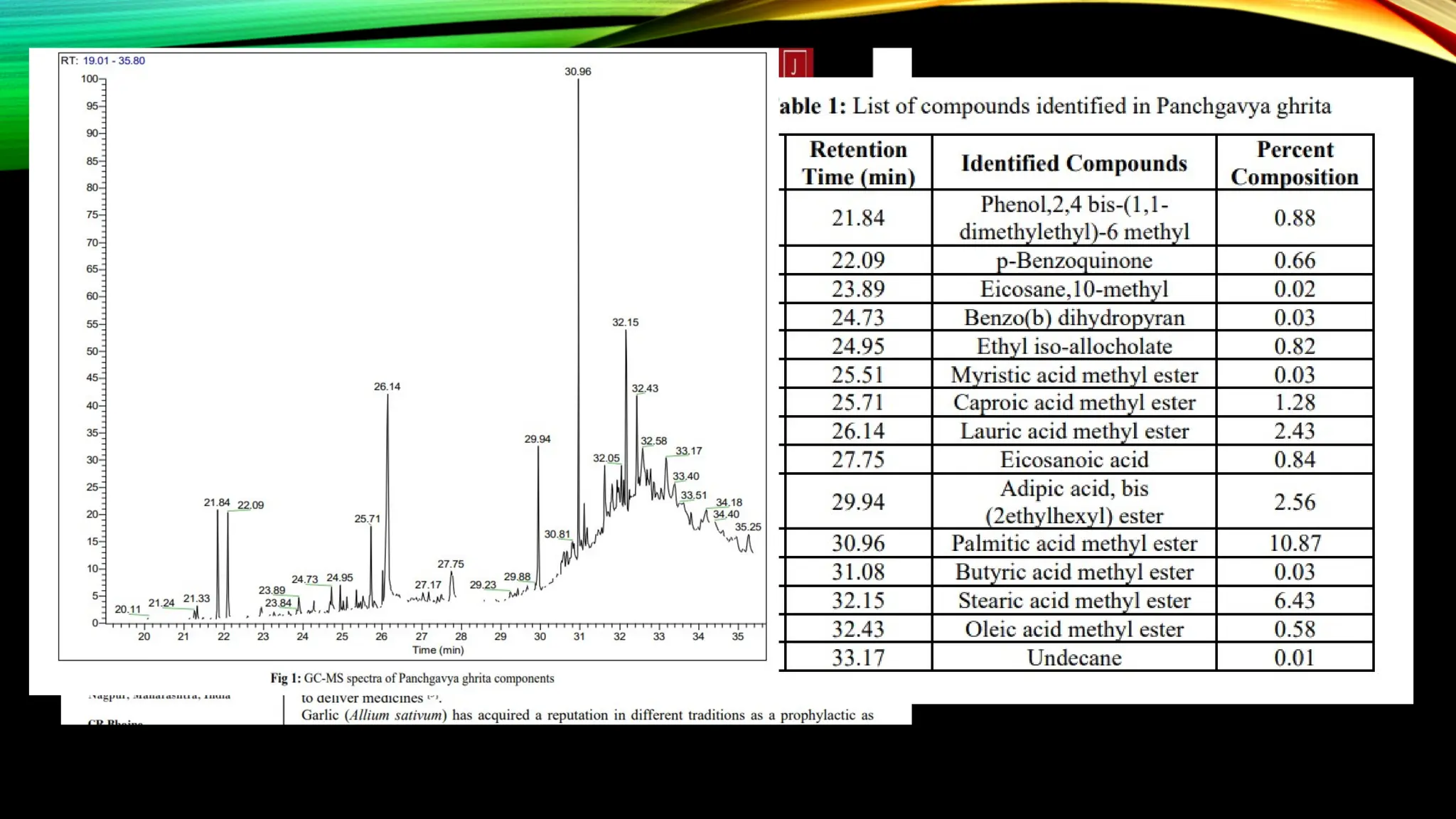
INTERPRETATION
• The techniquehas a range of applications and may be a good fit for your needs if you want to:
• Identify and quantify unknown samples (i.e. chemical composition of cooking oils or lubricants)
• Identify unknown contaminants
• Environmental analysis
• Identify trace elements in samples (i.e. trace toxins in plastic products)
• Identify gasses in a sealed environment
• Identify whether residual solvents are present within pharmaceutical products
• Identify odors coming from a product or sample (i.e. plastic used for food packaging)
20.
ADVANTAGES OF GC
•This technique has a very high resolution power. Complex mixture can be resolved into its
components by this method.
• Sensitivity is detected is very high with thermal conductivity detectors.
• It is a micro-method hence small sample size is required. Micro litre of sample is sufficient
for complete analysis.
• The speed of analysis is fast.
• It gives relatively good precision and accuracy.
• Qualitative and quantitative analysis at a time is possible.
21.
Conclusion
• Gas chromatography-massspectrometry (GC-MS) is an important technique for qualitative
and quantitative investigation of sample.
• GC-MS provides better sample identification, higher sensitivity, an improved range of
analysable samples, and rapid results.