VIBRATIONAL SPECTROSCOPY: REFLECTION,
ABSORPTION INFRA-RED SPECTROSCOPY (RAIRS). AN
OVERVIEW
By
Abubakar Yakubu (Research Group Leader)
Ammar Abd Ali, Ali Mohammed, Aini Zafar
12/23/2014 1
What is Spectroscopy
Historically, spectroscopy originated through the study of
visible light dispersed according to its wavelength, by a
prism
Spectroscopy is probing the unknown so as to understand
phenomena that are not visible to the ordinary eyes or any
interaction with radiative energy as a function of its
wavelength.
Probing in most prominent characterisation techniques are
achieved by using photons, electrons, and neutrons.
The probing energy range for photons is 100-500Mev,
neutrons is 1-300MeV and electrons is 1-10eV
12/23/2014 2
What is RAIRS
 The acronym RAIRS means; Reflection Absorption Infra-
red Spectroscopy.
 Provides the most definitive means of identifying the surface
species generated upon molecular adsorption and the species
generated by surface reactions.
 Used to obtain vibrational data from solid state or gas phase
samples
• Excellent energy resolution (<2 cm-1) - useful for separating
multiple peaks, phase transitions, lateral interactions, and
dynamics of coupling.
• Straight forward instrumentation
• Not restricted to surfaces in vacuum - can be used in "real
world" conditions12/23/2014 3
Best sensitivity for observing an adsorption
feature in RAIRS
• - p-polarized light
• - grazing incidence
• - molecule with transition dipole arranged along
surface normal (Selection rule)
• - molecule with large transition moment
12/23/2014 4
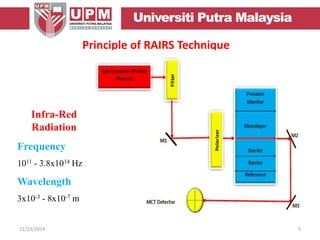
Principle of RAIRS Technique
12/23/2014 5
Infra-Red
Radiation
Frequency
1011 - 3.8x10¹⁴ Hz
Wavelength
3x10⁻³ - 8x10⁻⁷ m
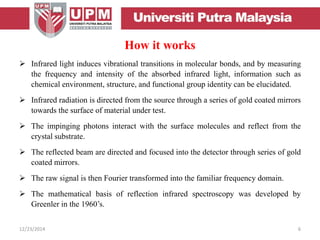
How it works
 Infrared light induces vibrational transitions in molecular bonds, and by measuring
the frequency and intensity of the absorbed infrared light, information such as
chemical environment, structure, and functional group identity can be elucidated.
 Infrared radiation is directed from the source through a series of gold coated mirrors
towards the surface of material under test.
 The impinging photons interact with the surface molecules and reflect from the
crystal substrate.
 The reflected beam are directed and focused into the detector through series of gold
coated mirrors.
 The raw signal is then Fourier transformed into the familiar frequency domain.
 The mathematical basis of reflection infrared spectroscopy was developed by
Greenler in the 1960’s.
12/23/2014 6
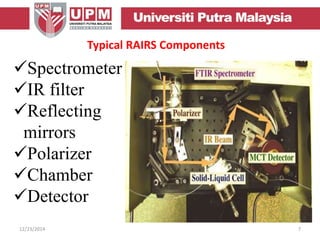
Typical RAIRS Components
12/23/2014 7
Spectrometer
IR filter
Reflecting
mirrors
Polarizer
Chamber
Detector
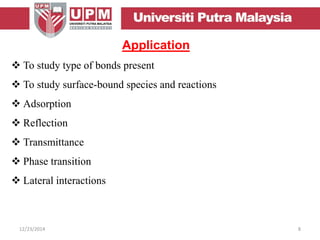
Application
 To study type of bonds present
 To study surface-bound species and reactions
 Adsorption
 Reflection
 Transmittance
 Phase transition
 Lateral interactions
12/23/2014 8
Theory
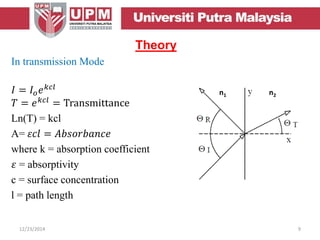
In transmission Mode
𝐼 = 𝐼 𝑜 𝑒 𝑘𝑐𝑙
𝑇 = 𝑒 𝑘𝑐𝑙
= Transmittance
Ln(T) = kcl
A= 𝜀𝑐𝑙 = 𝐴𝑏𝑠𝑜𝑟𝑏𝑎𝑛𝑐𝑒
where k = absorption coefficient
𝜀 = absorptivity
c = surface concentration
l = path length
12/23/2014 9
n1 n2
For Reflectivity
Maxwell’s equation is used for analyzing the interface of the
different refractive index (n).
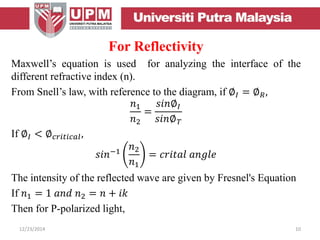
From Snell’s law, with reference to the diagram, if ∅𝐼 = ∅ 𝑅,
𝑛1
𝑛2
=
𝑠𝑖𝑛∅𝐼
𝑠𝑖𝑛∅ 𝑇
If ∅𝐼 < ∅ 𝑐𝑟𝑖𝑡𝑖𝑐𝑎𝑙,
𝑠𝑖𝑛−1
𝑛2
𝑛1
= 𝑐𝑟𝑖𝑡𝑎𝑙 𝑎𝑛𝑔𝑙𝑒
The intensity of the reflected wave are given by Fresnel's Equation
If 𝑛1 = 1 𝑎𝑛𝑑 𝑛2 = 𝑛 + 𝑖𝑘
Then for P-polarized light,
12/23/2014 10
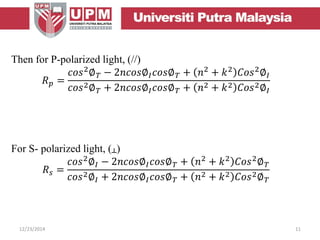
Then for P-polarized light, (//)
𝑅 𝑝 =
𝑐𝑜𝑠2∅ 𝑇 − 2𝑛𝑐𝑜𝑠∅𝐼 𝑐𝑜𝑠∅ 𝑇 + 𝑛2 + 𝑘2 𝐶𝑜𝑠2∅𝐼
𝑐𝑜𝑠2∅ 𝑇 + 2𝑛𝑐𝑜𝑠∅𝐼 𝑐𝑜𝑠∅ 𝑇 + 𝑛2 + 𝑘2 𝐶𝑜𝑠2∅𝐼
For S- polarized light, (┴)
𝑅 𝑠 =
𝑐𝑜𝑠2∅𝐼 − 2𝑛𝑐𝑜𝑠∅𝐼 𝑐𝑜𝑠∅ 𝑇 + 𝑛2 + 𝑘2 𝐶𝑜𝑠2∅ 𝑇
𝑐𝑜𝑠2∅𝐼 + 2𝑛𝑐𝑜𝑠∅𝐼 𝑐𝑜𝑠∅ 𝑇 + 𝑛2 + 𝑘2 𝐶𝑜𝑠2∅ 𝑇
12/23/2014 11
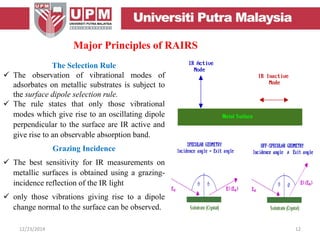
The Selection Rule
 The observation of vibrational modes of
adsorbates on metallic substrates is subject to
the surface dipole selection rule.
 The rule states that only those vibrational
modes which give rise to an oscillating dipole
perpendicular to the surface are IR active and
give rise to an observable absorption band.
Grazing Incidence
 The best sensitivity for IR measurements on
metallic surfaces is obtained using a grazing-
incidence reflection of the IR light
 only those vibrations giving rise to a dipole
change normal to the surface can be observed.
Major Principles of RAIRS
12/23/2014 12
P-polarized Light
12/23/2014 13
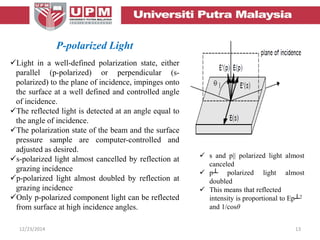
Light in a well-defined polarization state, either
parallel (p-polarized) or perpendicular (s-
polarized) to the plane of incidence, impinges onto
the surface at a well defined and controlled angle
of incidence.
The reflected light is detected at an angle equal to
the angle of incidence.
The polarization state of the beam and the surface
pressure sample are computer-controlled and
adjusted as desired.
s-polarized light almost cancelled by reflection at
grazing incidence
p-polarized light almost doubled by reflection at
grazing incidence
Only p-polarized component light can be reflected
from surface at high incidence angles.
 s and p|| polarized light almost
canceled
 p┴ polarized light almost
doubled
 This means that reflected
intensity is proportional to Ep┴2
and 1/cosθ
Examples of RAIRS Spectral
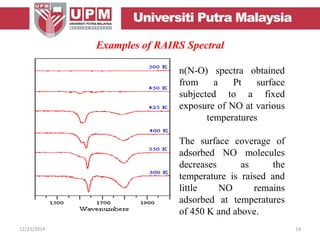
n(N-O) spectra obtained
from a Pt surface
subjected to a fixed
exposure of NO at various
temperatures
The surface coverage of
adsorbed NO molecules
decreases as the
temperature is raised and
little NO remains
adsorbed at temperatures
of 450 K and above.
12/23/2014 14
Examples
12/23/2014 15
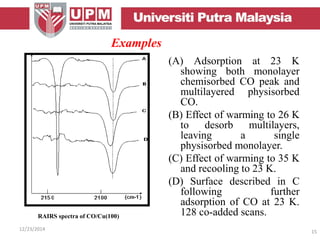
(A) Adsorption at 23 K
showing both monolayer
chemisorbed CO peak and
multilayered physisorbed
CO.
(B) Effect of warming to 26 K
to desorb multilayers,
leaving a single
physisorbed monolayer.
(C) Effect of warming to 35 K
and recooling to 23 K.
(D) Surface described in C
following further
adsorption of CO at 23 K.
128 co-added scans.RAIRS spectra of CO/Cu(100)
Limitations
 Successful finger printing
techniques for complex
functional groups at surfaces
 Molecular state, orientation and
binding site accessible
 Excellent RAIRS resolution
reveals even small shifts due to
phase transitions, lateral
interactions or dynamics of
coupling
 RAIRS may operate at ambient
pressure (catalysis!).
12/23/2014 16
 the signal is usually very
weak owing to the small
number of absorbing
molecules
 Only dipole active modes
visible in RAIRS/dipole-
scattering
 Coverage quantitation
difficult
 Low-energy frustrated
modes not accessible to
RAIRS
 RAIRS requires strong
dynamic dipole moment
(almost exclusively applied
to CO adsorption)
Advantages
12/23/2014 17
Conclusion
Photons is the source of probe in RAIRS analysis and the probe
energy is low in RAIRS instrumentation.
RAIRS is primarly used to study type of bonds, surface-bound
species and reactions, adsorption, reflection, transmittance, phase
transition, lateral interactions.
RAIRS have good energy resolution (<2 cm-1) which is useful for
separating multiple peaks.
RAIRS is a straight forward instrumentation which is not restricted
to surfaces in vacuum.
12/23/2014 18
Bibliography
12/23/2014 19
 1. Mendelsohn, R., Mao, G., & Flach, C. R. (2010). Infrared reflection–absorption
spectroscopy: principles and applications to lipid–protein interaction in Langmuir films.
Biochimica et Biophysica Acta (BBA)-Biomembranes, 1798(4), 788-800.
 2. http://www-jenkins.ch.cam.ac.uk/, Reflection Absorption Infra-Red Spectroscopy
(RAIRS), Chemistry Department University of Cambridge, Uk
 3. Mendelsohn, R., & Flach, C. R. (2002). Infrared Reflection–Absorption
Spectrometry of Monolayer Films at the Air–Water Interface. Handbook of vibrational
spectroscopy.
 4. Greenler, R. G. (1975). Design of a reflection–absorption experiment for studying the
ir spectrum of molecules adsorbed on a metal surface. Journal of Vacuum Science and
Technology, 12(6), 1410-1417.
 5. Hoffmann, F. M. (1983). Infrared reflection-absorption spectroscopy of adsorbed
molecules. Surface Science Reports, 3(2), 107-192.
 6. Primera-Pedrozo, O. M., Soto-Feliciano, Y. M., Pacheco-Londoño, L. C., &
Hernández-Rivera, S. P. (2009). Detection of high explosives using reflection
absorption infrared spectroscopy with fiber coupled grazing angle probe/FTIR.Sensing
and Imaging: An International Journal, 10(1-2), 1-13.
 J.C. Cook, S.K. Clowes and E.M. McCash, J. Chem. Soc. Faraday Trans 93 (1997)
2315)

Reflection absorption Infrared Spectroscopy (RAIRS)

  • 1.
    VIBRATIONAL SPECTROSCOPY: REFLECTION, ABSORPTIONINFRA-RED SPECTROSCOPY (RAIRS). AN OVERVIEW By Abubakar Yakubu (Research Group Leader) Ammar Abd Ali, Ali Mohammed, Aini Zafar 12/23/2014 1
  • 2.
    What is Spectroscopy Historically,spectroscopy originated through the study of visible light dispersed according to its wavelength, by a prism Spectroscopy is probing the unknown so as to understand phenomena that are not visible to the ordinary eyes or any interaction with radiative energy as a function of its wavelength. Probing in most prominent characterisation techniques are achieved by using photons, electrons, and neutrons. The probing energy range for photons is 100-500Mev, neutrons is 1-300MeV and electrons is 1-10eV 12/23/2014 2
  • 3.
    What is RAIRS The acronym RAIRS means; Reflection Absorption Infra- red Spectroscopy.  Provides the most definitive means of identifying the surface species generated upon molecular adsorption and the species generated by surface reactions.  Used to obtain vibrational data from solid state or gas phase samples • Excellent energy resolution (<2 cm-1) - useful for separating multiple peaks, phase transitions, lateral interactions, and dynamics of coupling. • Straight forward instrumentation • Not restricted to surfaces in vacuum - can be used in "real world" conditions12/23/2014 3
  • 4.
    Best sensitivity forobserving an adsorption feature in RAIRS • - p-polarized light • - grazing incidence • - molecule with transition dipole arranged along surface normal (Selection rule) • - molecule with large transition moment 12/23/2014 4
  • 5.
    Principle of RAIRSTechnique 12/23/2014 5 Infra-Red Radiation Frequency 1011 - 3.8x10¹⁴ Hz Wavelength 3x10⁻³ - 8x10⁻⁷ m
  • 6.
    How it works Infrared light induces vibrational transitions in molecular bonds, and by measuring the frequency and intensity of the absorbed infrared light, information such as chemical environment, structure, and functional group identity can be elucidated.  Infrared radiation is directed from the source through a series of gold coated mirrors towards the surface of material under test.  The impinging photons interact with the surface molecules and reflect from the crystal substrate.  The reflected beam are directed and focused into the detector through series of gold coated mirrors.  The raw signal is then Fourier transformed into the familiar frequency domain.  The mathematical basis of reflection infrared spectroscopy was developed by Greenler in the 1960’s. 12/23/2014 6
  • 7.
    Typical RAIRS Components 12/23/20147 Spectrometer IR filter Reflecting mirrors Polarizer Chamber Detector
  • 8.
    Application  To studytype of bonds present  To study surface-bound species and reactions  Adsorption  Reflection  Transmittance  Phase transition  Lateral interactions 12/23/2014 8
  • 9.
    Theory In transmission Mode 𝐼= 𝐼 𝑜 𝑒 𝑘𝑐𝑙 𝑇 = 𝑒 𝑘𝑐𝑙 = Transmittance Ln(T) = kcl A= 𝜀𝑐𝑙 = 𝐴𝑏𝑠𝑜𝑟𝑏𝑎𝑛𝑐𝑒 where k = absorption coefficient 𝜀 = absorptivity c = surface concentration l = path length 12/23/2014 9 n1 n2
  • 10.
    For Reflectivity Maxwell’s equationis used for analyzing the interface of the different refractive index (n). From Snell’s law, with reference to the diagram, if ∅𝐼 = ∅ 𝑅, 𝑛1 𝑛2 = 𝑠𝑖𝑛∅𝐼 𝑠𝑖𝑛∅ 𝑇 If ∅𝐼 < ∅ 𝑐𝑟𝑖𝑡𝑖𝑐𝑎𝑙, 𝑠𝑖𝑛−1 𝑛2 𝑛1 = 𝑐𝑟𝑖𝑡𝑎𝑙 𝑎𝑛𝑔𝑙𝑒 The intensity of the reflected wave are given by Fresnel's Equation If 𝑛1 = 1 𝑎𝑛𝑑 𝑛2 = 𝑛 + 𝑖𝑘 Then for P-polarized light, 12/23/2014 10
  • 11.
    Then for P-polarizedlight, (//) 𝑅 𝑝 = 𝑐𝑜𝑠2∅ 𝑇 − 2𝑛𝑐𝑜𝑠∅𝐼 𝑐𝑜𝑠∅ 𝑇 + 𝑛2 + 𝑘2 𝐶𝑜𝑠2∅𝐼 𝑐𝑜𝑠2∅ 𝑇 + 2𝑛𝑐𝑜𝑠∅𝐼 𝑐𝑜𝑠∅ 𝑇 + 𝑛2 + 𝑘2 𝐶𝑜𝑠2∅𝐼 For S- polarized light, (┴) 𝑅 𝑠 = 𝑐𝑜𝑠2∅𝐼 − 2𝑛𝑐𝑜𝑠∅𝐼 𝑐𝑜𝑠∅ 𝑇 + 𝑛2 + 𝑘2 𝐶𝑜𝑠2∅ 𝑇 𝑐𝑜𝑠2∅𝐼 + 2𝑛𝑐𝑜𝑠∅𝐼 𝑐𝑜𝑠∅ 𝑇 + 𝑛2 + 𝑘2 𝐶𝑜𝑠2∅ 𝑇 12/23/2014 11
  • 12.
    The Selection Rule The observation of vibrational modes of adsorbates on metallic substrates is subject to the surface dipole selection rule.  The rule states that only those vibrational modes which give rise to an oscillating dipole perpendicular to the surface are IR active and give rise to an observable absorption band. Grazing Incidence  The best sensitivity for IR measurements on metallic surfaces is obtained using a grazing- incidence reflection of the IR light  only those vibrations giving rise to a dipole change normal to the surface can be observed. Major Principles of RAIRS 12/23/2014 12
  • 13.
    P-polarized Light 12/23/2014 13 Lightin a well-defined polarization state, either parallel (p-polarized) or perpendicular (s- polarized) to the plane of incidence, impinges onto the surface at a well defined and controlled angle of incidence. The reflected light is detected at an angle equal to the angle of incidence. The polarization state of the beam and the surface pressure sample are computer-controlled and adjusted as desired. s-polarized light almost cancelled by reflection at grazing incidence p-polarized light almost doubled by reflection at grazing incidence Only p-polarized component light can be reflected from surface at high incidence angles.  s and p|| polarized light almost canceled  p┴ polarized light almost doubled  This means that reflected intensity is proportional to Ep┴2 and 1/cosθ
  • 14.
    Examples of RAIRSSpectral n(N-O) spectra obtained from a Pt surface subjected to a fixed exposure of NO at various temperatures The surface coverage of adsorbed NO molecules decreases as the temperature is raised and little NO remains adsorbed at temperatures of 450 K and above. 12/23/2014 14
  • 15.
    Examples 12/23/2014 15 (A) Adsorptionat 23 K showing both monolayer chemisorbed CO peak and multilayered physisorbed CO. (B) Effect of warming to 26 K to desorb multilayers, leaving a single physisorbed monolayer. (C) Effect of warming to 35 K and recooling to 23 K. (D) Surface described in C following further adsorption of CO at 23 K. 128 co-added scans.RAIRS spectra of CO/Cu(100)
  • 16.
    Limitations  Successful fingerprinting techniques for complex functional groups at surfaces  Molecular state, orientation and binding site accessible  Excellent RAIRS resolution reveals even small shifts due to phase transitions, lateral interactions or dynamics of coupling  RAIRS may operate at ambient pressure (catalysis!). 12/23/2014 16  the signal is usually very weak owing to the small number of absorbing molecules  Only dipole active modes visible in RAIRS/dipole- scattering  Coverage quantitation difficult  Low-energy frustrated modes not accessible to RAIRS  RAIRS requires strong dynamic dipole moment (almost exclusively applied to CO adsorption) Advantages
  • 17.
    12/23/2014 17 Conclusion Photons isthe source of probe in RAIRS analysis and the probe energy is low in RAIRS instrumentation. RAIRS is primarly used to study type of bonds, surface-bound species and reactions, adsorption, reflection, transmittance, phase transition, lateral interactions. RAIRS have good energy resolution (<2 cm-1) which is useful for separating multiple peaks. RAIRS is a straight forward instrumentation which is not restricted to surfaces in vacuum.
  • 18.
  • 19.
    Bibliography 12/23/2014 19  1.Mendelsohn, R., Mao, G., & Flach, C. R. (2010). Infrared reflection–absorption spectroscopy: principles and applications to lipid–protein interaction in Langmuir films. Biochimica et Biophysica Acta (BBA)-Biomembranes, 1798(4), 788-800.  2. http://www-jenkins.ch.cam.ac.uk/, Reflection Absorption Infra-Red Spectroscopy (RAIRS), Chemistry Department University of Cambridge, Uk  3. Mendelsohn, R., & Flach, C. R. (2002). Infrared Reflection–Absorption Spectrometry of Monolayer Films at the Air–Water Interface. Handbook of vibrational spectroscopy.  4. Greenler, R. G. (1975). Design of a reflection–absorption experiment for studying the ir spectrum of molecules adsorbed on a metal surface. Journal of Vacuum Science and Technology, 12(6), 1410-1417.  5. Hoffmann, F. M. (1983). Infrared reflection-absorption spectroscopy of adsorbed molecules. Surface Science Reports, 3(2), 107-192.  6. Primera-Pedrozo, O. M., Soto-Feliciano, Y. M., Pacheco-Londoño, L. C., & Hernández-Rivera, S. P. (2009). Detection of high explosives using reflection absorption infrared spectroscopy with fiber coupled grazing angle probe/FTIR.Sensing and Imaging: An International Journal, 10(1-2), 1-13.  J.C. Cook, S.K. Clowes and E.M. McCash, J. Chem. Soc. Faraday Trans 93 (1997) 2315)