GAS CHROMATOGRAPHY
SHALET K S
Asst. Prof
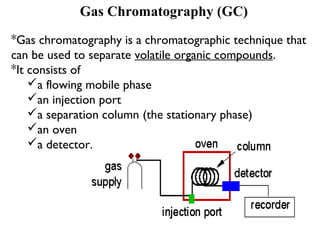
Gas Chromatography (GC)
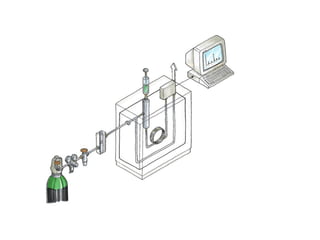
*Gas chromatography is a chromatographic technique that
can be used to separate volatile organic compounds.
*It consists of
a flowing mobile phase
an injection port
a separation column (the stationary phase)
an oven
a detector.
Gas chromatography is a technique used for separation
of volatile substances, or substances that can be made volatile,
from one another in a gaseous mixture at high temperatures.
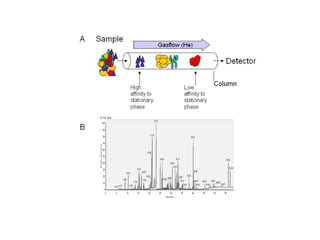
A sample containing the materials to be separated is injected
into the gas chromatograph. A mobile phase (carrier gas)
moves through a column that contains a wall coated or
granular solid coated stationary phase. As the carrier gas
flows through the column, the components of the sample
come in contact with the stationary phase. The different
components of the sample have different affinities for the
stationary phase, which results in differential migration of
solutes, thus leading to separation
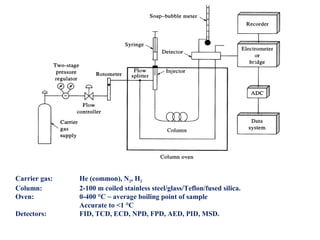
Carrier gas: He (common), N2, H2
Column: 2-100 m coiled stainless steel/glass/Teflon/fused silica.
Oven: 0-400 °C ~ average boiling point of sample
Accurate to <1 °C
Detectors: FID, TCD, ECD, NPD, FPD, AED, PID, MSD.
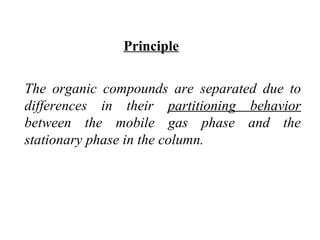
The organic compounds are separated due to
differences in their partitioning behavior
between the mobile gas phase and the
stationary phase in the column.
Principle
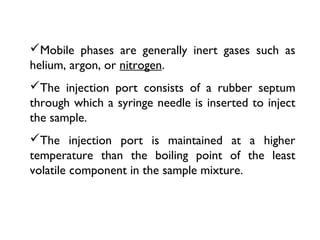
Mobile phases are generally inert gases such as
helium, argon, or nitrogen.
The injection port consists of a rubber septum
through which a syringe needle is inserted to inject
the sample.
The injection port is maintained at a higher
temperature than the boiling point of the least
volatile component in the sample mixture.
Since the partitioning behavior is dependent on
temperature, the separation column is usually
contained in a thermostat-controlled oven.
Separating components with a wide range of boiling
points is accomplished by starting at a low oven
temperature and increasing the temperature over
time to elute the high-boiling point components.
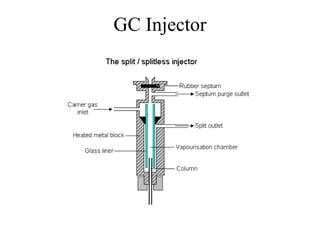
GC Injector
• Here it is important that the sample be injected onto the column as
a plug and of a suitable size. Also, the injector should provide
consistent and reproducible injections.
• The micro-syringe is used to load the sample onto the column.
The syringe should be clean and accurate and gas tight. The syringe
is injected through a rubber septum.
• The septum should be replaced after many injections to insure gas
tightness onto the column. An auto sampler can be used to inject
the samples.
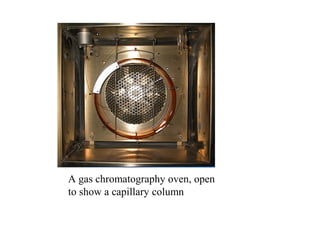
A gas chromatography oven, open
to show a capillary column
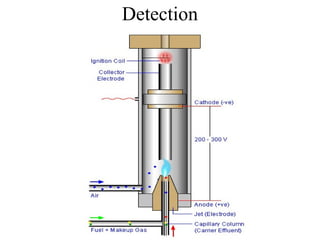
Detection
FID (flame ionization detector) is the most widely used detector.
The effluent from the column is mixed with hydrogen and air,
and ignited. Organic compounds burning in the flame produce ions
and electrons which can conduct electricity through the flame. A
large electrical potential is applied at the burner tip, and a
collector electrode is located above the flame.
The current resulting from the pyrolysis of any organic
compounds is measured. The FID is a useful general detector for
the analysis of organic compounds; it has high sensitivity, a large
linear response range, and low noise. It is also robust and easy to
use, but unfortunately, it destroys the sample.
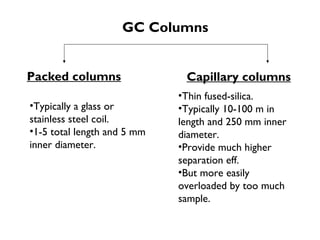
GC Columns
Capillary columnsPacked columns
•Typically a glass or
stainless steel coil.
•1-5 total length and 5 mm
inner diameter.
•Thin fused-silica.
•Typically 10-100 m in
length and 250 mm inner
diameter.
•Provide much higher
separation eff.
•But more easily
overloaded by too much
sample.
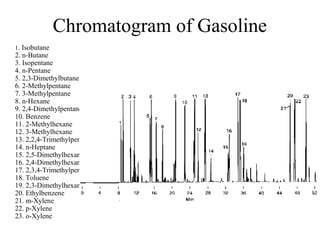
1. Isobutane
2. n-Butane
3. Isopentane
4. n-Pentane
5. 2,3-Dimethylbutane
6. 2-Methylpentane
7. 3-Methylpentane
8. n-Hexane
9. 2,4-Dimethylpentane
10. Benzene
11. 2-Methylhexane
12. 3-Methylhexane
13. 2,2,4-Trimethylpentane
14. n-Heptane
15. 2,5-Dimethylhexane
16. 2,4-Dimethylhexane
17. 2,3,4-Trimethylpentane
18. Toluene
19. 2,3-Dimethylhexane
20. Ethylbenzene
21. m-Xylene
22. p-Xylene
23. o-Xylene
Chromatogram of Gasoline

Gas chromatography

  • 1.
  • 2.
    Gas Chromatography (GC) *Gaschromatography is a chromatographic technique that can be used to separate volatile organic compounds. *It consists of a flowing mobile phase an injection port a separation column (the stationary phase) an oven a detector.
  • 3.
    Gas chromatography isa technique used for separation of volatile substances, or substances that can be made volatile, from one another in a gaseous mixture at high temperatures. A sample containing the materials to be separated is injected into the gas chromatograph. A mobile phase (carrier gas) moves through a column that contains a wall coated or granular solid coated stationary phase. As the carrier gas flows through the column, the components of the sample come in contact with the stationary phase. The different components of the sample have different affinities for the stationary phase, which results in differential migration of solutes, thus leading to separation
  • 4.
    Carrier gas: He(common), N2, H2 Column: 2-100 m coiled stainless steel/glass/Teflon/fused silica. Oven: 0-400 °C ~ average boiling point of sample Accurate to <1 °C Detectors: FID, TCD, ECD, NPD, FPD, AED, PID, MSD.
  • 7.
    The organic compoundsare separated due to differences in their partitioning behavior between the mobile gas phase and the stationary phase in the column. Principle
  • 8.
    Mobile phases aregenerally inert gases such as helium, argon, or nitrogen. The injection port consists of a rubber septum through which a syringe needle is inserted to inject the sample. The injection port is maintained at a higher temperature than the boiling point of the least volatile component in the sample mixture.
  • 9.
    Since the partitioningbehavior is dependent on temperature, the separation column is usually contained in a thermostat-controlled oven. Separating components with a wide range of boiling points is accomplished by starting at a low oven temperature and increasing the temperature over time to elute the high-boiling point components.
  • 10.
  • 11.
    • Here itis important that the sample be injected onto the column as a plug and of a suitable size. Also, the injector should provide consistent and reproducible injections. • The micro-syringe is used to load the sample onto the column. The syringe should be clean and accurate and gas tight. The syringe is injected through a rubber septum. • The septum should be replaced after many injections to insure gas tightness onto the column. An auto sampler can be used to inject the samples.
  • 12.
    A gas chromatographyoven, open to show a capillary column
  • 13.
  • 14.
    FID (flame ionizationdetector) is the most widely used detector. The effluent from the column is mixed with hydrogen and air, and ignited. Organic compounds burning in the flame produce ions and electrons which can conduct electricity through the flame. A large electrical potential is applied at the burner tip, and a collector electrode is located above the flame. The current resulting from the pyrolysis of any organic compounds is measured. The FID is a useful general detector for the analysis of organic compounds; it has high sensitivity, a large linear response range, and low noise. It is also robust and easy to use, but unfortunately, it destroys the sample.
  • 17.
    GC Columns Capillary columnsPackedcolumns •Typically a glass or stainless steel coil. •1-5 total length and 5 mm inner diameter. •Thin fused-silica. •Typically 10-100 m in length and 250 mm inner diameter. •Provide much higher separation eff. •But more easily overloaded by too much sample.
  • 18.
    1. Isobutane 2. n-Butane 3.Isopentane 4. n-Pentane 5. 2,3-Dimethylbutane 6. 2-Methylpentane 7. 3-Methylpentane 8. n-Hexane 9. 2,4-Dimethylpentane 10. Benzene 11. 2-Methylhexane 12. 3-Methylhexane 13. 2,2,4-Trimethylpentane 14. n-Heptane 15. 2,5-Dimethylhexane 16. 2,4-Dimethylhexane 17. 2,3,4-Trimethylpentane 18. Toluene 19. 2,3-Dimethylhexane 20. Ethylbenzene 21. m-Xylene 22. p-Xylene 23. o-Xylene Chromatogram of Gasoline