GARDEN CITIES
-SIR EBENEZER HOWARD
PRESENTED BY -
318106101020– T. SAI KRISHNA
318106101029- H.DURGA BHAVANI
3/5 B.ARCH
A.U.C.E
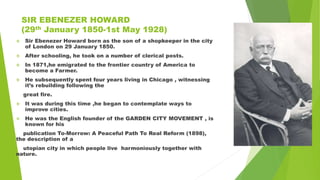
SIR EBENEZER HOWARD
(29th January 1850-1st May 1928)
 Sir Ebenezer Howard born as the son of a shopkeeper in the city
of London on 29 January 1850.
 After schooling, he took on a number of clerical posts.
 In 1871,he emigrated to the frontier country of America to
become a Farmer.
 He subsequently spent four years living in Chicago , witnessing
it’s rebuilding following the
great fire.
 It was during this time ,he began to contemplate ways to
improve cities.
 He was the English founder of the GARDEN CITY MOVEMENT , is
known for his
publication To-Morrow: A Peaceful Path To Real Reform (1898),
the description of a
utopian city in which people live harmoniously together with
nature.
GARDEN CITY MOVEMENT:THE
ORIGIN
 Howard was heavily influenced by the utopian visions of
Edward Bellamy and his publication Looking Backward
(1888).
 The ideas put forth in To-morrow were a synthesis of his
personal experiences and the works of others.
 The publication resulted in the founding of the garden
city movement , that realized several Garden Cities in
Great Britain at the beginning of the 20th century.
 The first garden cities proposed were Letchworth and
Welwyn in 1903 and 1920 respectively.
Core Garden City Principles
 Strong community
 Ordered development
 Environmental quality
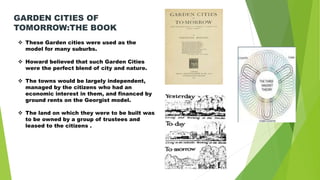
GARDEN CITIES OF
TOMORROW:THE BOOK
 This book offered a vision of towns free of
slums and enjoying the benefits of both
town(such as opportunity, amusement and
good wages) and country (such as beauty ,
fresh air and low rents).
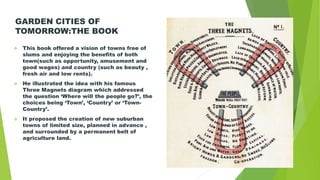
 He illustrated the idea with his famous
Three Magnets diagram which addressed
the question ‘Where will the people go?’, the
choices being ‘Town’, ‘Country’ or ‘Town-
Country’.
 It proposed the creation of new suburban
towns of limited size, planned in advance ,
and surrounded by a permanent belt of
agriculture land.
 These Garden cities were used as the
model for many suburbs.
 Howard believed that such Garden Cities
were the perfect blend of city and nature.
 The towns would be largely independent,
managed by the citizens who had an
economic interest in them, and financed by
ground rents on the Georgist model.
 The land on which they were to be built was
to be owned by a group of trustees and
leased to the citizens .
GARDEN CITIES OF
TOMORROW:THE BOOK
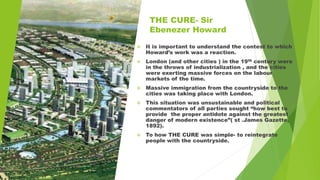
THE CURE- Sir
Ebenezer Howard
 It is important to understand the contest to which
Howard’s work was a reaction.
 London (and other cities ) in the 19th century were
in the throws of industrialization , and the cities
were exerting massive forces on the labour
markets of the time.
 Massive immigration from the countryside to the
cities was taking place with London.
 This situation was unsustainable and political
commentators of all parties sought “how best to
provide the proper antidote against the greatest
danger of modern existence”( st .James Gazette,
1892).
 To how THE CURE was simple- to reintegrate
people with the countryside.
 In trying to understand and represent the attraction of the city he compared
each city to a magnet with individuals represented as needles drawn to the city.
 He set about comparing the ‘town and the country magnets’ but decided that
neither were suitable atrractors for his utopian vision.
 Instead he believed that “ Human society and the beauty of nature are meant to
be enjoyed together” – hence giving his solution “the two magnets must be made
one”
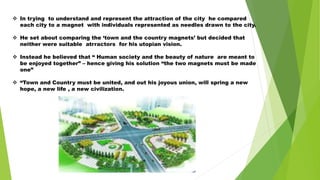
 “Town and Country must be united, and out his joyous union, will spring a new
hope, a new life , a new civilization.
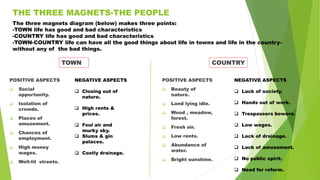
THE THREE MAGNETS-THE PEOPLE
TOWN
POSITIVE ASPECTS
 Social
opportunity.
 Isolation of
crowds.
 Places of
amusement.
 Chances of
employment.
 High money
wages.
 Well-lit streets.
COUNTRY
POSITIVE ASPECTS
 Beauty of
nature.
 Land lying idle.
 Wood , meadow,
forest.
 Fresh air.
 Low rents.
 Abundance of
water.
 Bright sunshine.
The three magnets diagram (below) makes three points:
-TOWN life has good and bad characteristics
-COUNTRY life has good and bad characteristics
-TOWN-COUNTRY life can have all the good things about life in towns and life in the country-
without any of the bad things.
NEGATIVE ASPECTS
 Lack of society.
 Hands out of work.
 Trespassers beware.
 Low wages.
 Lack of drainage.
 Lack of amusement.
 No public spirit.
 Need for reform.
NEGATIVE ASPECTS
 Closing out of
nature.
 High rents &
prices.
 Foul air and
murky sky.
 Slums & gin
palaces.
 Costly drainage.
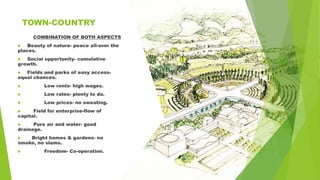
TOWN-COUNTRY
COMBINATION OF BOTH ASPECTS
 Beauty of nature- peace all-over the
places.
 Social opportunity- cumulative
growth.
 Fields and parks of easy access-
equal chances.
 Low rents- high wages.
 Low rates- plenty to do.
 Low prices- no sweating.
 Field for enterprise-flow of
capital.
 Pure air and water- good
drainage.
 Bright homes & gardens- no
smoke, no slums.
 Freedom- Co-operation.
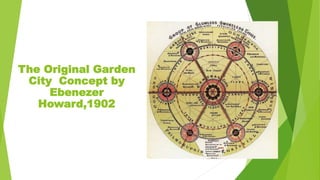
The Original Garden
City Concept by
Ebenezer
Howard,1902
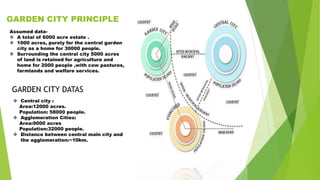
GARDEN CITY PRINCIPLE
Assumed data-
 A total of 6000 acre estate .
 1000 acres, purely for the central garden
city as a home for 30000 people.
 Surrounding the central city 5000 acres
of land is retained for agriculture and
home for 2000 people ,with cow pastures,
farmlands and welfare services.
GARDEN CITY DATAS
 Central city :
Area:12000 acres.
Population: 58000 people.
 Agglomeration Cities:
Area:9000 acres
Population:32000 people.
 Distance between central main city and
the agglomeration:~10km.
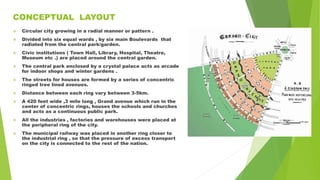
CONCEPTUAL LAYOUT
 Circular city growing in a radial manner or pattern .
 Divided into six equal wards , by six main Boulevards that
radiated from the central park/garden.
 Civic institutions ( Town Hall, Library, Hospital, Theatre,
Museum etc .) are placed around the central garden.
 The central park enclosed by a crystal palace acts as arcade
for indoor shops and winter gardens .
 The streets for houses are formed by a series of concentric
ringed tree lined avenues.
 Distance between each ring vary between 3-5km.
 A 420 feet wide ,3 mile long , Grand avenue which run in the
center of concentric rings, houses the schools and churches
and acts as a continuous public park.
 All the industries , factories and warehouses were placed at
the peripheral ring of the city.
 The municipal railway was placed in another ring closer to
the industrial ring , so that the pressure of excess transport
on the city is connected to the rest of the nation.
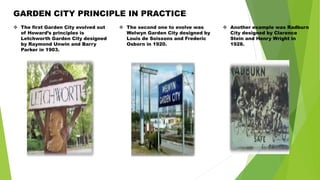
GARDEN CITY PRINCIPLE IN PRACTICE
 The first Garden City evolved out
of Howard’s principles is
Letchworth Garden City designed
by Raymond Unwin and Barry
Parker in 1903.
 The second one to evolve was
Welwyn Garden City designed by
Louis de Soissons and Frederic
Osborn in 1920.
 Another example was Radburn
City designed by Clarence
Stein and Henry Wright in
1928.
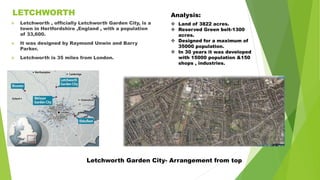
LETCHWORTH
 Letchworth , officially Letchworth Garden City, is a
town in Hertfordshire ,England , with a population
of 33,600.
 It was designed by Raymond Unwin and Barry
Parker.
 Letchworth is 35 miles from London.
Analysis:
 Land of 3822 acres.
 Reserved Green belt-1300
acres.
 Designed for a maximum of
35000 population.
 In 30 years it was developed
with 15000 population &150
shops , industries.
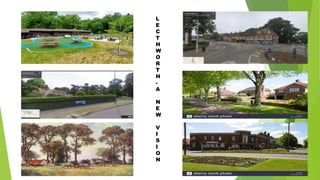
Letchworth Garden City- Arrangement from top
L
E
C
T
H
W
O
R
T
H
-
A
N
E
W
V
I
S
I
O
N
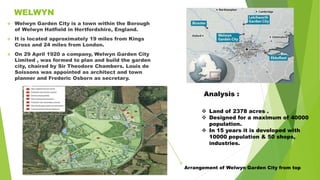
WELWYN
 Welwyn Garden City is a town within the Borough
of Welwyn Hatfield in Hertfordshire, England.
 It is located approximately 19 miles from Kings
Cross and 24 miles from London.
 On 29 April 1920 a company, Welwyn Garden City
Limited , was formed to plan and build the garden
city, chaired by Sir Theodore Chambers. Louis de
Soissons was appointed as architect and town
planner and Frederic Osborn as secretary.
Analysis :
 Land of 2378 acres .
 Designed for a maximum of 40000
population.
 In 15 years it is developed with
10000 population & 50 shops,
industries.
Arrangement of Welwyn Garden City from top
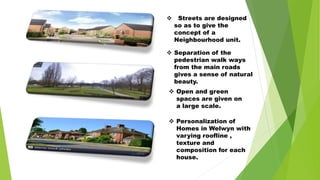
 Streets are designed
so as to give the
concept of a
Neighbourhood unit.
 Separation of the
pedestrian walk ways
from the main roads
gives a sense of natural
beauty.
 Open and green
spaces are given on
a large scale.
 Personalization of
Homes in Welwyn with
varying roofline ,
texture and
composition for each
house.
RADBURN , NEW JERSEY
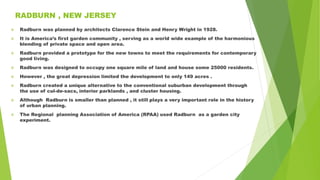
 Radburn was planned by architects Clarence Stein and Henry Wright in 1928.
 It is America’s first garden community , serving as a world wide example of the harmonious
blending of private space and open area.
 Radburn provided a prototype for the new towns to meet the requirements for contemporary
good living.
 Radburn was designed to occupy one square mile of land and house some 25000 residents.
 However , the great depression limited the development to only 149 acres .
 Radburn created a unique alternative to the conventional suburban development through
the use of cul-de-sacs, interior parklands , and cluster housing.
 Although Radburn is smaller than planned , it still plays a very important role in the history
of urban planning.
 The Regional planning Association of America (RPAA) used Radburn as a garden city
experiment.
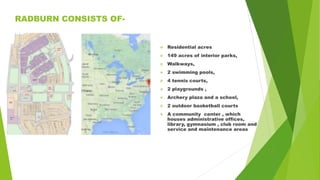
RADBURN CONSISTS OF-
 Residential acres
 149 acres of interior parks,
 Walkways,
 2 swimming pools,
 4 tennis courts,
 2 playgrounds ,
 Archery plaza and a school,
 2 outdoor basketball courts
 A community center , which
houses administrative offices,
library, gymnasium , club room and
service and maintenance areas
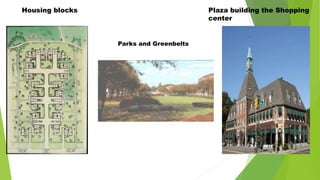
Housing blocks
Parks and Greenbelts
Plaza building the Shopping
center
CONCLUSION :
 Ebenezer Howard’s Garden City concept shows us a place where
genuine urban activities are carried at human scale .
 The garden city introduced the use of greenbelts that have served many
uses including the presence of agricultural and rural life, nature and
heritage conservation, recreation , pollution minimization , and growth
management.
 Garden city tradition endowed urban planning with a social and
community dimensions.
 The garden city idea however , showed how both industrial estates and
collective retailing spaces could be used within a comprehensive
planning approach to serve public purposes.
THANK YOU

Garden cities

  • 1.
    GARDEN CITIES -SIR EBENEZERHOWARD PRESENTED BY - 318106101020– T. SAI KRISHNA 318106101029- H.DURGA BHAVANI 3/5 B.ARCH A.U.C.E
  • 2.
    SIR EBENEZER HOWARD (29thJanuary 1850-1st May 1928)  Sir Ebenezer Howard born as the son of a shopkeeper in the city of London on 29 January 1850.  After schooling, he took on a number of clerical posts.  In 1871,he emigrated to the frontier country of America to become a Farmer.  He subsequently spent four years living in Chicago , witnessing it’s rebuilding following the great fire.  It was during this time ,he began to contemplate ways to improve cities.  He was the English founder of the GARDEN CITY MOVEMENT , is known for his publication To-Morrow: A Peaceful Path To Real Reform (1898), the description of a utopian city in which people live harmoniously together with nature.
  • 3.
    GARDEN CITY MOVEMENT:THE ORIGIN Howard was heavily influenced by the utopian visions of Edward Bellamy and his publication Looking Backward (1888).  The ideas put forth in To-morrow were a synthesis of his personal experiences and the works of others.  The publication resulted in the founding of the garden city movement , that realized several Garden Cities in Great Britain at the beginning of the 20th century.  The first garden cities proposed were Letchworth and Welwyn in 1903 and 1920 respectively. Core Garden City Principles  Strong community  Ordered development  Environmental quality
  • 4.
    GARDEN CITIES OF TOMORROW:THEBOOK  This book offered a vision of towns free of slums and enjoying the benefits of both town(such as opportunity, amusement and good wages) and country (such as beauty , fresh air and low rents).  He illustrated the idea with his famous Three Magnets diagram which addressed the question ‘Where will the people go?’, the choices being ‘Town’, ‘Country’ or ‘Town- Country’.  It proposed the creation of new suburban towns of limited size, planned in advance , and surrounded by a permanent belt of agriculture land.
  • 5.
     These Gardencities were used as the model for many suburbs.  Howard believed that such Garden Cities were the perfect blend of city and nature.  The towns would be largely independent, managed by the citizens who had an economic interest in them, and financed by ground rents on the Georgist model.  The land on which they were to be built was to be owned by a group of trustees and leased to the citizens . GARDEN CITIES OF TOMORROW:THE BOOK
  • 6.
    THE CURE- Sir EbenezerHoward  It is important to understand the contest to which Howard’s work was a reaction.  London (and other cities ) in the 19th century were in the throws of industrialization , and the cities were exerting massive forces on the labour markets of the time.  Massive immigration from the countryside to the cities was taking place with London.  This situation was unsustainable and political commentators of all parties sought “how best to provide the proper antidote against the greatest danger of modern existence”( st .James Gazette, 1892).  To how THE CURE was simple- to reintegrate people with the countryside.
  • 7.
     In tryingto understand and represent the attraction of the city he compared each city to a magnet with individuals represented as needles drawn to the city.  He set about comparing the ‘town and the country magnets’ but decided that neither were suitable atrractors for his utopian vision.  Instead he believed that “ Human society and the beauty of nature are meant to be enjoyed together” – hence giving his solution “the two magnets must be made one”  “Town and Country must be united, and out his joyous union, will spring a new hope, a new life , a new civilization.
  • 8.
    THE THREE MAGNETS-THEPEOPLE TOWN POSITIVE ASPECTS  Social opportunity.  Isolation of crowds.  Places of amusement.  Chances of employment.  High money wages.  Well-lit streets. COUNTRY POSITIVE ASPECTS  Beauty of nature.  Land lying idle.  Wood , meadow, forest.  Fresh air.  Low rents.  Abundance of water.  Bright sunshine. The three magnets diagram (below) makes three points: -TOWN life has good and bad characteristics -COUNTRY life has good and bad characteristics -TOWN-COUNTRY life can have all the good things about life in towns and life in the country- without any of the bad things. NEGATIVE ASPECTS  Lack of society.  Hands out of work.  Trespassers beware.  Low wages.  Lack of drainage.  Lack of amusement.  No public spirit.  Need for reform. NEGATIVE ASPECTS  Closing out of nature.  High rents & prices.  Foul air and murky sky.  Slums & gin palaces.  Costly drainage.
  • 9.
    TOWN-COUNTRY COMBINATION OF BOTHASPECTS  Beauty of nature- peace all-over the places.  Social opportunity- cumulative growth.  Fields and parks of easy access- equal chances.  Low rents- high wages.  Low rates- plenty to do.  Low prices- no sweating.  Field for enterprise-flow of capital.  Pure air and water- good drainage.  Bright homes & gardens- no smoke, no slums.  Freedom- Co-operation.
  • 10.
    The Original Garden CityConcept by Ebenezer Howard,1902
  • 11.
    GARDEN CITY PRINCIPLE Assumeddata-  A total of 6000 acre estate .  1000 acres, purely for the central garden city as a home for 30000 people.  Surrounding the central city 5000 acres of land is retained for agriculture and home for 2000 people ,with cow pastures, farmlands and welfare services. GARDEN CITY DATAS  Central city : Area:12000 acres. Population: 58000 people.  Agglomeration Cities: Area:9000 acres Population:32000 people.  Distance between central main city and the agglomeration:~10km.
  • 12.
    CONCEPTUAL LAYOUT  Circularcity growing in a radial manner or pattern .  Divided into six equal wards , by six main Boulevards that radiated from the central park/garden.  Civic institutions ( Town Hall, Library, Hospital, Theatre, Museum etc .) are placed around the central garden.  The central park enclosed by a crystal palace acts as arcade for indoor shops and winter gardens .  The streets for houses are formed by a series of concentric ringed tree lined avenues.  Distance between each ring vary between 3-5km.  A 420 feet wide ,3 mile long , Grand avenue which run in the center of concentric rings, houses the schools and churches and acts as a continuous public park.  All the industries , factories and warehouses were placed at the peripheral ring of the city.  The municipal railway was placed in another ring closer to the industrial ring , so that the pressure of excess transport on the city is connected to the rest of the nation.
  • 13.
    GARDEN CITY PRINCIPLEIN PRACTICE  The first Garden City evolved out of Howard’s principles is Letchworth Garden City designed by Raymond Unwin and Barry Parker in 1903.  The second one to evolve was Welwyn Garden City designed by Louis de Soissons and Frederic Osborn in 1920.  Another example was Radburn City designed by Clarence Stein and Henry Wright in 1928.
  • 14.
    LETCHWORTH  Letchworth ,officially Letchworth Garden City, is a town in Hertfordshire ,England , with a population of 33,600.  It was designed by Raymond Unwin and Barry Parker.  Letchworth is 35 miles from London. Analysis:  Land of 3822 acres.  Reserved Green belt-1300 acres.  Designed for a maximum of 35000 population.  In 30 years it was developed with 15000 population &150 shops , industries. Letchworth Garden City- Arrangement from top
  • 15.
  • 16.
    WELWYN  Welwyn GardenCity is a town within the Borough of Welwyn Hatfield in Hertfordshire, England.  It is located approximately 19 miles from Kings Cross and 24 miles from London.  On 29 April 1920 a company, Welwyn Garden City Limited , was formed to plan and build the garden city, chaired by Sir Theodore Chambers. Louis de Soissons was appointed as architect and town planner and Frederic Osborn as secretary. Analysis :  Land of 2378 acres .  Designed for a maximum of 40000 population.  In 15 years it is developed with 10000 population & 50 shops, industries. Arrangement of Welwyn Garden City from top
  • 17.
     Streets aredesigned so as to give the concept of a Neighbourhood unit.  Separation of the pedestrian walk ways from the main roads gives a sense of natural beauty.  Open and green spaces are given on a large scale.  Personalization of Homes in Welwyn with varying roofline , texture and composition for each house.
  • 18.
    RADBURN , NEWJERSEY  Radburn was planned by architects Clarence Stein and Henry Wright in 1928.  It is America’s first garden community , serving as a world wide example of the harmonious blending of private space and open area.  Radburn provided a prototype for the new towns to meet the requirements for contemporary good living.  Radburn was designed to occupy one square mile of land and house some 25000 residents.  However , the great depression limited the development to only 149 acres .  Radburn created a unique alternative to the conventional suburban development through the use of cul-de-sacs, interior parklands , and cluster housing.  Although Radburn is smaller than planned , it still plays a very important role in the history of urban planning.  The Regional planning Association of America (RPAA) used Radburn as a garden city experiment.
  • 19.
    RADBURN CONSISTS OF- Residential acres  149 acres of interior parks,  Walkways,  2 swimming pools,  4 tennis courts,  2 playgrounds ,  Archery plaza and a school,  2 outdoor basketball courts  A community center , which houses administrative offices, library, gymnasium , club room and service and maintenance areas
  • 20.
    Housing blocks Parks andGreenbelts Plaza building the Shopping center
  • 21.
    CONCLUSION :  EbenezerHoward’s Garden City concept shows us a place where genuine urban activities are carried at human scale .  The garden city introduced the use of greenbelts that have served many uses including the presence of agricultural and rural life, nature and heritage conservation, recreation , pollution minimization , and growth management.  Garden city tradition endowed urban planning with a social and community dimensions.  The garden city idea however , showed how both industrial estates and collective retailing spaces could be used within a comprehensive planning approach to serve public purposes.
  • 22.