SHUBHAM GAIKWAD

GANESH JAVHARE

MIS NO 111214005

MIS NO 111214011
According to the definition given by Garden Cities & Town
Planning Association in 1919
“A Garden City is a Town designed for healthy living and
industry; of a size that makes possible a full measure of
social life, but not larger; surrounded by a rural belt; the
whole of the land being in public ownership or held in trust
for the community.”
•Each a self-sufficient entity—not a dormitory suburb—of
30,000 population
•Each ringed by an agricultural belt
Sir Ebenzer Howard

(founder of the English garden-city movement,
which influenced city planning throughout the
world.)

•Howard wrote(1880 ) Tomorrow: A Peaceful
Path to Social Reform. Not published until 1898
•This work was reissued in 1902 as Garden Cites of
Tomorrow.
•Howard learned shorthand and held various jobs as a
private secretary and stenographer before becoming a
shorthand reporter in the London law courts.
•He was a liberal social reformer who was decisively
influenced by Edward Bellamy's utopian novel Looking
Backward (1889).
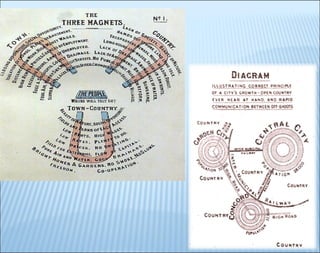
According to Howard

•Settlement would be has advantages of both urban
and the rural life styles

•Would avoid all adverse qualities that make everyday
life more difficult

•So he hoped that a town built according to Garden city
would be third magnet

•That would attract the most of the unhappy inhabitants of
the British suffocating industrial cities, and thus resolve
one of the biggest national problems of the time.
Founding of the Garden City Association, 1899, can be
considered as the first step in the application of the
Garden City theory.
In the year 1902, The Garden City Pioneer Company
was established, which, soon after, acquired the capital
needed for creation of the first Garden City by selling
the shares.
The place chosen for the First Garden City in the world
was located 50km North-East of London, on the way to
Cambridge, in Hertfordshire.
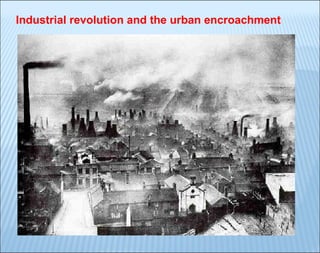
Industrial revolution and the urban encroachment
A Widely Diffused Model

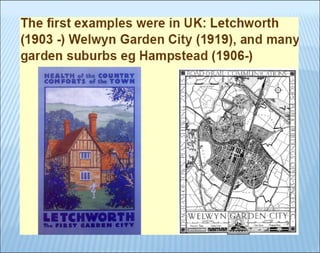
•Letchworth and Welwyn Garden City were the closest to
Howard’s
ideals
communities.

–

freestanding,

self-contained

•But

many garden suburbs applied some of Howard’s
principles to existing cities.

• Ideas soon spread to other countries, especially Europe
and USA.

•International

contacts, trade and colonialism also took
them to other parts of world.
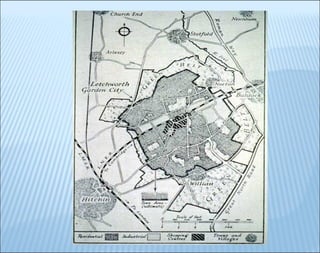
Letchworth Garden City

•As one of the world's first new towns and the
first Garden city.

•It had great influence on future town planning
and the New Towns movement.

•It influenced Welwyn garden city, which used a
similar approach and inspired other projects
around the world

•Planned to combine the best of ‘town and
country’ living
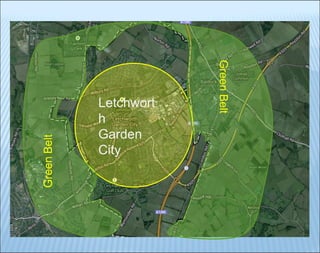
Green Belt

Letchwort
h
Garden
City
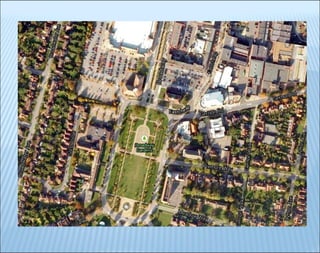
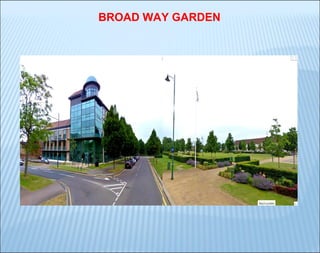
BROAD WAY GARDEN
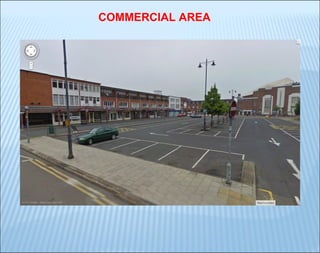
COMMERCIAL AREA
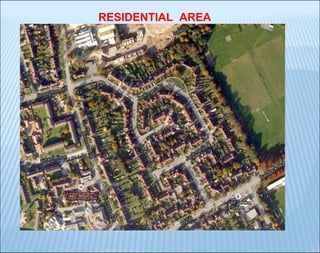
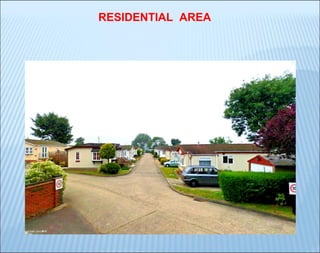
RESIDENTIAL AREA
RESIDENTIAL AREA
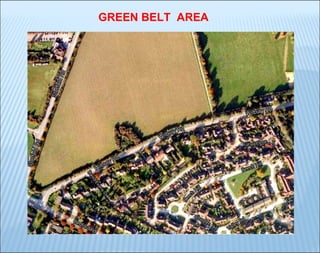
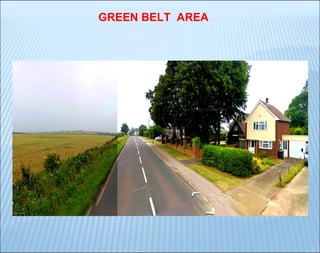
GREEN BELT AREA
GREEN BELT AREA
GREEN BELT CONCEPT
 “Greenbelt” refers to any area of undeveloped natural
land that has been set aside near urban or developed land
to provide open space, offer light recreational
opportunities or contain development.
Greenbelts in and around urban areas act as lung space
and are important to the ecological health of any region.
The various plants and trees in greenbelts serve as
organic sponges for various forms of pollution, and
as storehouses of Carbon-di-oxide to help offset global
warming
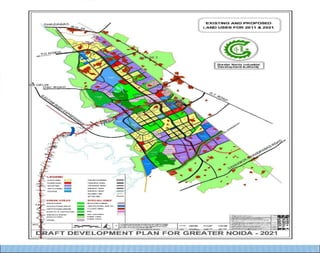
Typically ,Master Plan and Regional Plans designate
spaces around the city as Green Belt which act as a
buffer.
With in the city also provisions are made for Green strip
which may act as a buffer between residential and
industrial area.
Green Belt also adds to the city aesthetics.
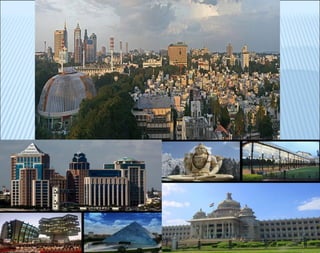
Bangalore
 Today is Asia's fastest growing cosmopolitan city.
 It is home To
• The I.T industry
•some of India's premier scientific establishments
•Blessed with a salubrious climate, gardens &
parks, natural lakes, architectural landmarks,
shopping malls, the best restaurants and pubs in
this part of the globe
•Bangalore is the ideal gateway to India and beyond.
Garden city

Garden city

  • 1.
    SHUBHAM GAIKWAD GANESH JAVHARE MISNO 111214005 MIS NO 111214011
  • 2.
    According to thedefinition given by Garden Cities & Town Planning Association in 1919 “A Garden City is a Town designed for healthy living and industry; of a size that makes possible a full measure of social life, but not larger; surrounded by a rural belt; the whole of the land being in public ownership or held in trust for the community.” •Each a self-sufficient entity—not a dormitory suburb—of 30,000 population •Each ringed by an agricultural belt
  • 3.
    Sir Ebenzer Howard (founderof the English garden-city movement, which influenced city planning throughout the world.) •Howard wrote(1880 ) Tomorrow: A Peaceful Path to Social Reform. Not published until 1898 •This work was reissued in 1902 as Garden Cites of Tomorrow. •Howard learned shorthand and held various jobs as a private secretary and stenographer before becoming a shorthand reporter in the London law courts. •He was a liberal social reformer who was decisively influenced by Edward Bellamy's utopian novel Looking Backward (1889).
  • 5.
    According to Howard •Settlementwould be has advantages of both urban and the rural life styles •Would avoid all adverse qualities that make everyday life more difficult •So he hoped that a town built according to Garden city would be third magnet •That would attract the most of the unhappy inhabitants of the British suffocating industrial cities, and thus resolve one of the biggest national problems of the time.
  • 6.
    Founding of theGarden City Association, 1899, can be considered as the first step in the application of the Garden City theory. In the year 1902, The Garden City Pioneer Company was established, which, soon after, acquired the capital needed for creation of the first Garden City by selling the shares. The place chosen for the First Garden City in the world was located 50km North-East of London, on the way to Cambridge, in Hertfordshire.
  • 7.
    Industrial revolution andthe urban encroachment
  • 8.
    A Widely DiffusedModel •Letchworth and Welwyn Garden City were the closest to Howard’s ideals communities. – freestanding, self-contained •But many garden suburbs applied some of Howard’s principles to existing cities. • Ideas soon spread to other countries, especially Europe and USA. •International contacts, trade and colonialism also took them to other parts of world.
  • 10.
    Letchworth Garden City •Asone of the world's first new towns and the first Garden city. •It had great influence on future town planning and the New Towns movement. •It influenced Welwyn garden city, which used a similar approach and inspired other projects around the world •Planned to combine the best of ‘town and country’ living
  • 12.
  • 15.
  • 16.
  • 17.
  • 18.
  • 19.
  • 20.
  • 21.
    GREEN BELT CONCEPT “Greenbelt” refers to any area of undeveloped natural land that has been set aside near urban or developed land to provide open space, offer light recreational opportunities or contain development. Greenbelts in and around urban areas act as lung space and are important to the ecological health of any region. The various plants and trees in greenbelts serve as organic sponges for various forms of pollution, and as storehouses of Carbon-di-oxide to help offset global warming
  • 22.
    Typically ,Master Planand Regional Plans designate spaces around the city as Green Belt which act as a buffer. With in the city also provisions are made for Green strip which may act as a buffer between residential and industrial area. Green Belt also adds to the city aesthetics.
  • 24.
    Bangalore  Today isAsia's fastest growing cosmopolitan city.  It is home To • The I.T industry •some of India's premier scientific establishments •Blessed with a salubrious climate, gardens & parks, natural lakes, architectural landmarks, shopping malls, the best restaurants and pubs in this part of the globe •Bangalore is the ideal gateway to India and beyond.