.
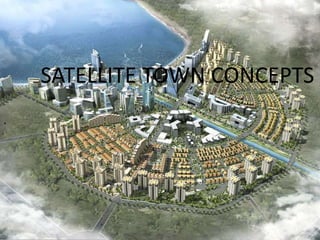
SATELLITE TOWN CONCEPTS
INTRODUCTION
What Are Satellite Townships?
A satellite town or satellite city is a concept in urban planning that
refers essentially to smaller metropolitan areas which are located
somewhat near to, but are mostly independent of, larger metropolitan
areas.
City Development Plan for Satellite Town
SCATTERED SATELLITES
Development of Satellite Townships
Town or a city reach a certain limit of congestion and exhaustion
Land Shortage , Inadequate Transportation.
Charecteristics
predate the metropolis' suburban expansion
At least partially independent from that metropolis economically and
socially
Physically separated from the metropolis by rural territory or by a
major geographic barrier such as a large river; satellite cities should
have their own independent urbanized area, or equivalent
Have their own bedroom communities
Have a traditional downtown surrounded by traditional "inner city"
neighborhoods
May or may not be counted as part of the large metropolis' Combined
Statistical Area
Need For Satellite Town
Severe uncontrolled growth of
urban population
Problem in managing already
over strained cities
increase in the demand for
infrastructure facilities and
amenities
land shortage, housing shortfall,
inadequate transportation
Need For Satellite Town
Challenges in management of
essential infrastructure like
water supply
Sewerage
Drainage
 solid waste disposal
Need For Satellite Town
Tremendous strain on the delivery of
services in major cities due to the
concentration of economic activities
and population
Need for decentralization of activities
so as to reduce the burden on these
cities.
FEATURES
Satellite townships have their own local government and corporate
life.
They have all the necessary amenities and facilities present within
their limits except for a few purposes like employment and sometimes
education, they have to depend on the main city i.e. the parent city.
Transportation means such as buses, trains etc all connect the various
satellite townships to the main city so that travelling to the main city
for work is not an issue. It is free to decide its economic, social and
cultural activities.
Satellite townships generally develop beyond the green belt of the
city.
FEATURES
setting up of industries is prohibited in Satellite townships. It is mainly
a residential area having only local shops, schools for children, etc.
Zoning regulations are not an issue in the development of satellite
townships.
These townships never become a rival to their parent city because
their size and development is restricted and controlled.
satellite townships are considered as a part of the market for some
goods and services that are produced in the parent city (some times)
Admissible Components
Central assistance will be admissible for the following components
Water supply and sanitation
Sewerage and solid waste management
Capacity building assistance
Sewerage and solid waste
Water supply
Inadmissible Components
Central assistance will not be admissible for the following components
Power
 Telecom
Health
Education
Wage employment programmes
staff component
OBJECTIVES
To develop urban infrastructure facilities such as
DRAINAGE AND SOLID WASTE MANAGEMENT
TRANSPORTATIONSEWERAGE
OBJECTIVES
To adopt innovative public – private partnerships models for
development of satellite towns.
Earmarking 10-15% of housing sites for the urban poor
i.e,Economically Weaker Sections (EWS) / Low Income Group (LIG)
c. Reform of property tax with Geographical Information System (GIS)
and arrangements for its effective implementation so as to raise
collection efficiency to 85 per cent.
d. Levy of reasonable user charges, with the objective that full cost of
operation and maintenance is collected within some years.
Objectives
e. Internal earmarking of budgets
for basic services to the urban poor
f. Earmarking of housing sites for
the urban poor
g. Formulating bye laws which shall
incorporate provisions for disaster
management, rainwater harvesting,
reuse and recycle of waste water,
barrier free environment and
structural safety and shall also be in
strict compliance with the National
Building code
Objectives
h. Implementation of Public Disclosure Law
i. Implementation of Community Participation Law
Process
City Development Plan for Satellite Town
Preparation of City Region Plan
Integration of Planning Process between the Mother City and
Satellite Towns.
Appraisal of City Development Plan
Detailed Project Report
Appraisal of Detailed Projects Reports
Sanction and monitoring of Projects under the Scheme
Monitoring and Evaluation
City Development Plan for Satellite Town
A City Development Plan (CDP) shall be prepared for the satellite town
by the ULB or some other agency designated for the purpose
Planning on concept of continuity, compactness and self –
containment
Each part of the township while being self-sufficient in itself should
form an integral part of the town as a whole having clear functional
linkages with the mother city and other urban centers
The planning of satellite town may adopt different kind of
development i.e. low-rise and low-density development/high rise
medium density or high-rise and high-density development depending
on the local and felt demand.
City Development Plan for
Satellite Town
The planning of the town shall address environmental
sustainability issues, green buildings and disaster mitigation
aspects
Incremental approach in providing for infrastructure /
facilities
have rational and judicious use of scarce resources both in
the form ofland and fiscal resources.
Preparation of City Region Plan
The concerned ULB should prepare a City Region Plan, which should contain:
Delineation of area based on physical and socio-economic linkages
 Settlement structure
 Land use and network
 Environmentally sensitive zones.
Heritage precincts
Addressing prominent concerns of major sectors of the economy,
Integration of Planning Process between
the Mother City and Satellite Towns.
The planning process of the Mother town and the Satellite townships
shall be integrated through inclusion of suitable representation of the
Satellite Township in the Metropolitan Planning Committee of the
Mother Town.
Outcomes Of Satellite Township
Development
a. Amelioration of population pressure on metropolitan towns.
b. Improved financial management in urban local bodies.
c. Improvement in basic infrastructure and service delivery related to
water supply, sanitation and solid waste management.
d. Improved urban planning
Satellite town planning

Satellite town planning

  • 1.
  • 2.
    INTRODUCTION What Are SatelliteTownships? A satellite town or satellite city is a concept in urban planning that refers essentially to smaller metropolitan areas which are located somewhat near to, but are mostly independent of, larger metropolitan areas.
  • 3.
    City Development Planfor Satellite Town
  • 5.
  • 6.
    Development of SatelliteTownships Town or a city reach a certain limit of congestion and exhaustion Land Shortage , Inadequate Transportation.
  • 7.
    Charecteristics predate the metropolis'suburban expansion At least partially independent from that metropolis economically and socially Physically separated from the metropolis by rural territory or by a major geographic barrier such as a large river; satellite cities should have their own independent urbanized area, or equivalent Have their own bedroom communities Have a traditional downtown surrounded by traditional "inner city" neighborhoods May or may not be counted as part of the large metropolis' Combined Statistical Area
  • 8.
    Need For SatelliteTown Severe uncontrolled growth of urban population Problem in managing already over strained cities increase in the demand for infrastructure facilities and amenities land shortage, housing shortfall, inadequate transportation
  • 9.
    Need For SatelliteTown Challenges in management of essential infrastructure like water supply Sewerage Drainage  solid waste disposal
  • 10.
    Need For SatelliteTown Tremendous strain on the delivery of services in major cities due to the concentration of economic activities and population Need for decentralization of activities so as to reduce the burden on these cities.
  • 11.
    FEATURES Satellite townships havetheir own local government and corporate life. They have all the necessary amenities and facilities present within their limits except for a few purposes like employment and sometimes education, they have to depend on the main city i.e. the parent city. Transportation means such as buses, trains etc all connect the various satellite townships to the main city so that travelling to the main city for work is not an issue. It is free to decide its economic, social and cultural activities. Satellite townships generally develop beyond the green belt of the city.
  • 12.
    FEATURES setting up ofindustries is prohibited in Satellite townships. It is mainly a residential area having only local shops, schools for children, etc. Zoning regulations are not an issue in the development of satellite townships. These townships never become a rival to their parent city because their size and development is restricted and controlled. satellite townships are considered as a part of the market for some goods and services that are produced in the parent city (some times)
  • 13.
    Admissible Components Central assistancewill be admissible for the following components Water supply and sanitation Sewerage and solid waste management Capacity building assistance Sewerage and solid waste Water supply
  • 14.
    Inadmissible Components Central assistancewill not be admissible for the following components Power  Telecom Health Education Wage employment programmes staff component
  • 15.
    OBJECTIVES To develop urbaninfrastructure facilities such as DRAINAGE AND SOLID WASTE MANAGEMENT TRANSPORTATIONSEWERAGE
  • 16.
    OBJECTIVES To adopt innovativepublic – private partnerships models for development of satellite towns. Earmarking 10-15% of housing sites for the urban poor i.e,Economically Weaker Sections (EWS) / Low Income Group (LIG)
  • 17.
    c. Reform ofproperty tax with Geographical Information System (GIS) and arrangements for its effective implementation so as to raise collection efficiency to 85 per cent. d. Levy of reasonable user charges, with the objective that full cost of operation and maintenance is collected within some years.
  • 18.
    Objectives e. Internal earmarkingof budgets for basic services to the urban poor f. Earmarking of housing sites for the urban poor g. Formulating bye laws which shall incorporate provisions for disaster management, rainwater harvesting, reuse and recycle of waste water, barrier free environment and structural safety and shall also be in strict compliance with the National Building code
  • 19.
    Objectives h. Implementation ofPublic Disclosure Law i. Implementation of Community Participation Law
  • 20.
    Process City Development Planfor Satellite Town Preparation of City Region Plan Integration of Planning Process between the Mother City and Satellite Towns. Appraisal of City Development Plan Detailed Project Report Appraisal of Detailed Projects Reports Sanction and monitoring of Projects under the Scheme Monitoring and Evaluation
  • 21.
    City Development Planfor Satellite Town A City Development Plan (CDP) shall be prepared for the satellite town by the ULB or some other agency designated for the purpose Planning on concept of continuity, compactness and self – containment Each part of the township while being self-sufficient in itself should form an integral part of the town as a whole having clear functional linkages with the mother city and other urban centers The planning of satellite town may adopt different kind of development i.e. low-rise and low-density development/high rise medium density or high-rise and high-density development depending on the local and felt demand.
  • 22.
    City Development Planfor Satellite Town The planning of the town shall address environmental sustainability issues, green buildings and disaster mitigation aspects Incremental approach in providing for infrastructure / facilities have rational and judicious use of scarce resources both in the form ofland and fiscal resources.
  • 23.
    Preparation of CityRegion Plan The concerned ULB should prepare a City Region Plan, which should contain: Delineation of area based on physical and socio-economic linkages  Settlement structure  Land use and network  Environmentally sensitive zones. Heritage precincts Addressing prominent concerns of major sectors of the economy,
  • 24.
    Integration of PlanningProcess between the Mother City and Satellite Towns. The planning process of the Mother town and the Satellite townships shall be integrated through inclusion of suitable representation of the Satellite Township in the Metropolitan Planning Committee of the Mother Town.
  • 25.
    Outcomes Of SatelliteTownship Development a. Amelioration of population pressure on metropolitan towns. b. Improved financial management in urban local bodies. c. Improvement in basic infrastructure and service delivery related to water supply, sanitation and solid waste management. d. Improved urban planning