City Beautiful MovementCity Beautiful Movement
------------Daniel H.BurnhaDaniel H.Burnha
BIRTH OF THE CONCEPTBIRTH OF THE CONCEPT
The 1890s and early years of the twentieth century were a turning
point in American society. The economic system struggled to
define itself social unrest and violence, results of economic
depressions, disgust with corruption in government, and
overcrowded urban centers erupted periodically throughout the
era.
Most important of all, the triumph of industry over agriculture was now assured.
the middle and upper-middle class retreated from the cities into the suburbs. The upper
classes traveled into the city to attend to their business, consume the leisure activities
contained therein, and the return to their comfortable and beautiful suburban homes.
What they left behind in the cities is poverty-stricken to the quickly decaying urban center
The middle and upper-class reformers who sought to remedy
this situation did so, for the most part, out of their own fear.
They knew that for their own safety and business viability
something had to be done; but how to attack the problem?
"Common to almost all the reformers...was the conviction--
explicit or implicit--that the city, although obviously different
from the village...should nevertheless replicate the moral
order of the village. City dwellers, they believed, must
somehow be brought to perceive themselves as members of
cohesive communities knit together by shared moral and
social values."
 Generally stated, the City Beautiful sought to improve their city
through beautification, which would have a number of effects:
1) social ills would be swept away, as the beauty of the city would
inspire civic loyalty and moral rectitude in the impoverished;
2) American cities would be brought to cultural parity with their
European competitors through the use of the European Beaux-
Arts idiom; and
3) More inviting city center still would not bring the upper classes
back to live, but certainly to work and spend money in the urban
areas.
 The premise of the movement was the idea that beauty could be
an effective social control device
 The idiom the City Beautiful leaders used in their ideal civic centers was the Beaux-Arts
style, named for the famous Ecole des Beaux-Arts in Paris, which instructed artists and
architects in the necessity of order, dignity, and harmony in their work.
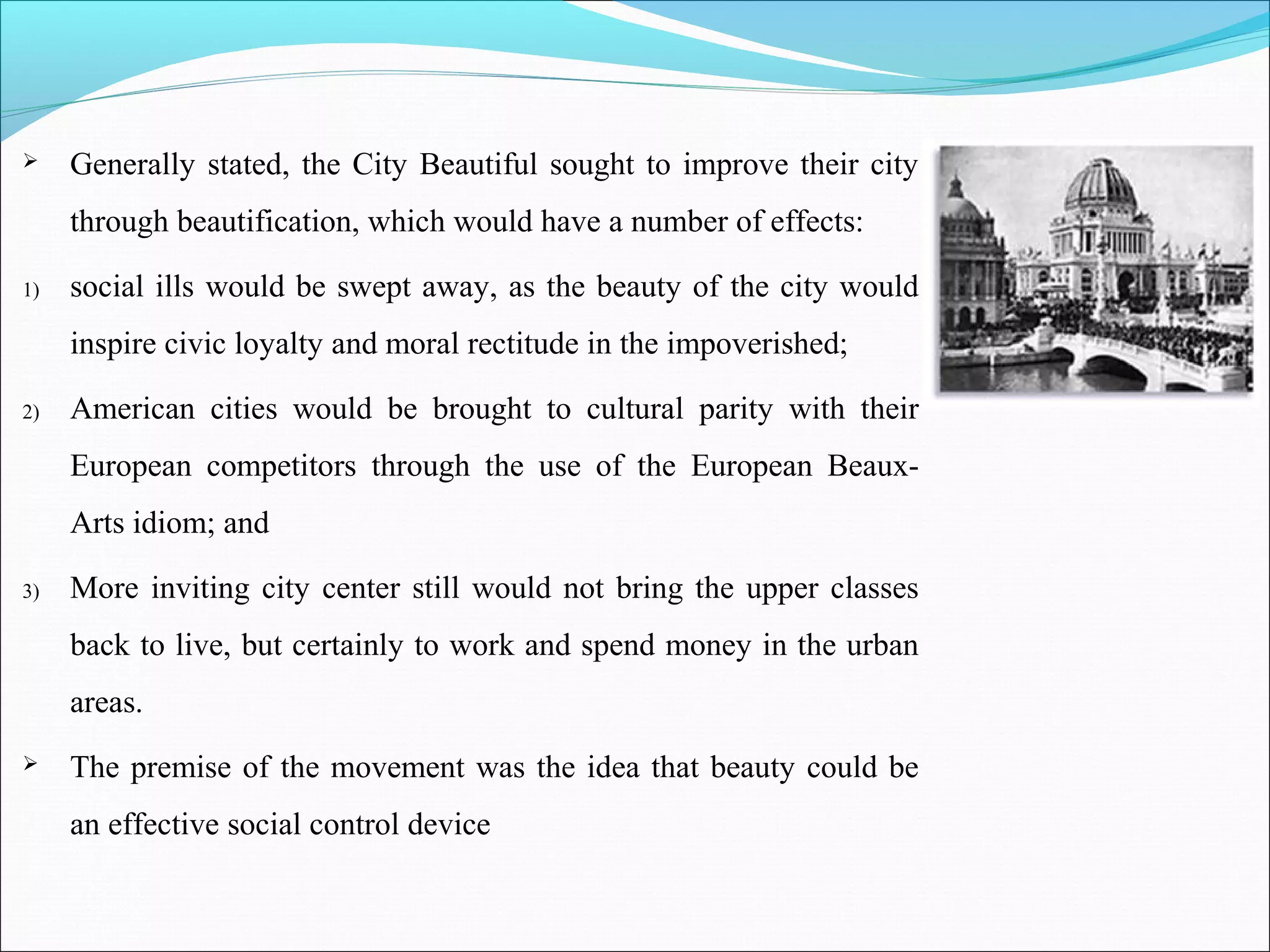
 The first expression of this monumental style in the United States was found at the
World's Columbian Exposition of 1893. The shimmering "White City," as the fair came to
be known during that summer in Chicago, was a tour de force of early city planning and
architectural cohesion.
 The first organized expression of the City Beautiful movement as a means of
beautification and social control was, as we will see in the next section, the 1901 Plan for
Washington D.C., designed by Daniel Burnham, former Director of Construction for the
fair, and his Senate Parks Commission.
DANIEL BURNHAM BIOGRAPHYDANIEL BURNHAM BIOGRAPHY
 Daniel Hudson Burnham was one of the Chicago architectsDaniel Hudson Burnham was one of the Chicago architects
 He is responsible for the earliest development of the American sky scraper.He is responsible for the earliest development of the American sky scraper.
 He was designed the flatiron building in New York(1902)He was designed the flatiron building in New York(1902)
 He was also commissioned by the U.S Philippine commission in 1904He was also commissioned by the U.S Philippine commission in 1904
 he was the co-author of the Chicago plan, which laid out plans for the future ofhe was the co-author of the Chicago plan, which laid out plans for the future of
Chicago in 1909Chicago in 1909
 He was died on June 1, 1912 in Heidelberg, GermanyHe was died on June 1, 1912 in Heidelberg, Germany
DANIEL BURNHAM BIOGRAPHYDANIEL BURNHAM BIOGRAPHY
 Daniel Hudson Burnham was one of the Chicago architectsDaniel Hudson Burnham was one of the Chicago architects
 He is responsible for the earliest development of the American sky scraper.He is responsible for the earliest development of the American sky scraper.
 He was designed the flatiron building in New York(1902)He was designed the flatiron building in New York(1902)
 He was also commissioned by the U.S Philippine commission in 1904He was also commissioned by the U.S Philippine commission in 1904
 he was the co-author of the Chicago plan, which laid out plans for the future ofhe was the co-author of the Chicago plan, which laid out plans for the future of
Chicago in 1909Chicago in 1909
 He was died on June 1, 1912 in Heidelberg, GermanyHe was died on June 1, 1912 in Heidelberg, Germany

City beautiful movement

  • 1.
    City Beautiful MovementCityBeautiful Movement ------------Daniel H.BurnhaDaniel H.Burnha
  • 2.
    BIRTH OF THECONCEPTBIRTH OF THE CONCEPT The 1890s and early years of the twentieth century were a turning point in American society. The economic system struggled to define itself social unrest and violence, results of economic depressions, disgust with corruption in government, and overcrowded urban centers erupted periodically throughout the era. Most important of all, the triumph of industry over agriculture was now assured. the middle and upper-middle class retreated from the cities into the suburbs. The upper classes traveled into the city to attend to their business, consume the leisure activities contained therein, and the return to their comfortable and beautiful suburban homes. What they left behind in the cities is poverty-stricken to the quickly decaying urban center
  • 3.
    The middle andupper-class reformers who sought to remedy this situation did so, for the most part, out of their own fear. They knew that for their own safety and business viability something had to be done; but how to attack the problem? "Common to almost all the reformers...was the conviction-- explicit or implicit--that the city, although obviously different from the village...should nevertheless replicate the moral order of the village. City dwellers, they believed, must somehow be brought to perceive themselves as members of cohesive communities knit together by shared moral and social values."
  • 4.
     Generally stated,the City Beautiful sought to improve their city through beautification, which would have a number of effects: 1) social ills would be swept away, as the beauty of the city would inspire civic loyalty and moral rectitude in the impoverished; 2) American cities would be brought to cultural parity with their European competitors through the use of the European Beaux- Arts idiom; and 3) More inviting city center still would not bring the upper classes back to live, but certainly to work and spend money in the urban areas.  The premise of the movement was the idea that beauty could be an effective social control device
  • 5.
     The idiomthe City Beautiful leaders used in their ideal civic centers was the Beaux-Arts style, named for the famous Ecole des Beaux-Arts in Paris, which instructed artists and architects in the necessity of order, dignity, and harmony in their work.  The first expression of this monumental style in the United States was found at the World's Columbian Exposition of 1893. The shimmering "White City," as the fair came to be known during that summer in Chicago, was a tour de force of early city planning and architectural cohesion.  The first organized expression of the City Beautiful movement as a means of beautification and social control was, as we will see in the next section, the 1901 Plan for Washington D.C., designed by Daniel Burnham, former Director of Construction for the fair, and his Senate Parks Commission.
  • 6.
    DANIEL BURNHAM BIOGRAPHYDANIELBURNHAM BIOGRAPHY  Daniel Hudson Burnham was one of the Chicago architectsDaniel Hudson Burnham was one of the Chicago architects  He is responsible for the earliest development of the American sky scraper.He is responsible for the earliest development of the American sky scraper.  He was designed the flatiron building in New York(1902)He was designed the flatiron building in New York(1902)  He was also commissioned by the U.S Philippine commission in 1904He was also commissioned by the U.S Philippine commission in 1904  he was the co-author of the Chicago plan, which laid out plans for the future ofhe was the co-author of the Chicago plan, which laid out plans for the future of Chicago in 1909Chicago in 1909  He was died on June 1, 1912 in Heidelberg, GermanyHe was died on June 1, 1912 in Heidelberg, Germany
  • 7.
    DANIEL BURNHAM BIOGRAPHYDANIELBURNHAM BIOGRAPHY  Daniel Hudson Burnham was one of the Chicago architectsDaniel Hudson Burnham was one of the Chicago architects  He is responsible for the earliest development of the American sky scraper.He is responsible for the earliest development of the American sky scraper.  He was designed the flatiron building in New York(1902)He was designed the flatiron building in New York(1902)  He was also commissioned by the U.S Philippine commission in 1904He was also commissioned by the U.S Philippine commission in 1904  he was the co-author of the Chicago plan, which laid out plans for the future ofhe was the co-author of the Chicago plan, which laid out plans for the future of Chicago in 1909Chicago in 1909  He was died on June 1, 1912 in Heidelberg, GermanyHe was died on June 1, 1912 in Heidelberg, Germany