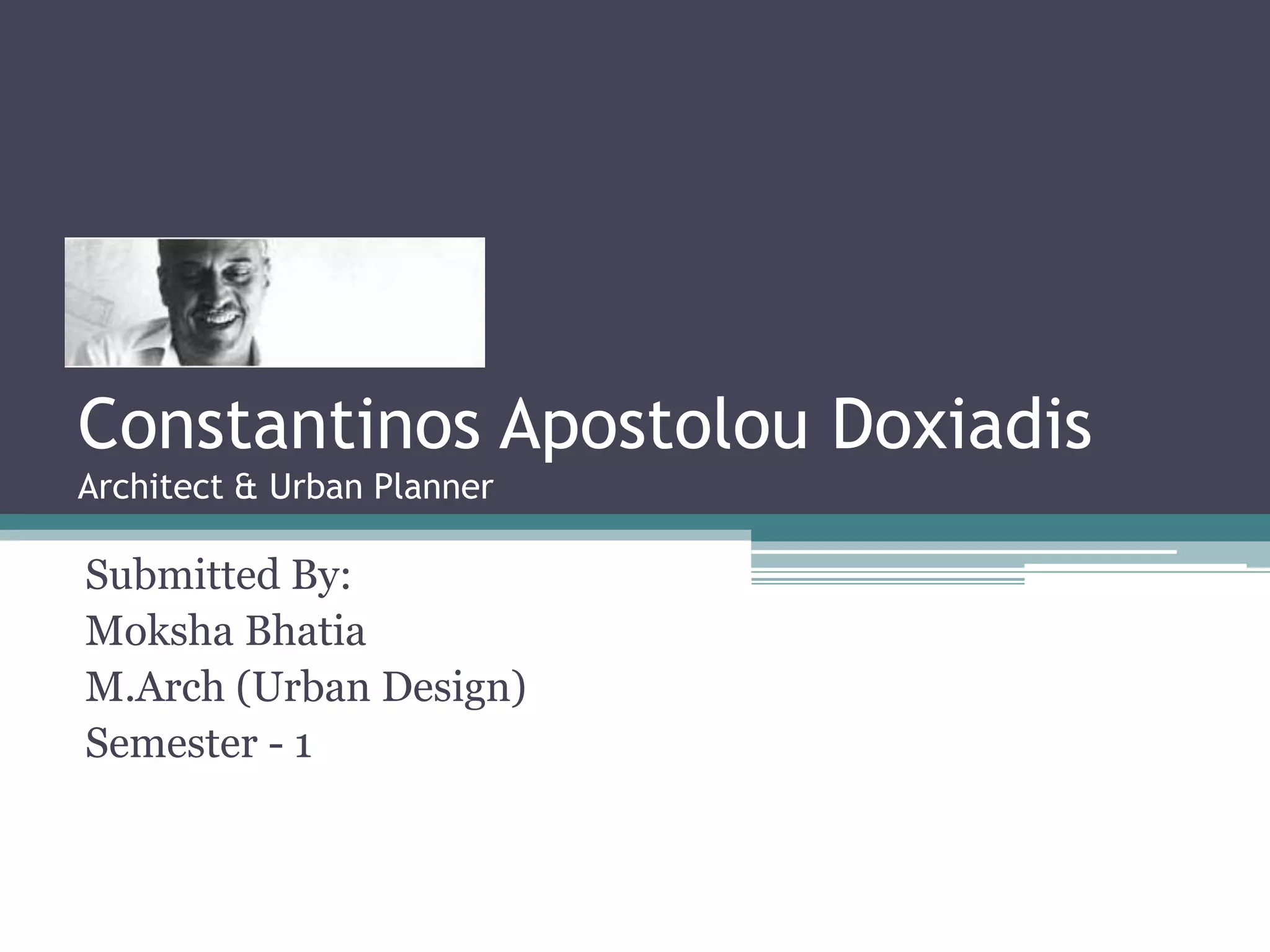
Constantinos Apostolou Doxiadis
Architect & Urban Planner
Submitted By:
Moksha Bhatia
M.Arch (Urban Design)
Semester - 1
Contents
• Introduction
• Life and Career
• Theories and Work
- Ekistics
- Master Plan Of Islamabad
- Aspra Spitia
• Other Works
• Books and Journals
• Bibliography
Introduction
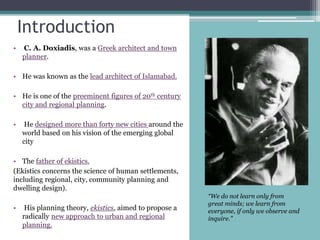
• C. A. Doxiadis, was a Greek architect and town
planner.
• He was known as the lead architect of Islamabad.
• He is one of the preeminent figures of 20th century
city and regional planning.
• He designed more than forty new cities around the
world based on his vision of the emerging global
city
• The father of ekistics.
(Ekistics concerns the science of human settlements,
including regional, city, community planning and
dwelling design).
• His planning theory, ekistics, aimed to propose a
radically new approach to urban and regional
planning.
“We do not learn only from
great minds; we learn from
everyone, if only we observe and
inquire.”
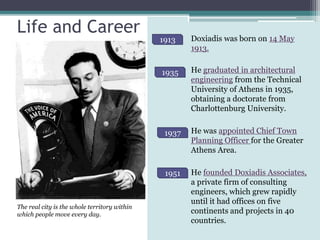
Life and Career
1913 Doxiadis was born on 14 May
1913.
He graduated in architectural
engineering from the Technical
University of Athens in 1935,
obtaining a doctorate from
Charlottenburg University.
He was appointed Chief Town
Planning Officer for the Greater
Athens Area.
He founded Doxiadis Associates,
a private firm of consulting
engineers, which grew rapidly
until it had offices on five
continents and projects in 40
countries.
1935
1937
1951
The real city is the whole territory within
which people move every day.
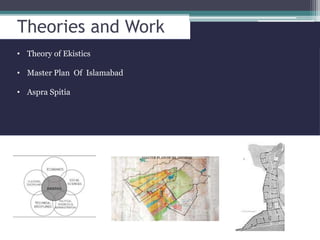
Theories and Work
• Theory of Ekistics
• Master Plan Of Islamabad
• Aspra Spitia
Ekistics
• The term 'ekistics' was coined
by Constantinos Apostolos Doxiadis in
1942
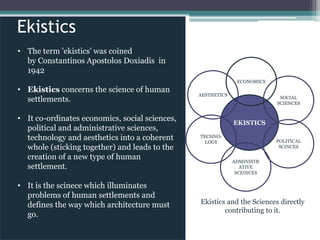
• Ekistics concerns the science of human
settlements.
• It co-ordinates economics, social sciences,
political and administrative sciences,
technology and aesthetics into a coherent
whole (sticking together) and leads to the
creation of a new type of human
settlement.
• It is the scinece which illuminates
problems of human settlements and
defines the way which architecture must
go.
EKISTICS
POLITICAL
SCINCES
SOCIAL
SCIENCES
ECONOMICS
ADMINISTR
ATIVE
SCEINCES
TECHNO-
LOGY
AESTHETICS
Ekistics and the Sciences directly
contributing to it.
This science, termed Ekistics, will
take into consideration :-
• The principles man takes into
account when building his
settlements.
• The evolution of human
settlements through history in
terms of size and quality.
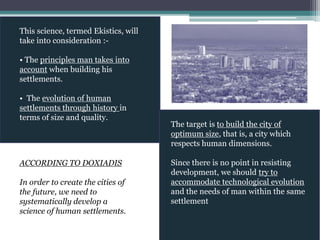
The target is to build the city of
optimum size, that is, a city which
respects human dimensions.
Since there is no point in resisting
development, we should try to
accommodate technological evolution
and the needs of man within the same
settlement
ACCORDING TO DOXIADIS
In order to create the cities of
the future, we need to
systematically develop a
science of human settlements.
CLASSIFICATION OF HUMAN SETTLEMENTS : -
• By Ekistics Units
• By Ekistics Elements
• By Ekistics Functions
• By Evolutionary Phases
• By Factors & Disciplines
C
L
A
S
S
I
F
I
C
A
T
I
O
N
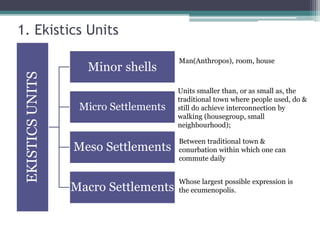
EKISTICSUNITS
Minor shells
Micro Settlements
Meso Settlements
Macro Settlements
Man(Anthropos), room, house
Units smaller than, or as small as, the
traditional town where people used, do &
still do achieve interconnection by
walking (housegroup, small
neighbourhood);
Between traditional town &
conurbation within which one can
commute daily
Whose largest possible expression is
the ecumenopolis.
1. Ekistics Units
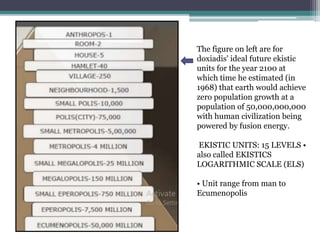
The figure on left are for
doxiadis' ideal future ekistic
units for the year 2100 at
which time he estimated (in
1968) that earth would achieve
zero population growth at a
population of 50,000,000,000
with human civilization being
powered by fusion energy.
EKISTIC UNITS: 15 LEVELS •
also called EKISTICS
LOGARITHMIC SCALE (ELS)
• Unit range from man to
Ecumenopolis
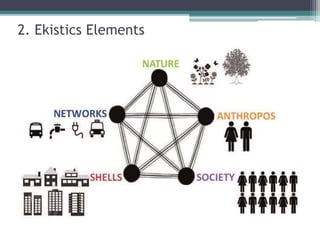
2. Ekistics Elements
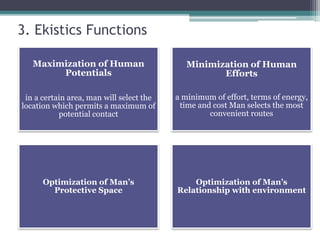
3. Ekistics Functions
Maximization of Human
Potentials
in a certain area, man will select the
location which permits a maximum of
potential contact
Minimization of Human
Efforts
a minimum of effort, terms of energy,
time and cost Man selects the most
convenient routes
Optimization of Man’s
Protective Space
Optimization of Man’s
Relationship with environment
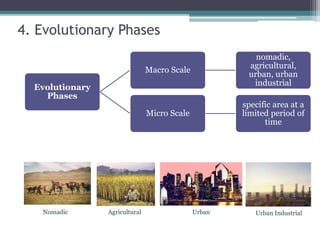
4. Evolutionary Phases
Evolutionary
Phases
Macro Scale
nomadic,
agricultural,
urban, urban
industrial
Micro Scale
specific area at a
limited period of
time
Nomadic Agricultural Urban Urban Industrial
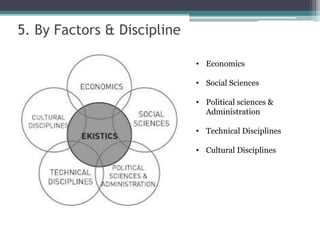
5. By Factors & Discipline
• Economics
• Social Sciences
• Political sciences &
Administration
• Technical Disciplines
• Cultural Disciplines
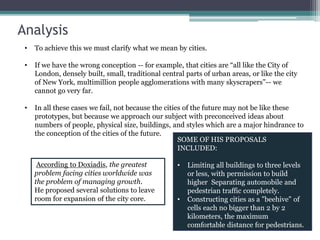
Analysis
• To achieve this we must clarify what we mean by cities.
• If we have the wrong conception -- for example, that cities are “all like the City of
London, densely built, small, traditional central parts of urban areas, or like the city
of New York, multimillion people agglomerations with many skyscrapers”-- we
cannot go very far.
• In all these cases we fail, not because the cities of the future may not be like these
prototypes, but because we approach our subject with preconceived ideas about
numbers of people, physical size, buildings, and styles which are a major hindrance to
the conception of the cities of the future.
According to Doxiadis, the greatest
problem facing cities worldwide was
the problem of managing growth.
He proposed several solutions to leave
room for expansion of the city core.
SOME OF HIS PROPOSALS
INCLUDED:
• Limiting all buildings to three levels
or less, with permission to build
higher Separating automobile and
pedestrian traffic completely.
• Constructing cities as a "beehive" of
cells each no bigger than 2 by 2
kilometers, the maximum
comfortable distance for pedestrians.
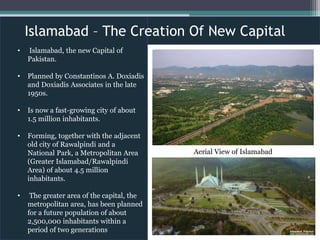
• Islamabad, the new Capital of
Pakistan.
• Planned by Constantinos A. Doxiadis
and Doxiadis Associates in the late
1950s.
• Is now a fast-growing city of about
1.5 million inhabitants.
• Forming, together with the adjacent
old city of Rawalpindi and a
National Park, a Metropolitan Area
(Greater Islamabad/Rawalpindi
Area) of about 4.5 million
inhabitants.
• The greater area of the capital, the
metropolitan area, has been planned
for a future population of about
2,500,000 inhabitants within a
period of two generations
Islamabad – The Creation Of New Capital
Aerial View of Islamabad
Islamabad – Birth and Location
• Planned in the
period, 1959-63
on the basis of
“Ekistics”,
Doxiadis’
“Science of
human
settlements”.
• Islamabad is
being
developed fully
respecting the
“Doxiadis
Plan”.
• A new capital for Pakistan was necessary following the
independence of India in 1947 and the inevitable partition
into India and Pakistan.
• Various solutions were proposed for the location of the
new capital from 1947 to1959 when the final decision was
reached.
• In February 1959, the government decided to investigate
the problem in a more thorough way. A commission and
nine sub-committees were formed .
• In March 1959, C.A. Doxiadis, proposed a site he visited
in the summer of 1959, which was finally approved.
• The approved site is located at the foot of the Margala
hills in northern Pakistan between the historical cities of
Lahore and Peshawar, west of the Idaspis (now Jhelum)
river where Alexander the Great defeated king Poros
Islamabad – The hierarchical concept in
communities, land uses and transportation system
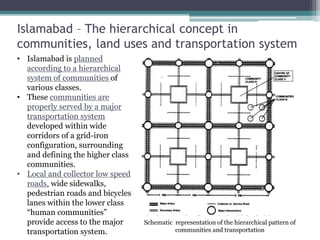
• Islamabad is planned
according to a hierarchical
system of communities of
various classes.
• These communities are
properly served by a major
transportation system
developed within wide
corridors of a grid-iron
configuration, surrounding
and defining the higher class
communities.
• Local and collector low speed
roads, wide sidewalks,
pedestrian roads and bicycles
lanes within the lower class
“human communities”
provide access to the major
transportation system.
Schematic representation of the hierarchical pattern of
communities and transportation
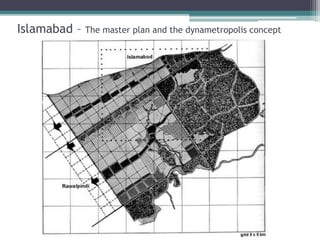
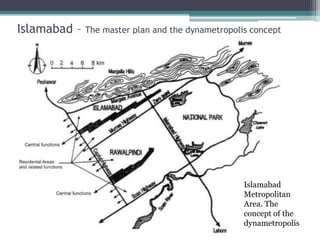
Islamabad – The master plan and the dynametropolis concept
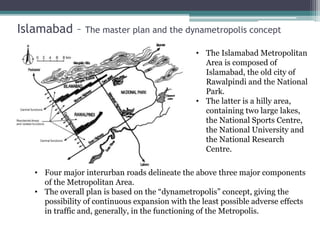
• The Islamabad Metropolitan
Area is composed of
Islamabad, the old city of
Rawalpindi and the National
Park.
• The latter is a hilly area,
containing two large lakes,
the National Sports Centre,
the National University and
the National Research
Centre.
• Four major interurban roads delineate the above three major components
of the Metropolitan Area.
• The overall plan is based on the “dynametropolis” concept, giving the
possibility of continuous expansion with the least possible adverse effects
in traffic and, generally, in the functioning of the Metropolis.
Islamabad – The master plan and the dynametropolis concept
Islamabad
Metropolitan
Area. The
concept of the
dynametropolis
Islamabad – The master plan and the dynametropolis concept
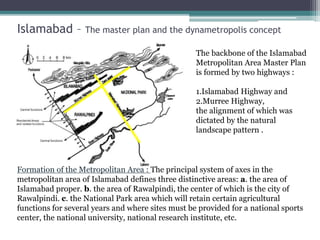
The backbone of the Islamabad
Metropolitan Area Master Plan
is formed by two highways :
1.Islamabad Highway and
2.Murree Highway,
the alignment of which was
dictated by the natural
landscape pattern .
Formation of the Metropolitan Area : The principal system of axes in the
metropolitan area of Islamabad defines three distinctive areas: a. the area of
Islamabad proper. b. the area of Rawalpindi, the center of which is the city of
Rawalpindi. c. the National Park area which will retain certain agricultural
functions for several years and where sites must be provided for a national sports
center, the national university, national research institute, etc.
Islamabad – The master plan and the dynametropolis concept
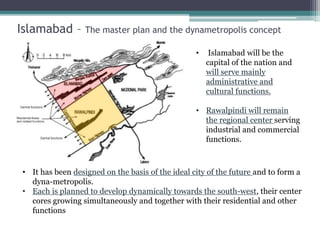
• Islamabad will be the
capital of the nation and
will serve mainly
administrative and
cultural functions.
• Rawalpindi will remain
the regional center serving
industrial and commercial
functions.
• It has been designed on the basis of the ideal city of the future and to form a
dyna-metropolis.
• Each is planned to develop dynamically towards the south-west, their center
cores growing simultaneously and together with their residential and other
functions
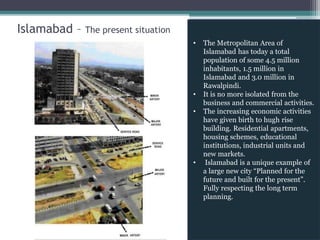
Islamabad – The present situation
• The Metropolitan Area of
Islamabad has today a total
population of some 4.5 million
inhabitants, 1.5 million in
Islamabad and 3.0 million in
Rawalpindi.
• It is no more isolated from the
business and commercial activities.
• The increasing economic activities
have given birth to hugh rise
building. Residential apartments,
housing schemes, educational
institutions, industrial units and
new markets.
• Islamabad is a unique example of
a large new city “Planned for the
future and built for the present”.
Fully respecting the long term
planning.
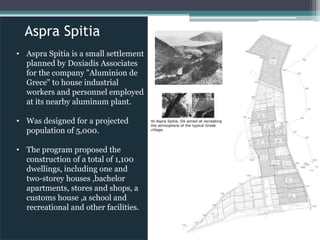
Aspra Spitia
• Aspra Spitia is a small settlement
planned by Doxiadis Associates
for the company "Aluminion de
Grece" to house industrial
workers and personnel employed
at its nearby aluminum plant.
• Was designed for a projected
population of 5,000.
• The program proposed the
construction of a total of 1,100
dwellings, including one and
two-storey houses ,bachelor
apartments, stores and shops, a
customs house ,a school and
recreational and other facilities.
• Doxiadis Associates carried out not only the pure planning work (general
plan and layout plans for residential communities and central areas), but also
the study of the house types and buildings, the design of the infrastructure
(water and electricity supply, sewer and storm water networks), the
compilation of the tender documents and the supervision of the
implementation.
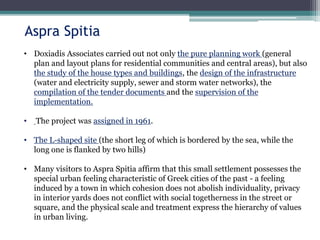
• The project was assigned in 1961.
• The L-shaped site (the short leg of which is bordered by the sea, while the
long one is flanked by two hills)
• Many visitors to Aspra Spitia affirm that this small settlement possesses the
special urban feeling characteristic of Greek cities of the past - a feeling
induced by a town in which cohesion does not abolish individuality, privacy
in interior yards does not conflict with social togetherness in the street or
square, and the physical scale and treatment express the hierarchy of values
in urban living.
Aspra Spitia
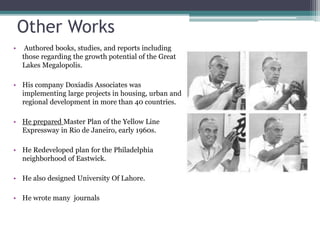
Other Works
• Authored books, studies, and reports including
those regarding the growth potential of the Great
Lakes Megalopolis.
• His company Doxiadis Associates was
implementing large projects in housing, urban and
regional development in more than 40 countries.
• He prepared Master Plan of the Yellow Line
Expressway in Rio de Janeiro, early 1960s.
• He Redeveloped plan for the Philadelphia
neighborhood of Eastwick.
• He also designed University Of Lahore.
• He wrote many journals
Books and Journals
• Dynapolis The City Of The Future (1960)[6]
• Doxiadis, Constantinos A. (1966). Emergence
and Growth of an Urban Region: The
Developing Urban Detroit Area. Detroit:
Detroit Edison.
• Doxiadis, Constantinos A. (1966). Urban
Renewal and the Future of the American City.
Chicago: Public Administration Service.
• Doxiadis, Constantinos A. (1968). Ekistics: An
Introduction to the Science of Human
Settlements. New York: Oxford University
Press.
• Doxiadis, Constantinos A.
(1974). Anthropopolis: City for Human
Development. New York: W.W. Norton.
• Doxiadis, Constantinos A.; Papaioannou, J.G.
(1974). Ecumenopolis: The Inevitable City of
the Future. Athens: Athens Center of Ekistics.
• Doxiadis, Constantinos A. (1975). Building
Entopia. Athens: Athens Publishing Center.
• Doxiadis, Constantinos A. (1976). Action for
Human Settlements. New York: W.W. Norton.
• Doxiadis, Constantinos A.
(1965). "On Linear
Cities" (PDF). Town Planning
Review. 36 (1):
1. doi:10.3828/tpr.36.1.f41483
03n72753nm.
• Doxiadis, Constantinos A.
(1967). "Islamabad, the
creation of a new
capital". Town Planning
Review. 38 (1):
35. doi:10.3828/tpr.38.1.7073
3287173p06k8.
• Doxiadis, Constantinos A.
(1968). "Man's Movement and
His City". Science. 162 (3851):
326–
334. doi:10.1126/science.162.3
851.326.
Bibliography
• https://www.witpress.com/Secure/elibrary/pap
ers/SDP09/SDP09008FU1.pdf
• https://www.doxiadis.org/Downloads/aspra_sp
itia.pdf
• Book – Architecture in Transition.
• https://en.wikipedia.org/wiki/Constantinos_Ap
ostolou_Doxiadis
• https://www.doxiadis.org/
Thank You!
We should never forget that values of the past are first
overlooked when a change is necessary, but later they are
understood and re-established.

Constantinos apostolou doxiadis

  • 1.
    Constantinos Apostolou Doxiadis Architect& Urban Planner Submitted By: Moksha Bhatia M.Arch (Urban Design) Semester - 1
  • 2.
    Contents • Introduction • Lifeand Career • Theories and Work - Ekistics - Master Plan Of Islamabad - Aspra Spitia • Other Works • Books and Journals • Bibliography
  • 3.
    Introduction • C. A.Doxiadis, was a Greek architect and town planner. • He was known as the lead architect of Islamabad. • He is one of the preeminent figures of 20th century city and regional planning. • He designed more than forty new cities around the world based on his vision of the emerging global city • The father of ekistics. (Ekistics concerns the science of human settlements, including regional, city, community planning and dwelling design). • His planning theory, ekistics, aimed to propose a radically new approach to urban and regional planning. “We do not learn only from great minds; we learn from everyone, if only we observe and inquire.”
  • 4.
    Life and Career 1913Doxiadis was born on 14 May 1913. He graduated in architectural engineering from the Technical University of Athens in 1935, obtaining a doctorate from Charlottenburg University. He was appointed Chief Town Planning Officer for the Greater Athens Area. He founded Doxiadis Associates, a private firm of consulting engineers, which grew rapidly until it had offices on five continents and projects in 40 countries. 1935 1937 1951 The real city is the whole territory within which people move every day.
  • 5.
    Theories and Work •Theory of Ekistics • Master Plan Of Islamabad • Aspra Spitia
  • 6.
    Ekistics • The term'ekistics' was coined by Constantinos Apostolos Doxiadis in 1942 • Ekistics concerns the science of human settlements. • It co-ordinates economics, social sciences, political and administrative sciences, technology and aesthetics into a coherent whole (sticking together) and leads to the creation of a new type of human settlement. • It is the scinece which illuminates problems of human settlements and defines the way which architecture must go. EKISTICS POLITICAL SCINCES SOCIAL SCIENCES ECONOMICS ADMINISTR ATIVE SCEINCES TECHNO- LOGY AESTHETICS Ekistics and the Sciences directly contributing to it.
  • 7.
    This science, termedEkistics, will take into consideration :- • The principles man takes into account when building his settlements. • The evolution of human settlements through history in terms of size and quality. The target is to build the city of optimum size, that is, a city which respects human dimensions. Since there is no point in resisting development, we should try to accommodate technological evolution and the needs of man within the same settlement ACCORDING TO DOXIADIS In order to create the cities of the future, we need to systematically develop a science of human settlements.
  • 8.
    CLASSIFICATION OF HUMANSETTLEMENTS : - • By Ekistics Units • By Ekistics Elements • By Ekistics Functions • By Evolutionary Phases • By Factors & Disciplines C L A S S I F I C A T I O N
  • 9.
    EKISTICSUNITS Minor shells Micro Settlements MesoSettlements Macro Settlements Man(Anthropos), room, house Units smaller than, or as small as, the traditional town where people used, do & still do achieve interconnection by walking (housegroup, small neighbourhood); Between traditional town & conurbation within which one can commute daily Whose largest possible expression is the ecumenopolis. 1. Ekistics Units
  • 10.
    The figure onleft are for doxiadis' ideal future ekistic units for the year 2100 at which time he estimated (in 1968) that earth would achieve zero population growth at a population of 50,000,000,000 with human civilization being powered by fusion energy. EKISTIC UNITS: 15 LEVELS • also called EKISTICS LOGARITHMIC SCALE (ELS) • Unit range from man to Ecumenopolis
  • 11.
  • 12.
    3. Ekistics Functions Maximizationof Human Potentials in a certain area, man will select the location which permits a maximum of potential contact Minimization of Human Efforts a minimum of effort, terms of energy, time and cost Man selects the most convenient routes Optimization of Man’s Protective Space Optimization of Man’s Relationship with environment
  • 13.
    4. Evolutionary Phases Evolutionary Phases MacroScale nomadic, agricultural, urban, urban industrial Micro Scale specific area at a limited period of time Nomadic Agricultural Urban Urban Industrial
  • 14.
    5. By Factors& Discipline • Economics • Social Sciences • Political sciences & Administration • Technical Disciplines • Cultural Disciplines
  • 15.
    Analysis • To achievethis we must clarify what we mean by cities. • If we have the wrong conception -- for example, that cities are “all like the City of London, densely built, small, traditional central parts of urban areas, or like the city of New York, multimillion people agglomerations with many skyscrapers”-- we cannot go very far. • In all these cases we fail, not because the cities of the future may not be like these prototypes, but because we approach our subject with preconceived ideas about numbers of people, physical size, buildings, and styles which are a major hindrance to the conception of the cities of the future. According to Doxiadis, the greatest problem facing cities worldwide was the problem of managing growth. He proposed several solutions to leave room for expansion of the city core. SOME OF HIS PROPOSALS INCLUDED: • Limiting all buildings to three levels or less, with permission to build higher Separating automobile and pedestrian traffic completely. • Constructing cities as a "beehive" of cells each no bigger than 2 by 2 kilometers, the maximum comfortable distance for pedestrians.
  • 16.
    • Islamabad, thenew Capital of Pakistan. • Planned by Constantinos A. Doxiadis and Doxiadis Associates in the late 1950s. • Is now a fast-growing city of about 1.5 million inhabitants. • Forming, together with the adjacent old city of Rawalpindi and a National Park, a Metropolitan Area (Greater Islamabad/Rawalpindi Area) of about 4.5 million inhabitants. • The greater area of the capital, the metropolitan area, has been planned for a future population of about 2,500,000 inhabitants within a period of two generations Islamabad – The Creation Of New Capital Aerial View of Islamabad
  • 17.
    Islamabad – Birthand Location • Planned in the period, 1959-63 on the basis of “Ekistics”, Doxiadis’ “Science of human settlements”. • Islamabad is being developed fully respecting the “Doxiadis Plan”. • A new capital for Pakistan was necessary following the independence of India in 1947 and the inevitable partition into India and Pakistan. • Various solutions were proposed for the location of the new capital from 1947 to1959 when the final decision was reached. • In February 1959, the government decided to investigate the problem in a more thorough way. A commission and nine sub-committees were formed . • In March 1959, C.A. Doxiadis, proposed a site he visited in the summer of 1959, which was finally approved. • The approved site is located at the foot of the Margala hills in northern Pakistan between the historical cities of Lahore and Peshawar, west of the Idaspis (now Jhelum) river where Alexander the Great defeated king Poros
  • 18.
    Islamabad – Thehierarchical concept in communities, land uses and transportation system • Islamabad is planned according to a hierarchical system of communities of various classes. • These communities are properly served by a major transportation system developed within wide corridors of a grid-iron configuration, surrounding and defining the higher class communities. • Local and collector low speed roads, wide sidewalks, pedestrian roads and bicycles lanes within the lower class “human communities” provide access to the major transportation system. Schematic representation of the hierarchical pattern of communities and transportation
  • 19.
    Islamabad – Themaster plan and the dynametropolis concept • The Islamabad Metropolitan Area is composed of Islamabad, the old city of Rawalpindi and the National Park. • The latter is a hilly area, containing two large lakes, the National Sports Centre, the National University and the National Research Centre. • Four major interurban roads delineate the above three major components of the Metropolitan Area. • The overall plan is based on the “dynametropolis” concept, giving the possibility of continuous expansion with the least possible adverse effects in traffic and, generally, in the functioning of the Metropolis.
  • 20.
    Islamabad – Themaster plan and the dynametropolis concept
  • 21.
    Islamabad – Themaster plan and the dynametropolis concept Islamabad Metropolitan Area. The concept of the dynametropolis
  • 22.
    Islamabad – Themaster plan and the dynametropolis concept The backbone of the Islamabad Metropolitan Area Master Plan is formed by two highways : 1.Islamabad Highway and 2.Murree Highway, the alignment of which was dictated by the natural landscape pattern . Formation of the Metropolitan Area : The principal system of axes in the metropolitan area of Islamabad defines three distinctive areas: a. the area of Islamabad proper. b. the area of Rawalpindi, the center of which is the city of Rawalpindi. c. the National Park area which will retain certain agricultural functions for several years and where sites must be provided for a national sports center, the national university, national research institute, etc.
  • 23.
    Islamabad – Themaster plan and the dynametropolis concept • Islamabad will be the capital of the nation and will serve mainly administrative and cultural functions. • Rawalpindi will remain the regional center serving industrial and commercial functions. • It has been designed on the basis of the ideal city of the future and to form a dyna-metropolis. • Each is planned to develop dynamically towards the south-west, their center cores growing simultaneously and together with their residential and other functions
  • 24.
    Islamabad – Thepresent situation • The Metropolitan Area of Islamabad has today a total population of some 4.5 million inhabitants, 1.5 million in Islamabad and 3.0 million in Rawalpindi. • It is no more isolated from the business and commercial activities. • The increasing economic activities have given birth to hugh rise building. Residential apartments, housing schemes, educational institutions, industrial units and new markets. • Islamabad is a unique example of a large new city “Planned for the future and built for the present”. Fully respecting the long term planning.
  • 25.
    Aspra Spitia • AspraSpitia is a small settlement planned by Doxiadis Associates for the company "Aluminion de Grece" to house industrial workers and personnel employed at its nearby aluminum plant. • Was designed for a projected population of 5,000. • The program proposed the construction of a total of 1,100 dwellings, including one and two-storey houses ,bachelor apartments, stores and shops, a customs house ,a school and recreational and other facilities.
  • 26.
    • Doxiadis Associatescarried out not only the pure planning work (general plan and layout plans for residential communities and central areas), but also the study of the house types and buildings, the design of the infrastructure (water and electricity supply, sewer and storm water networks), the compilation of the tender documents and the supervision of the implementation. • The project was assigned in 1961. • The L-shaped site (the short leg of which is bordered by the sea, while the long one is flanked by two hills) • Many visitors to Aspra Spitia affirm that this small settlement possesses the special urban feeling characteristic of Greek cities of the past - a feeling induced by a town in which cohesion does not abolish individuality, privacy in interior yards does not conflict with social togetherness in the street or square, and the physical scale and treatment express the hierarchy of values in urban living. Aspra Spitia
  • 27.
    Other Works • Authoredbooks, studies, and reports including those regarding the growth potential of the Great Lakes Megalopolis. • His company Doxiadis Associates was implementing large projects in housing, urban and regional development in more than 40 countries. • He prepared Master Plan of the Yellow Line Expressway in Rio de Janeiro, early 1960s. • He Redeveloped plan for the Philadelphia neighborhood of Eastwick. • He also designed University Of Lahore. • He wrote many journals
  • 28.
    Books and Journals •Dynapolis The City Of The Future (1960)[6] • Doxiadis, Constantinos A. (1966). Emergence and Growth of an Urban Region: The Developing Urban Detroit Area. Detroit: Detroit Edison. • Doxiadis, Constantinos A. (1966). Urban Renewal and the Future of the American City. Chicago: Public Administration Service. • Doxiadis, Constantinos A. (1968). Ekistics: An Introduction to the Science of Human Settlements. New York: Oxford University Press. • Doxiadis, Constantinos A. (1974). Anthropopolis: City for Human Development. New York: W.W. Norton. • Doxiadis, Constantinos A.; Papaioannou, J.G. (1974). Ecumenopolis: The Inevitable City of the Future. Athens: Athens Center of Ekistics. • Doxiadis, Constantinos A. (1975). Building Entopia. Athens: Athens Publishing Center. • Doxiadis, Constantinos A. (1976). Action for Human Settlements. New York: W.W. Norton. • Doxiadis, Constantinos A. (1965). "On Linear Cities" (PDF). Town Planning Review. 36 (1): 1. doi:10.3828/tpr.36.1.f41483 03n72753nm. • Doxiadis, Constantinos A. (1967). "Islamabad, the creation of a new capital". Town Planning Review. 38 (1): 35. doi:10.3828/tpr.38.1.7073 3287173p06k8. • Doxiadis, Constantinos A. (1968). "Man's Movement and His City". Science. 162 (3851): 326– 334. doi:10.1126/science.162.3 851.326.
  • 29.
    Bibliography • https://www.witpress.com/Secure/elibrary/pap ers/SDP09/SDP09008FU1.pdf • https://www.doxiadis.org/Downloads/aspra_sp itia.pdf •Book – Architecture in Transition. • https://en.wikipedia.org/wiki/Constantinos_Ap ostolou_Doxiadis • https://www.doxiadis.org/
  • 30.
    Thank You! We shouldnever forget that values of the past are first overlooked when a change is necessary, but later they are understood and re-established.