{
Journalist ,writer and activist
 Jane Jacobs was an
American-Canadian
journalist ,writer and
activist.
best known for her
influence on urban
studies, sociology,
and economics.
 May 4 ,1916- April 25,2006
 Education:
 Scranton High School
(1933),
 Columbia University,
 School of General
Studies of Columbia
University
Background
 She opposed the idea of “Urban Renewal” and “Slum Clearance” and
activity led movements against downtown expressways in New York
and in Toronto, Canada.
 She was an advocate for a place –based, community- centered
approach to urban planning.
 However, The Life and Death of Great American Cities, that propelled
her an international scholar in planning; or as they call her, “The
Mother of Urban Design.”
Introduction
 In 1952 , She became associate editor of Architectural Forum.
Where she closely observed the mechanism of city planning and
urban renewal.
 In the process, she became increasingly critical of conventional
planning theory and practice, observing that many of the city
rebuilding projects she wrote about were not safe, interesting,
alive, or economically sound.
 The observations were later reflected in her book” The Death and
Life of Great American Cities”
Biography
 Jacobs’ also became involved in urban activism, leading local
efforts to oppose the top-down neighbourhood clearing and
stopping Robert Moses’s proposed Lower Manhattan Expressway
which would pass through Manhattan’s Washington Square Park
and west village.
 She got arrested in 1968 but the campaign is often considered to
be one of the turning points in the development of New York
City.
 Jacobs’ harsh criticism of “slum-clearing” and High-Rise housing
projects was also instrumental in discrediting these once
universally supported planning practices.
Biography
 In 1968 Jacobs moved with her family to Toronto, where she
remained an outspoken critic of Top-Down city planning. In the
early 1970s she helped lead the Stop Spadina Campaign, to
prevent the construction of a major highway through some of
Toronto’s liveliest neighbourhoods.
Biography
 A city is a large human settlement, it generally has
extensive systems for housing, transportation,
sanitation, utilities, land use, and communication.
 “Cities have the capability of providing something for
everybody, only because, and only when, they are
created by everybody.” — Jane Jacobs, The Death and
Life of Great American Cities
 Jacobs had no professional training in the field of city
planning, nor did she hold the title of planner. Instead,
she relied on her observations and common sense to
show why certain places work, and what can be done to
improve those that do not.
Ideology
 Books
 Dark Age Ahead, Random House, 2004.
 The Nature of Economies, New York: Modern Library/ Random
House, 2000.
 A SCHOOLTEACHER IN OLD ALASKA: The Story of Hannah
Breece, Owen Sound, Ontario: Ginger Press, 1995.
 Systems of Survival: A Dialogue on the Moral Foundations of
Commerce and Politics, New York: Random House, 1992.
 Cities and the Wealth of Nations, New York: Random House, 1984.
 A Question of Separatism: Quebec and the Struggle over Sovereignty,
New York: Random House, 1980.
 The Economy of Cities, New York: Random House, 1969.
 The Death and Life of Great American Cities, New York: Random
House and Vintage Books, 1961.
 Ideas That Matter: The Worlds of Jane Jacobs, edited by Max Allen,
Owen Sound, Ontario: The Ginger Press, 1997.
Publications of Jane Jacobs
The Death and Life of Great American Cities,
New York: Random House and Vintage Books, 1961
Here she disagree with the thought of
Robert Moses who believe that”
“Cities are created by and for traffic. A
city without traffic is a ghost town”
Where Jacobs’ believe” A city is a
large human settlement, it generally
has extensive systems for housing,
transportation, sanitation, utilities,
land use, and communication”
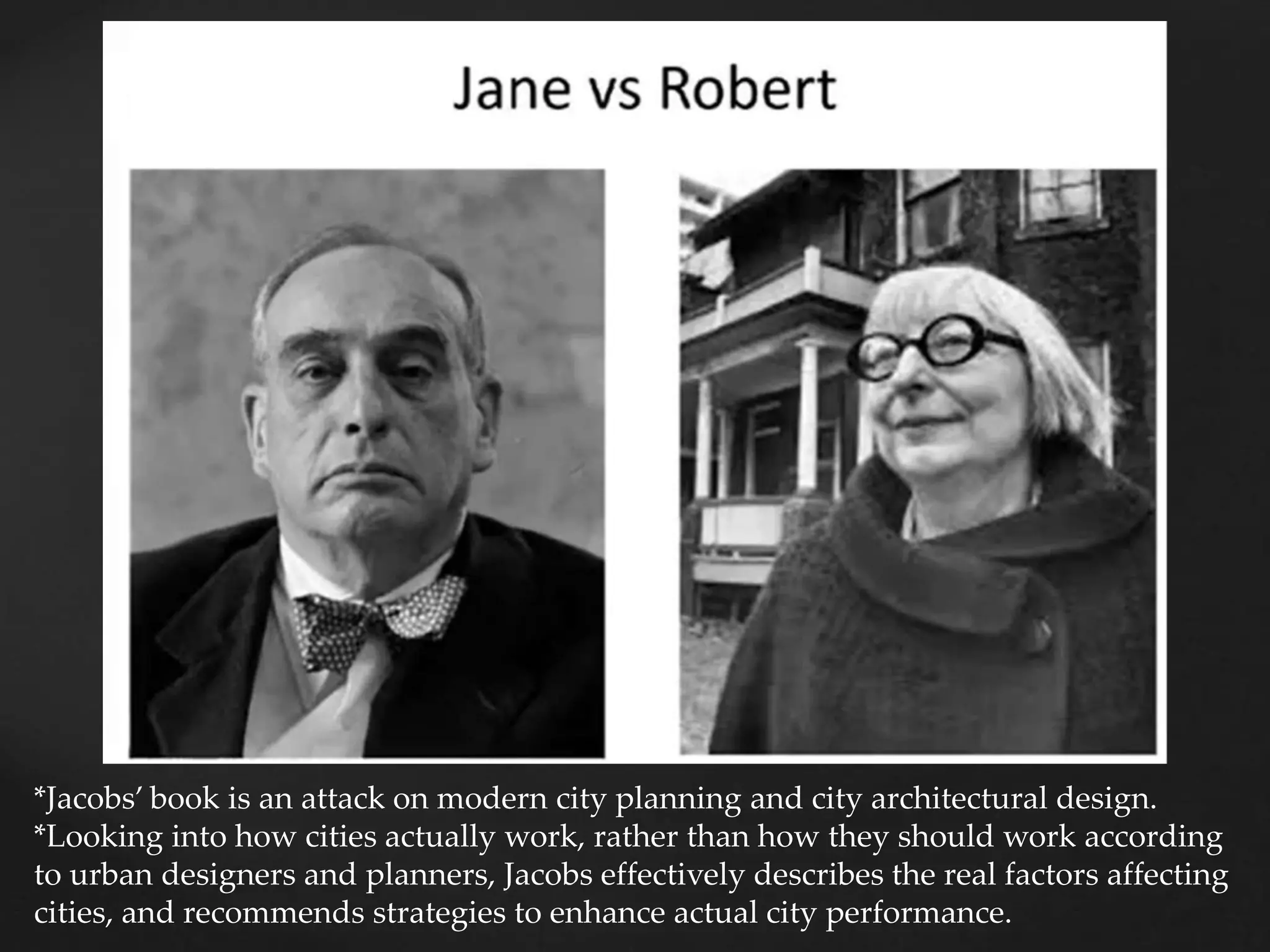
*Jacobs’ book is an attack on modern city planning and city architectural design.
*Looking into how cities actually work, rather than how they should work according
to urban designers and planners, Jacobs effectively describes the real factors affecting
cities, and recommends strategies to enhance actual city performance.
 A copy of Jane Jacobs book was sent to Robert Moses To
which his response was…
 “I am returning the book you sent me. Aside from the fact
that it is intemperate and inaccurate, it is also a defamation. I
call your attention, for example, to page 131. sell this junk to
someone else.” (the Guardian,2018)
Jane vs Robert
 The “Master Builder” of New
York, and designer of LOMEX
( Highway in NY)
 Designed -1930
 Opposed -1955
 Death of Project - 1960
Robert Moses
LOMEX-Low mid Manhattan Expressway
https://urbandemos.nyu.edu/wp-content/uploads/2015/10/13-lomex-brochure-480x382-1-480x382.jpg
https://sohomemory.org/sites/default/files/2018-10/417_148_2011_03_lomex-map.jpg
Map of the proposed Lower Manhattan Expressway (image:
Vanshnookenraggen/Flickr)
 The idea for the Lower Manhattan Expressway, or LOMEX
was to run the length of Broome Street, would have razed
most of what is now SoHo and Little Italy.
 If Robert Moses and his cohorts had had their way, SoHo
would never have existed, and the whole area of lower
Manhattan between the Holland Tunnel and the Williamsburg
and Manhattan Bridges would most certainly have shared the
same fate as the South Bronx after the Cross Bronx
Expressway (another Moses project) was built.
 The demolition of buildings more than 2000 houses, 800
business would have brought down.
 Lack of safety and surveillance.
 But thanks to community activists, led by Jane Jacobs,
opposition to the proposed highway connecting New Jersey
and Brooklyn (via some of the most historically significant
areas of New York City) killed the project, and the highway
was never built.
https://cdn.vox-cdn.com/thumbor/wERGl-
JpdZPyOlgV_N6IKQXXnzk=/420x0:3091x2003/2070x1164/filters:focal(420x0:3091x2003):format(webp)/cdn.vox-
cdn.com/uploads/chorus_image/image/49483673/jgh_janejacobs_FINAL_flat_lead_image.0.jpg
 D:ACAMEDIESMit 1st semptpRobert
Moses.mp4
 https://youtu.be/rvWB8R8yqAA
 D:ACAMEDIESMit 1st semptpIntro to
Jane Jacobs's Death & Life of Great American
Cities.mp4
Video clips
 Street sidewalks:
 Safety-protection
 To context- social cohesion.
 Protecting children-safe environment to play.
 Levels of cities:
 (City-District-Street)-relates each other.
 Diversity:-diversity to density
 District serve more than one primary function to ensure presence of people using
the same common facilities at different time.
 Blocks should be short to increase pass options in point of departure and
Destination and therefore enhance social and as a result in economical development.
 The age of buildings should be varying accommodating different people and
businesses which can afford different levels of range.
 The population and residence concentration should be present in order to promote
the city life.
 City performance:
 In terms of subsiding dwelling which were offer to build who is not affording to
build a housing and is calculated on based of Income levels.
Jacobs’ Elements & Ideas of the city
 Permeability: Road and Pedestrian route should be extensively
connected and intersect at multiple points allowing people and
appendence of choice inefficiency how the navigate an
environment.
 Mixed uses: Residence-Commercial-Institutional building in same
area maintains the identity of places and those that never offs the
place.
 Density: The close proximity of mixed use building strengthen the
economy of place and allows people to travel less distance
 Natural surveillance: When the build environment is constructed at
a human scale , the building-podium-public spaces, people watch
them in the daily activity which create the safe urban environment
where people will fill more Occam
Principles
 Articles
 “Downtown is for People,” Fortune, April 1958.
 “Vital Little Plans,” in Conference Report titled,
“Safdie/Rouse/Jacobs: An Exchange.”
 “Putting Toronto’s Best Self Forward,” Places, 7:2.
 “Market Nurturing Run Amok,” Openair-Market Net, October
1995.
 “Why TVA Failed,” The New York Review of Books, vol 31, no. 8,
May 10, 1984.
 Essay on Charles Dickens’s Hard Times, in The New York Review
of Books, 48 (12), July 19, 2001.
 Introduction to the new edition of Hard Times, by Charles
Dickens, New York: Modern Library, 2002.
 Introduction to the new edition of The Jungle, by Upton Sinclair,
New York: Modern Library, 2002.
 Introduction to the new edition of Innocents Abroad, by Mark
Twain, New York: Modern Library, 2003.
Other more Publications
 In 2005, in collaboration with Jane Jacobs, a
small group of accomplished urbanists and
activists founded The Center for the Living
City to build on Ms. Jacobs’ work.
 The Center’s purpose is to expand the
understanding of contemporary urban life and
inspire civic engagement and creative
responses for the urgent advancement of social,
economic and environmental justice.
Jane Jacobs and the
Center
 The impact of Jane Jacobs's observation,
activism, and writing has led to a 'planning
blueprint' for generations of architects,
planners, politicians and activists to practice.
 “Probably no single thinker has done more in the last fifty years to
transform our ideas about the nature of urban life”-Chicago
Tribune
 “Jane Jacobs’ observations about the way cities work and don’t
work revolutionized the urban planning profession. Thanks to
Jacobs, ideas once considered lunatic, such as mixed-use
development , short blocks, and dense concentrations of people
working and living downtown, are now taken for granted.”-
Adele Freedman, The Globe and Mail.
Accolades
 Jacobs was selected to be an officer of the Order
of Canada in 1996 for her seminal writings and
thought-provoking commentaries on urban
development. She received the American
Sociological Association Outstanding Lifetime
Contribution Award.
 She received the second Vincent Scully Prize
from the National Building Museum in 2000
which is awarded for exemplary practice,
scholarship, or criticism in architecture, historic
preservation, and urban design.
Awards & Achievements
Conclusion
 https://centerforthelivingcity.org/janejacobs#jane-and-
the-center
 https://www.pps.org/article/jjacobs-2
 https://sohomemory.org/the-master-builder
 The Death and Life of Great American Cities, New
York: Random House and Vintage Books, 1961
 https://www.theguardian.com/cities/series/the-story-of-
cities
 Brooke, G (1987) ,The penguin dictionary of human
geography. London.
 https://www.thefamouspeople.com/profiles/jane-
jacobs-4857.php
 https://helmofthepublicrealm.com/2012/11/18/urban-
designer-series-jane-jacobs/
REFERENCES

Jane Jacobs- urban activist

  • 1.
  • 2.
     Jane Jacobswas an American-Canadian journalist ,writer and activist. best known for her influence on urban studies, sociology, and economics.  May 4 ,1916- April 25,2006  Education:  Scranton High School (1933),  Columbia University,  School of General Studies of Columbia University Background
  • 3.
     She opposedthe idea of “Urban Renewal” and “Slum Clearance” and activity led movements against downtown expressways in New York and in Toronto, Canada.  She was an advocate for a place –based, community- centered approach to urban planning.  However, The Life and Death of Great American Cities, that propelled her an international scholar in planning; or as they call her, “The Mother of Urban Design.” Introduction
  • 4.
     In 1952, She became associate editor of Architectural Forum. Where she closely observed the mechanism of city planning and urban renewal.  In the process, she became increasingly critical of conventional planning theory and practice, observing that many of the city rebuilding projects she wrote about were not safe, interesting, alive, or economically sound.  The observations were later reflected in her book” The Death and Life of Great American Cities” Biography
  • 5.
     Jacobs’ alsobecame involved in urban activism, leading local efforts to oppose the top-down neighbourhood clearing and stopping Robert Moses’s proposed Lower Manhattan Expressway which would pass through Manhattan’s Washington Square Park and west village.  She got arrested in 1968 but the campaign is often considered to be one of the turning points in the development of New York City.  Jacobs’ harsh criticism of “slum-clearing” and High-Rise housing projects was also instrumental in discrediting these once universally supported planning practices. Biography
  • 6.
     In 1968Jacobs moved with her family to Toronto, where she remained an outspoken critic of Top-Down city planning. In the early 1970s she helped lead the Stop Spadina Campaign, to prevent the construction of a major highway through some of Toronto’s liveliest neighbourhoods. Biography
  • 8.
     A cityis a large human settlement, it generally has extensive systems for housing, transportation, sanitation, utilities, land use, and communication.  “Cities have the capability of providing something for everybody, only because, and only when, they are created by everybody.” — Jane Jacobs, The Death and Life of Great American Cities  Jacobs had no professional training in the field of city planning, nor did she hold the title of planner. Instead, she relied on her observations and common sense to show why certain places work, and what can be done to improve those that do not. Ideology
  • 9.
     Books  DarkAge Ahead, Random House, 2004.  The Nature of Economies, New York: Modern Library/ Random House, 2000.  A SCHOOLTEACHER IN OLD ALASKA: The Story of Hannah Breece, Owen Sound, Ontario: Ginger Press, 1995.  Systems of Survival: A Dialogue on the Moral Foundations of Commerce and Politics, New York: Random House, 1992.  Cities and the Wealth of Nations, New York: Random House, 1984.  A Question of Separatism: Quebec and the Struggle over Sovereignty, New York: Random House, 1980.  The Economy of Cities, New York: Random House, 1969.  The Death and Life of Great American Cities, New York: Random House and Vintage Books, 1961.  Ideas That Matter: The Worlds of Jane Jacobs, edited by Max Allen, Owen Sound, Ontario: The Ginger Press, 1997. Publications of Jane Jacobs
  • 10.
    The Death andLife of Great American Cities, New York: Random House and Vintage Books, 1961 Here she disagree with the thought of Robert Moses who believe that” “Cities are created by and for traffic. A city without traffic is a ghost town” Where Jacobs’ believe” A city is a large human settlement, it generally has extensive systems for housing, transportation, sanitation, utilities, land use, and communication”
  • 11.
    *Jacobs’ book isan attack on modern city planning and city architectural design. *Looking into how cities actually work, rather than how they should work according to urban designers and planners, Jacobs effectively describes the real factors affecting cities, and recommends strategies to enhance actual city performance.
  • 12.
     A copyof Jane Jacobs book was sent to Robert Moses To which his response was…  “I am returning the book you sent me. Aside from the fact that it is intemperate and inaccurate, it is also a defamation. I call your attention, for example, to page 131. sell this junk to someone else.” (the Guardian,2018) Jane vs Robert
  • 13.
     The “MasterBuilder” of New York, and designer of LOMEX ( Highway in NY)  Designed -1930  Opposed -1955  Death of Project - 1960 Robert Moses LOMEX-Low mid Manhattan Expressway https://urbandemos.nyu.edu/wp-content/uploads/2015/10/13-lomex-brochure-480x382-1-480x382.jpg
  • 14.
    https://sohomemory.org/sites/default/files/2018-10/417_148_2011_03_lomex-map.jpg Map of theproposed Lower Manhattan Expressway (image: Vanshnookenraggen/Flickr)
  • 15.
     The ideafor the Lower Manhattan Expressway, or LOMEX was to run the length of Broome Street, would have razed most of what is now SoHo and Little Italy.  If Robert Moses and his cohorts had had their way, SoHo would never have existed, and the whole area of lower Manhattan between the Holland Tunnel and the Williamsburg and Manhattan Bridges would most certainly have shared the same fate as the South Bronx after the Cross Bronx Expressway (another Moses project) was built.  The demolition of buildings more than 2000 houses, 800 business would have brought down.  Lack of safety and surveillance.  But thanks to community activists, led by Jane Jacobs, opposition to the proposed highway connecting New Jersey and Brooklyn (via some of the most historically significant areas of New York City) killed the project, and the highway was never built.
  • 16.
  • 17.
     D:ACAMEDIESMit 1stsemptpRobert Moses.mp4  https://youtu.be/rvWB8R8yqAA  D:ACAMEDIESMit 1st semptpIntro to Jane Jacobs's Death & Life of Great American Cities.mp4 Video clips
  • 18.
     Street sidewalks: Safety-protection  To context- social cohesion.  Protecting children-safe environment to play.  Levels of cities:  (City-District-Street)-relates each other.  Diversity:-diversity to density  District serve more than one primary function to ensure presence of people using the same common facilities at different time.  Blocks should be short to increase pass options in point of departure and Destination and therefore enhance social and as a result in economical development.  The age of buildings should be varying accommodating different people and businesses which can afford different levels of range.  The population and residence concentration should be present in order to promote the city life.  City performance:  In terms of subsiding dwelling which were offer to build who is not affording to build a housing and is calculated on based of Income levels. Jacobs’ Elements & Ideas of the city
  • 19.
     Permeability: Roadand Pedestrian route should be extensively connected and intersect at multiple points allowing people and appendence of choice inefficiency how the navigate an environment.  Mixed uses: Residence-Commercial-Institutional building in same area maintains the identity of places and those that never offs the place.  Density: The close proximity of mixed use building strengthen the economy of place and allows people to travel less distance  Natural surveillance: When the build environment is constructed at a human scale , the building-podium-public spaces, people watch them in the daily activity which create the safe urban environment where people will fill more Occam Principles
  • 20.
     Articles  “Downtownis for People,” Fortune, April 1958.  “Vital Little Plans,” in Conference Report titled, “Safdie/Rouse/Jacobs: An Exchange.”  “Putting Toronto’s Best Self Forward,” Places, 7:2.  “Market Nurturing Run Amok,” Openair-Market Net, October 1995.  “Why TVA Failed,” The New York Review of Books, vol 31, no. 8, May 10, 1984.  Essay on Charles Dickens’s Hard Times, in The New York Review of Books, 48 (12), July 19, 2001.  Introduction to the new edition of Hard Times, by Charles Dickens, New York: Modern Library, 2002.  Introduction to the new edition of The Jungle, by Upton Sinclair, New York: Modern Library, 2002.  Introduction to the new edition of Innocents Abroad, by Mark Twain, New York: Modern Library, 2003. Other more Publications
  • 22.
     In 2005,in collaboration with Jane Jacobs, a small group of accomplished urbanists and activists founded The Center for the Living City to build on Ms. Jacobs’ work.  The Center’s purpose is to expand the understanding of contemporary urban life and inspire civic engagement and creative responses for the urgent advancement of social, economic and environmental justice. Jane Jacobs and the Center
  • 23.
     The impactof Jane Jacobs's observation, activism, and writing has led to a 'planning blueprint' for generations of architects, planners, politicians and activists to practice.
  • 24.
     “Probably nosingle thinker has done more in the last fifty years to transform our ideas about the nature of urban life”-Chicago Tribune  “Jane Jacobs’ observations about the way cities work and don’t work revolutionized the urban planning profession. Thanks to Jacobs, ideas once considered lunatic, such as mixed-use development , short blocks, and dense concentrations of people working and living downtown, are now taken for granted.”- Adele Freedman, The Globe and Mail. Accolades
  • 25.
     Jacobs wasselected to be an officer of the Order of Canada in 1996 for her seminal writings and thought-provoking commentaries on urban development. She received the American Sociological Association Outstanding Lifetime Contribution Award.  She received the second Vincent Scully Prize from the National Building Museum in 2000 which is awarded for exemplary practice, scholarship, or criticism in architecture, historic preservation, and urban design. Awards & Achievements
  • 26.
  • 27.
     https://centerforthelivingcity.org/janejacobs#jane-and- the-center  https://www.pps.org/article/jjacobs-2 https://sohomemory.org/the-master-builder  The Death and Life of Great American Cities, New York: Random House and Vintage Books, 1961  https://www.theguardian.com/cities/series/the-story-of- cities  Brooke, G (1987) ,The penguin dictionary of human geography. London.  https://www.thefamouspeople.com/profiles/jane- jacobs-4857.php  https://helmofthepublicrealm.com/2012/11/18/urban- designer-series-jane-jacobs/ REFERENCES