SIR EBENEZER HOWARD
BY:
ANMOL BHANDARI (A1904013)
HARSH GUPTA (A19040131)
PALAK SAHNI (A1904013131)
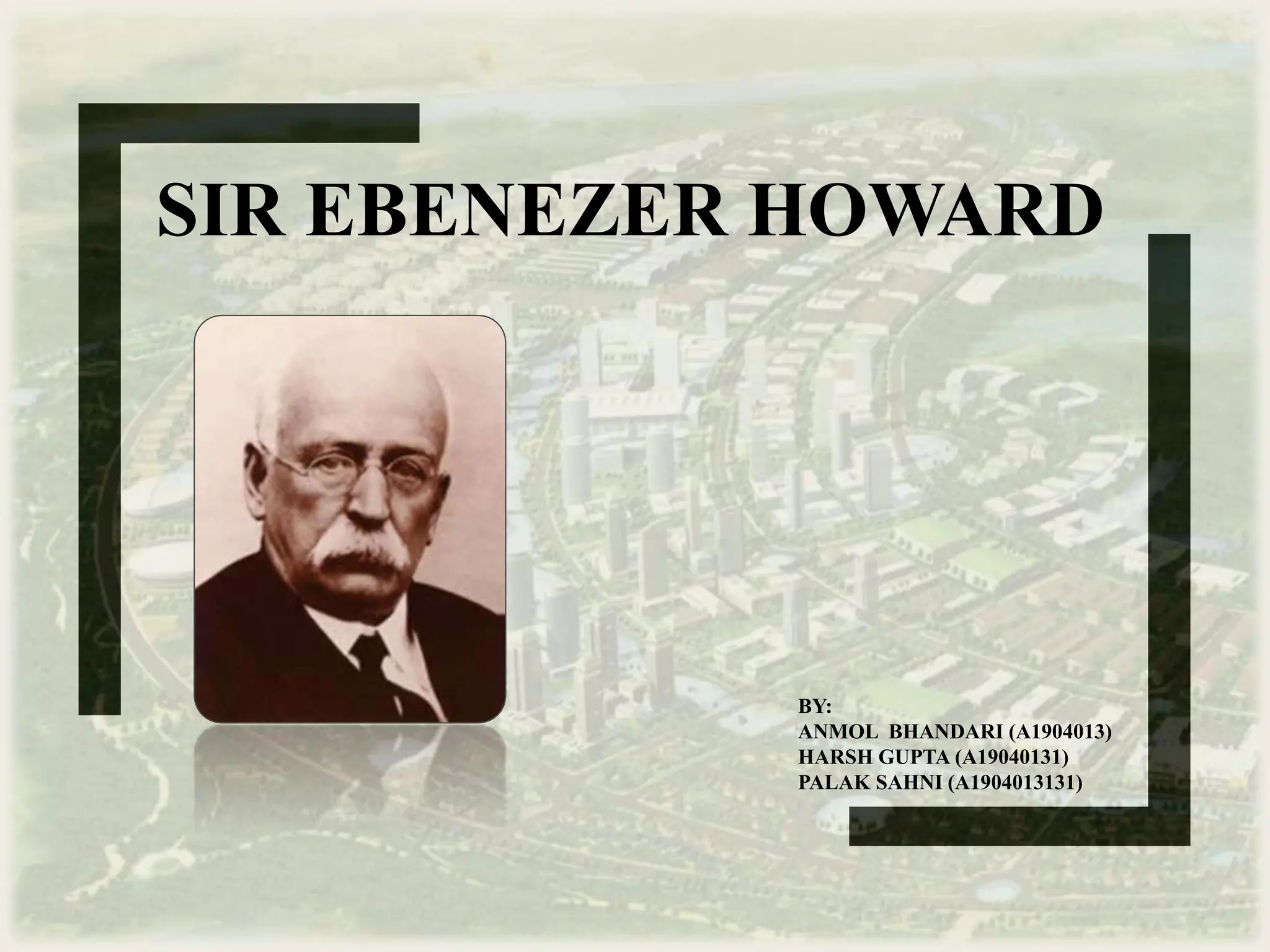
SIR EBENEZER HOWARD
(29TH JANUARY 1850– MAY 1ST, 1928)
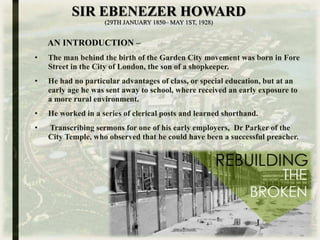
AN INTRODUCTION –
• The man behind the birth of the Garden City movement was born in Fore
Street in the City of London, the son of a shopkeeper.
• He had no particular advantages of class, or special education, but at an
early age he was sent away to school, where received an early exposure to
a more rural environment.
• He worked in a series of clerical posts and learned shorthand.
• Transcribing sermons for one of his early employers, Dr Parker of the
City Temple, who observed that he could have been a successful preacher.
GARDEN CITY MOVEMENT: The Origin -
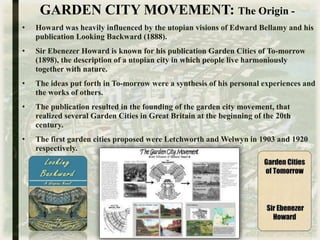
• Howard was heavily influenced by the utopian visions of Edward Bellamy and his
publication Looking Backward (1888).
• Sir Ebenezer Howard is known for his publication Garden Cities of To-morrow
(1898), the description of a utopian city in which people live harmoniously
together with nature.
• The ideas put forth in To-morrow were a synthesis of his personal experiences and
the works of others.
• The publication resulted in the founding of the garden city movement, that
realized several Garden Cities in Great Britain at the beginning of the 20th
century.
• The first garden cities proposed were Letchworth and Welwyn in 1903 and 1920
respectively.
GARDEN CITIES OF TOMORROW :
The Book –
• This book offered a vision of towns free of slums and enjoying the benefits
of both town (such as opportunity, amusement and good wages) and
country (such as beauty, fresh air and low rents).
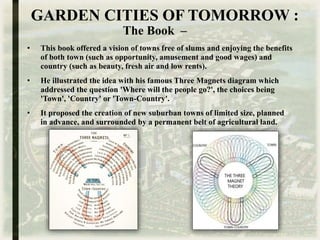
• He illustrated the idea with his famous Three Magnets diagram which
addressed the question 'Where will the people go?', the choices being
'Town', 'Country' or 'Town-Country'.
• It proposed the creation of new suburban towns of limited size, planned
in advance, and surrounded by a permanent belt of agricultural land.
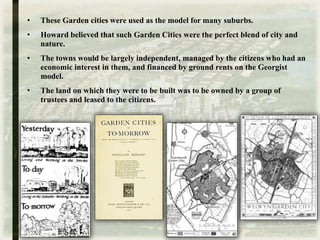
• These Garden cities were used as the model for many suburbs.
• Howard believed that such Garden Cities were the perfect blend of city and
nature.
• The towns would be largely independent, managed by the citizens who had an
economic interest in them, and financed by ground rents on the Georgist
model.
• The land on which they were to be built was to be owned by a group of
trustees and leased to the citizens.
THE CURE
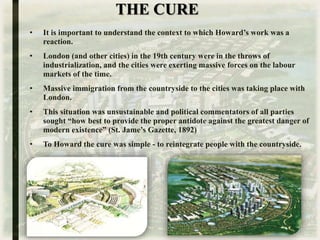
• It is important to understand the context to which Howard’s work was a
reaction.
• London (and other cities) in the 19th century were in the throws of
industrialization, and the cities were exerting massive forces on the labour
markets of the time.
• Massive immigration from the countryside to the cities was taking place with
London.
• This situation was unsustainable and political commentators of all parties
sought “how best to provide the proper antidote against the greatest danger of
modern existence” (St. Jame’s Gazette, 1892)
• To Howard the cure was simple - to reintegrate people with the countryside.
• In trying to understand and represent the attraction of the city he compared
each city to a magnet, with individuals represented as needles drawn to the
city.
• He set about comparing the ‘town and country magnets’ but decided that
neither were suitable attractors for his utopian vision.
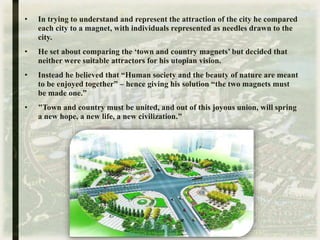
• Instead he believed that “Human society and the beauty of nature are meant
to be enjoyed together” – hence giving his solution “the two magnets must
be made one.”
• "Town and country must be united, and out of this joyous union, will spring
a new hope, a new life, a new civilization."
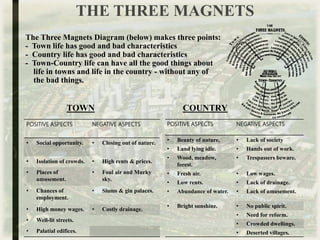
The Three Magnets Diagram (below) makes three points:
- Town life has good and bad characteristics
- Country life has good and bad characteristics
- Town-Country life can have all the good things about
life in towns and life in the country - without any of
the bad things.
POSITIVE ASPECTS NEGATIVE ASPECTS
• Social opportunity. • Closing out of nature.
• Isolation of crowds. • High rents & prices.
• Places of
amusement.
• Foul air and Murky
sky.
• Chances of
employment.
• Slums & gin palaces.
• High money wages. • Costly drainage.
• Well-lit streets.
• Palatial edifices.
TOWN
POSITIVE ASPECTS NEGATIVE ASPECTS
• Beauty of nature. • Lack of society
• Land lying idle. • Hands out of work.
• Wood, meadow,
forest.
• Trespassers beware.
• Fresh air. • Low wages.
• Low rents. • Lack of drainage.
• Abundance of water. • Lack of amusement.
• Bright sunshine. • No public spirit.
• Need for reform.
• Crowded dwellings.
• Deserted villages.
COUNTRY
THE THREE MAGNETS
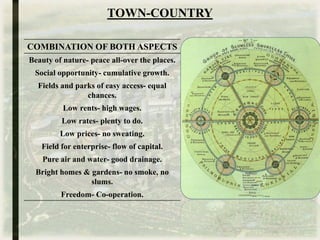
TOWN-COUNTRY
COMBINATION OF BOTH ASPECTS
Beauty of nature- peace all-over the places.
Social opportunity- cumulative growth.
Fields and parks of easy access- equal
chances.
Low rents- high wages.
Low rates- plenty to do.
Low prices- no sweating.
Field for enterprise- flow of capital.
Pure air and water- good drainage.
Bright homes & gardens- no smoke, no
slums.
Freedom- Co-operation.
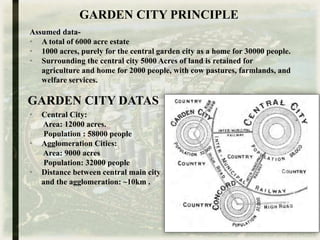
GARDEN CITY PRINCIPLE
GARDEN CITY DATAS
• Central City:
Area: 12000 acres.
Population : 58000 people
• Agglomeration Cities:
Area: 9000 acres
Population: 32000 people
• Distance between central main city
and the agglomeration: ~10km .
Assumed data-
• A total of 6000 acre estate
• 1000 acres, purely for the central garden city as a home for 30000 people.
• Surrounding the central city 5000 Acres of land is retained for
agriculture and home for 2000 people, with cow pastures, farmlands, and
welfare services.
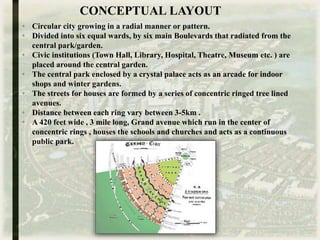
• Circular city growing in a radial manner or pattern.
• Divided into six equal wards, by six main Boulevards that radiated from the
central park/garden.
• Civic institutions (Town Hall, Library, Hospital, Theatre, Museum etc. ) are
placed around the central garden.
• The central park enclosed by a crystal palace acts as an arcade for indoor
shops and winter gardens.
• The streets for houses are formed by a series of concentric ringed tree lined
avenues.
• Distance between each ring vary between 3-5km .
• A 420 feet wide , 3 mile long, Grand avenue which run in the center of
concentric rings , houses the schools and churches and acts as a continuous
public park.
CONCEPTUAL LAYOUT
Howard goes to great lengths to demonstrate how the revenue derived simply
from rents could be used to:
• All the industries, factories and warehouses were placed at the periferal
ring of the city.
REVENUE AND EXPENDITURE
• The municipal railway was placed in another ring closer to the industrial
ring , so that the pressure of excess transport on the city streets are reduced
and the city is connected to the rest of the nation.
• Pay the interest with which the estate was purchased (providing a 4% return
for the initial investors)
• Provide a sinking fund for the purpose of paying off the principal.
• Construct and maintain all the works typically undertaken by municipalities
(including a detailed breakdown of associated costs).
• Provide a large surplus for other purposes including old age pensions,
medical services and insurance.
ADMINISTRATION
• Howard did not advocate the complete municipalisation of industry or the
elimination of private enterprise, instead he proposes a cautious and limited
municipality that doesn’t attempt “too much.”
 The activities are to be closely related to the rate-rent of the tenants and would
“grow in proportion as municipal work is done efficiently and honestly.”
 With this in mind the structure of the municipality and its administration is
proposed with a Board of Management composed of The Central Council and The
Departments (Public Control, Engineering, Social and Education).
 Assuming the Garden City model was implemented and found to be successful
Howard begins to describe how the City could grow and become part of an
integrated network of Garden Cities.
CITY GROWTH
 The principle of “always preserving a belt of country” around cities should
always be maintained, argues Howard, so once a city has reached capacity a new
one must be founded outside the agricultural belt (the influence of colonial-
models prominent).
 Eventually there a central city (of perhaps 58,000 inhabitants) would be
surrounded by a number of smaller off-shoot cities, connected by railroad and
canal infrastructure.
GARDEN CITY PRINCIPLE IN PRACTICE
 The first Garden City evolved out of Howard’s
principles is Letchworth Garden City designed by
Raymond Unwin and Barry Parker in 1903.
 The second one to evolve was Welwyn Garden City
designed by Louis de Soissons and Frederic Osborn
in 1920.
 Another example was Radburn City designed by
Clarence Stein and Henry Wright in 1928.
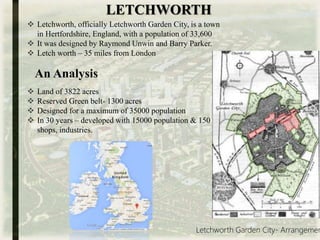
LETCHWORTH
 Letchworth, officially Letchworth Garden City, is a town
in Hertfordshire, England, with a population of 33,600
 It was designed by Raymond Unwin and Barry Parker.
 Letch worth – 35 miles from London
 Land of 3822 acres
 Reserved Green belt- 1300 acres
 Designed for a maximum of 35000 population
 In 30 years – developed with 15000 population & 150
shops, industries.
An Analysis
Letchworth Garden City- Arrangemen
LETCHWORTH- A NEW VISION
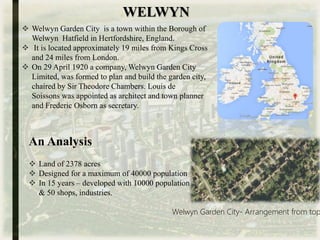
WELWYN
 Welwyn Garden City is a town within the Borough of
Welwyn Hatfield in Hertfordshire, England.
 It is located approximately 19 miles from Kings Cross
and 24 miles from London.
 On 29 April 1920 a company, Welwyn Garden City
Limited, was formed to plan and build the garden city,
chaired by Sir Theodore Chambers. Louis de
Soissons was appointed as architect and town planner
and Frederic Osborn as secretary.
. An Analysis
Welwyn Garden City- Arrangement from top
 Land of 2378 acres
 Designed for a maximum of 40000 population
 In 15 years – developed with 10000 population
& 50 shops, industries.
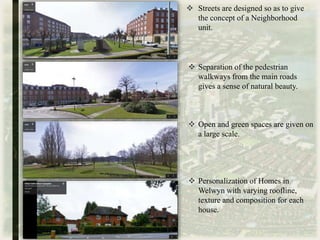
 Personalization of Homes in
Welwyn with varying roofline,
texture and composition for each
house.
 Streets are designed so as to give
the concept of a Neighborhood
unit.
 Separation of the pedestrian
walkways from the main roads
gives a sense of natural beauty.
 Open and green spaces are given on
a large scale.
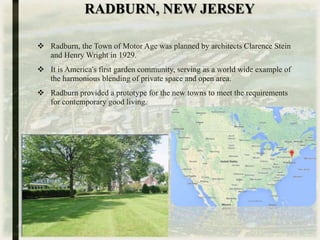
RADBURN, NEW JERSEY
 Radburn, the Town of Motor Age was planned by architects Clarence Stein
and Henry Wright in 1929.
 It is America's first garden community, serving as a world wide example of
the harmonious blending of private space and open area.
 Radburn provided a prototype for the new towns to meet the requirements
for contemporary good living.
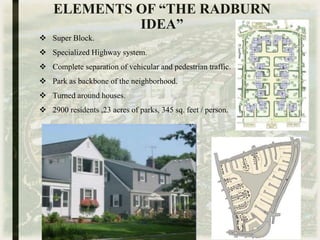
ELEMENTS OF “THE RADBURN
IDEA”
 Super Block.
 Specialized Highway system.
 Complete separation of vehicular and pedestrian traffic.
 Park as backbone of the neighborhood.
 Turned around houses.
 2900 residents ,23 acres of parks, 345 sq. feet / person.
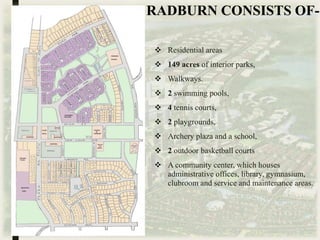
RADBURN CONSISTS OF-
 Residential areas
 149 acres of interior parks,
 Walkways.
 2 swimming pools,
 4 tennis courts,
 2 playgrounds,
 Archery plaza and a school,
 2 outdoor basketball courts
 A community center, which houses
administrative offices, library, gymnasium,
clubroom and service and maintenance areas.
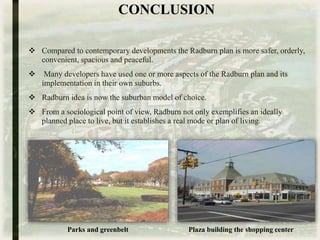
CONCLUSION
 Compared to contemporary developments the Radburn plan is more safer, orderly,
convenient, spacious and peaceful.
 Many developers have used one or more aspects of the Radburn plan and its
implementation in their own suburbs.
 Radburn idea is now the suburban model of choice.
 From a sociological point of view, Radburn not only exemplifies an ideally
planned place to live, but it establishes a real mode or plan of living.
Parks and greenbelt Plaza building the shopping center
LUTYENS,NEW DELHI
 Sir Edwin lutyens was inspired by garden city movement while
designing New Delhi.
 The movement, an urban planning concept, saw a city as a group of
planned, self-contained communities surrounded by green belts.
 Lutyens' Delhi, also known as the "Eighth City of Delhi", stood out
from the start with wide tree-lined avenues, large plots and spacious
bungalows set in them.
FEATURES
 Rashtrapati Bhavan, North Block and South Block, large bungalow
plots and other government buildings knit together carefully by a web
of wide shady avenues lend to the city a grand order, symmetry and
unique aesthetic character.
 The city was laid out in a grand manner and is an excellent example of a
fine blend of classical and modern town planning
CONCLUSION
• Ebenezer Howard’s Garden City concept shows us a place where genuine urban
activities are carried at human scale.
• The garden city introduced the use of greenbelts that have served many uses
including the preservation of agricultural and rural life, nature and heritage
conservation, recreation, pollution minimization, and growth management.
• Garden city tradition endowed urban planning with a social and community
dimensions.
• The garden city idea however, showed how both industrial estates and
collective retailing spaces could be used within a comprehensive planning
approach to serve public purposes.
Ebenzer Howard, palak, anmol , harsh.pptx

Ebenzer Howard, palak, anmol , harsh.pptx

  • 1.
    SIR EBENEZER HOWARD BY: ANMOLBHANDARI (A1904013) HARSH GUPTA (A19040131) PALAK SAHNI (A1904013131)
  • 2.
    SIR EBENEZER HOWARD (29THJANUARY 1850– MAY 1ST, 1928) AN INTRODUCTION – • The man behind the birth of the Garden City movement was born in Fore Street in the City of London, the son of a shopkeeper. • He had no particular advantages of class, or special education, but at an early age he was sent away to school, where received an early exposure to a more rural environment. • He worked in a series of clerical posts and learned shorthand. • Transcribing sermons for one of his early employers, Dr Parker of the City Temple, who observed that he could have been a successful preacher.
  • 3.
    GARDEN CITY MOVEMENT:The Origin - • Howard was heavily influenced by the utopian visions of Edward Bellamy and his publication Looking Backward (1888). • Sir Ebenezer Howard is known for his publication Garden Cities of To-morrow (1898), the description of a utopian city in which people live harmoniously together with nature. • The ideas put forth in To-morrow were a synthesis of his personal experiences and the works of others. • The publication resulted in the founding of the garden city movement, that realized several Garden Cities in Great Britain at the beginning of the 20th century. • The first garden cities proposed were Letchworth and Welwyn in 1903 and 1920 respectively.
  • 4.
    GARDEN CITIES OFTOMORROW : The Book – • This book offered a vision of towns free of slums and enjoying the benefits of both town (such as opportunity, amusement and good wages) and country (such as beauty, fresh air and low rents). • He illustrated the idea with his famous Three Magnets diagram which addressed the question 'Where will the people go?', the choices being 'Town', 'Country' or 'Town-Country'. • It proposed the creation of new suburban towns of limited size, planned in advance, and surrounded by a permanent belt of agricultural land.
  • 5.
    • These Gardencities were used as the model for many suburbs. • Howard believed that such Garden Cities were the perfect blend of city and nature. • The towns would be largely independent, managed by the citizens who had an economic interest in them, and financed by ground rents on the Georgist model. • The land on which they were to be built was to be owned by a group of trustees and leased to the citizens.
  • 6.
    THE CURE • Itis important to understand the context to which Howard’s work was a reaction. • London (and other cities) in the 19th century were in the throws of industrialization, and the cities were exerting massive forces on the labour markets of the time. • Massive immigration from the countryside to the cities was taking place with London. • This situation was unsustainable and political commentators of all parties sought “how best to provide the proper antidote against the greatest danger of modern existence” (St. Jame’s Gazette, 1892) • To Howard the cure was simple - to reintegrate people with the countryside.
  • 7.
    • In tryingto understand and represent the attraction of the city he compared each city to a magnet, with individuals represented as needles drawn to the city. • He set about comparing the ‘town and country magnets’ but decided that neither were suitable attractors for his utopian vision. • Instead he believed that “Human society and the beauty of nature are meant to be enjoyed together” – hence giving his solution “the two magnets must be made one.” • "Town and country must be united, and out of this joyous union, will spring a new hope, a new life, a new civilization."
  • 8.
    The Three MagnetsDiagram (below) makes three points: - Town life has good and bad characteristics - Country life has good and bad characteristics - Town-Country life can have all the good things about life in towns and life in the country - without any of the bad things. POSITIVE ASPECTS NEGATIVE ASPECTS • Social opportunity. • Closing out of nature. • Isolation of crowds. • High rents & prices. • Places of amusement. • Foul air and Murky sky. • Chances of employment. • Slums & gin palaces. • High money wages. • Costly drainage. • Well-lit streets. • Palatial edifices. TOWN POSITIVE ASPECTS NEGATIVE ASPECTS • Beauty of nature. • Lack of society • Land lying idle. • Hands out of work. • Wood, meadow, forest. • Trespassers beware. • Fresh air. • Low wages. • Low rents. • Lack of drainage. • Abundance of water. • Lack of amusement. • Bright sunshine. • No public spirit. • Need for reform. • Crowded dwellings. • Deserted villages. COUNTRY THE THREE MAGNETS
  • 9.
    TOWN-COUNTRY COMBINATION OF BOTHASPECTS Beauty of nature- peace all-over the places. Social opportunity- cumulative growth. Fields and parks of easy access- equal chances. Low rents- high wages. Low rates- plenty to do. Low prices- no sweating. Field for enterprise- flow of capital. Pure air and water- good drainage. Bright homes & gardens- no smoke, no slums. Freedom- Co-operation.
  • 10.
    GARDEN CITY PRINCIPLE GARDENCITY DATAS • Central City: Area: 12000 acres. Population : 58000 people • Agglomeration Cities: Area: 9000 acres Population: 32000 people • Distance between central main city and the agglomeration: ~10km . Assumed data- • A total of 6000 acre estate • 1000 acres, purely for the central garden city as a home for 30000 people. • Surrounding the central city 5000 Acres of land is retained for agriculture and home for 2000 people, with cow pastures, farmlands, and welfare services.
  • 11.
    • Circular citygrowing in a radial manner or pattern. • Divided into six equal wards, by six main Boulevards that radiated from the central park/garden. • Civic institutions (Town Hall, Library, Hospital, Theatre, Museum etc. ) are placed around the central garden. • The central park enclosed by a crystal palace acts as an arcade for indoor shops and winter gardens. • The streets for houses are formed by a series of concentric ringed tree lined avenues. • Distance between each ring vary between 3-5km . • A 420 feet wide , 3 mile long, Grand avenue which run in the center of concentric rings , houses the schools and churches and acts as a continuous public park. CONCEPTUAL LAYOUT
  • 12.
    Howard goes togreat lengths to demonstrate how the revenue derived simply from rents could be used to: • All the industries, factories and warehouses were placed at the periferal ring of the city. REVENUE AND EXPENDITURE • The municipal railway was placed in another ring closer to the industrial ring , so that the pressure of excess transport on the city streets are reduced and the city is connected to the rest of the nation. • Pay the interest with which the estate was purchased (providing a 4% return for the initial investors) • Provide a sinking fund for the purpose of paying off the principal. • Construct and maintain all the works typically undertaken by municipalities (including a detailed breakdown of associated costs). • Provide a large surplus for other purposes including old age pensions, medical services and insurance. ADMINISTRATION • Howard did not advocate the complete municipalisation of industry or the elimination of private enterprise, instead he proposes a cautious and limited municipality that doesn’t attempt “too much.”
  • 13.
     The activitiesare to be closely related to the rate-rent of the tenants and would “grow in proportion as municipal work is done efficiently and honestly.”  With this in mind the structure of the municipality and its administration is proposed with a Board of Management composed of The Central Council and The Departments (Public Control, Engineering, Social and Education).  Assuming the Garden City model was implemented and found to be successful Howard begins to describe how the City could grow and become part of an integrated network of Garden Cities. CITY GROWTH  The principle of “always preserving a belt of country” around cities should always be maintained, argues Howard, so once a city has reached capacity a new one must be founded outside the agricultural belt (the influence of colonial- models prominent).  Eventually there a central city (of perhaps 58,000 inhabitants) would be surrounded by a number of smaller off-shoot cities, connected by railroad and canal infrastructure.
  • 14.
    GARDEN CITY PRINCIPLEIN PRACTICE  The first Garden City evolved out of Howard’s principles is Letchworth Garden City designed by Raymond Unwin and Barry Parker in 1903.  The second one to evolve was Welwyn Garden City designed by Louis de Soissons and Frederic Osborn in 1920.  Another example was Radburn City designed by Clarence Stein and Henry Wright in 1928.
  • 15.
    LETCHWORTH  Letchworth, officiallyLetchworth Garden City, is a town in Hertfordshire, England, with a population of 33,600  It was designed by Raymond Unwin and Barry Parker.  Letch worth – 35 miles from London  Land of 3822 acres  Reserved Green belt- 1300 acres  Designed for a maximum of 35000 population  In 30 years – developed with 15000 population & 150 shops, industries. An Analysis Letchworth Garden City- Arrangemen
  • 16.
  • 17.
    WELWYN  Welwyn GardenCity is a town within the Borough of Welwyn Hatfield in Hertfordshire, England.  It is located approximately 19 miles from Kings Cross and 24 miles from London.  On 29 April 1920 a company, Welwyn Garden City Limited, was formed to plan and build the garden city, chaired by Sir Theodore Chambers. Louis de Soissons was appointed as architect and town planner and Frederic Osborn as secretary. . An Analysis Welwyn Garden City- Arrangement from top  Land of 2378 acres  Designed for a maximum of 40000 population  In 15 years – developed with 10000 population & 50 shops, industries.
  • 18.
     Personalization ofHomes in Welwyn with varying roofline, texture and composition for each house.  Streets are designed so as to give the concept of a Neighborhood unit.  Separation of the pedestrian walkways from the main roads gives a sense of natural beauty.  Open and green spaces are given on a large scale.
  • 19.
    RADBURN, NEW JERSEY Radburn, the Town of Motor Age was planned by architects Clarence Stein and Henry Wright in 1929.  It is America's first garden community, serving as a world wide example of the harmonious blending of private space and open area.  Radburn provided a prototype for the new towns to meet the requirements for contemporary good living.
  • 20.
    ELEMENTS OF “THERADBURN IDEA”  Super Block.  Specialized Highway system.  Complete separation of vehicular and pedestrian traffic.  Park as backbone of the neighborhood.  Turned around houses.  2900 residents ,23 acres of parks, 345 sq. feet / person.
  • 21.
    RADBURN CONSISTS OF- Residential areas  149 acres of interior parks,  Walkways.  2 swimming pools,  4 tennis courts,  2 playgrounds,  Archery plaza and a school,  2 outdoor basketball courts  A community center, which houses administrative offices, library, gymnasium, clubroom and service and maintenance areas.
  • 22.
    CONCLUSION  Compared tocontemporary developments the Radburn plan is more safer, orderly, convenient, spacious and peaceful.  Many developers have used one or more aspects of the Radburn plan and its implementation in their own suburbs.  Radburn idea is now the suburban model of choice.  From a sociological point of view, Radburn not only exemplifies an ideally planned place to live, but it establishes a real mode or plan of living. Parks and greenbelt Plaza building the shopping center
  • 23.
    LUTYENS,NEW DELHI  SirEdwin lutyens was inspired by garden city movement while designing New Delhi.  The movement, an urban planning concept, saw a city as a group of planned, self-contained communities surrounded by green belts.  Lutyens' Delhi, also known as the "Eighth City of Delhi", stood out from the start with wide tree-lined avenues, large plots and spacious bungalows set in them.
  • 24.
    FEATURES  Rashtrapati Bhavan,North Block and South Block, large bungalow plots and other government buildings knit together carefully by a web of wide shady avenues lend to the city a grand order, symmetry and unique aesthetic character.  The city was laid out in a grand manner and is an excellent example of a fine blend of classical and modern town planning
  • 25.
    CONCLUSION • Ebenezer Howard’sGarden City concept shows us a place where genuine urban activities are carried at human scale. • The garden city introduced the use of greenbelts that have served many uses including the preservation of agricultural and rural life, nature and heritage conservation, recreation, pollution minimization, and growth management. • Garden city tradition endowed urban planning with a social and community dimensions. • The garden city idea however, showed how both industrial estates and collective retailing spaces could be used within a comprehensive planning approach to serve public purposes.