Frank Lloyd Wright
and
The Suburbia
Bidhya Gupta 6
Rojina Kafle 8
Prashant Rasaili 22
Nandita Shrestha 25
1
TABLE OF CONTENTS
INTRODUCTION
01
02
03
PLANNING
CONCLUSION
2
BROADACRE CITY
3
● Location :Midwest USA
● Year(s) :1932-1935 [Status: Unbuilt]
● Footprint :4 mi²
● Designer :Frank Lloyd Wright
● Key Components :1 acre devoted per family, suburban
sprawl,minimal apartment living, local
commercialism
● Program(s) :Private
● Title :Local / public amenities
● Funding Streams :Edgar Kauffman
-FRANK LLOYD WRIGHT
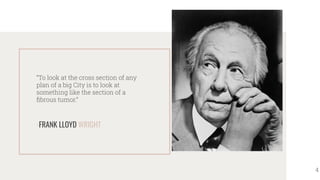
“To look at the cross section of any
plan of a big City is to look at
something like the section of a
fibrous tumor.”
4
ORIGIN
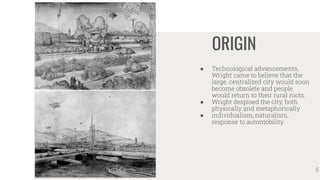
● Technological advancements,
Wright came to believe that the
large, centralized city would soon
become obsolete and people
would return to their rural roots.
● Wright despised the city, both
physically and metaphorically
● individualism, naturalism,
response to automobility.
5
KEY CONCEPT- Individualism
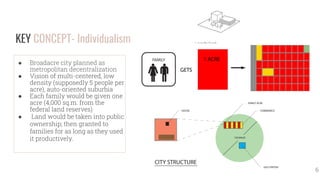
● Broadacre city planned as
metropolitan decentralization
● Vision of multi-centered, low
density (supposedly 5 people per
acre), auto-oriented suburbia
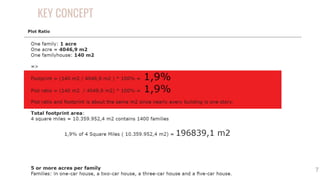
● Each family would be given one
acre (4,000 sq.m. from the
federal land reserves)
● Land would be taken into public
ownership; then granted to
families for as long as they used
it productively.
6
KEY CONCEPT
7
CONCEPT
Naturalism
.
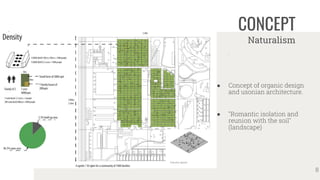
● Concept of organic design
and usonian architecture.
● "Romantic isolation and
reunion with the soil"
(landscape)
8
CONCEPT
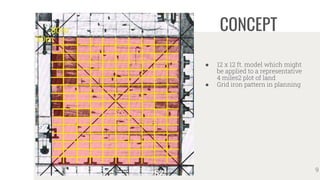
● 12 x 12 ft. model which might
be applied to a representative
4 miles2 plot of land
● Grid iron pattern in planning
9
CONCEPT
.
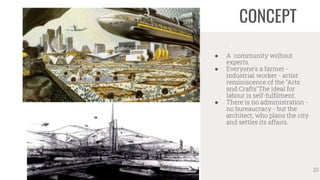
● A community without
experts.
● Everyone's a farmer -
industrial worker - artist:
reminiscence of the "Arts
and Crafts"The ideal for
labour is self-fulfilment.
● There is no administration -
no bureaucracy - but the
architect, who plans the city
and settles its affairs.
10
CONCEPT
(automobility)
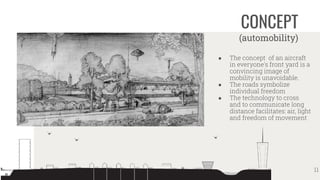
● The concept of an aircraft
in everyone's front yard is a
convincing image of
mobility is unavoidable.
● The roads symbolize
individual freedom
● The technology to cross
and to communicate long
distance facilitates: air, light
and freedom of movement
11
PROCESS
12
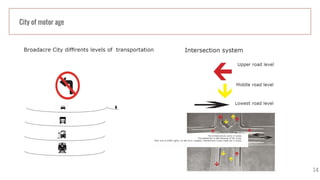
City of motor age
.
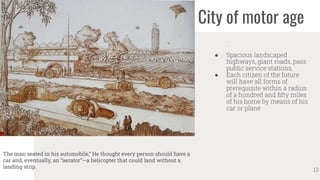
● Spacious landscaped
highways, giant roads, pass
public service stations,
● Each citizen of the future
will have all forms of
prerequisite within a radius
of a hundred and fifty miles
of his home by means of his
car or plane
13
The man seated in his automobile,” He thought every person should have a
car and, eventually, an “aerator”—a helicopter that could land without a
landing strip.
14
City of motor age
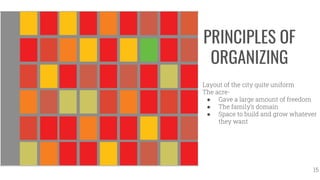
Layout of the city quite uniform
The acre-
● Gave a large amount of freedom
● The family’s domain
● Space to build and grow whatever
they want
PRINCIPLES OF
ORGANIZING
15
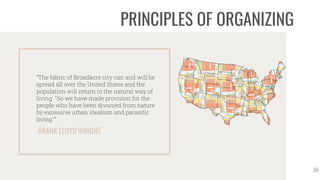
-FRANK LLOYD WRIGHT
“The fabric of Broadacre city can and will be
spread all over the United States and the
population will return to the natural way of
living. "So we have made provision for the
people who have been divorced from nature
by excessive urban idealism and parasitic
living."”
16
PRINCIPLES OF ORGANIZING
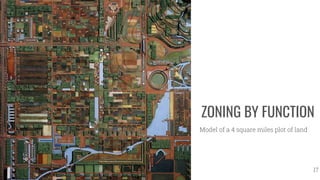
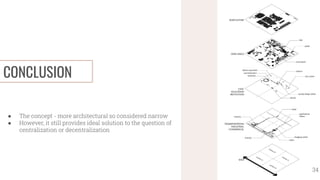
Model of a 4 square miles plot of land
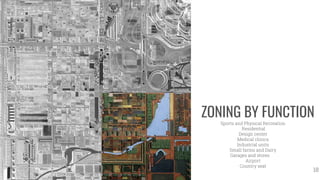
ZONING BY FUNCTION
17
ZONING BY FUNCTION
Sports and Physical Recreation
Residential
Design center
Medical clinics
Industrial units
Small farms and Dairy
Garages and stores
Airport
Country seat
18
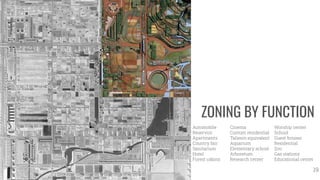
Automobile
Reservoir
Apartments
Country fair
Sanitarium
Hotel
Forest cabins
Cinema
Custom residential
Taliesin equivalent
Aquarium
Elementary school
Arboretum
Research center
Worship center
School
Guest houses
Residential
Zoo
Gas stations
Educational center
ZONING BY FUNCTION
19
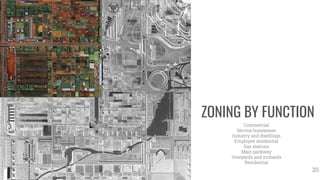
Commercial
Service businesses
Industry and dwellings
Employee residential
Gas stations
Main parkway
Vineyards and orchards
Residential
ZONING BY FUNCTION
20
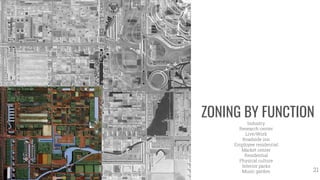
Industry
Research center
Live/Work
Roadside inn
Employee residential
Market center
Residential
Physical culture
Interior parks
Music garden
ZONING BY FUNCTION
21
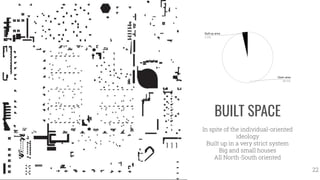
BUILT SPACE
In spite of the individual-oriented
ideology
Built up in a very strict system
Big and small houses
All North-South oriented
22
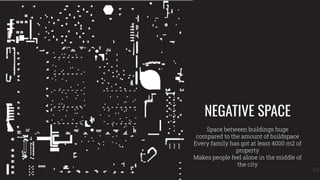
NEGATIVE SPACE
Space between buildings huge
compared to the amount of buildspace
Every family has got at least 4000 m2 of
property
Makes people feel alone in the middle of
the city
23
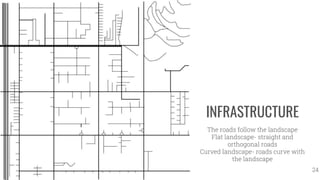
INFRASTRUCTURE
The roads follow the landscape
Flat landscape- straight and
orthogonal roads
Curved landscape- roads curve with
the landscape
24
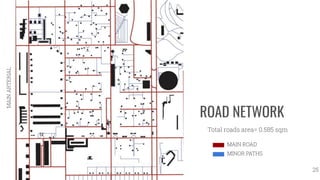
ROAD NETWORK
Total roads area= 0.585 sqm
MAIN ROAD
MINOR PATHS
MAIN
ARTERIAL
25
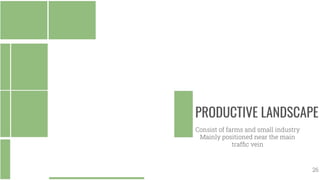
PRODUCTIVE LANDSCAPE
Consist of farms and small industry
Mainly positioned near the main
traffic vein
26
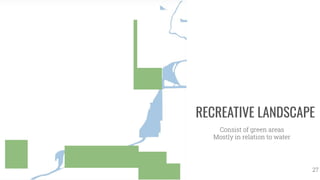
RECREATIVE LANDSCAPE
Consist of green areas
Mostly in relation to water
27
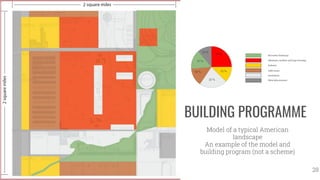
BUILDING PROGRAMME
Model of a typical American
landscape
An example of the model and
building program (not a scheme)
28
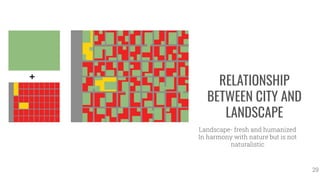
RELATIONSHIP
BETWEEN CITY AND
LANDSCAPE
Landscape- fresh and humanized
In harmony with nature but is not
naturalistic
29
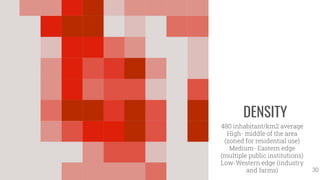
DENSITY
480 inhabitant/km2 average
High- middle of the area
(zoned for residential use)
Medium- Eastern edge
(multiple public institutions)
Low-Western edge (industry
and farms) 30
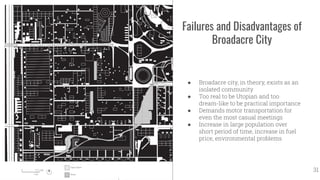
Failures and Disadvantages of
Broadacre City
● Broadacre city, in theory, exists as an
isolated community
● Too real to be Utopian and too
dream-like to be practical importance
● Demands motor transportation for
even the most casual meetings
● Increase in large population over
short period of time, increase in fuel
price, environmental problems
31
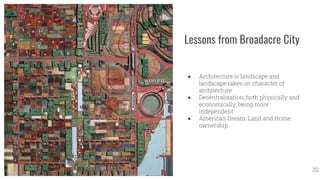
Lessons from Broadacre City
● Architecture is landscape and
landscape takes on character of
architecture
● Decentralization, both physically and
economically; being more
independent
● American Dream: Land and Home
ownership
32
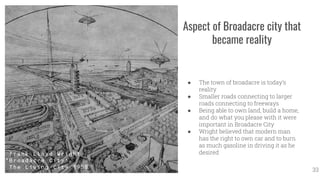
Aspect of Broadacre city that
became reality
● The town of broadacre is today’s
reality
● Smaller roads connecting to larger
roads connecting to freeways
● Being able to own land, build a home,
and do what you please with it were
important in Broadacre City
● Wright believed that modern man
has the right to own car and to burn
as much gasoline in driving it as he
desired
33
CONCLUSION
● The concept - more architectural so considered narrow
● However, it still provides ideal solution to the question of
centralization or decentralization
34
References
● Frank Lloyd Wright- Broadacre City: Analysis by: Nina Mathiesen, Rikke
Liv Pedersen, Frederik Lyng, Mathias Bagger Poulsen, Johanne
Rønsholt, Rikke Sjelborg, Ove Christensen, Nina Andersen.
● Frank Lloyd Wright’s Utopian Dystopia- Katherine Don | The Transport
Politic
● https://arquiscopio.com/archivo/2013/08/10/broadacre-city/?lang=en
● https://64.media.tumblr.com/0f1403078b65b78df3385bd5bc76453a/tumb
lr_muqfk0Xhoq1qcg0xgo1_1280.jpg
● Theories and Methods of Urban Design 2018-
● Broadacre City Concept- JN Gvara
● Presentation template by Slidesgo
35
THANK YOU
36

Broadacre city

  • 1.
    Frank Lloyd Wright and TheSuburbia Bidhya Gupta 6 Rojina Kafle 8 Prashant Rasaili 22 Nandita Shrestha 25 1
  • 2.
  • 3.
    BROADACRE CITY 3 ● Location:Midwest USA ● Year(s) :1932-1935 [Status: Unbuilt] ● Footprint :4 mi² ● Designer :Frank Lloyd Wright ● Key Components :1 acre devoted per family, suburban sprawl,minimal apartment living, local commercialism ● Program(s) :Private ● Title :Local / public amenities ● Funding Streams :Edgar Kauffman
  • 4.
    -FRANK LLOYD WRIGHT “Tolook at the cross section of any plan of a big City is to look at something like the section of a fibrous tumor.” 4
  • 5.
    ORIGIN ● Technological advancements, Wrightcame to believe that the large, centralized city would soon become obsolete and people would return to their rural roots. ● Wright despised the city, both physically and metaphorically ● individualism, naturalism, response to automobility. 5
  • 6.
    KEY CONCEPT- Individualism ●Broadacre city planned as metropolitan decentralization ● Vision of multi-centered, low density (supposedly 5 people per acre), auto-oriented suburbia ● Each family would be given one acre (4,000 sq.m. from the federal land reserves) ● Land would be taken into public ownership; then granted to families for as long as they used it productively. 6
  • 7.
  • 8.
    CONCEPT Naturalism . ● Concept oforganic design and usonian architecture. ● "Romantic isolation and reunion with the soil" (landscape) 8
  • 9.
    CONCEPT ● 12 x12 ft. model which might be applied to a representative 4 miles2 plot of land ● Grid iron pattern in planning 9
  • 10.
    CONCEPT . ● A communitywithout experts. ● Everyone's a farmer - industrial worker - artist: reminiscence of the "Arts and Crafts"The ideal for labour is self-fulfilment. ● There is no administration - no bureaucracy - but the architect, who plans the city and settles its affairs. 10
  • 11.
    CONCEPT (automobility) ● The conceptof an aircraft in everyone's front yard is a convincing image of mobility is unavoidable. ● The roads symbolize individual freedom ● The technology to cross and to communicate long distance facilitates: air, light and freedom of movement 11
  • 12.
  • 13.
    City of motorage . ● Spacious landscaped highways, giant roads, pass public service stations, ● Each citizen of the future will have all forms of prerequisite within a radius of a hundred and fifty miles of his home by means of his car or plane 13 The man seated in his automobile,” He thought every person should have a car and, eventually, an “aerator”—a helicopter that could land without a landing strip.
  • 14.
  • 15.
    Layout of thecity quite uniform The acre- ● Gave a large amount of freedom ● The family’s domain ● Space to build and grow whatever they want PRINCIPLES OF ORGANIZING 15
  • 16.
    -FRANK LLOYD WRIGHT “Thefabric of Broadacre city can and will be spread all over the United States and the population will return to the natural way of living. "So we have made provision for the people who have been divorced from nature by excessive urban idealism and parasitic living."” 16 PRINCIPLES OF ORGANIZING
  • 17.
    Model of a4 square miles plot of land ZONING BY FUNCTION 17
  • 18.
    ZONING BY FUNCTION Sportsand Physical Recreation Residential Design center Medical clinics Industrial units Small farms and Dairy Garages and stores Airport Country seat 18
  • 19.
    Automobile Reservoir Apartments Country fair Sanitarium Hotel Forest cabins Cinema Customresidential Taliesin equivalent Aquarium Elementary school Arboretum Research center Worship center School Guest houses Residential Zoo Gas stations Educational center ZONING BY FUNCTION 19
  • 20.
    Commercial Service businesses Industry anddwellings Employee residential Gas stations Main parkway Vineyards and orchards Residential ZONING BY FUNCTION 20
  • 21.
    Industry Research center Live/Work Roadside inn Employeeresidential Market center Residential Physical culture Interior parks Music garden ZONING BY FUNCTION 21
  • 22.
    BUILT SPACE In spiteof the individual-oriented ideology Built up in a very strict system Big and small houses All North-South oriented 22
  • 23.
    NEGATIVE SPACE Space betweenbuildings huge compared to the amount of buildspace Every family has got at least 4000 m2 of property Makes people feel alone in the middle of the city 23
  • 24.
    INFRASTRUCTURE The roads followthe landscape Flat landscape- straight and orthogonal roads Curved landscape- roads curve with the landscape 24
  • 25.
    ROAD NETWORK Total roadsarea= 0.585 sqm MAIN ROAD MINOR PATHS MAIN ARTERIAL 25
  • 26.
    PRODUCTIVE LANDSCAPE Consist offarms and small industry Mainly positioned near the main traffic vein 26
  • 27.
    RECREATIVE LANDSCAPE Consist ofgreen areas Mostly in relation to water 27
  • 28.
    BUILDING PROGRAMME Model ofa typical American landscape An example of the model and building program (not a scheme) 28
  • 29.
    RELATIONSHIP BETWEEN CITY AND LANDSCAPE Landscape-fresh and humanized In harmony with nature but is not naturalistic 29
  • 30.
    DENSITY 480 inhabitant/km2 average High-middle of the area (zoned for residential use) Medium- Eastern edge (multiple public institutions) Low-Western edge (industry and farms) 30
  • 31.
    Failures and Disadvantagesof Broadacre City ● Broadacre city, in theory, exists as an isolated community ● Too real to be Utopian and too dream-like to be practical importance ● Demands motor transportation for even the most casual meetings ● Increase in large population over short period of time, increase in fuel price, environmental problems 31
  • 32.
    Lessons from BroadacreCity ● Architecture is landscape and landscape takes on character of architecture ● Decentralization, both physically and economically; being more independent ● American Dream: Land and Home ownership 32
  • 33.
    Aspect of Broadacrecity that became reality ● The town of broadacre is today’s reality ● Smaller roads connecting to larger roads connecting to freeways ● Being able to own land, build a home, and do what you please with it were important in Broadacre City ● Wright believed that modern man has the right to own car and to burn as much gasoline in driving it as he desired 33
  • 34.
    CONCLUSION ● The concept- more architectural so considered narrow ● However, it still provides ideal solution to the question of centralization or decentralization 34
  • 35.
    References ● Frank LloydWright- Broadacre City: Analysis by: Nina Mathiesen, Rikke Liv Pedersen, Frederik Lyng, Mathias Bagger Poulsen, Johanne Rønsholt, Rikke Sjelborg, Ove Christensen, Nina Andersen. ● Frank Lloyd Wright’s Utopian Dystopia- Katherine Don | The Transport Politic ● https://arquiscopio.com/archivo/2013/08/10/broadacre-city/?lang=en ● https://64.media.tumblr.com/0f1403078b65b78df3385bd5bc76453a/tumb lr_muqfk0Xhoq1qcg0xgo1_1280.jpg ● Theories and Methods of Urban Design 2018- ● Broadacre City Concept- JN Gvara ● Presentation template by Slidesgo 35
  • 36.