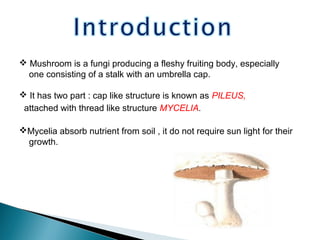
 Mushroom is a fungi producing a fleshy fruiting body, especially
one consisting of a stalk with an umbrella cap.
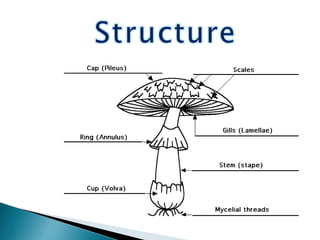
 It has two part : cap like structure is known as PILEUS,
attached with thread like structure MYCELIA.
Mycelia absorb nutrient from soil , it do not require sun light for their
growth.
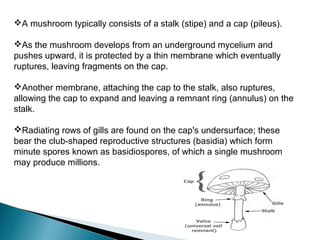
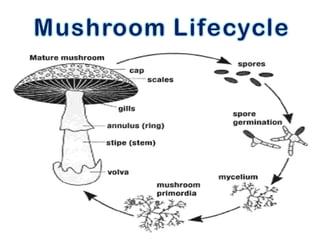
A mushroom typically consists of a stalk (stipe) and a cap (pileus).
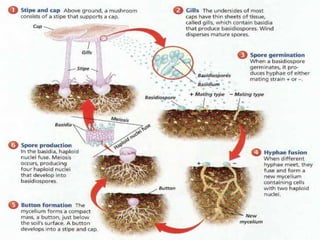
As the mushroom develops from an underground mycelium and
pushes upward, it is protected by a thin membrane which eventually
ruptures, leaving fragments on the cap.
Another membrane, attaching the cap to the stalk, also ruptures,
allowing the cap to expand and leaving a remnant ring (annulus) on the
stalk.
Radiating rows of gills are found on the cap's undersurface; these
bear the club-shaped reproductive structures (basidia) which form
minute spores known as basidiospores, of which a single mushroom
may produce millions.
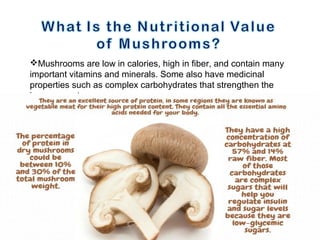
Mushrooms are low in calories, high in fiber, and contain many
important vitamins and minerals. Some also have medicinal
properties such as complex carbohydrates that strengthen the
immune system.
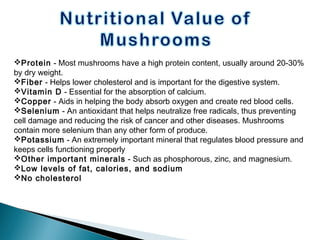
Protein - Most mushrooms have a high protein content, usually around 20-30%
by dry weight.
Fiber - Helps lower cholesterol and is important for the digestive system.
Vitamin D - Essential for the absorption of calcium.
Copper - Aids in helping the body absorb oxygen and create red blood cells.
Selenium - An antioxidant that helps neutralize free radicals, thus preventing
cell damage and reducing the risk of cancer and other diseases. Mushrooms
contain more selenium than any other form of produce.
Potassium - An extremely important mineral that regulates blood pressure and
keeps cells functioning properly
Other important minerals - Such as phosphorous, zinc, and magnesium.
Low levels of fat, calories, and sodium
No cholesterol
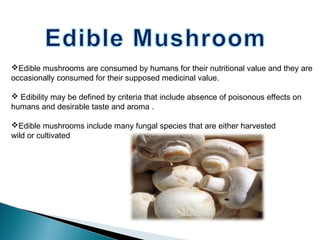
Edible mushrooms are consumed by humans for their nutritional value and they are
occasionally consumed for their supposed medicinal value.
 Edibility may be defined by criteria that include absence of poisonous effects on
humans and desirable taste and aroma .
Edible mushrooms include many fungal species that are either harvested
wild or cultivated
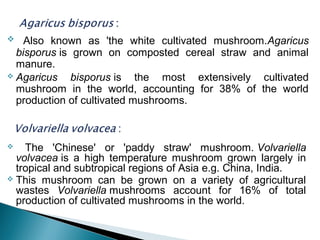
 Also known as 'the white cultivated mushroom.Agaricus
bisporus is grown on composted cereal straw and animal
manure.
 Agaricus bisporus is the most extensively cultivated
mushroom in the world, accounting for 38% of the world
production of cultivated mushrooms.
 The 'Chinese' or 'paddy straw' mushroom. Volvariella
volvacea is a high temperature mushroom grown largely in
tropical and subtropical regions of Asia e.g. China, India.
 This mushroom can be grown on a variety of agricultural
wastes Volvariella mushrooms account for 16% of total
production of cultivated mushrooms in the world.
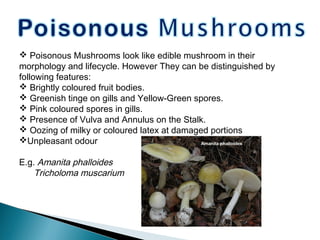
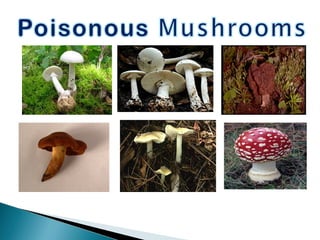
 Poisonous Mushrooms look like edible mushroom in their
morphology and lifecycle. However They can be distinguished by
following features:
 Brightly coloured fruit bodies.
 Greenish tinge on gills and Yellow-Green spores.
 Pink coloured spores in gills.
 Presence of Vulva and Annulus on the Stalk.
 Oozing of milky or coloured latex at damaged portions
Unpleasant odour
E.g. Amanita phalloides
Tricholoma muscarium
 The key generic steps in mushroom production – a
cycle that takes between one to three months from start
to finish depending on species – are:
 identifying and cleaning a dedicated room or building in
which temperature, moisture and sanitary conditions can
be controlled to grow mushrooms in choosing a growing
medium and storing the raw ingredients in a clean place
under cover and protected from rain.
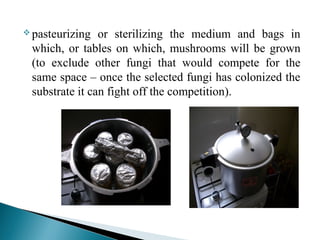
 pasteurizing or sterilizing the medium and bags in
which, or tables on which, mushrooms will be grown
(to exclude other fungi that would compete for the
same space – once the selected fungi has colonized the
substrate it can fight off the competition).
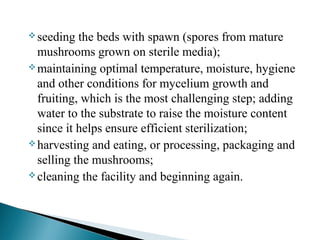
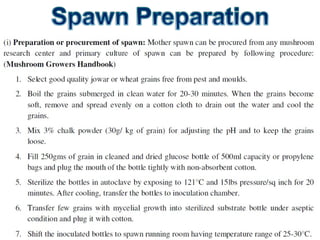
seeding the beds with spawn (spores from mature
mushrooms grown on sterile media);
maintaining optimal temperature, moisture, hygiene
and other conditions for mycelium growth and
fruiting, which is the most challenging step; adding
water to the substrate to raise the moisture content
since it helps ensure efficient sterilization;
harvesting and eating, or processing, packaging and
selling the mushrooms;
cleaning the facility and beginning again.
Mushroom Cultivation

Mushroom Cultivation

  • 3.
     Mushroom isa fungi producing a fleshy fruiting body, especially one consisting of a stalk with an umbrella cap.  It has two part : cap like structure is known as PILEUS, attached with thread like structure MYCELIA. Mycelia absorb nutrient from soil , it do not require sun light for their growth.
  • 7.
    A mushroom typicallyconsists of a stalk (stipe) and a cap (pileus). As the mushroom develops from an underground mycelium and pushes upward, it is protected by a thin membrane which eventually ruptures, leaving fragments on the cap. Another membrane, attaching the cap to the stalk, also ruptures, allowing the cap to expand and leaving a remnant ring (annulus) on the stalk. Radiating rows of gills are found on the cap's undersurface; these bear the club-shaped reproductive structures (basidia) which form minute spores known as basidiospores, of which a single mushroom may produce millions.
  • 8.
    Mushrooms are lowin calories, high in fiber, and contain many important vitamins and minerals. Some also have medicinal properties such as complex carbohydrates that strengthen the immune system.
  • 9.
    Protein - Most mushroomshave a high protein content, usually around 20-30% by dry weight. Fiber - Helps lower cholesterol and is important for the digestive system. Vitamin D - Essential for the absorption of calcium. Copper - Aids in helping the body absorb oxygen and create red blood cells. Selenium - An antioxidant that helps neutralize free radicals, thus preventing cell damage and reducing the risk of cancer and other diseases. Mushrooms contain more selenium than any other form of produce. Potassium - An extremely important mineral that regulates blood pressure and keeps cells functioning properly Other important minerals - Such as phosphorous, zinc, and magnesium. Low levels of fat, calories, and sodium No cholesterol
  • 10.
    Edible mushrooms areconsumed by humans for their nutritional value and they are occasionally consumed for their supposed medicinal value.  Edibility may be defined by criteria that include absence of poisonous effects on humans and desirable taste and aroma . Edible mushrooms include many fungal species that are either harvested wild or cultivated
  • 11.
     Also knownas 'the white cultivated mushroom.Agaricus bisporus is grown on composted cereal straw and animal manure.  Agaricus bisporus is the most extensively cultivated mushroom in the world, accounting for 38% of the world production of cultivated mushrooms.  The 'Chinese' or 'paddy straw' mushroom. Volvariella volvacea is a high temperature mushroom grown largely in tropical and subtropical regions of Asia e.g. China, India.  This mushroom can be grown on a variety of agricultural wastes Volvariella mushrooms account for 16% of total production of cultivated mushrooms in the world.
  • 12.
     Poisonous Mushroomslook like edible mushroom in their morphology and lifecycle. However They can be distinguished by following features:  Brightly coloured fruit bodies.  Greenish tinge on gills and Yellow-Green spores.  Pink coloured spores in gills.  Presence of Vulva and Annulus on the Stalk.  Oozing of milky or coloured latex at damaged portions Unpleasant odour E.g. Amanita phalloides Tricholoma muscarium
  • 16.
     The keygeneric steps in mushroom production – a cycle that takes between one to three months from start to finish depending on species – are:  identifying and cleaning a dedicated room or building in which temperature, moisture and sanitary conditions can be controlled to grow mushrooms in choosing a growing medium and storing the raw ingredients in a clean place under cover and protected from rain.
  • 17.
     pasteurizing orsterilizing the medium and bags in which, or tables on which, mushrooms will be grown (to exclude other fungi that would compete for the same space – once the selected fungi has colonized the substrate it can fight off the competition).
  • 18.
    seeding the bedswith spawn (spores from mature mushrooms grown on sterile media); maintaining optimal temperature, moisture, hygiene and other conditions for mycelium growth and fruiting, which is the most challenging step; adding water to the substrate to raise the moisture content since it helps ensure efficient sterilization; harvesting and eating, or processing, packaging and selling the mushrooms; cleaning the facility and beginning again.