

GROUP :- 4
Rahul Purohit
 Pradeep
Kamal
Saurabh
Deepshika
Anjali
Hemant
Rajendra (Leader)
Shubham
Abhishek
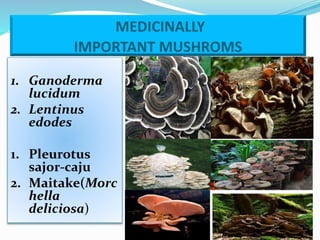
1. Ganoderma
lucidum
2. Lentinus
edodes
1. Pleurotus
sajor-caju
2. Maitake(Morc
hella
deliciosa)
MEDICINALLY
IMPORTANT MUSHROMS
RAW MATERIAL
1) Vegetable waste
2) Forest litter
3) Straw from Wheat/Rice
4) Wheat bran
Reishi (Ganoderma lucidum)
Introduction
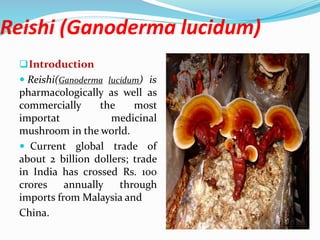
 Reishi(Ganoderma lucidum) is
pharmacologically as well as
commercially the most
importat medicinal
mushroom in the world.
 Current global trade of
about 2 billion dollers; trade
in India has crossed Rs. 100
crores annually through
imports from Malaysia and
China.
Production
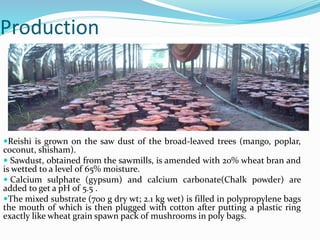
Reishi is grown on the saw dust of the broad-leaved trees (mango, poplar,
coconut, shisham).
 Sawdust, obtained from the sawmills, is amended with 20% wheat bran and
is wetted to a level of 65% moisture.
 Calcium sulphate (gypsum) and calcium carbonate(Chalk powder) are
added to get a pH of 5.5 .
The mixed substrate (700 g dry wt; 2.1 kg wet) is filled in polypropylene bags
the mouth of which is then plugged with cotton after putting a plastic ring
exactly like wheat grain spawn pack of mushrooms in poly bags.
The bags are then sterilized in autoclave at 22 p.s.i. for 2
hrs.
 After cooling, the substrate is spawned with wheat grain
or saw dusts pawn @ 3% on the dry weight basis, as it is
comparatively a slow growing fungus.
 Spawn run(incubation) is done at 28-35 °C in the closed
rooms (high carbon dioxide) and darkness.
 After the complete spawn run (bags white all over),
which takes about 25 days,
polythene top is cut at the level of the substrate totally
exposing the top side and proper conditions for fruiting or
pinning (temp. 28 °C,1500 ppm CO2, 800 lux light, 95%
RH) are provided.
 Once the pins have grown up enough to form the cap
which is indicated by the flattenning of the whitish top of
the pin head, humidity is reduced to 80% RH and more
fresh air is introduced (1000 ppm CO2).
 Once the cap is fully formed, which is indicated by
yellowing of the cap margin (which is otherwise
white),temperature is lowered to 25 °C and RH is further
reduced to 60% for cap thickening, reddening and
maturation of the fruit bodies.
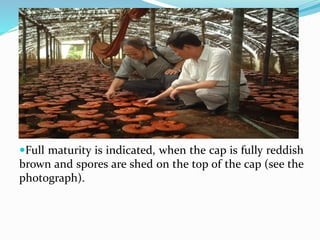
Full maturity is indicated, when the cap is fully reddish
brown and spores are shed on the top of the cap (see the
photograph).
Harvesting is done by the tight plucking, holding the
root with one hand and pulling up with another.
Scissors and knives can also be used but no
residual bud is left after harvesting.
One cycle of the growing takes 10-15 days.
 After harvesting the first flush, conditions for
pinning are again switched on (i.e. 28 °C,
95%RH, 1500 ppm CO2, 800 lux light) for
staring and completing the second flush.
 One crop takes about four months.
Harvested mushrooms, after washing with water, are
dried at low temperature (<50 °C) in the cabinet driers,
preferably at 35 °C in the dehumidifying cabinet drier.
 Freeze drying is, however, the best.
Reishi mushroom has very high dry matter (45% i.e.
450 g dry from 1 kg fresh).
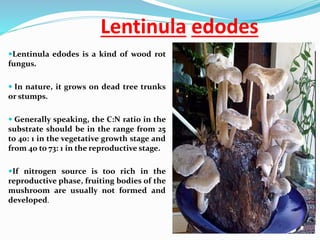
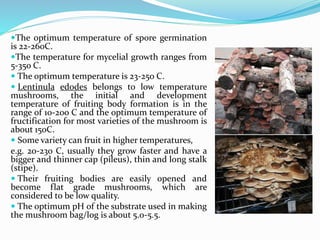
Lentinula edodes
Lentinula edodes is a kind of wood rot
fungus.
 In nature, it grows on dead tree trunks
or stumps.
 Generally speaking, the C:N ratio in the
substrate should be in the range from 25
to 40: 1 in the vegetative growth stage and
from 40 to 73: 1 in the reproductive stage.
If nitrogen source is too rich in the
reproductive phase, fruiting bodies of the
mushroom are usually not formed and
developed.
The optimum temperature of spore germination
is 22-26oC.
The temperature for mycelial growth ranges from
5-35o C.
 The optimum temperature is 23-25o C.
 Lentinula edodes belongs to low temperature
mushrooms, the initial and development
temperature of fruiting body formation is in the
range of 10-20o C and the optimum temperature of
fructification for most varieties of the mushroom is
about 15oC.
 Some variety can fruit in higher temperatures,
e.g. 20-23o C, usually they grow faster and have a
bigger and thinner cap (pileus), thin and long stalk
(stipe).
 Their fruiting bodies are easily opened and
become flat grade mushrooms, which are
considered to be low quality.
 The optimum pH of the substrate used in making
the mushroom bag/log is about 5.0-5.5.
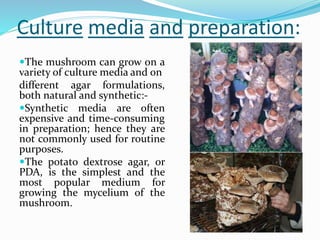
Culture media and preparation:
The mushroom can grow on a
variety of culture media and on
different agar formulations,
both natural and synthetic:-
Synthetic media are often
expensive and time-consuming
in preparation; hence they are
not commonly used for routine
purposes.
The potato dextrose agar, or
PDA, is the simplest and the
most popular medium for
growing the mycelium of the
mushroom.
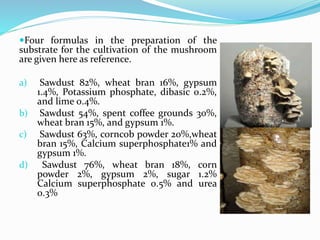
Four formulas in the preparation of the
substrate for the cultivation of the mushroom
are given here as reference.
a) Sawdust 82%, wheat bran 16%, gypsum
1.4%, Potassium phosphate, dibasic 0.2%,
and lime 0.4%.
b) Sawdust 54%, spent coffee grounds 30%,
wheat bran 15%, and gypsum 1%.
c) Sawdust 63%, corncob powder 20%,wheat
bran 15%, Calcium superphosphate1% and
gypsum 1%.
d) Sawdust 76%, wheat bran 18%, corn
powder 2%, gypsum 2%, sugar 1.2%
Calcium superphosphate 0.5% and urea
0.3%
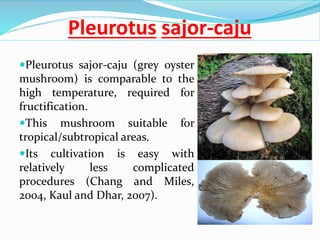
Pleurotus sajor-caju
Pleurotus sajor-caju (grey oyster
mushroom) is comparable to the
high temperature, required for
fructification.
This mushroom suitable for
tropical/subtropical areas.
Its cultivation is easy with
relatively less complicated
procedures (Chang and Miles,
2004, Kaul and Dhar, 2007).
1) . Biological nature: The temperature for growth of
mycelium is 10-35oC. The optimum growing
temperature of the mycelium is 23-28o.
 The optimum developmental temperature of the
fruiting body is 18-24oC.
 The optimum pH of the substrate used in making
the mushroom bag/bed is 6.8-8.0.
 The C:N ratio in the substrate is in the range of 30-
60: 1. A large circulation of air and reasonable light
are required for the development of the fruiting
bodies.
 Procedure :-
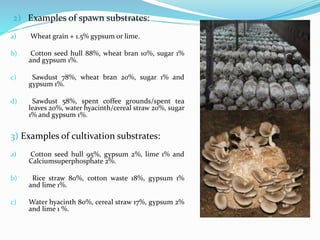
2) Examples of spawn substrates:
a) Wheat grain + 1.5% gypsum or lime.
b) Cotton seed hull 88%, wheat bran 10%, sugar 1%
and gypsum 1%.
c) Sawdust 78%, wheat bran 20%, sugar 1% and
gypsum 1%.
d) Sawdust 58%, spent coffee grounds/spent tea
leaves 20%, water hyacinth/cereal straw 20%, sugar
1% and gypsum 1%.
3) Examples of cultivation substrates:
a) Cotton seed hull 95%, gypsum 2%, lime 1% and
Calciumsuperphosphate 2%.
b) Rice straw 80%, cotton waste 18%, gypsum 1%
and lime 1%.
c) Water hyacinth 80%, cereal straw 17%, gypsum 2%
and lime 1 %.
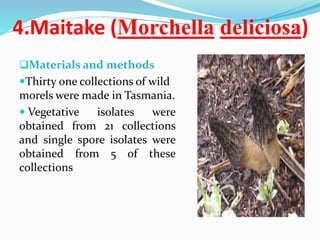
4.Maitake (Morchella deliciosa)
Materials and methods
Thirty one collections of wild
morels were made in Tasmania.
 Vegetative isolates were
obtained from 21 collections
and single spore isolates were
obtained from 5 of these
collections
Field sampling of wild Morels
To ensure a variety of genetic material was available, morels
were collected throughout Tasmania, Australia.
Where possible, three ascocarps at different developmental
stages, were collected from each site and given a collection
number.
 Each ascocarp was removed with the first 15 mm of
substrate attached to the base of the stipe and loosely
wrapped in paper prior to insertion of each ascocarp into a
separate paper bag.
 In the laboratory each collection was photographed,
measured and described and a sporulating ascocarp selected
for spore collection.
To ensure that the ascocarp did not dry out too quickly and
to enhance spore collection, the sporulating structure was
wrapped in grease proof paper, aluminium foil and placed in
a separate paper bag until spore collection was complete, or
the ascocarp had dried
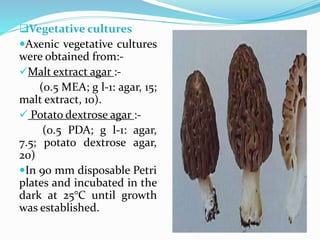
Vegetative cultures
Axenic vegetative cultures
were obtained from:-
Malt extract agar :-
(0.5 MEA; g l-1: agar, 15;
malt extract, 10).
 Potato dextrose agar :-
(0.5 PDA; g l-1: agar,
7.5; potato dextrose agar,
20)
In 90 mm disposable Petri
plates and incubated in the
dark at 25°C until growth
was established.
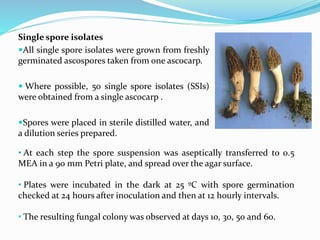
Single spore isolates
All single spore isolates were grown from freshly
germinated ascospores taken from one ascocarp.
 Where possible, 50 single spore isolates (SSIs)
were obtained from a single ascocarp .
Spores were placed in sterile distilled water, and
a dilution series prepared.
• At each step the spore suspension was aseptically transferred to 0.5
MEA in a 90 mm Petri plate, and spread over the agar surface.
• Plates were incubated in the dark at 25 ºC with spore germination
checked at 24 hours after inoculation and then at 12 hourly intervals.
• The resulting fungal colony was observed at days 10, 30, 50 and 60.
Precautions
 Keep the spawn running room dark so that spawn
running will be faster.
 Periodically sprinkle water on sand layer to maintain the
required conditions.
 Never spray any insecticides on the mushroom beds.
 In case of contamination, the contaminated block should
be remove to spot well away from the house and buried
in a pit or burnt.
 Broken pieces of the mushroom stalk, while harvesting ,
should not be left on the blocks. If the stalk breaks, it
should be removed entirely from the bed.
Medicinal Mushroom Cultivation

Medicinal Mushroom Cultivation

  • 2.
    GROUP :- 4 RahulPurohit  Pradeep Kamal Saurabh Deepshika Anjali Hemant Rajendra (Leader) Shubham Abhishek
  • 4.
    1. Ganoderma lucidum 2. Lentinus edodes 1.Pleurotus sajor-caju 2. Maitake(Morc hella deliciosa) MEDICINALLY IMPORTANT MUSHROMS
  • 5.
    RAW MATERIAL 1) Vegetablewaste 2) Forest litter 3) Straw from Wheat/Rice 4) Wheat bran
  • 6.
    Reishi (Ganoderma lucidum) Introduction Reishi(Ganoderma lucidum) is pharmacologically as well as commercially the most importat medicinal mushroom in the world.  Current global trade of about 2 billion dollers; trade in India has crossed Rs. 100 crores annually through imports from Malaysia and China.
  • 7.
    Production Reishi is grownon the saw dust of the broad-leaved trees (mango, poplar, coconut, shisham).  Sawdust, obtained from the sawmills, is amended with 20% wheat bran and is wetted to a level of 65% moisture.  Calcium sulphate (gypsum) and calcium carbonate(Chalk powder) are added to get a pH of 5.5 . The mixed substrate (700 g dry wt; 2.1 kg wet) is filled in polypropylene bags the mouth of which is then plugged with cotton after putting a plastic ring exactly like wheat grain spawn pack of mushrooms in poly bags.
  • 8.
    The bags arethen sterilized in autoclave at 22 p.s.i. for 2 hrs.  After cooling, the substrate is spawned with wheat grain or saw dusts pawn @ 3% on the dry weight basis, as it is comparatively a slow growing fungus.  Spawn run(incubation) is done at 28-35 °C in the closed rooms (high carbon dioxide) and darkness.  After the complete spawn run (bags white all over), which takes about 25 days,
  • 9.
    polythene top iscut at the level of the substrate totally exposing the top side and proper conditions for fruiting or pinning (temp. 28 °C,1500 ppm CO2, 800 lux light, 95% RH) are provided.  Once the pins have grown up enough to form the cap which is indicated by the flattenning of the whitish top of the pin head, humidity is reduced to 80% RH and more fresh air is introduced (1000 ppm CO2).  Once the cap is fully formed, which is indicated by yellowing of the cap margin (which is otherwise white),temperature is lowered to 25 °C and RH is further reduced to 60% for cap thickening, reddening and maturation of the fruit bodies.
  • 10.
    Full maturity isindicated, when the cap is fully reddish brown and spores are shed on the top of the cap (see the photograph).
  • 11.
    Harvesting is doneby the tight plucking, holding the root with one hand and pulling up with another. Scissors and knives can also be used but no residual bud is left after harvesting. One cycle of the growing takes 10-15 days.  After harvesting the first flush, conditions for pinning are again switched on (i.e. 28 °C, 95%RH, 1500 ppm CO2, 800 lux light) for staring and completing the second flush.
  • 12.
     One croptakes about four months. Harvested mushrooms, after washing with water, are dried at low temperature (<50 °C) in the cabinet driers, preferably at 35 °C in the dehumidifying cabinet drier.  Freeze drying is, however, the best. Reishi mushroom has very high dry matter (45% i.e. 450 g dry from 1 kg fresh).
  • 13.
    Lentinula edodes Lentinula edodesis a kind of wood rot fungus.  In nature, it grows on dead tree trunks or stumps.  Generally speaking, the C:N ratio in the substrate should be in the range from 25 to 40: 1 in the vegetative growth stage and from 40 to 73: 1 in the reproductive stage. If nitrogen source is too rich in the reproductive phase, fruiting bodies of the mushroom are usually not formed and developed.
  • 14.
    The optimum temperatureof spore germination is 22-26oC. The temperature for mycelial growth ranges from 5-35o C.  The optimum temperature is 23-25o C.  Lentinula edodes belongs to low temperature mushrooms, the initial and development temperature of fruiting body formation is in the range of 10-20o C and the optimum temperature of fructification for most varieties of the mushroom is about 15oC.  Some variety can fruit in higher temperatures, e.g. 20-23o C, usually they grow faster and have a bigger and thinner cap (pileus), thin and long stalk (stipe).  Their fruiting bodies are easily opened and become flat grade mushrooms, which are considered to be low quality.  The optimum pH of the substrate used in making the mushroom bag/log is about 5.0-5.5.
  • 15.
    Culture media andpreparation: The mushroom can grow on a variety of culture media and on different agar formulations, both natural and synthetic:- Synthetic media are often expensive and time-consuming in preparation; hence they are not commonly used for routine purposes. The potato dextrose agar, or PDA, is the simplest and the most popular medium for growing the mycelium of the mushroom.
  • 16.
    Four formulas inthe preparation of the substrate for the cultivation of the mushroom are given here as reference. a) Sawdust 82%, wheat bran 16%, gypsum 1.4%, Potassium phosphate, dibasic 0.2%, and lime 0.4%. b) Sawdust 54%, spent coffee grounds 30%, wheat bran 15%, and gypsum 1%. c) Sawdust 63%, corncob powder 20%,wheat bran 15%, Calcium superphosphate1% and gypsum 1%. d) Sawdust 76%, wheat bran 18%, corn powder 2%, gypsum 2%, sugar 1.2% Calcium superphosphate 0.5% and urea 0.3%
  • 17.
    Pleurotus sajor-caju Pleurotus sajor-caju(grey oyster mushroom) is comparable to the high temperature, required for fructification. This mushroom suitable for tropical/subtropical areas. Its cultivation is easy with relatively less complicated procedures (Chang and Miles, 2004, Kaul and Dhar, 2007).
  • 18.
    1) . Biologicalnature: The temperature for growth of mycelium is 10-35oC. The optimum growing temperature of the mycelium is 23-28o.  The optimum developmental temperature of the fruiting body is 18-24oC.  The optimum pH of the substrate used in making the mushroom bag/bed is 6.8-8.0.  The C:N ratio in the substrate is in the range of 30- 60: 1. A large circulation of air and reasonable light are required for the development of the fruiting bodies.  Procedure :-
  • 19.
    2) Examples ofspawn substrates: a) Wheat grain + 1.5% gypsum or lime. b) Cotton seed hull 88%, wheat bran 10%, sugar 1% and gypsum 1%. c) Sawdust 78%, wheat bran 20%, sugar 1% and gypsum 1%. d) Sawdust 58%, spent coffee grounds/spent tea leaves 20%, water hyacinth/cereal straw 20%, sugar 1% and gypsum 1%. 3) Examples of cultivation substrates: a) Cotton seed hull 95%, gypsum 2%, lime 1% and Calciumsuperphosphate 2%. b) Rice straw 80%, cotton waste 18%, gypsum 1% and lime 1%. c) Water hyacinth 80%, cereal straw 17%, gypsum 2% and lime 1 %.
  • 20.
    4.Maitake (Morchella deliciosa) Materialsand methods Thirty one collections of wild morels were made in Tasmania.  Vegetative isolates were obtained from 21 collections and single spore isolates were obtained from 5 of these collections
  • 21.
    Field sampling ofwild Morels To ensure a variety of genetic material was available, morels were collected throughout Tasmania, Australia. Where possible, three ascocarps at different developmental stages, were collected from each site and given a collection number.  Each ascocarp was removed with the first 15 mm of substrate attached to the base of the stipe and loosely wrapped in paper prior to insertion of each ascocarp into a separate paper bag.  In the laboratory each collection was photographed, measured and described and a sporulating ascocarp selected for spore collection. To ensure that the ascocarp did not dry out too quickly and to enhance spore collection, the sporulating structure was wrapped in grease proof paper, aluminium foil and placed in a separate paper bag until spore collection was complete, or the ascocarp had dried
  • 22.
    Vegetative cultures Axenic vegetativecultures were obtained from:- Malt extract agar :- (0.5 MEA; g l-1: agar, 15; malt extract, 10).  Potato dextrose agar :- (0.5 PDA; g l-1: agar, 7.5; potato dextrose agar, 20) In 90 mm disposable Petri plates and incubated in the dark at 25°C until growth was established.
  • 23.
    Single spore isolates Allsingle spore isolates were grown from freshly germinated ascospores taken from one ascocarp.  Where possible, 50 single spore isolates (SSIs) were obtained from a single ascocarp . Spores were placed in sterile distilled water, and a dilution series prepared. • At each step the spore suspension was aseptically transferred to 0.5 MEA in a 90 mm Petri plate, and spread over the agar surface. • Plates were incubated in the dark at 25 ºC with spore germination checked at 24 hours after inoculation and then at 12 hourly intervals. • The resulting fungal colony was observed at days 10, 30, 50 and 60.
  • 24.
    Precautions  Keep thespawn running room dark so that spawn running will be faster.  Periodically sprinkle water on sand layer to maintain the required conditions.  Never spray any insecticides on the mushroom beds.  In case of contamination, the contaminated block should be remove to spot well away from the house and buried in a pit or burnt.  Broken pieces of the mushroom stalk, while harvesting , should not be left on the blocks. If the stalk breaks, it should be removed entirely from the bed.