Closed Feed Water Heaters 
Ideal Regenerative Rankine Cycle
Introduction 
• A feedwater heater is used in a conventional power plant to 
preheat boiler feed water. The source of heat is steam bled 
from the turbines, and the objective is to improve the 
thermodynamic efficiency of the cycle.
A Closed Feedwater
Description of C.F.W.H 
• Closed feed-water heaters are typically shell and tube type heat 
exchanger where the feed-water passes throughout the tubes and is 
heated by turbine extraction steam. These do not require separate 
pumps before and after the heater to boost the feed-water to the 
pressure of the extracted steam as with an open heater.
Advantages of C.F.W.H 
• Reduces the irreversibility involved in steam generation and hence 
increase efficiency. 
• It helps to avoid thermal shock to the boiler metal when the feed-water 
is introduced back into the steam cycle. 
• Streams generally need to be at the same pressure to be reversibly 
mixed. 
• After stream 4 transfers heat to the boiler feed in the feedwater 
heater, it can either be pumped up to the boiler pressure and added 
to the boiler feed as shown here, or it can be allowed to irreversibly 
mix with the condenser feed.
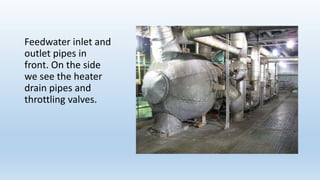
Feedwater inlet and 
outlet pipes in 
front. On the side 
we see the heater 
drain pipes and 
throttling valves.
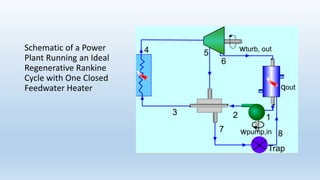
Schematic of a Power 
Plant Running an Ideal 
Regenerative Rankine 
Cycle with One Closed 
Feedwater Heater
T-S Diagram of an Ideal Regenerative Rankine 
Cycle with One Closed Feedwater Heater
CFWH vs OFWH 
• Compared with open feedwater heaters, closed feedwater heaters 
are more complex, and thus more expensive. Since the two streams 
do not mix in the heater, closed feedwater heaters do not require a 
separate pump for each heater. Most power plants use a combination 
of open and closed feedwater heaters.
Materials used in MFG (CFWH) 
• Processing and testing advancements on the welded and cold worked 
tubing developed over the last 65 years offer many technical and 
commercial advantages over the seamless product. Although 
seamless carbon and alloy steel feedwater heater tubing is still used, 
the vast majority of stainless steel feedwater heater tubing is in the 
welded, cold-worked, and annealed condition. Even though the 
seamless stainless tubing enjoys an ASME Code advantage of 15% 
higher stress level allowing a thinner wall, little, if any, is used in 
global feedwater heaters. The welded and cold-worked tube 
manufacturers have developed standard proprietary manufacturing 
processes and testing focused toward feedwater heater applications 
that most seamless producers have not followed.
Seamless vs. Welded and Cold worked
Sample Problem 
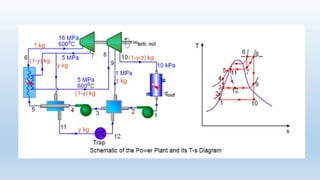
A steam power plant operates on an ideal reheat-regenerative Rankine 
cycle with one open feedwater heater, one closed feedwater heater, 
and one reheater. The fractions of stream extracted from turbines and 
the thermal efficiency of the cycle are to be determined. 
Assumptions: 
All the components in the cycle operate at steady state. 
Kinetic and potential energy changes are negligible.
Solution 
(1) Determine the fraction of steam extracted from the turbines 
The enthalpies at various states and the pump work per unit mass 
of fluid flowing through them can be determined by using the 
water tables. 
State1: saturated water 
P1 = 10 kPa ( given) 
h1 = 191.83 kJ/kg 
v1 = 0.00101 m3/kg 
State 2: compressed water 
P2 = 1 MPa (given) 
wpump,in = v1 (P2 - P1) 
= 0.00101(1,000 - 10) = 1.0 kJ/kg 
h2 = h1 + wpump,in = 192.83 kJ/kg 
State 3: saturated water 
P3 = 1 MPa (given) 
h3 = 762.81 kJ/kg 
v3 = 0.00113 m3/kg 
State 4: compressed water 
P4 = 16 MPa (given) 
wpump,in = v3 (P4 - P3) 
= 0.00113(16,000 - 1,000) = 16.9 kJ/kg 
h4 = h3 + wpump,in = 762.81+ 16.9 = 779.71 kJ/kg 
State 5: saturated water 
P5 = 16 MPa (given) 
h5 = 1,650.1 kJ/kg 
State 6: superheated vapor 
P6 = 16 MPa (given) 
T6 = 600oC (given) 
h6 = 3,569.8 kJ/kg 
s6= 6.6988 kJ/(kg-K) 
State7: superheated vapor 
P7 = 5 MPa (given) 
s7 =s6= 6.6988 kJ/(kg-K) 
h7 = 3,222.4 kJ/kg 
State 8: superheated vapor 
P8 = 5 MPa (given) 
T8 = 600oC (given) 
h8 = 3,665.6 kJ/kg 
s8= 7.2731 kJ/(kg-K) 
State 9: superheated vapor 
P9 = 1 MPa (given) 
s9 =s8= 7.2731 kJ/(kg-K) 
h9 = 3,138.1 kJ/kg 
State 10: saturated mixture 
P10 = 10 kPa (given) 
s10 =s8= 7.2731 kJ/(kg-K) 
x8 = (s8 - sf@10 kPa)/sfg@10 kPa = 88.3% 
h10 = hf@10 kPa+ x8hfg@10 kPa = 2,304.76 kJ/kg
Closed feed water heaters :)

Closed feed water heaters :)

  • 1.
    Closed Feed WaterHeaters Ideal Regenerative Rankine Cycle
  • 2.
    Introduction • Afeedwater heater is used in a conventional power plant to preheat boiler feed water. The source of heat is steam bled from the turbines, and the objective is to improve the thermodynamic efficiency of the cycle.
  • 3.
  • 4.
    Description of C.F.W.H • Closed feed-water heaters are typically shell and tube type heat exchanger where the feed-water passes throughout the tubes and is heated by turbine extraction steam. These do not require separate pumps before and after the heater to boost the feed-water to the pressure of the extracted steam as with an open heater.
  • 5.
    Advantages of C.F.W.H • Reduces the irreversibility involved in steam generation and hence increase efficiency. • It helps to avoid thermal shock to the boiler metal when the feed-water is introduced back into the steam cycle. • Streams generally need to be at the same pressure to be reversibly mixed. • After stream 4 transfers heat to the boiler feed in the feedwater heater, it can either be pumped up to the boiler pressure and added to the boiler feed as shown here, or it can be allowed to irreversibly mix with the condenser feed.
  • 6.
    Feedwater inlet and outlet pipes in front. On the side we see the heater drain pipes and throttling valves.
  • 8.
    Schematic of aPower Plant Running an Ideal Regenerative Rankine Cycle with One Closed Feedwater Heater
  • 9.
    T-S Diagram ofan Ideal Regenerative Rankine Cycle with One Closed Feedwater Heater
  • 10.
    CFWH vs OFWH • Compared with open feedwater heaters, closed feedwater heaters are more complex, and thus more expensive. Since the two streams do not mix in the heater, closed feedwater heaters do not require a separate pump for each heater. Most power plants use a combination of open and closed feedwater heaters.
  • 11.
    Materials used inMFG (CFWH) • Processing and testing advancements on the welded and cold worked tubing developed over the last 65 years offer many technical and commercial advantages over the seamless product. Although seamless carbon and alloy steel feedwater heater tubing is still used, the vast majority of stainless steel feedwater heater tubing is in the welded, cold-worked, and annealed condition. Even though the seamless stainless tubing enjoys an ASME Code advantage of 15% higher stress level allowing a thinner wall, little, if any, is used in global feedwater heaters. The welded and cold-worked tube manufacturers have developed standard proprietary manufacturing processes and testing focused toward feedwater heater applications that most seamless producers have not followed.
  • 12.
    Seamless vs. Weldedand Cold worked
  • 16.
    Sample Problem Asteam power plant operates on an ideal reheat-regenerative Rankine cycle with one open feedwater heater, one closed feedwater heater, and one reheater. The fractions of stream extracted from turbines and the thermal efficiency of the cycle are to be determined. Assumptions: All the components in the cycle operate at steady state. Kinetic and potential energy changes are negligible.
  • 18.
    Solution (1) Determinethe fraction of steam extracted from the turbines The enthalpies at various states and the pump work per unit mass of fluid flowing through them can be determined by using the water tables. State1: saturated water P1 = 10 kPa ( given) h1 = 191.83 kJ/kg v1 = 0.00101 m3/kg State 2: compressed water P2 = 1 MPa (given) wpump,in = v1 (P2 - P1) = 0.00101(1,000 - 10) = 1.0 kJ/kg h2 = h1 + wpump,in = 192.83 kJ/kg State 3: saturated water P3 = 1 MPa (given) h3 = 762.81 kJ/kg v3 = 0.00113 m3/kg State 4: compressed water P4 = 16 MPa (given) wpump,in = v3 (P4 - P3) = 0.00113(16,000 - 1,000) = 16.9 kJ/kg h4 = h3 + wpump,in = 762.81+ 16.9 = 779.71 kJ/kg State 5: saturated water P5 = 16 MPa (given) h5 = 1,650.1 kJ/kg State 6: superheated vapor P6 = 16 MPa (given) T6 = 600oC (given) h6 = 3,569.8 kJ/kg s6= 6.6988 kJ/(kg-K) State7: superheated vapor P7 = 5 MPa (given) s7 =s6= 6.6988 kJ/(kg-K) h7 = 3,222.4 kJ/kg State 8: superheated vapor P8 = 5 MPa (given) T8 = 600oC (given) h8 = 3,665.6 kJ/kg s8= 7.2731 kJ/(kg-K) State 9: superheated vapor P9 = 1 MPa (given) s9 =s8= 7.2731 kJ/(kg-K) h9 = 3,138.1 kJ/kg State 10: saturated mixture P10 = 10 kPa (given) s10 =s8= 7.2731 kJ/(kg-K) x8 = (s8 - sf@10 kPa)/sfg@10 kPa = 88.3% h10 = hf@10 kPa+ x8hfg@10 kPa = 2,304.76 kJ/kg