Histamine
Mr. Vishal Balakrushna Jadhav
Assistant Professor (Pharmacology)
School of Pharmaceutical Sciences (SOPS), Sandip University, Nashik
1
Overview of Discussion
 Histamine
 Synthesis, storage, release and destruction
 Histamine receptors
 Pharmacological actions
 Pathophysiological roles
 Uses
 Histamine analogue
 Histamine releasers
2
Histamine
 Histamine, meaning ‘tissue amine’ (histos- tissue)
 Almost ubiquitously present in animal tissues and in certain
plants, e.g. stinging nettle.
 Close parallelism was noted between its actions and the
manifestations of certain allergic reactions.
 Implicated as a mediator of hypersensitivity phenomena and tissue
injury reactions (allergy and inflammation), and known to
play important physiological roles (gastric acid secretion, and
neurotransmission in parts of the brain).
3
 Synthesis
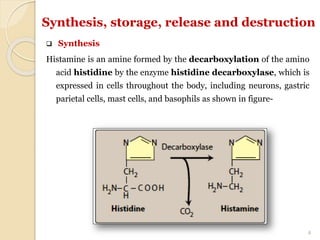
Histamine is an amine formed by the decarboxylation of the amino
acid histidine by the enzyme histidine decarboxylase, which is
expressed in cells throughout the body, including neurons, gastric
parietal cells, mast cells, and basophils as shown in figure-
Synthesis, storage, release and destruction
4
 Storage
Within intracellular storage granules of mast cells, histamine
(+ charged) is held by an acidic protein and heparin (- charged).
It is also present in blood, most body secretions, venoms and
pathological fluids. Tissues rich in histamine are skin, gastric and
intestinal mucosa, lungs, liver and placenta. Nonmast cell
histamine occurs in brain, epidermis, gastric mucosa and growing
regions. Turnover of mast cell histamine is slow, while that of
nonmast cell histamine is fast.
5
 Release
In response to stimuli such as destruction of cells as a result of cold,
toxins from organisms, venoms from insects and spiders, and
trauma, histamine is released from intracellular storage granules of
mast cells by exocytosis where Na+ ions in e.c.f. exchange with
histamine to release it free.
Allergies and anaphylaxis can also trigger significant release of
histamine.
Increase in intracellular cAMP (caused by β- adrenergic agonists and
methylxanthines) inhibits histamine release.
6
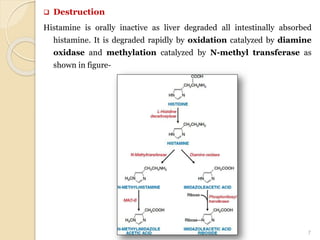
 Destruction
Histamine is orally inactive as liver degraded all intestinally absorbed
histamine. It is degraded rapidly by oxidation catalyzed by diamine
oxidase and methylation catalyzed by N-methyl transferase as
shown in figure-
7
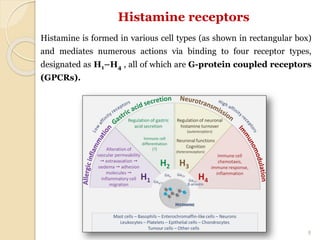
Histamine receptors
Histamine is formed in various cell types (as shown in rectangular box)
and mediates numerous actions via binding to four receptor types,
designated as H1–H4 , all of which are G-protein coupled receptors
(GPCRs).
8
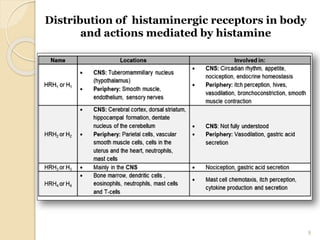
Distribution of histaminergic receptors in body
and actions mediated by histamine
9
10
Pharmacological actions
 Blood vessels
Marked dilatation of smaller blood vessels, including arterioles,
capillaries and venules. On s.c. injection flushing, especially in the
blush area, heat, increased heart rate and cardiac output, with little
or no fall in BP are produced. Rapid i.v. injection causes fall in BP.
Fall in BP due to large doses is completely blocked only by a
combination of H1 and H2 antagonists. Dilatation of cranial vessels
causes pulsatile headache.
H1 receptor mediating vasodilatation is partly indirect action on
the endothelial cells mediated through ‘endothelium dependent
relaxing factor’ (EDRF/NO) while H2 receptors mediating
vasodilatation is direct action on the vascular smooth muscle.
11
Vasoconstriction of larger arteries and veins by histamine is H1
receptor mediated action on vascular smooth muscle.
Histamine also causes increased capillary permeability due to
separation of endothelial cells → exudation of plasma. This is
primarily a H1 response.
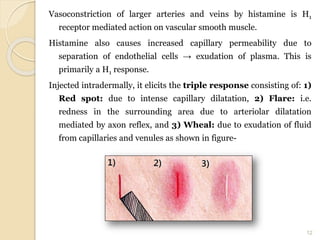
Injected intradermally, it elicits the triple response consisting of: 1)
Red spot: due to intense capillary dilatation, 2) Flare: i.e.
redness in the surrounding area due to arteriolar dilatation
mediated by axon reflex, and 3) Wheal: due to exudation of fluid
from capillaries and venules as shown in figure-
12
 Heart
Direct effects of histamine on in situ heart are not prominent, but H1
mediated negative dromotropic effect (slowing of A-V
conduction), and H2 mediated positive inotropic and
chronotropic effect (increased rate and force of contraction) has
been demonstrated on the isolated heart, especially of guinea pig.
 Visceral smooth muscle
Histamine causes bronchoconstriction; guinea pigs and patients of
asthma are highly sensitive. Large doses cause abdominal cramps
and colic by increasing intestinal contractions. Guinea pig uterus is
contracted while that of rat is relaxed; human uterus is not much
affected as are most other visceral smooth muscles. Smooth
muscle contraction is a H1 response. In few instances H2
mediated relaxation is also seen, e.g. bronchial muscle of sheep,
human bronchi after H1 blockade.
13
 Glands
Histamine causes marked increase in gastric secretion- primarily
of acid and pepsin. This is a direct action exerted on parietal cells
through H2 receptors and is mediated by increased cAMP
generation, which in turn activates the membrane proton
pump (H+-K+-ATPase). Histamine can increase other secretions
also, but the effect is hardly detectable.
 Sensory nerve endings
Itching occurs when histamine is injected i.v. or intracutaneously.
Higher concentrations injected more deeply cause pain. These are
reflections of the capacity of histamine to stimulate nerve endings.
 Autonomic ganglia and adrenal medulla
These structures are stimulated and release of Adr occurs, which
can cause a secondary rise in BP.
14
 CNS
Histamine does not penetrate blood brain barrier (BBB)- no
central effects are seen on i.v. injection.
However, intracerebroventricular administration produces
rise in BP, cardiac stimulation, behavioural arousal, hypothermia,
vomiting and ADH release.
These effects are mediated through both H1 and H2 receptors.
15
Pathophysiological roles
 Gastric secretion
Histamine has dominant physiological role in mediating secretion of
HCl in the stomach. Nonmast cell histamine occurs in gastric
mucosa, possibly in cells called ‘histaminocytes’ situated close
to the parietal cells. This histamine has high turnover rate. It is
released locally under the influence of all stimuli that evoke gastric
secretion (feeding, vagal stimulation, cholinergic drugs and gastrin)
and activates the proton pump (H+K+ ATPase) through H2
receptors.
Acetyl choline (ACh) and gastrin along with histamine activate
the same proton pump (H+K+ ATPase) in the parietal cell
membrane, but through their own receptors i.e. muscarinic and
gastrin/cholecystokinin (CCK2) receptors respectively.
H2 blockers not only suppress acid secretion induced by histamine
but also markedly diminish that in response to ACh and gastrin.
16
 Allergic phenomena
Mediation of hypersensitivity reactions was the first role ascribed to
histamine. It is an important, but only one of the mediators of
such phenomena. Released from mast cells following AG : AB
reaction on their surface (involving IgE type of reaginic
antibodies) in immediate type of hypersensitivity
reactions, histamine is causative in urticaria, angioedema,
bronchoconstriction and anaphylactic shock. The H1
antagonists are effective in controlling these manifestations to a
considerable extent, except asthma and to a lesser extent
anaphylactic fall in BP in which leukotrienes (especially
LTD4) and PAF appear to be more important.
Histamine is not involved in delayed or retarded type of allergic
reactions.
17
 As transmitter
Histamine is believed to be the afferent transmitter which
initiates the sensation of itch and pain at sensory nerve endings.
Nonmast cell histamine occurs in brain, especially hypothalamus
and midbrain. It is involved in maintaining wakefulness; H1
antihistaminics induced their sedative action through blockade
of this function.
In the brain H1 agonism suppresses appetite. This may explain the
appetite promoting action of certain H1 antagonists.
Histamine as a transmitter regulating body temperature,
cardiovascular function, thirst, and possibly other functions,
mainly through H2 (postsynaptic receptors) and H3 (presynaptic
autoreceptors).
18
 Inflammation
Histamine is a mediator of vasodilatation and other changes that
occur during inflammation. It promotes adhesion of leukocytes to
vascular endothelium by expressing adhesion molecule P-
selectin on endothelial cell surface, sequestrating leukocytes at
the inflammatory site. It may also regulate microcirculation
according to local needs.
 Tissue growth and repair
Because growing and regenerating tissues contain high
concentrations of histamine, it has been suggested to play an
essential role in the process of growth and repair.
 Headache
Histamine has been implicated in certain vascular headaches, but
there is no conclusive evidence.
19
Uses
Histamine has no clinical applications.
In the past histamine has been used to test-
 Acid secreting capacity of stomach,
 Bronchial hyperreactivity in asthmatics, and
 For diagnosis of pheochromocytoma,
These pharmacological tests are risky and obsolete now.
20
Histamine analogue
Betahistine
It is an orally active, somewhat H1 selective histamine analogue,
which is used to control vertigo in patients of Meniere’s
disease: possibly acts by causing vasodilatation in the internal
ear.
It is contraindicated in asthmatics and ulcer patients.
Marketed preparation VERTIN 8 mg tab., 1/2 to 1 tab. QID.
21
Histamine releasers
A variety of mechanical, chemical and immunological stimuli
are capable of releasing histamine from mast cells.
 Tissue damage: trauma, stings and venoms, proteolytic enzymes,
phospholipase A.
 Antigen: antibody reaction involving IgE antibodies.
 Polymers like dextran, polyvinyl pyrrolidone (PVP).
 Some basic drugs- tubocurarine, morphine, atropine,
pentamidine, polymyxins B, vancomycin and even some
antihistaminics directly release histamine without an
immunological reaction.
 Surface acting agents like Tween 80, compound 48/80 etc.
22
The primary action of these substances is release of histamine
from mast cells, therefore they are called ‘histamine
liberators’.
These agents produce an ‘anaphylactoid reaction’- itching and
burning sensation, flushing, urticaria, fall in BP, tachycardia,
headache, colic and asthma. Most of these symptoms are
controlled by a H1 blocker, combination with H2 blocker is better.
23
24
25

b1. Histamine.pdf

  • 1.
    Histamine Mr. Vishal BalakrushnaJadhav Assistant Professor (Pharmacology) School of Pharmaceutical Sciences (SOPS), Sandip University, Nashik 1
  • 2.
    Overview of Discussion Histamine  Synthesis, storage, release and destruction  Histamine receptors  Pharmacological actions  Pathophysiological roles  Uses  Histamine analogue  Histamine releasers 2
  • 3.
    Histamine  Histamine, meaning‘tissue amine’ (histos- tissue)  Almost ubiquitously present in animal tissues and in certain plants, e.g. stinging nettle.  Close parallelism was noted between its actions and the manifestations of certain allergic reactions.  Implicated as a mediator of hypersensitivity phenomena and tissue injury reactions (allergy and inflammation), and known to play important physiological roles (gastric acid secretion, and neurotransmission in parts of the brain). 3
  • 4.
     Synthesis Histamine isan amine formed by the decarboxylation of the amino acid histidine by the enzyme histidine decarboxylase, which is expressed in cells throughout the body, including neurons, gastric parietal cells, mast cells, and basophils as shown in figure- Synthesis, storage, release and destruction 4
  • 5.
     Storage Within intracellularstorage granules of mast cells, histamine (+ charged) is held by an acidic protein and heparin (- charged). It is also present in blood, most body secretions, venoms and pathological fluids. Tissues rich in histamine are skin, gastric and intestinal mucosa, lungs, liver and placenta. Nonmast cell histamine occurs in brain, epidermis, gastric mucosa and growing regions. Turnover of mast cell histamine is slow, while that of nonmast cell histamine is fast. 5
  • 6.
     Release In responseto stimuli such as destruction of cells as a result of cold, toxins from organisms, venoms from insects and spiders, and trauma, histamine is released from intracellular storage granules of mast cells by exocytosis where Na+ ions in e.c.f. exchange with histamine to release it free. Allergies and anaphylaxis can also trigger significant release of histamine. Increase in intracellular cAMP (caused by β- adrenergic agonists and methylxanthines) inhibits histamine release. 6
  • 7.
     Destruction Histamine isorally inactive as liver degraded all intestinally absorbed histamine. It is degraded rapidly by oxidation catalyzed by diamine oxidase and methylation catalyzed by N-methyl transferase as shown in figure- 7
  • 8.
    Histamine receptors Histamine isformed in various cell types (as shown in rectangular box) and mediates numerous actions via binding to four receptor types, designated as H1–H4 , all of which are G-protein coupled receptors (GPCRs). 8
  • 9.
    Distribution of histaminergicreceptors in body and actions mediated by histamine 9
  • 10.
  • 11.
    Pharmacological actions  Bloodvessels Marked dilatation of smaller blood vessels, including arterioles, capillaries and venules. On s.c. injection flushing, especially in the blush area, heat, increased heart rate and cardiac output, with little or no fall in BP are produced. Rapid i.v. injection causes fall in BP. Fall in BP due to large doses is completely blocked only by a combination of H1 and H2 antagonists. Dilatation of cranial vessels causes pulsatile headache. H1 receptor mediating vasodilatation is partly indirect action on the endothelial cells mediated through ‘endothelium dependent relaxing factor’ (EDRF/NO) while H2 receptors mediating vasodilatation is direct action on the vascular smooth muscle. 11
  • 12.
    Vasoconstriction of largerarteries and veins by histamine is H1 receptor mediated action on vascular smooth muscle. Histamine also causes increased capillary permeability due to separation of endothelial cells → exudation of plasma. This is primarily a H1 response. Injected intradermally, it elicits the triple response consisting of: 1) Red spot: due to intense capillary dilatation, 2) Flare: i.e. redness in the surrounding area due to arteriolar dilatation mediated by axon reflex, and 3) Wheal: due to exudation of fluid from capillaries and venules as shown in figure- 12
  • 13.
     Heart Direct effectsof histamine on in situ heart are not prominent, but H1 mediated negative dromotropic effect (slowing of A-V conduction), and H2 mediated positive inotropic and chronotropic effect (increased rate and force of contraction) has been demonstrated on the isolated heart, especially of guinea pig.  Visceral smooth muscle Histamine causes bronchoconstriction; guinea pigs and patients of asthma are highly sensitive. Large doses cause abdominal cramps and colic by increasing intestinal contractions. Guinea pig uterus is contracted while that of rat is relaxed; human uterus is not much affected as are most other visceral smooth muscles. Smooth muscle contraction is a H1 response. In few instances H2 mediated relaxation is also seen, e.g. bronchial muscle of sheep, human bronchi after H1 blockade. 13
  • 14.
     Glands Histamine causesmarked increase in gastric secretion- primarily of acid and pepsin. This is a direct action exerted on parietal cells through H2 receptors and is mediated by increased cAMP generation, which in turn activates the membrane proton pump (H+-K+-ATPase). Histamine can increase other secretions also, but the effect is hardly detectable.  Sensory nerve endings Itching occurs when histamine is injected i.v. or intracutaneously. Higher concentrations injected more deeply cause pain. These are reflections of the capacity of histamine to stimulate nerve endings.  Autonomic ganglia and adrenal medulla These structures are stimulated and release of Adr occurs, which can cause a secondary rise in BP. 14
  • 15.
     CNS Histamine doesnot penetrate blood brain barrier (BBB)- no central effects are seen on i.v. injection. However, intracerebroventricular administration produces rise in BP, cardiac stimulation, behavioural arousal, hypothermia, vomiting and ADH release. These effects are mediated through both H1 and H2 receptors. 15
  • 16.
    Pathophysiological roles  Gastricsecretion Histamine has dominant physiological role in mediating secretion of HCl in the stomach. Nonmast cell histamine occurs in gastric mucosa, possibly in cells called ‘histaminocytes’ situated close to the parietal cells. This histamine has high turnover rate. It is released locally under the influence of all stimuli that evoke gastric secretion (feeding, vagal stimulation, cholinergic drugs and gastrin) and activates the proton pump (H+K+ ATPase) through H2 receptors. Acetyl choline (ACh) and gastrin along with histamine activate the same proton pump (H+K+ ATPase) in the parietal cell membrane, but through their own receptors i.e. muscarinic and gastrin/cholecystokinin (CCK2) receptors respectively. H2 blockers not only suppress acid secretion induced by histamine but also markedly diminish that in response to ACh and gastrin. 16
  • 17.
     Allergic phenomena Mediationof hypersensitivity reactions was the first role ascribed to histamine. It is an important, but only one of the mediators of such phenomena. Released from mast cells following AG : AB reaction on their surface (involving IgE type of reaginic antibodies) in immediate type of hypersensitivity reactions, histamine is causative in urticaria, angioedema, bronchoconstriction and anaphylactic shock. The H1 antagonists are effective in controlling these manifestations to a considerable extent, except asthma and to a lesser extent anaphylactic fall in BP in which leukotrienes (especially LTD4) and PAF appear to be more important. Histamine is not involved in delayed or retarded type of allergic reactions. 17
  • 18.
     As transmitter Histamineis believed to be the afferent transmitter which initiates the sensation of itch and pain at sensory nerve endings. Nonmast cell histamine occurs in brain, especially hypothalamus and midbrain. It is involved in maintaining wakefulness; H1 antihistaminics induced their sedative action through blockade of this function. In the brain H1 agonism suppresses appetite. This may explain the appetite promoting action of certain H1 antagonists. Histamine as a transmitter regulating body temperature, cardiovascular function, thirst, and possibly other functions, mainly through H2 (postsynaptic receptors) and H3 (presynaptic autoreceptors). 18
  • 19.
     Inflammation Histamine isa mediator of vasodilatation and other changes that occur during inflammation. It promotes adhesion of leukocytes to vascular endothelium by expressing adhesion molecule P- selectin on endothelial cell surface, sequestrating leukocytes at the inflammatory site. It may also regulate microcirculation according to local needs.  Tissue growth and repair Because growing and regenerating tissues contain high concentrations of histamine, it has been suggested to play an essential role in the process of growth and repair.  Headache Histamine has been implicated in certain vascular headaches, but there is no conclusive evidence. 19
  • 20.
    Uses Histamine has noclinical applications. In the past histamine has been used to test-  Acid secreting capacity of stomach,  Bronchial hyperreactivity in asthmatics, and  For diagnosis of pheochromocytoma, These pharmacological tests are risky and obsolete now. 20
  • 21.
    Histamine analogue Betahistine It isan orally active, somewhat H1 selective histamine analogue, which is used to control vertigo in patients of Meniere’s disease: possibly acts by causing vasodilatation in the internal ear. It is contraindicated in asthmatics and ulcer patients. Marketed preparation VERTIN 8 mg tab., 1/2 to 1 tab. QID. 21
  • 22.
    Histamine releasers A varietyof mechanical, chemical and immunological stimuli are capable of releasing histamine from mast cells.  Tissue damage: trauma, stings and venoms, proteolytic enzymes, phospholipase A.  Antigen: antibody reaction involving IgE antibodies.  Polymers like dextran, polyvinyl pyrrolidone (PVP).  Some basic drugs- tubocurarine, morphine, atropine, pentamidine, polymyxins B, vancomycin and even some antihistaminics directly release histamine without an immunological reaction.  Surface acting agents like Tween 80, compound 48/80 etc. 22
  • 23.
    The primary actionof these substances is release of histamine from mast cells, therefore they are called ‘histamine liberators’. These agents produce an ‘anaphylactoid reaction’- itching and burning sensation, flushing, urticaria, fall in BP, tachycardia, headache, colic and asthma. Most of these symptoms are controlled by a H1 blocker, combination with H2 blocker is better. 23
  • 24.
  • 25.