DMARDS
MODERATOR- DR SREYA TODI (
Associate Professor MD
Pharmacology)
RESIDENT- DR TITIR BISWAS
(DEPT. of PHARMACOLGY)
INDEX
 Rheumatoid Arthritits
a) Pathophysiology
b) Staging
 Role of NSAIDs
 DMARDs
a) Rationale
b) Classification
c) Individual drugs
 Adjuvant Drugs
 Recent advances
RHEUMATOID ARTHRITIS
 Rheumatoid arthritis is a chronic multisystem
disease of unknown etiology characterized by
persistent inflammatory synovitis, usually
involving peripheral joints symmetrically.
 Although cartilaginous destruction , bony
erosions, and joint deformity are hallmarks, the
course of RA can be quite variable.
RHEUMATOID ARTHRITIS
PATHOPHYSIOLOGY
Immune complexes composed of IgM activate
complement and release cytokines
(mainly TNFα and IL-1)
These are chemotactic for neutrophils
These inflammatory cells secrete lysosomal enzymes
which damage cartilage and erode bone
While PGs produced in the process cause vasodilation and
pain.
RHEUMATOID ARTHRITITS
RHEUMATOID ARTHRITIS
ROLE OF NSAIDS
 NSAIDs are the first line drugs which afford
symptomatic relief in pain, swelling, morning
stiffness, immobility.
 They do not arrest the disease progress.
 These blocks Cox enzymes of the body which
decreases the inflammation.
 Examples: Aspirin, Celecoxib, Diclofenac, etc.
 Side Effects: Stomach ulcers, Raised blood
pressure, Anemia, Headache, Rashes, etc.
DMARDs
 Disease- modifying antirheumatic drugs
(DMARDs) are a group of medication commonly
used in people with Rheumatoid arthritis.
 Some of these drugs are also used in treating
other conditions like Ankylosing spondylitis,
Psoriatic arthritis, Systemic lupus erythematosus,
Inflammatory bowel diseases, etc.
Rationale of DMARDs
 Alleviate pain
 Slow or stop progression of joint damage
 Preservation of structure and function of joints
 Maximise quality of life
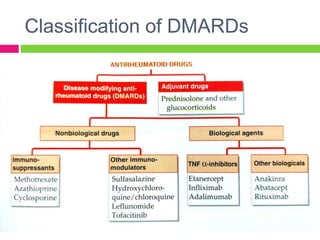
Classification of DMARDs
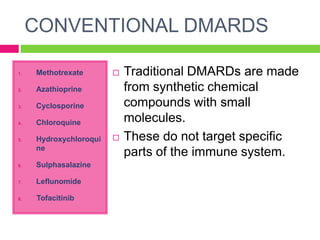
CONVENTIONAL DMARDS
1. Methotrexate
2. Azathioprine
3. Cyclosporine
4. Chloroquine
5. Hydroxychloroqui
ne
6. Sulphasalazine
7. Leflunomide
8. Tofacitinib
 Traditional DMARDs are made
from synthetic chemical
compounds with small
molecules.
 These do not target specific
parts of the immune system.
METHOTREXATE (Mtx)
 Methotrexate is a dihydrofolate reductase inhibitor and has
prominent immunosuppressant and antiinflammatory property.
 Common first choice drug.
 More rapid onset of action than other DMARDs.
PHARMACOKINETICS
 Oral bioavailability of Mtx is variable and may be affected by food
 Can be given Intramuscularly, Intravenously or Intrathecally
 Excretion is hindered in renal diseases
 Has low lipid solubility, thus does not cross Blood Brain Barrier
 Dose- 7.5- 25 mg weekly, orally.
 Half life – 3to10 hours in low doses; 8-15 hours in high doses.
METHOTREXATE (Mtx)
PHARMACODYNAMICS
 Inhibits enzymes responsible for nucleotide synthesis
which prevents cell division and leads to anti-
inflammatory actions.
 Has a long duration of action.
 Has a narrow therapeutic index.
SIDE EFFECTS
 Bone marrow depression
 Oral ulceration
 GI upset
 Liver cirrhosis
METHOTREXATE (Mtx)
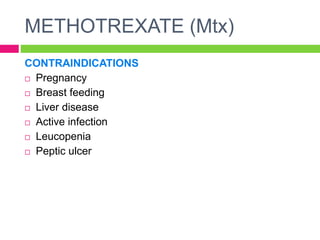
CONTRAINDICATIONS
 Pregnancy
 Breast feeding
 Liver disease
 Active infection
 Leucopenia
 Peptic ulcer
AZATHIOPRINE
 Purine synthase inhibitor.
 Acts after getting converted into 6-mercaptopurine.
 Given along with corticosteroids.
 Less commonly used.
PHARMACOKINETICS
 Oral Azathioprine is well absorbed.
 Bioavailability varies between 30-90% because the
drug is partly inactivated in Liver.
 T half- 5 hours
 Excreted via urine and not detectable in urine after 8
hours.
 Dose- 50 to 150mg/day.
AZATHIOPRINE
PHARMACODYNAMICS
 Immunosuppressive agent functioning through
modulation of rac1 to induce T cell apoptosis.
 Also affects differentiation and functioning of NK cells.
 Has a long duration of action.
 Has a narrow therapeutic index.
SIDE EFFECTS
 Nausea and vomiting.
 Leukopenia.
 Increased chances of infection.
 Reactivation of latent infections.
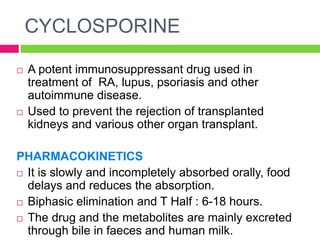
CYCLOSPORINE
 A potent immunosuppressant drug used in
treatment of RA, lupus, psoriasis and other
autoimmune disease.
 Used to prevent the rejection of transplanted
kidneys and various other organ transplant.
PHARMACOKINETICS
 It is slowly and incompletely absorbed orally, food
delays and reduces the absorption.
 Biphasic elimination and T Half : 6-18 hours.
 The drug and the metabolites are mainly excreted
through bile in faeces and human milk.
CYCLOSPORINE
PHARMACODYNAMICS
 It produces reversible inhibition of IL-2 and T
helper lymphocytes function.
SIDE EFFECTS
 Hypertension
 Hyperlipidemia
 Hirtuism
 Gum hypertrophy
 Hyperuricemia
SULFASALAZINE
 Compound of sulfapyridine & 5 amino salicylic acid
 Used as a second line drug for milder cases or is combined
with Mtx.
 Useful in Ulcerative colitis and Crohn’s disease.
PHARMACOKINETICS
 Most of the drug reaches colon, where it is metabolized by
bacteria into sulfapyridine and mesalazine( also known as
5- aminosalicylic acid or 5-ASA)
 Excreted with feces
 Dose- 500mg OD for 7 days orally and increased by 500
mg every week to a maximum of 3g/day in 2-3 divided
doses
 Half life – 6-15 hours
SULFASALAZINE
PHARMACODYNAMICS
 Sulfasalazine is an anti- inflammatory indicated for the
treatment of ulcerative colitics and rheumatoid arthritis.
 May act by scavenging the toxic oxygen metabolites
produced by neutrophils.
SIDE EFFECTS
 Neutropenia/ Leucopenia/ Thrombocytopenia
 Hepatitis is possible
 Decreased sperm count
 GI disturbances
 Malaise
 Headache
LEFLUNOMIDE
 Pyrimidine synthesis inhibitor in actively dividing cells.
 Also been used for the prevention of acute and chronic
rejection in recipients of solid organ transplants.
 In clinical trials its efficacy has been rated comparable to Mtx
and onset of benefit is as fast as 4 weeks.
PHARMACOKINETICS
 Well absorbed orally.
 Half life- 2 weeks.
 Metabolism is primarily hepatic.
 Highly bound to plasma protein.
 Around 43% of the drug is eliminated in urine and 48%
through feces.
 Dose- 100mg for 3 days followed by 20mg OD
LEFLUNOMIDE
PHARMACODYNAMICS
 Inhibits dihydro-orotate dehydrogenase and pyrimidine
synthesis in actively dividing cells.
 Antibody production by B- cells may be depressed.
SIDE EFFECTS
 Diarrhoea
 Headache
 Nausea
 Loss of hair
 Thrombocytopenia and leucopenia
 Increased chances of chest infection
 Raised hepatic transaminases
LEFLUNOMIDE
CONTRAINDICATIONS
 Not to be used in children and pregnant.
 Not to be used in lactating women.
 Combination with Mtx is more hepatotoxic.
HYDROXYCHLOROQUINE AND
CHLOROQUINE
 Anti malarial drug.
 Employed in milder non erosive desease.
 Has to be given for long periods.
 Advantage is relatively low toxicity.
 Efficacy is also low.
PHARMACOKINETICS
 Well absorbed when given orally.
 Both have prolonged half lives (40-50 days).
 Protein binding ranges between 30-40% to both albumin and α
glycoprotein
 40-50% excreted renally and 25% through feces
 Dose- HCQ: 400mg/day for 4-6 weeks followed by 200mg/day for
maintenance
CQ- 150mg/day
HYDROXYCHLOROQUINE AND
CHLOROQUINE
PHARMACODYNAMICS
 Mechanism of action is unclear.
 Found to reduce monocyte IL-1, consequently inhibiting B
lymphocytes.
 Antigen processing may be interfered.
 Lysosomal enzymes may be stabilised.
 Trapping of free radicals.
SIDE EFFECTS
 Retinal damage and corneal opacity ( less common and reversible
with HCQ)
 Skin rashes
 Graying of hair
 Irritable bowel syndrome
 Myopathy and Neuropathy
d- PENICILLAMINE
 Penicillamine is dimethylcysteine and obtained as a
degradation of pencillin
 Efficacy is similar to that of other DMARDs but with
higher toxicity. Hence no longer in use.
 Decreases IL-1 and the number of T- lymphocytes.
 It also prevents collagen cross linkage.
SIDE EFFECTS
 Rashes and stomatitis.
 Anorexia and fever.
 Nausea, vomiting and proteinuria.
 Disturbance of taste due to chelation of Zinc.
GOLD COMPOUNDS
 Gold is administered in the form of organic
complexes; SODIUM AUROTHIOMALATE AND
AURANOFIN are the two most common
preparations.
 Because of high toxicity these have gone out of
use.
 The mechanism of action is not clear, but Auranofin
inhibits the induction of IL-1 and TNF-α.
SIDE EFFECTS
 Unwanted effects are less frequent and less severe
with Auranofin but these include: Diarrhoea,
Abdominal cramps,etc.
 Unwanted effects of Sodium aurothiomalate
BIOLOGICAL AGENTS
A. TNF α
antagonist
1. Etanercept
2. Infliximab
3. Adalimubab
B. IL-1 antagonist
1. Anakinra
C. T-cell
modulating
agents
1. Abatacept
D. B-lympho
depletor
1. Rituximab
 Several recombinant
proteins/monoclonal antibodies
that bind and inhibit cytokines,
especially TNFα or IL-1 have
been produced.
 They have substansial benefit in
autoimmune diseases like RA,
IBD, Psoriasis, Scleroderma, etc.
 All of them produce prominent
adverse effect, are expensive,
and are used only as reserve
drugs for severe refractory
ETANERCEPT
 It is a recombinant fusion protein of TNF-
receptor and Fc portion of Human IgG.
 Administered by s.c. injection 50mg weekly.
 Pain, redness, itching, and swelling occur at
injection site.
 Chest infections may be increased.
INFLIXIMAB
 It is a chimeral monoclonal antibody which
binds and neutralizes TNF alpha.
 3-5mg/kg is infused i.v. every 4-8 weeks.
 An acute reaction comprising of fever, chills,
urticaria, bronchospasm, rarely anaphylaxis
may follow the infusion.
 Susceptibility to respiratory infections is
increased and worsening of CHF has been
noted.
ADALIMUMAB
 This recombinant monoclonal anti- TNF
antibody is administered s.c. 40mg every 2
weeks.
 Injection site reaction and respiratory infection
are the common adverse effects.
 Combination with Mtx is advised to improve
the response and decrease antibody
formation.
ANAKINRA
 It is a recombinant human IL-1 receptor
antagonist.
 Though clinically less effective than TNF
inhibitors, it has been used in cases who have
failed on one or more DMARDS.
 Dose: 100mg s.c. daily
 Local reaction and chest infections are the
main adverse effects.
ABATACEPT
 It inhibits T- cell activation.
 Route of elimination is by kidney and liver.
 Doses upto 50mg/kg have been administered
without apparent toxic effect.
 Most common adverse events are headache,
upper respiratory tract infection,
nasopharyngitis and nausea.
RITUXIMAB
 It is a monoclonal antibody that targets CD20,
an antigen present on the surface of pre-B and
mature B-lymphocytes.
ADJUVANT DRUGS
(CORTICOSTEROIDS)
 Glucocorticoids have potent immunosuppressant
and antiinflammatory activity.
 Can be inducted almost at any stage in RA along
with first or second line drugs.
 Symptomatic relief is prompt and marked but they
do not arrest the rheumatoid process, joint
destruction may be slowed and bony erosions
delayed.
 It is difficult to withdraw steroid; exacerbation is
precipitated and the patient becomes steroid
dependant.
RECENT ADVANCES
 Sarilumab, a Human Monoclonal Ab directed
against IL-6 receptor complex, is the newest
biologic to be approved for RA by U.S. FDA in
2017.
 At present, Tofacitinib,Baricitinib, Peficitinib,
Upadacitinib, Filgotinib designated as JAK
inhibitors have been approved for the
treatment of Rheumatoid Arthritis.
Email: vikasbiswas10@gmail.com
DR. TITIR BISWAS

DMARDs .pptx

  • 1.
    DMARDS MODERATOR- DR SREYATODI ( Associate Professor MD Pharmacology) RESIDENT- DR TITIR BISWAS (DEPT. of PHARMACOLGY)
  • 2.
    INDEX  Rheumatoid Arthritits a)Pathophysiology b) Staging  Role of NSAIDs  DMARDs a) Rationale b) Classification c) Individual drugs  Adjuvant Drugs  Recent advances
  • 3.
    RHEUMATOID ARTHRITIS  Rheumatoidarthritis is a chronic multisystem disease of unknown etiology characterized by persistent inflammatory synovitis, usually involving peripheral joints symmetrically.  Although cartilaginous destruction , bony erosions, and joint deformity are hallmarks, the course of RA can be quite variable.
  • 4.
    RHEUMATOID ARTHRITIS PATHOPHYSIOLOGY Immune complexescomposed of IgM activate complement and release cytokines (mainly TNFα and IL-1) These are chemotactic for neutrophils These inflammatory cells secrete lysosomal enzymes which damage cartilage and erode bone While PGs produced in the process cause vasodilation and pain.
  • 5.
  • 6.
  • 7.
  • 8.
    ROLE OF NSAIDS NSAIDs are the first line drugs which afford symptomatic relief in pain, swelling, morning stiffness, immobility.  They do not arrest the disease progress.  These blocks Cox enzymes of the body which decreases the inflammation.  Examples: Aspirin, Celecoxib, Diclofenac, etc.  Side Effects: Stomach ulcers, Raised blood pressure, Anemia, Headache, Rashes, etc.
  • 9.
    DMARDs  Disease- modifyingantirheumatic drugs (DMARDs) are a group of medication commonly used in people with Rheumatoid arthritis.  Some of these drugs are also used in treating other conditions like Ankylosing spondylitis, Psoriatic arthritis, Systemic lupus erythematosus, Inflammatory bowel diseases, etc. Rationale of DMARDs  Alleviate pain  Slow or stop progression of joint damage  Preservation of structure and function of joints  Maximise quality of life
  • 10.
  • 11.
    CONVENTIONAL DMARDS 1. Methotrexate 2.Azathioprine 3. Cyclosporine 4. Chloroquine 5. Hydroxychloroqui ne 6. Sulphasalazine 7. Leflunomide 8. Tofacitinib  Traditional DMARDs are made from synthetic chemical compounds with small molecules.  These do not target specific parts of the immune system.
  • 12.
    METHOTREXATE (Mtx)  Methotrexateis a dihydrofolate reductase inhibitor and has prominent immunosuppressant and antiinflammatory property.  Common first choice drug.  More rapid onset of action than other DMARDs. PHARMACOKINETICS  Oral bioavailability of Mtx is variable and may be affected by food  Can be given Intramuscularly, Intravenously or Intrathecally  Excretion is hindered in renal diseases  Has low lipid solubility, thus does not cross Blood Brain Barrier  Dose- 7.5- 25 mg weekly, orally.  Half life – 3to10 hours in low doses; 8-15 hours in high doses.
  • 13.
    METHOTREXATE (Mtx) PHARMACODYNAMICS  Inhibitsenzymes responsible for nucleotide synthesis which prevents cell division and leads to anti- inflammatory actions.  Has a long duration of action.  Has a narrow therapeutic index. SIDE EFFECTS  Bone marrow depression  Oral ulceration  GI upset  Liver cirrhosis
  • 14.
    METHOTREXATE (Mtx) CONTRAINDICATIONS  Pregnancy Breast feeding  Liver disease  Active infection  Leucopenia  Peptic ulcer
  • 15.
    AZATHIOPRINE  Purine synthaseinhibitor.  Acts after getting converted into 6-mercaptopurine.  Given along with corticosteroids.  Less commonly used. PHARMACOKINETICS  Oral Azathioprine is well absorbed.  Bioavailability varies between 30-90% because the drug is partly inactivated in Liver.  T half- 5 hours  Excreted via urine and not detectable in urine after 8 hours.  Dose- 50 to 150mg/day.
  • 16.
    AZATHIOPRINE PHARMACODYNAMICS  Immunosuppressive agentfunctioning through modulation of rac1 to induce T cell apoptosis.  Also affects differentiation and functioning of NK cells.  Has a long duration of action.  Has a narrow therapeutic index. SIDE EFFECTS  Nausea and vomiting.  Leukopenia.  Increased chances of infection.  Reactivation of latent infections.
  • 17.
    CYCLOSPORINE  A potentimmunosuppressant drug used in treatment of RA, lupus, psoriasis and other autoimmune disease.  Used to prevent the rejection of transplanted kidneys and various other organ transplant. PHARMACOKINETICS  It is slowly and incompletely absorbed orally, food delays and reduces the absorption.  Biphasic elimination and T Half : 6-18 hours.  The drug and the metabolites are mainly excreted through bile in faeces and human milk.
  • 18.
    CYCLOSPORINE PHARMACODYNAMICS  It producesreversible inhibition of IL-2 and T helper lymphocytes function. SIDE EFFECTS  Hypertension  Hyperlipidemia  Hirtuism  Gum hypertrophy  Hyperuricemia
  • 19.
    SULFASALAZINE  Compound ofsulfapyridine & 5 amino salicylic acid  Used as a second line drug for milder cases or is combined with Mtx.  Useful in Ulcerative colitis and Crohn’s disease. PHARMACOKINETICS  Most of the drug reaches colon, where it is metabolized by bacteria into sulfapyridine and mesalazine( also known as 5- aminosalicylic acid or 5-ASA)  Excreted with feces  Dose- 500mg OD for 7 days orally and increased by 500 mg every week to a maximum of 3g/day in 2-3 divided doses  Half life – 6-15 hours
  • 20.
    SULFASALAZINE PHARMACODYNAMICS  Sulfasalazine isan anti- inflammatory indicated for the treatment of ulcerative colitics and rheumatoid arthritis.  May act by scavenging the toxic oxygen metabolites produced by neutrophils. SIDE EFFECTS  Neutropenia/ Leucopenia/ Thrombocytopenia  Hepatitis is possible  Decreased sperm count  GI disturbances  Malaise  Headache
  • 21.
    LEFLUNOMIDE  Pyrimidine synthesisinhibitor in actively dividing cells.  Also been used for the prevention of acute and chronic rejection in recipients of solid organ transplants.  In clinical trials its efficacy has been rated comparable to Mtx and onset of benefit is as fast as 4 weeks. PHARMACOKINETICS  Well absorbed orally.  Half life- 2 weeks.  Metabolism is primarily hepatic.  Highly bound to plasma protein.  Around 43% of the drug is eliminated in urine and 48% through feces.  Dose- 100mg for 3 days followed by 20mg OD
  • 22.
    LEFLUNOMIDE PHARMACODYNAMICS  Inhibits dihydro-orotatedehydrogenase and pyrimidine synthesis in actively dividing cells.  Antibody production by B- cells may be depressed. SIDE EFFECTS  Diarrhoea  Headache  Nausea  Loss of hair  Thrombocytopenia and leucopenia  Increased chances of chest infection  Raised hepatic transaminases
  • 23.
    LEFLUNOMIDE CONTRAINDICATIONS  Not tobe used in children and pregnant.  Not to be used in lactating women.  Combination with Mtx is more hepatotoxic.
  • 24.
    HYDROXYCHLOROQUINE AND CHLOROQUINE  Antimalarial drug.  Employed in milder non erosive desease.  Has to be given for long periods.  Advantage is relatively low toxicity.  Efficacy is also low. PHARMACOKINETICS  Well absorbed when given orally.  Both have prolonged half lives (40-50 days).  Protein binding ranges between 30-40% to both albumin and α glycoprotein  40-50% excreted renally and 25% through feces  Dose- HCQ: 400mg/day for 4-6 weeks followed by 200mg/day for maintenance CQ- 150mg/day
  • 25.
    HYDROXYCHLOROQUINE AND CHLOROQUINE PHARMACODYNAMICS  Mechanismof action is unclear.  Found to reduce monocyte IL-1, consequently inhibiting B lymphocytes.  Antigen processing may be interfered.  Lysosomal enzymes may be stabilised.  Trapping of free radicals. SIDE EFFECTS  Retinal damage and corneal opacity ( less common and reversible with HCQ)  Skin rashes  Graying of hair  Irritable bowel syndrome  Myopathy and Neuropathy
  • 26.
    d- PENICILLAMINE  Penicillamineis dimethylcysteine and obtained as a degradation of pencillin  Efficacy is similar to that of other DMARDs but with higher toxicity. Hence no longer in use.  Decreases IL-1 and the number of T- lymphocytes.  It also prevents collagen cross linkage. SIDE EFFECTS  Rashes and stomatitis.  Anorexia and fever.  Nausea, vomiting and proteinuria.  Disturbance of taste due to chelation of Zinc.
  • 27.
    GOLD COMPOUNDS  Goldis administered in the form of organic complexes; SODIUM AUROTHIOMALATE AND AURANOFIN are the two most common preparations.  Because of high toxicity these have gone out of use.  The mechanism of action is not clear, but Auranofin inhibits the induction of IL-1 and TNF-α. SIDE EFFECTS  Unwanted effects are less frequent and less severe with Auranofin but these include: Diarrhoea, Abdominal cramps,etc.  Unwanted effects of Sodium aurothiomalate
  • 28.
    BIOLOGICAL AGENTS A. TNFα antagonist 1. Etanercept 2. Infliximab 3. Adalimubab B. IL-1 antagonist 1. Anakinra C. T-cell modulating agents 1. Abatacept D. B-lympho depletor 1. Rituximab  Several recombinant proteins/monoclonal antibodies that bind and inhibit cytokines, especially TNFα or IL-1 have been produced.  They have substansial benefit in autoimmune diseases like RA, IBD, Psoriasis, Scleroderma, etc.  All of them produce prominent adverse effect, are expensive, and are used only as reserve drugs for severe refractory
  • 29.
    ETANERCEPT  It isa recombinant fusion protein of TNF- receptor and Fc portion of Human IgG.  Administered by s.c. injection 50mg weekly.  Pain, redness, itching, and swelling occur at injection site.  Chest infections may be increased.
  • 30.
    INFLIXIMAB  It isa chimeral monoclonal antibody which binds and neutralizes TNF alpha.  3-5mg/kg is infused i.v. every 4-8 weeks.  An acute reaction comprising of fever, chills, urticaria, bronchospasm, rarely anaphylaxis may follow the infusion.  Susceptibility to respiratory infections is increased and worsening of CHF has been noted.
  • 31.
    ADALIMUMAB  This recombinantmonoclonal anti- TNF antibody is administered s.c. 40mg every 2 weeks.  Injection site reaction and respiratory infection are the common adverse effects.  Combination with Mtx is advised to improve the response and decrease antibody formation.
  • 32.
    ANAKINRA  It isa recombinant human IL-1 receptor antagonist.  Though clinically less effective than TNF inhibitors, it has been used in cases who have failed on one or more DMARDS.  Dose: 100mg s.c. daily  Local reaction and chest infections are the main adverse effects.
  • 33.
    ABATACEPT  It inhibitsT- cell activation.  Route of elimination is by kidney and liver.  Doses upto 50mg/kg have been administered without apparent toxic effect.  Most common adverse events are headache, upper respiratory tract infection, nasopharyngitis and nausea.
  • 34.
    RITUXIMAB  It isa monoclonal antibody that targets CD20, an antigen present on the surface of pre-B and mature B-lymphocytes.
  • 35.
    ADJUVANT DRUGS (CORTICOSTEROIDS)  Glucocorticoidshave potent immunosuppressant and antiinflammatory activity.  Can be inducted almost at any stage in RA along with first or second line drugs.  Symptomatic relief is prompt and marked but they do not arrest the rheumatoid process, joint destruction may be slowed and bony erosions delayed.  It is difficult to withdraw steroid; exacerbation is precipitated and the patient becomes steroid dependant.
  • 36.
    RECENT ADVANCES  Sarilumab,a Human Monoclonal Ab directed against IL-6 receptor complex, is the newest biologic to be approved for RA by U.S. FDA in 2017.  At present, Tofacitinib,Baricitinib, Peficitinib, Upadacitinib, Filgotinib designated as JAK inhibitors have been approved for the treatment of Rheumatoid Arthritis.
  • 37.