DISEASE MODIFYING ANTI
-RHEUMATIC DRUGS
Faisal Ghafoor
WHAT IS RHEUMATOID ARTHRITIS
 A long lasting autoimmune disorder.
 Primarily affects joints.
 Result in warm, swollen and painful joints.
 Wrist and hands are more commonly involved.
 Cause is not clear but believed to involve
genetic and environmental factors.
 Affects bone and cartilage
DMARDS
 A category of unrelated drugs defined by their use in
rheumatoid arthritis .
 Also called Remission Inducing Drugs (RIDs)
 OR Slow Acting Anti Rheumatic Drugs ( SAARDs).
 Also pertain many other diseases like,
.SLE
. Sjögren‘s syndrome.
. Myasthenia gravis etc etc.
 Reduce symptoms of RA
 Its effect take 6weeks- 6months
 slow acting as compared to NSAIDs
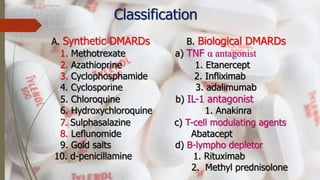
Classification
A. Synthetic DMARDs B. Biological DMARDs
1. Methotrexate a) TNF α antagonist
2. Azathioprine 1. Etanercept
3. Cyclophosphamide 2. Infliximab
4. Cyclosporine 3. adalimumab
5. Chloroquine b) IL-1 antagonist
6. Hydroxychloroquine 1. Anakinra
7. Sulphasalazine c) T-cell modulating agents
8. Leflunomide Abatacept
9. Gold salts d) B-lympho depletor
10. d-penicillamine 1. Rituximab
2. Methyl prednisolone
METHOTREXATE
 Considered first choice to treat RA
 MOA: it probably relates to inhibition of
aminoimidazolecarboxamide ribonucleotide
(AICAR) transformylase & thymidylate synthetase.
 It has secondary effects on PMN cells chemotaxis.
 It has direct inhibitory effects on proliferation
 and stimulates apoptosis in immune - inflammatory
cells.
 Orally 70% absorption.
 Metabolized to a less active hydroxylated metabolite,
(con. . . )
 Both parent cmpnd and metabolite
are Polyglutamated with in cells.
 Dose 15-25 mg weekly, starting with
7.5 mg
Adverse effects of Methotrexate:
 Nausea, mucosal ulcers.
 Dose related hepatotoxicity.
 Leucovorin used to reduce side
effects.
 Contraindicated in pregnancy, liver
disease, peptic ulcer.
Azathioprine
 Acts through major metabolite; 6 Thioguanine
 Which suppress;
Inosinic acid synthesis.
B-cell and T-cell function.
Ig production.
IL-2 production.
 production of 6 thioguanine is dependent on thiopurine methyl
transferase (TPMT), Pt with low TPMT or absent activity are at
High risk of of myelosuppression if the dosage is not adjusted.
Dosage; 2mg/kg/day.
Adverse effects  Bone marrow suppression
 GIT disturbance
 Increase infection risk
 Fever, rash, hepatoxicity
Cyclophoshamide
 MOA; its major metabolite is: Phosphoramide mustard
 Which;
.cross link DNA and prevent cell replication
. Suppress T-cell & B-cell function.
 Dosage: 2mg/kg/day orally.
Adverse effect;
 Nausea
 vomiting
Sulfasalazine:
 It is metabolized to sulfa pyridine &
5- amino salicylic acid.
 In treated arthritis patients, IgA & IgM
rheumatoid factor production are
decreased.
 Suppression of T cell responses to
concanavalin (glycoprotein that play role
in cell interaction in inflammatory cell).
 Inhibition of in vitro B cell proliferation.
 Reduces radiologic disease progression.
 Inhibit release of cytokines ( IL-1, IL-2,
IL-6, IL-12, TNFα)
(Con…)
 10%-20% of orally administered drug is absorbed.
 Sulfa pyridines well absorbed if 5aminosalicylclic acid
is unabsorbed.
Adverse effect
 Nausea
 Vomiting
 Rashes
 Hemolytic anemia etc.
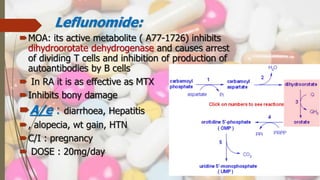
Leflunomide:
MOA: its active metabolite ( A77-1726) inhibits
dihydroorotate dehydrogenase and causes arrest
of dividing T cells and inhibition of production of
autoantibodies by B cells
 In RA it is as effective as MTX
Inhibits bony damage
A/e : diarrhoea, Hepatitis
, alopecia, wt gain, HTN
C/I : pregnancy
 DOSE : 20mg/day
Cyclosporine
 Acts through regulation of gene transcription.
 It inhibit IL-1 & IL-2 receptor production.
 Inhibit macrophage T-cell interaction
 Also inhibit T-cell responsiveness
 Its absorption is incomplete & some erratic
although micro emulsion formulation improves
its consistency & provide 20% - 30% bioavailability
 Grapefruit juice Inc. cyclosporine bioavailability by
as much as 62%.
 retards the appearance of bony erosion.
 Dosage : 3.5mg/kg/day.
Adverse effects
 Nephrotoxicity
 Hyper tension
 Hepatotoxicity
 Hyperkalemia
 Gingival hyperplasia
 Hirsutism.
Chloroquine & hydroxychloroquine
Mainly use in malaria and in rheumatic disease.
Mech : is unclear but
Proposed mech is:
 suppression of T lymphocytes response to mitogens.
Dec leukocytes chemotaxis.
Stabilization of lysosomal enzymes.
Inhibition of DNA & RNA synthesis.
Trapping of free radical.
 Rapidly absorb & about 50% protein bound in plasma
 very extensively tissue bound sp: melanin-containing
tissue i.e Eye
 Deaminated in liver.
 Half life 45 days.
(Con…..)
 Dosage:
chloroquine = 200mg/day
hydroxychloroquine = 6.4mg/kg/day
 this drug is safe in pregnancy.
Adverse effect
Ocular toxicity
Dyspepsia
Nausea
Vomiting
Abd: pain
Rashes
Nightmares.
Gold salts
 Administered through,
a) parenterally : aurothiomalate
aurothioglucose
b) orally: auranofin
 They were used extensively
 But are no longer recommended b/c of significant
toxicities & questionable efficacy.
D-penicillamine
 Metabolite of penicillin
 Rarely use now b/c of toxicity.
Biologic therapies, or biologics
o Newer drugs that reduce RA inflammation in a more
highly targeted manner than the sDMARDs. These are
used when there is inadequate response with the
DMARDS
o Biologics are made through biotechnology and target very
specific proteins or cells that are involved in the
inflammatory process.
o Biologics have also been shown to help reduce the
progression of joint damage in RA.
o The currently available biologic therapies for RA must
either be injected under the skin [etanercept,
adalimumab, anakinra] or infused [infliximab, abatacept,
and rituxumab]).
TNFα inhibitors
Etanercept:
MOA: it is recombinant fusion protein consisting
of two soluble TNF p75 receptor moieties linked
to Fc portion of human IgG1, it binds TNFα
molecule
It decreases rate of formation of new erosion
 DOSE: 25 mg twice weekly given s.c.
A/E
- Opportunistic infections, Activation of latent TB
Infliximab
MOA: it is chimeric (25% mouse , 75%human) IgG1
monoclonal antibody that binds with TNFα
Mech : prevents TNFa interaction with cell surface
receptors causing down regulation of macrophages
and Tcell function.
DOSE: 3-10 mg/kg as an i.v. infusion every 8 weekly
Comb with MTX improves response and decreases
rate of formtion of new erosions more than MTX
alone
A/E: URTI, nausea, headache, sinusitis, rash,
activation of latent TB
C/I: multiple sclerosis as demyelinating syndromes
have been reported
Adalimumab
MOA: it is fully human IgG1 anti TNF monoclonal
antibody complexes with soluble TNFα and
prevents its interaction with cell surface
receptors causing down regulation of
macrophages and T-cell function
DOSE: 40 mg given every 2 weekly given s.c.
Respiratory infection is a common a/e
Comb with MTX to improve response
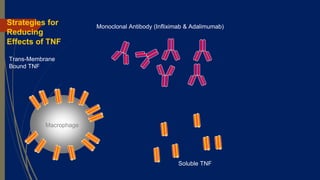
Trans-Membrane
Bound TNF
Soluble TNF
Strategies for
Reducing
Effects of TNF
Macrophage
Monoclonal Antibody (Infliximab & Adalimumab)
IL-1 ANTAGONIST
Anakinra
 It is recombinant human IL-1 receptor
antagonist.
Used in cases who have failed on others drugs.
A/e local reaction on s/c inj. & chest infection
 Do not use in combination with TNF-alpha
antagonists
T-cell modulating agent
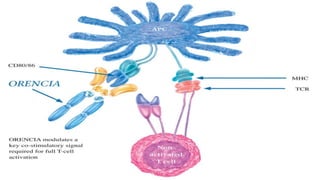
Abatacept:
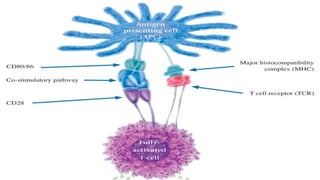
It is recombinant fusion protein.
MOA: inhibits activation of T cell
DOSE: depends on body wt it is given as i.v inj.
 <60 kg: 500mg
 60-100 kg: 750 mg
 >100kg: 1000mg.
Used when there is inadequate response to
DMARDS
A/e :
Risk of infections
Hypersensitivity reaction
Unfortunately not all patients respond
sufficiently to TNF blockade and some of the
patients become unresponsive to TNF-blocking
agents.
(Con….)
B-LYMPHOCYTES DEPLETOR
Targeting B-lymphocytes in these patients has opened a
new therapeutic window
Rituximab
 Chimeric monoclonal Ab, targets CD20 B cells
 Used in resistant RA .Benefit in treatment of RA
refractory to antiTNF agents
 Combination therapy with methotrexate
 Dose: 2ml IV infusions 2 wks apart
 ADRs: Mild infusion reactions (infrequent)
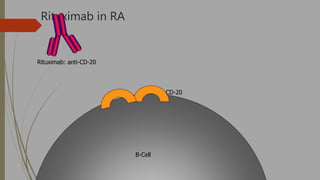
Rituximab in RA
B-Cell
CD-20
Rituximab: anti-CD-20
Thank you

DMARDs

  • 1.
  • 2.
    WHAT IS RHEUMATOIDARTHRITIS  A long lasting autoimmune disorder.  Primarily affects joints.  Result in warm, swollen and painful joints.  Wrist and hands are more commonly involved.  Cause is not clear but believed to involve genetic and environmental factors.  Affects bone and cartilage
  • 3.
    DMARDS  A categoryof unrelated drugs defined by their use in rheumatoid arthritis .  Also called Remission Inducing Drugs (RIDs)  OR Slow Acting Anti Rheumatic Drugs ( SAARDs).  Also pertain many other diseases like, .SLE . Sjögren‘s syndrome. . Myasthenia gravis etc etc.  Reduce symptoms of RA  Its effect take 6weeks- 6months  slow acting as compared to NSAIDs
  • 4.
    Classification A. Synthetic DMARDsB. Biological DMARDs 1. Methotrexate a) TNF α antagonist 2. Azathioprine 1. Etanercept 3. Cyclophosphamide 2. Infliximab 4. Cyclosporine 3. adalimumab 5. Chloroquine b) IL-1 antagonist 6. Hydroxychloroquine 1. Anakinra 7. Sulphasalazine c) T-cell modulating agents 8. Leflunomide Abatacept 9. Gold salts d) B-lympho depletor 10. d-penicillamine 1. Rituximab 2. Methyl prednisolone
  • 5.
    METHOTREXATE  Considered firstchoice to treat RA  MOA: it probably relates to inhibition of aminoimidazolecarboxamide ribonucleotide (AICAR) transformylase & thymidylate synthetase.  It has secondary effects on PMN cells chemotaxis.  It has direct inhibitory effects on proliferation  and stimulates apoptosis in immune - inflammatory cells.  Orally 70% absorption.  Metabolized to a less active hydroxylated metabolite,
  • 6.
    (con. . .)  Both parent cmpnd and metabolite are Polyglutamated with in cells.  Dose 15-25 mg weekly, starting with 7.5 mg Adverse effects of Methotrexate:  Nausea, mucosal ulcers.  Dose related hepatotoxicity.  Leucovorin used to reduce side effects.  Contraindicated in pregnancy, liver disease, peptic ulcer.
  • 8.
    Azathioprine  Acts throughmajor metabolite; 6 Thioguanine  Which suppress; Inosinic acid synthesis. B-cell and T-cell function. Ig production. IL-2 production.  production of 6 thioguanine is dependent on thiopurine methyl transferase (TPMT), Pt with low TPMT or absent activity are at High risk of of myelosuppression if the dosage is not adjusted. Dosage; 2mg/kg/day. Adverse effects  Bone marrow suppression  GIT disturbance  Increase infection risk  Fever, rash, hepatoxicity
  • 9.
    Cyclophoshamide  MOA; itsmajor metabolite is: Phosphoramide mustard  Which; .cross link DNA and prevent cell replication . Suppress T-cell & B-cell function.  Dosage: 2mg/kg/day orally. Adverse effect;  Nausea  vomiting
  • 10.
    Sulfasalazine:  It ismetabolized to sulfa pyridine & 5- amino salicylic acid.  In treated arthritis patients, IgA & IgM rheumatoid factor production are decreased.  Suppression of T cell responses to concanavalin (glycoprotein that play role in cell interaction in inflammatory cell).  Inhibition of in vitro B cell proliferation.  Reduces radiologic disease progression.  Inhibit release of cytokines ( IL-1, IL-2, IL-6, IL-12, TNFα)
  • 11.
    (Con…)  10%-20% oforally administered drug is absorbed.  Sulfa pyridines well absorbed if 5aminosalicylclic acid is unabsorbed. Adverse effect  Nausea  Vomiting  Rashes  Hemolytic anemia etc.
  • 12.
    Leflunomide: MOA: its activemetabolite ( A77-1726) inhibits dihydroorotate dehydrogenase and causes arrest of dividing T cells and inhibition of production of autoantibodies by B cells  In RA it is as effective as MTX Inhibits bony damage A/e : diarrhoea, Hepatitis , alopecia, wt gain, HTN C/I : pregnancy  DOSE : 20mg/day
  • 13.
    Cyclosporine  Acts throughregulation of gene transcription.  It inhibit IL-1 & IL-2 receptor production.  Inhibit macrophage T-cell interaction  Also inhibit T-cell responsiveness  Its absorption is incomplete & some erratic although micro emulsion formulation improves its consistency & provide 20% - 30% bioavailability  Grapefruit juice Inc. cyclosporine bioavailability by as much as 62%.  retards the appearance of bony erosion.  Dosage : 3.5mg/kg/day.
  • 14.
    Adverse effects  Nephrotoxicity Hyper tension  Hepatotoxicity  Hyperkalemia  Gingival hyperplasia  Hirsutism.
  • 15.
    Chloroquine & hydroxychloroquine Mainlyuse in malaria and in rheumatic disease. Mech : is unclear but Proposed mech is:  suppression of T lymphocytes response to mitogens. Dec leukocytes chemotaxis. Stabilization of lysosomal enzymes. Inhibition of DNA & RNA synthesis. Trapping of free radical.  Rapidly absorb & about 50% protein bound in plasma  very extensively tissue bound sp: melanin-containing tissue i.e Eye  Deaminated in liver.  Half life 45 days.
  • 16.
    (Con…..)  Dosage: chloroquine =200mg/day hydroxychloroquine = 6.4mg/kg/day  this drug is safe in pregnancy. Adverse effect Ocular toxicity Dyspepsia Nausea Vomiting Abd: pain Rashes Nightmares.
  • 17.
    Gold salts  Administeredthrough, a) parenterally : aurothiomalate aurothioglucose b) orally: auranofin  They were used extensively  But are no longer recommended b/c of significant toxicities & questionable efficacy. D-penicillamine  Metabolite of penicillin  Rarely use now b/c of toxicity.
  • 18.
    Biologic therapies, orbiologics o Newer drugs that reduce RA inflammation in a more highly targeted manner than the sDMARDs. These are used when there is inadequate response with the DMARDS o Biologics are made through biotechnology and target very specific proteins or cells that are involved in the inflammatory process. o Biologics have also been shown to help reduce the progression of joint damage in RA. o The currently available biologic therapies for RA must either be injected under the skin [etanercept, adalimumab, anakinra] or infused [infliximab, abatacept, and rituxumab]).
  • 19.
    TNFα inhibitors Etanercept: MOA: itis recombinant fusion protein consisting of two soluble TNF p75 receptor moieties linked to Fc portion of human IgG1, it binds TNFα molecule It decreases rate of formation of new erosion  DOSE: 25 mg twice weekly given s.c. A/E - Opportunistic infections, Activation of latent TB
  • 20.
    Infliximab MOA: it ischimeric (25% mouse , 75%human) IgG1 monoclonal antibody that binds with TNFα Mech : prevents TNFa interaction with cell surface receptors causing down regulation of macrophages and Tcell function. DOSE: 3-10 mg/kg as an i.v. infusion every 8 weekly Comb with MTX improves response and decreases rate of formtion of new erosions more than MTX alone A/E: URTI, nausea, headache, sinusitis, rash, activation of latent TB C/I: multiple sclerosis as demyelinating syndromes have been reported
  • 21.
    Adalimumab MOA: it isfully human IgG1 anti TNF monoclonal antibody complexes with soluble TNFα and prevents its interaction with cell surface receptors causing down regulation of macrophages and T-cell function DOSE: 40 mg given every 2 weekly given s.c. Respiratory infection is a common a/e Comb with MTX to improve response
  • 22.
    Trans-Membrane Bound TNF Soluble TNF Strategiesfor Reducing Effects of TNF Macrophage Monoclonal Antibody (Infliximab & Adalimumab)
  • 23.
    IL-1 ANTAGONIST Anakinra  Itis recombinant human IL-1 receptor antagonist. Used in cases who have failed on others drugs. A/e local reaction on s/c inj. & chest infection  Do not use in combination with TNF-alpha antagonists
  • 24.
    T-cell modulating agent Abatacept: Itis recombinant fusion protein. MOA: inhibits activation of T cell DOSE: depends on body wt it is given as i.v inj.  <60 kg: 500mg  60-100 kg: 750 mg  >100kg: 1000mg.
  • 25.
    Used when thereis inadequate response to DMARDS A/e : Risk of infections Hypersensitivity reaction Unfortunately not all patients respond sufficiently to TNF blockade and some of the patients become unresponsive to TNF-blocking agents. (Con….)
  • 28.
    B-LYMPHOCYTES DEPLETOR Targeting B-lymphocytesin these patients has opened a new therapeutic window Rituximab  Chimeric monoclonal Ab, targets CD20 B cells  Used in resistant RA .Benefit in treatment of RA refractory to antiTNF agents  Combination therapy with methotrexate  Dose: 2ml IV infusions 2 wks apart  ADRs: Mild infusion reactions (infrequent)
  • 29.
  • 30.