Factor affecting performance
Skill
Definition of Skill
"The learned ability to bring about
predetermined results with maximum
certainty, often with the minimum outlay of
time or energy or both" (Guthrie, 1956)
The important parts of this definition are discussed
below:
• Learned - a skill is something that is learned.
Although some people seem to perform a skill
naturally, all physical skills have to be learned.
• Predetermined - a skill has a result that
anticipated. The outcome of the skill action is
expected by the performer.
• Minimum outlay - a skill, once it is learned
correctly, is performed with the minimum effort.
So, a skill uses the components of fitness
efficiently. There is a control of physical
movement.
Types of skills
Basic and Complex skills:
Basic skills are best described as physical
skills that:
• you learn at an early age, i.e. jumping &
throwing
• are easily transferred to a number of
situations, i.e. running in different ways
• form the basics for more complex skills,
i.e. seat drop is the basis of swivel hips on
the trampoline.
Complex skills are best described as
physical skills that:
• are specific to a given sport but not to any
other sport, i.e. a serve in tennis
• need much practice to learn correctly, i.e.
they may be made up of a number of
basic skills.
Example
In tennis, for example the is decribed as a complex skill.
It is made up from a number of basic skills. These are:
• holding the racket correctly
• being able to throw a ball in the air correctly
• being able to hit something above your head correctly
• being able to direct the ball to a specific point when it is
hit
All these basic skills have to be learned and practiced
before they are put together to produce the complex skill
of serving.
Fine and gross motor skills
Gross movements are those that involve
large muscle coordinaton. Running,
jumping, and sliding are examples. These
movements can be reinforced through
fitness training. Transfer of learning
among activities with common gross
movements is greater due to the
similarities between them.
Fine and gross motor skills
Fine movements involve precise control of
small muscles. Tasks such as writing or
piano playing are examples. While most
tasks fall on the gross motor end of the
continuum, finger dexterity for controlling a
ball arguably requires some level of fine,
specific coordinations.
Open and closed skills
1. An open skill is one which is affected by
many external factors. eg; in golf, you
can't just go up to the ball and take a
swing, oblivious to what's going on around
you. You need to consider things like the
position of the hole, obstacles like trees,
and the effect of the wind.
Open and closed skills
2. A closed skill is one hardly affected by the
environment or external factors. eg; in
squash, you usually make the same
movements - you don't need to change
them for different conditions.
Factors affecting variations in skill
Age and Maturity:
Age is an important factor which affects skill
level as at different point in your life, you may or
may not be able to perform a certain skill.
For example, a child may not be able to run 100m
as fast as a middle-aged man might be able to.
As you grow older, you will slowly learn and
develop stronger muscle which will allow, for
instance, the child to run as fast as a middle-
aged man by the time he reaches the same age.
Motivation
Motivation is the amount of desire or enthusiasm
that a person has for a given physical performance.
This can be influence how well or how badly can
individual will perform. These are two types:
1. Intrinsic motivation is when a person motivates him
or herself - the desire to succeed comes from within.
2. Extrinsic motivation is when a person's desire to
succedd is stimulated by the chance of winning a
trophy or prize - a reward from outside the
performer.
Anxiety
Learning is affected by the emotional state
of a learner. Eg; anxiety prevent a person
from performing to his best.
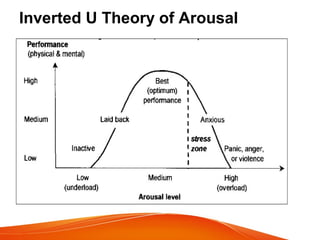
Arousal conditions
Your level arousal can be described as
how prepared you are to take part in an
event. How keen you are to take part can
influence how hard you might try to win.
Unfortunately, it is possible to over-arouse
a competitor. Too much arousal can lead
to anxiety and excessive stress, cousing a
decrease in performance standard.
Inverted U Theory of Arousal
Facilities
Facilities and Equipment:
The quality of your training venue or training
equipment can affect the results you give from
that sport.
For example, you are training for a football
tournament with your team and all you guys
have are worn out and deflated balls and play on
a pitch with terrible quality. Chances are your
team will not be able to do well at the
tournament with the simple reason: lack of
proper facilities and equipment.
Environment
Environment - the weather can affect your
performance either positively or
negatively. For example a good wind will
improve a sailors performance but may
impair a tennis players performance
Teaching and Coaching
Learners with better experience maybe
able to perform sport skill better. The
instructor is also important as you want to
learn the right things.
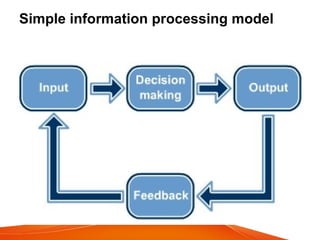
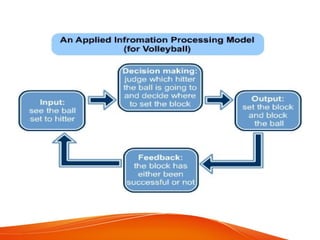
Simple information processing model
Input - all the information your brain receive.
(see, hear & feel) eg; speed of the ball.
Decision making - your brain processes the
informations and decide how to act. eg;
which pass to make, whether to tackle,
move or not.
Simple information processing model
Output - is the result of both input and
decision-making; eg. selecting the
appropriate skill, the right pass, being in
the right place at the right time.
Feedback - most important of the learning
process. Looking at the result of the output
and register the information to do better
next time.
Types of Feedback
Intrinsic: you know how well you did the
technique because of what it 'felt' like.
Extrinsic: someone else tells you or shows
you what happened, and how to improve
Knowlegde of performance
Knowlegde of performance - did you use the
correct technique?
1. Intrinsic feedback - e.g. you know you
didn't kick the ball with the right part of
your foot.
2. Extrinsic feedback - e.g. a coach or
trainer telling you which bits of the
movement you did well, and which bits
weren't so good.
Knowledge of results
Knowledge of results - what was the
outcome?
This usually extrinsic. It can come from the
coaches and trainers, e.g. a 400 m runner
being told their time, or the javelin thrower
getting their distance.
The Importance of feedback
Why? - you can only improve skills and
performance if you know what's wrong
with then and how this might be put right.
To maximise the chances of improvement,
evaluation, analysis and planning need to
be done regularly.
Feedback provides the information required
to identify group or individual faults and
errors in performance.
The Importance of feedback
• diagram?
Learning and developing skills
1. Demonstration
2. Copying
3. Practice
4. Trial and error
5. Role models
Learning and developing skills
Demonstration and copying:
Skills are learned by copying other people;
sports stars on TV, your teacher or trainer,
your friends.
A teacher or coach will demonstrate how a
skill should be performed, and then
feedback on a student's performance until
it's being done correctly.
Learning and developing skills
Practice:
Practising means repeating a skill until
you can do it. For practice to be effective,
it must be based upon correct procedures.
Therefore any demostration must be
technically correct.
"practice makes perfect" or it would be
better like this "perfect practice makes
perfect"
Learning and developing skills
Trial and Error:
This is when you repeat a technique, but
change it slightly each time to find out
what works and what doesn't. It can be
quite a long process, but it's a good way to
improve and develop a skill, e.g. shooting
an arrow or taking free kicks.
Learning and developing skills
Role Models:
Role models (stars in a particular sport or
activity) can be very useful in
demonstrating skills.
To be useful in learning skills, the role
model has to be a good technical role
model, but to be a good role model a
person should also promote the sport in
their conduct both on and off the field of
play.
FAP - Skill
1. Definition
2. Types of skill
3. Factor affecting variation in skill level
4. Simple information processing model
5. Types of Feedback
6. The importance of feedback
7. Learning and developing skills.

Factor affecting performance

  • 1.
  • 2.
    Definition of Skill "Thelearned ability to bring about predetermined results with maximum certainty, often with the minimum outlay of time or energy or both" (Guthrie, 1956)
  • 3.
    The important partsof this definition are discussed below: • Learned - a skill is something that is learned. Although some people seem to perform a skill naturally, all physical skills have to be learned. • Predetermined - a skill has a result that anticipated. The outcome of the skill action is expected by the performer. • Minimum outlay - a skill, once it is learned correctly, is performed with the minimum effort. So, a skill uses the components of fitness efficiently. There is a control of physical movement.
  • 4.
    Types of skills Basicand Complex skills: Basic skills are best described as physical skills that: • you learn at an early age, i.e. jumping & throwing • are easily transferred to a number of situations, i.e. running in different ways • form the basics for more complex skills, i.e. seat drop is the basis of swivel hips on the trampoline.
  • 5.
    Complex skills arebest described as physical skills that: • are specific to a given sport but not to any other sport, i.e. a serve in tennis • need much practice to learn correctly, i.e. they may be made up of a number of basic skills.
  • 6.
    Example In tennis, forexample the is decribed as a complex skill. It is made up from a number of basic skills. These are: • holding the racket correctly • being able to throw a ball in the air correctly • being able to hit something above your head correctly • being able to direct the ball to a specific point when it is hit All these basic skills have to be learned and practiced before they are put together to produce the complex skill of serving.
  • 7.
    Fine and grossmotor skills Gross movements are those that involve large muscle coordinaton. Running, jumping, and sliding are examples. These movements can be reinforced through fitness training. Transfer of learning among activities with common gross movements is greater due to the similarities between them.
  • 8.
    Fine and grossmotor skills Fine movements involve precise control of small muscles. Tasks such as writing or piano playing are examples. While most tasks fall on the gross motor end of the continuum, finger dexterity for controlling a ball arguably requires some level of fine, specific coordinations.
  • 9.
    Open and closedskills 1. An open skill is one which is affected by many external factors. eg; in golf, you can't just go up to the ball and take a swing, oblivious to what's going on around you. You need to consider things like the position of the hole, obstacles like trees, and the effect of the wind.
  • 10.
    Open and closedskills 2. A closed skill is one hardly affected by the environment or external factors. eg; in squash, you usually make the same movements - you don't need to change them for different conditions.
  • 11.
    Factors affecting variationsin skill Age and Maturity: Age is an important factor which affects skill level as at different point in your life, you may or may not be able to perform a certain skill. For example, a child may not be able to run 100m as fast as a middle-aged man might be able to. As you grow older, you will slowly learn and develop stronger muscle which will allow, for instance, the child to run as fast as a middle- aged man by the time he reaches the same age.
  • 12.
    Motivation Motivation is theamount of desire or enthusiasm that a person has for a given physical performance. This can be influence how well or how badly can individual will perform. These are two types: 1. Intrinsic motivation is when a person motivates him or herself - the desire to succeed comes from within. 2. Extrinsic motivation is when a person's desire to succedd is stimulated by the chance of winning a trophy or prize - a reward from outside the performer.
  • 13.
    Anxiety Learning is affectedby the emotional state of a learner. Eg; anxiety prevent a person from performing to his best.
  • 14.
    Arousal conditions Your levelarousal can be described as how prepared you are to take part in an event. How keen you are to take part can influence how hard you might try to win. Unfortunately, it is possible to over-arouse a competitor. Too much arousal can lead to anxiety and excessive stress, cousing a decrease in performance standard.
  • 15.
  • 16.
    Facilities Facilities and Equipment: Thequality of your training venue or training equipment can affect the results you give from that sport. For example, you are training for a football tournament with your team and all you guys have are worn out and deflated balls and play on a pitch with terrible quality. Chances are your team will not be able to do well at the tournament with the simple reason: lack of proper facilities and equipment.
  • 17.
    Environment Environment - theweather can affect your performance either positively or negatively. For example a good wind will improve a sailors performance but may impair a tennis players performance
  • 18.
    Teaching and Coaching Learnerswith better experience maybe able to perform sport skill better. The instructor is also important as you want to learn the right things.
  • 19.
  • 20.
    Simple information processingmodel Input - all the information your brain receive. (see, hear & feel) eg; speed of the ball. Decision making - your brain processes the informations and decide how to act. eg; which pass to make, whether to tackle, move or not.
  • 21.
    Simple information processingmodel Output - is the result of both input and decision-making; eg. selecting the appropriate skill, the right pass, being in the right place at the right time. Feedback - most important of the learning process. Looking at the result of the output and register the information to do better next time.
  • 23.
    Types of Feedback Intrinsic:you know how well you did the technique because of what it 'felt' like. Extrinsic: someone else tells you or shows you what happened, and how to improve
  • 24.
    Knowlegde of performance Knowlegdeof performance - did you use the correct technique? 1. Intrinsic feedback - e.g. you know you didn't kick the ball with the right part of your foot. 2. Extrinsic feedback - e.g. a coach or trainer telling you which bits of the movement you did well, and which bits weren't so good.
  • 25.
    Knowledge of results Knowledgeof results - what was the outcome? This usually extrinsic. It can come from the coaches and trainers, e.g. a 400 m runner being told their time, or the javelin thrower getting their distance.
  • 26.
    The Importance offeedback Why? - you can only improve skills and performance if you know what's wrong with then and how this might be put right. To maximise the chances of improvement, evaluation, analysis and planning need to be done regularly. Feedback provides the information required to identify group or individual faults and errors in performance.
  • 27.
    The Importance offeedback • diagram?
  • 28.
    Learning and developingskills 1. Demonstration 2. Copying 3. Practice 4. Trial and error 5. Role models
  • 29.
    Learning and developingskills Demonstration and copying: Skills are learned by copying other people; sports stars on TV, your teacher or trainer, your friends. A teacher or coach will demonstrate how a skill should be performed, and then feedback on a student's performance until it's being done correctly.
  • 30.
    Learning and developingskills Practice: Practising means repeating a skill until you can do it. For practice to be effective, it must be based upon correct procedures. Therefore any demostration must be technically correct. "practice makes perfect" or it would be better like this "perfect practice makes perfect"
  • 31.
    Learning and developingskills Trial and Error: This is when you repeat a technique, but change it slightly each time to find out what works and what doesn't. It can be quite a long process, but it's a good way to improve and develop a skill, e.g. shooting an arrow or taking free kicks.
  • 32.
    Learning and developingskills Role Models: Role models (stars in a particular sport or activity) can be very useful in demonstrating skills. To be useful in learning skills, the role model has to be a good technical role model, but to be a good role model a person should also promote the sport in their conduct both on and off the field of play.
  • 33.
    FAP - Skill 1.Definition 2. Types of skill 3. Factor affecting variation in skill level 4. Simple information processing model 5. Types of Feedback 6. The importance of feedback 7. Learning and developing skills.